
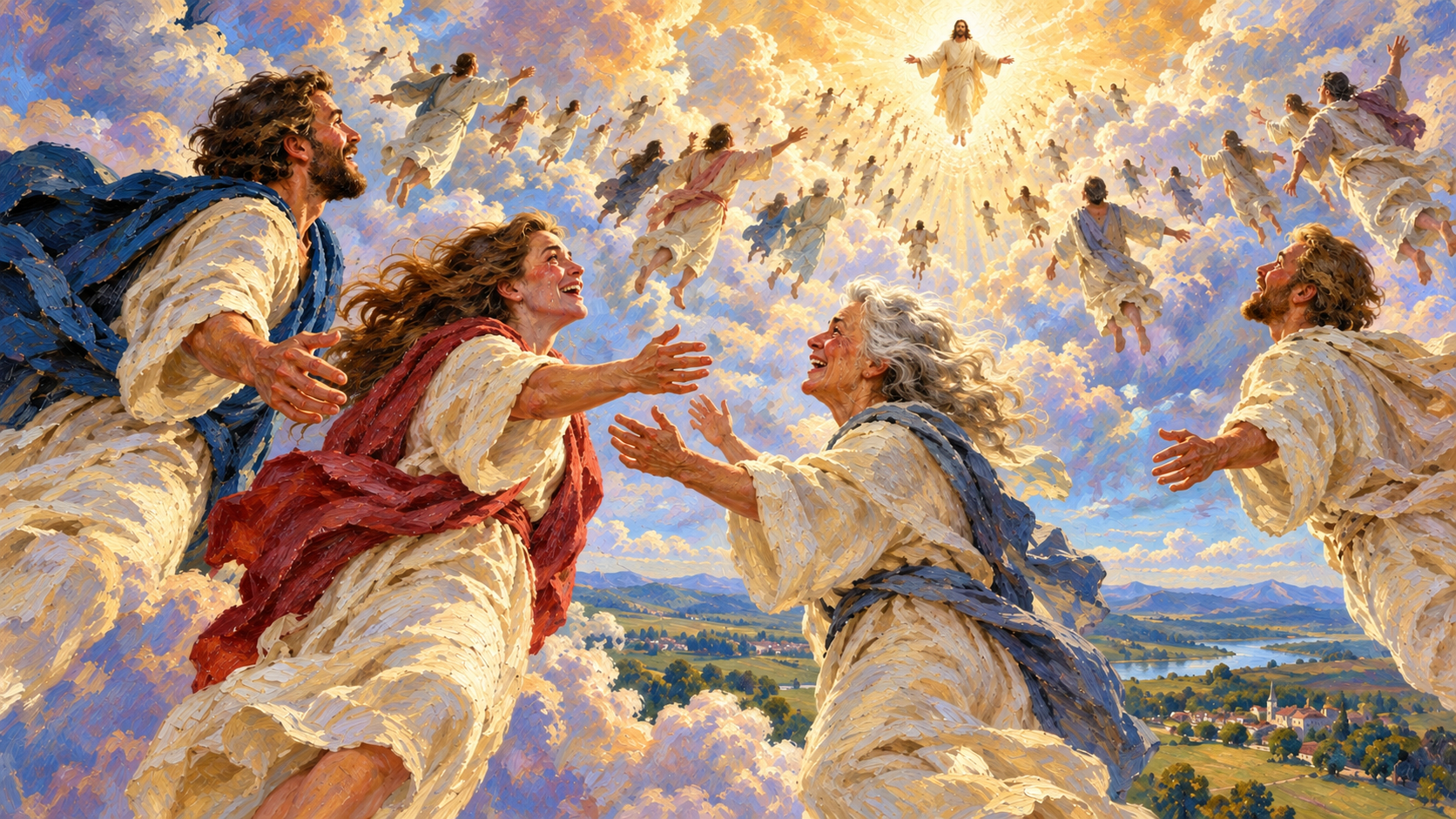
Does the Bible place the gathering of the Church after the Tribulation, or before that seven-year hour of judgment begins? Christians who hold either view believe Jesus will return bodily and visibly, so the real question is whether Paul’s catching away of the Church is the same event as Christ’s public return after the Tribulation. I believe Scripture distinguishes them, and I want to work through the reasons carefully.
The Real Question and the Coming Wrath
The post-Tribulation view says that the Church remains on earth through the Tribulation and is caught up to meet Christ when He comes after those days. Many believers who hold this position are trying to honor Matthew 24:29-31, where the Son of Man comes after the Tribulation and gathers His elect. I want to take that concern seriously by reading Matthew 24 in its own setting. We also need to give the same care to Paul’s teaching and Christ’s promises to the Church, along with what Daniel and Revelation tell us.
The Bible uses the word tribulation in more than one way. The Church has always faced persecution and affliction, so believers should not expect an easy life or protection from ordinary human hostility in the present age. The future Tribulation refers to something more specific: Daniel’s seventieth week, when divine judgments fall on the earth and Israel passes through the time Jeremiah calls Jacob’s trouble.
For then there will be great tribulation, such as has not been since the beginning of the world until this time, no, nor ever shall be.
We need to distinguish those two uses of tribulation throughout this study. Paul taught that believers enter God’s kingdom through many tribulations, so I cannot take a pre-Tribulation gathering as a promise of comfort and ease now. What I want to examine is whether the Church is appointed to the specific future hour of wrath described in Daniel, the Olivet Discourse, and Revelation. The promises given to the Church point toward deliverance from that hour.
Paul’s letters to the Thessalonians bring the catching up of believers into a discussion of the Lord’s coming and the Day of the Lord. He describes the Church waiting for God’s Son from heaven, and he identifies that Son as the One who delivers us from coming wrath. Because Paul connects deliverance with waiting for the Son, I understand him to be speaking about the Lord’s return rather than merely repeating the general truth that believers are forgiven.
And to wait for His Son from heaven, whom He raised from the dead, even Jesus who delivers us from the wrath to come.
For God did not appoint us to wrath, but to obtain salvation through our Lord Jesus Christ.
In 1 Thessalonians 5, Paul moves directly from the catching up of believers to the times and seasons and the Day of the Lord. That Day comes like a thief, bringing sudden destruction upon people who are saying “Peace and safety.” Paul distinguishes the people overtaken by that Day from the believers he is addressing: “They” are overtaken, while “you” are sons of light and sons of the day.
The Thessalonians were already suffering, so Paul was not promising freedom from every trial. He was saying that the Church is not appointed to the coming wrath of the Day of the Lord. We also need to notice who directs the judgments in Revelation. The Lamb opens the seals, heavenly authority directs the trumpet judgments, and the final bowls are explicitly called the bowls of God’s wrath. This is divine judgment, which is why I believe placing the Church inside that appointed hour weakens the comfort Paul gives.
Because you have kept My command to persevere, I also will keep you from the hour of trial which shall come upon the whole world, to test those who dwell on the earth.
In Revelation 3:10, I notice that Jesus promises to keep believers from the hour that will come upon the whole world. He promises more than spiritual protection while they remain inside the trial; the wording points to deliverance from the period of testing itself. Revelation repeatedly uses “those who dwell on the earth” for the unbelieving world in rebellion against God. The Church may suffer persecution in this age, but it is not appointed to that worldwide hour of wrath.
Daniel’s Seventieth Week and the Time of Jacob’s Trouble
Daniel 9 helps us understand where this final seven-year period belongs in prophecy. Gabriel tells Daniel that seventy weeks are determined for Daniel’s people and his holy city, which identifies Israel and Jerusalem as the subjects of the prophecy. It traces Messiah’s coming and His being cut off, then describes the destruction connected with the people of the coming prince. In the final week, a covenant is followed by interrupted sacrifice, abomination, and desolation.
Seventy weeks are determined For your people and for your holy city, To finish the transgression, To make an end of sins, To make reconciliation for iniquity, To bring in everlasting righteousness, To seal up vision and prophecy, And to anoint the Most Holy.
Then he shall confirm a covenant with many for one week; But in the middle of the week He shall bring an end to sacrifice and offering. And on the wing of abominations shall be one who makes desolate, Even until the consummation, which is determined, Is poured out on the desolate.
Since Gabriel ties this prophecy to Daniel’s people and holy city, I do not believe we should insert the Church into it. God’s distinct promises and purposes do not make the Church less loved or less fully saved, and they do not erase Israel’s national future. The New Testament describes the Church as one body in Christ made up of believing Jews and Gentiles. Daniel’s seventieth week completes the prophetic program tied to Israel and Jerusalem.
Jeremiah describes this future distress as the time of Jacob’s trouble, then promises that Jacob will be saved out of it. He is speaking about Israel, whom God will bring through terrible trouble toward promised restoration. Judgment and deliverance belong together in this passage. It does not teach that God must purify the Church by placing it under His wrath.
Alas! For that day is great, So that none is like it; And it is the time of Jacob’s trouble, But he shall be saved out of it.
Jesus also points back to Daniel when He speaks about the abomination of desolation in Matthew 24. He refers to Judea and the holy place, includes Sabbath concerns, and calls for urgent flight from rooftops and fields before the great Tribulation. Those details locate His instructions in Israel, with Jerusalem and the land in view. Christ will return publicly after that Tribulation, but those instructions do not establish that Matthew 24 describes the same event as the gathering Paul reveals to the Church.
The Blessed Hope and Revelation’s Sequence
The New Testament teaches the Church to wait for the Son from heaven and look for the blessed hope. It does not tell believers that the covenant with the coming prince must happen first, or that they must await a rebuilt sacrificial system and the abomination. Nor does it place the mark of the beast, the bowls, or Armageddon before the fulfillment of their hope. Our expectation is directed toward Christ Himself.
Looking for the blessed hope and glorious appearing of our great God and Savior Jesus Christ.
Let not your heart be troubled; you believe in God, believe also in Me. In My Father’s house are many mansions; if it were not so, I would have told you. I go to prepare a place for you.
And if I go and prepare a place for you, I will come again and receive you to Myself; that where I am, there you may be also.
In John 14, Jesus comforted His troubled disciples with the promise that He would return and receive them to Himself. I notice where He said He was preparing a place for them: the Father’s house. That is the first destination named in the passage, rather than Armageddon or the immediate exercise of earthly rule. The comfort is personal because the Lord receives His own to be where He is.
When I speak of imminence, I mean that Scripture reveals no prophetic event that must occur before Christ can gather His Church. That gives us no permission to invent a date, which Jesus forbids. If the Church must pass through Daniel’s whole seventieth week, believers would have to see a recognizable sequence of events before the rapture could happen. I find that difficult to reconcile with the New Testament call to watch and wait for Christ Himself.
But of that day and hour no one knows, not even the angels of heaven, but My Father only.
Matthew 24:36 should restrain speculation about the day or hour because no person knows it. Yet the same chapter gives identifiable signs tied to the Tribulation and the public appearance of the Son of Man. I believe the pre-Tribulation position accounts for both truths. The Church watches for Christ without calculating from the midpoint of Daniel’s week, while the world still faces the revealed Tribulation sequence before His public appearing in glory.
Revelation does not prove a pre-Tribulation rapture through one phrase. Some teachers treat Revelation 4:1 and the words “Come up here” as if they settle the issue by themselves. John is personally called into heaven in a vision, so I would not build the whole doctrine on that verse. It is consistent with the book’s shift to heaven, but the larger structure carries more weight.
After these things I looked, and behold, a door standing open in heaven. And the first voice which I heard was like a trumpet speaking with me, saying, “Come up here, and I will show you things which must take place after this.”
The churches are prominent in Revelation 2 and 3, followed by the scene in the throne room. As worldwide judgments unfold under the Lamb’s authority in chapters 6 through 18, the Church is not addressed as being on earth. Instead, we read about those who dwell on the earth and about Tribulation saints, with imagery centered on Israel. By Revelation 19, the bride is associated with heaven and made ready before Christ descends in public victory.
Let us be glad and rejoice and give Him glory, for the marriage of the Lamb has come, and His wife has made herself ready.
And to her it was granted to be arrayed in fine linen, clean and bright, for the fine linen is the righteous acts of the saints.
And the armies in heaven, clothed in fine linen, white and clean, followed Him on white horses.
That sequence is one reason I find the post-Tribulation view difficult to accept. If the Church is caught up only when the Tribulation ends and immediately turns around to descend, where does the Father’s-house comfort of John 14 fit? The same difficulty arises with the judgment-seat and reward themes, and with the bride being made ready before Christ’s public descent. These events fit more naturally if the Church is already with the Lord before He appears with heaven’s armies.
Matthew 24 and Paul’s Gathering of the Church
The strongest post-Tribulation argument often begins in Matthew 24, and I do not want to pass over what Jesus plainly says there. Cosmic signs appear after the Tribulation, followed by the Son of Man coming in glory and angels gathering His elect from the four winds. We should believe every part of that passage. What we need to establish is whether this is the Church’s rapture in 1 Thessalonians 4 or a gathering connected with Christ’s public return and kingdom after the Tribulation.
Immediately after the tribulation of those days the sun will be darkened, and the moon will not give its light; the stars will fall from heaven, and the powers of the heavens will be shaken.
Then the sign of the Son of Man will appear in heaven, and then all the tribes of the earth will mourn, and they will see the Son of Man coming on the clouds of heaven with power and great glory.
And He will send His angels with a great sound of a trumpet, and they will gather together His elect from the four winds, from one end of heaven to the other.
Jesus was answering Jewish disciples who had asked about the temple, His coming, and the end of the age. His answer included Daniel’s abomination and instructions for people in Judea to flee, with specific concern about the Sabbath. False christs and cosmic signs lead into the visible appearance of the Son of Man. These details describe Christ’s public return after the Tribulation, but they differ from the details Paul gives when comforting the Church.
Compare that with 1 Thessalonians 4, where the Lord descends and the dead in Christ rise. Living believers are caught up with them in the clouds to meet the Lord in the air, and Paul tells the Church to comfort one another. In Matthew 24, angels gather the elect after cosmic signs and Christ’s public appearance. The nations mourn as judgment and the arrival of the kingdom come into view. I understand both gatherings to belong to one prophetic program, but that does not make them a single event.
For the Lord Himself will descend from heaven with a shout, with the voice of an archangel, and with the trumpet of God. And the dead in Christ will rise first.
Then we who are alive and remain shall be caught up together with them in the clouds to meet the Lord in the air. And thus we shall always be with the Lord.
Paul’s description also keeps us from thinking of the rapture only as the rescue of living Christians. The dead in Christ rise first, and living believers are then transformed and caught up with them. The rapture therefore includes resurrection and belongs to the resurrection program for the Church.
Revelation 20 describes people who were beheaded for their witness to Jesus during the Tribulation. They refused the beast and his mark, and they live again to reign with Christ for a thousand years. When I read the description “the first resurrection,” I have to account for those raised before that point. Christ has risen as the firstfruits, and I believe the dead in Christ rise at the Church’s earlier gathering. “First resurrection” therefore names the category of resurrection unto life, in contrast with the second death; it cannot mean that no one was raised before this moment.
And I saw thrones, and they sat on them, and judgment was committed to them. Then I saw the souls of those who had been beheaded for their witness to Jesus and for the word of God, who had not worshiped the beast or his image, and had not received his mark on their foreheads or on their hands. And they lived and reigned with Christ for a thousand years.
But the rest of the dead did not live again until the thousand years were finished. This is the first resurrection.
The post-Tribulation position requires the Church and the Tribulation martyrs to be raised while the reward scenes and Christ’s public return also occur. I believe that brings too much into one moment. I understand Scripture to give a different sequence: Christ rose first, and the Church is raised and caught up when He comes for His own. The Tribulation martyrs rise to reign when He establishes His kingdom, while the wicked dead are raised after the thousand years for judgment. These are phases within God’s resurrection program.
The Millennial Kingdom and the Comfort of Christ’s Coming
The literal Millennial Kingdom raises a further question about who will live in it. Jesus teaches that glorified saints do not marry, yet the Old Testament describes children being born and people living long lives in Messiah’s kingdom. Nations remain and people cultivate the earth, while death becomes an exceptional judgment. We therefore need to account for both glorified saints reigning with Christ and mortal subjects continuing ordinary human life.
For in the resurrection they neither marry nor are given in marriage, but are like angels of God in heaven.
No more shall an infant from there live but a few days, Nor an old man who has not fulfilled his days; For the child shall die one hundred years old, But the sinner being one hundred years old shall be accursed.
If every believer alive when the Tribulation ends is raptured and glorified, then immediately returns with Christ, who enters the kingdom in a mortal body? Glorified believers do not reproduce, while unbelievers face judgment at Christ’s return. Yet Isaiah shows mortal life continuing under Messiah’s reign. A pre-Tribulation gathering allows people to believe during the Tribulation, survive until Christ returns, and enter His kingdom in mortal bodies.
This is a difficulty I cannot dismiss: a literal thousand-year kingdom requires mortal subjects as well as glorified saints reigning with Christ. An explanation of that population still needs to preserve both the promised transformation of believers and the judgment of unbelievers when Christ returns. I do not believe the post-Tribulation view adequately accounts for both.
Paul wrote his rapture teaching to comfort Thessalonian Christians who were grieving and worried about believers who had died. He did not tell them that the seals, trumpets, and bowls must come before Jesus could receive them. He told them that the Lord Himself would descend and the dead in Christ would rise. Living believers would be caught up with them, so that all of them would always be with the Lord.
Therefore comfort one another with these words.
I find comfort in the certainty that the Lord Himself is coming for His people. The dead in Christ will rise, and living believers will join them so that all of us will always be with Him. This hope is neither vague nor temporary: Christ promises to receive His blood-bought Church before the hour of wrath comes upon the world. That promise gives us no excuse to neglect our responsibilities now.
This hope should steady us in holy living and give us urgency to tell others about Christ. Paul connected it with ordinary faithfulness, so it should not encourage laziness or speculation. Believers are to continue their work with sober minds and keep growing in love. That includes caring for the fainthearted and warning those who are unruly. Prophecy calls us to stay awake and faithful with our confidence in Christ, rather than turn that expectation into a performance.
Putting these passages together, I understand Christ to gather His Church before the seven-year Tribulation unfolds. Later, He returns bodily and visibly to defeat His enemies and deliver Israel. At that time He raises the Tribulation martyrs to reign and judges the nations as He establishes His thousand-year kingdom. These are distinct events, all centered on the same Lord.
Readers who want to examine the surrounding studies may continue with the pre-Tribulation rapture, Daniel’s seventy weeks, the end-times timeline, and the blessed hope.
My Final Thoughts
After comparing these passages, I remain convinced that the post-Tribulation view brings together events Scripture keeps distinct. The Church is not appointed to the coming wrath, Daniel’s final week still concerns Israel and Jerusalem, and Paul presents Christ’s gathering of His Church as a present comfort. After the Tribulation, Jesus will return bodily and visibly to judge His enemies, deliver Israel, and establish His thousand-year kingdom. Our hope is not a timetable we can master but the Lord Himself. We wait for the Son from heaven, the Savior who delivers His people from the wrath to come.