
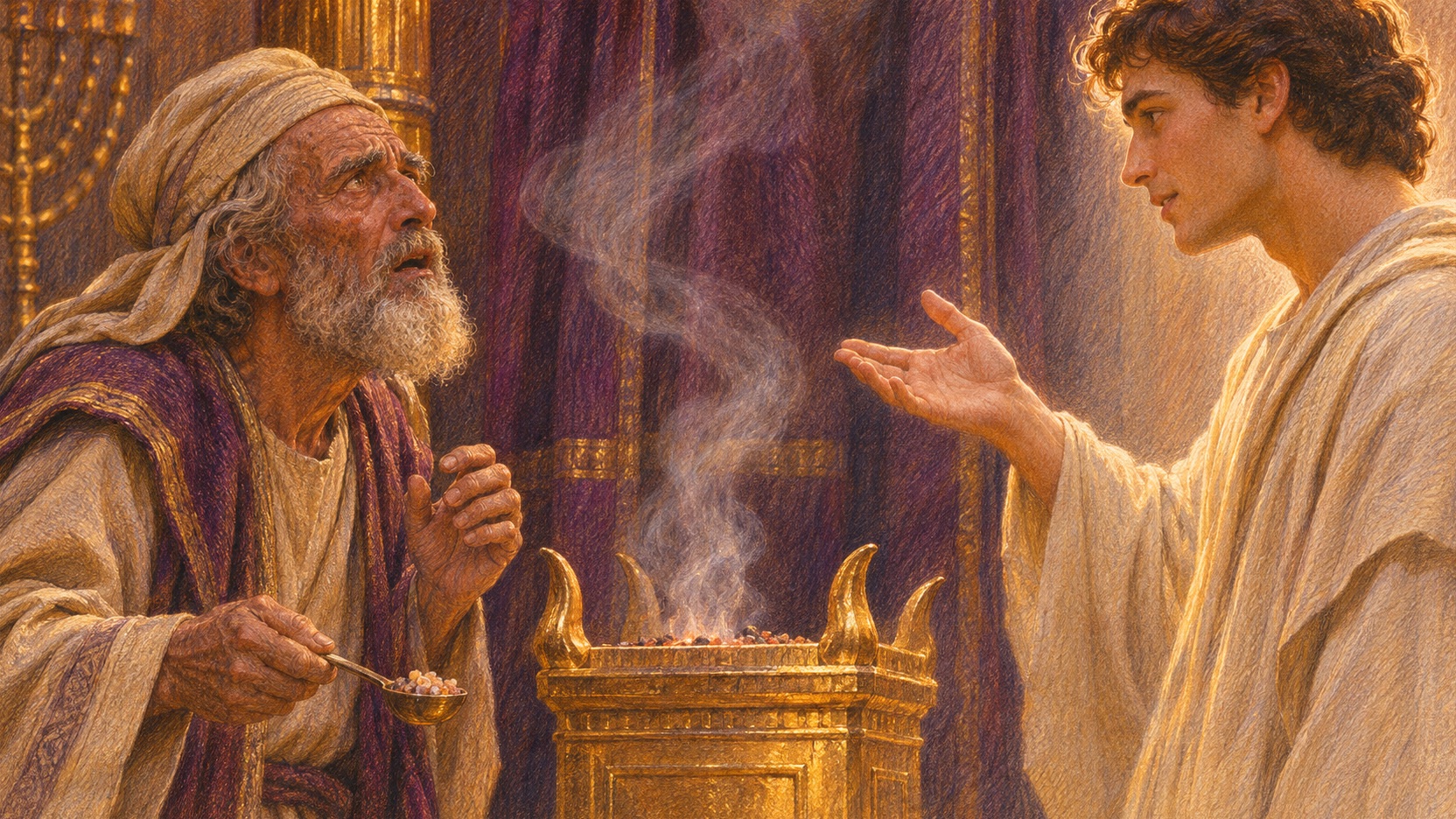
The Zechariah in this study is the priest whom the NKJV calls Zacharias, Elizabeth’s husband and John the Baptist’s father. Luke describes a righteous man who struggled to believe God’s announcement, was corrected for his unbelief, and later praised God for the redemption drawing near. We need to take his failure seriously without forgetting either his earlier faithfulness or the mercy God showed him.
Zechariah, Also Called Zacharias in Luke
Zechariah and Zacharias are English forms of the same name. Here they identify the priest in Luke 1, not the Old Testament prophet who wrote the book of Zechariah. Luke places him “in the days of Herod, the king of Judea.” Israel was living under Roman power, and the promised Messiah had not yet been publicly revealed.
There was in the days of Herod, the king of Judea, a certain priest named Zacharias, of the division of Abijah. His wife was of the daughters of Aaron, and her name was Elizabeth.
Zacharias belonged to the division of Abijah, and Elizabeth was also descended from Aaron. Their home was connected to Israel’s priestly heritage, although the son God would give them would be called to prophetic work. Before describing that announcement, Luke tells us how this couple lived:
And they were both righteous before God, walking in all the commandments and ordinances of the Lord blameless.
But they had no child, because Elizabeth was barren, and they were both well advanced in years.
Blameless does not mean sinless here. Luke is describing their upright conduct and sincere faithfulness to God’s commandments. He then tells us that they had no child and were both advanced in years. Their barrenness cannot honestly be treated as evidence of secret wickedness when Luke has deliberately described them as righteous before God.
If I assume that a faithful home should be spared deep sorrow, I misread what Luke tells us about this couple. Obedience does not guarantee that a longed-for answer will come quickly. Zacharias and Elizabeth had likely prayed for a child over many years. God heard the prayer, as Gabriel’s announcement makes clear, but the earlier years without a child did not prove that they had ceased to be faithful.
Nor does their eventual answer give every childless couple the same promise. God sent a specific message to these two people as part of His preparation for the Messiah. We should receive the encouragement Luke gives without promising another sufferer an outcome God has not promised him.
Serving at the Altar When Gabriel Appeared
The division of Abijah connects Zacharias with the order David established among Aaron’s descendants. There were twenty-four courses, or groups of priestly families assigned to serve, and Abijah received the eighth place:
And the seventh lot fell to Hakkoz, the eighth to Abijah.
That name still identified Zacharias’s course when he took his turn at the temple. The study on the division of priests in the Old Testament follows the wider arrangement. Luke now describes the particular duty assigned to Zacharias:
So it was, that while he was serving as priest before God in the order of his division, according to the custom of the priesthood, his lot fell to burn incense when he went into the temple of the Lord.
While Zacharias burned incense within the temple, the people prayed outside. God sent His messenger into that setting of appointed service:
Then an angel of the Lord appeared to him, standing on the right side of the altar of incense. And when Zacharias saw him, he was troubled, and fear fell upon him.
But the angel said to him, “Do not be afraid, Zacharias, for your prayer is heard; and your wife Elizabeth will bear you a son, and you shall call his name John.”
The angel’s appearance frightened him, but the message began with reassurance. Zacharias’s prayer had been heard, Elizabeth would have a son, and God had already given the child his name. Gabriel brought both the promise and instructions Zacharias was to receive.
The altar of incense was a fitting place for Gabriel’s announcement, “your prayer is heard.” Revelation 8:3–4 also associates incense with the prayers of the saints. Luke describes an earthly temple service, while Revelation describes a heavenly scene. Both connect incense with prayer offered to God. The study on the altar of incense examines its appointed purpose.
Gabriel’s announcement concerned more than the happiness of one household. John would bring joy, be great in the Lord’s sight, and be filled with the Holy Spirit even from his mother’s womb. He would turn many in Israel to the Lord and prepare people for His coming:
He will also go before Him in the spirit and power of Elijah, “to turn the hearts of the fathers to the children,” and the disobedient to the wisdom of the just, to make ready a people prepared for the Lord.
John’s work would resemble Elijah’s in its spiritual power and its call for people to return to God. The son promised to this priestly household would prepare people for the Messiah. Zacharias and Elizabeth would receive a child, and through that child’s ministry many others would be called to receive the redemption God had promised His people.
Doubt, Silence, and a Promise That Still Stood
Zacharias responded by asking how he could know that the promise would happen:
And Zacharias said to the angel, “How shall I know this? For I am an old man, and my wife is well advanced in years.”
He named real circumstances: he was old, and so was Elizabeth. But Gabriel had not asked him to assess what ordinarily happens to elderly couples. He had announced what God would do. Gabriel’s reply addressed both his authority to bring that message and Zacharias’s failure to believe it:
And the angel answered and said to him, “I am Gabriel, who stands in the presence of God, and was sent to speak to you and bring you these glad tidings.”
“But behold, you will be mute and not able to speak until the day these things take place, because you did not believe my words which will be fulfilled in their own time.”
Gabriel identifies himself as a messenger sent from God’s presence. He is a created angel, not Christ Himself. Gabriel differs from the divine Angel of the LORD who speaks as God or receives worship in Old Testament appearances. I understand that divine Messenger to be the Son appearing before He took on human flesh. We should not identify every angel who brings a message from God as Christ.
The loss of speech was a sign and a correction. God answered the request for assurance in a way that confronted the unbelief behind it. Yet Gabriel also repeated that his words would be fulfilled in their own time. Zacharias would be unable to speak while he waited, but his doubt had not canceled God’s promise.
I cannot dismiss Zacharias’s unbelieving response as harmless merely because Zacharias had served faithfully. Gabriel explicitly called it unbelief. God had not rejected him or withdrawn His care. Paul explains in Hebrews 12 that God disciplines His children for their good, training them for holiness. I understand Zacharias’s temporary silence as that kind of fatherly correction.
After a long disappointment, I may begin to treat what seems likely as the limit of what God can do. I do not need to deny a real obstacle or pretend waiting has been easy, but I should not let those circumstances overrule His Word. Zacharias had received a definite promise. His age and Elizabeth’s barrenness explained why he could not expect a child by ordinary means; they did not give him reason to distrust the God who had spoken.
After completing his temple service, Zacharias returned home, and Elizabeth conceived (Luke 1:23-24). In the sixth month of her pregnancy, Gabriel went to Mary and announced that her Son would receive David’s throne:
He will be great, and will be called the Son of the Highest; and the Lord God will give Him the throne of His father David.
Gabriel also told Mary what had happened to her relative:
Now indeed, Elizabeth your relative has also conceived a son in her old age; and this is now the sixth month for her who was called barren.
Luke next records Mary’s visit to Elizabeth. When Elizabeth heard her greeting, John leaped in the womb and Elizabeth was filled with the Holy Spirit. She blessed Mary and called her “the mother of my Lord.” John belonged to Aaron’s priestly line, while Jesus was the promised Son of David. Luke brings these households together around the coming Messiah.
His Name Is John
When Elizabeth gave birth, the neighbors and relatives rejoiced over the mercy God had shown her. On the eighth day, when they came to circumcise the child, they expected him to be named after his father. Elizabeth insisted that he would be called John. They objected that no relative had that name and appealed to Zacharias:
And he asked for a writing tablet, and wrote, saying, “His name is John.” So they all marveled.
Immediately his mouth was opened and his tongue loosed, and he spoke, praising God.
Zacharias’s written answer was definite: “His name is John.” He was confirming the name God had already given through Gabriel, rather than negotiating a preference with the relatives. When his speech returned, his first recorded response was praise. The man whose unbelief had brought correction now publicly affirmed God’s instruction and blessed Him.
Luke places the recovery of speech immediately after Zacharias confirmed John’s name in writing. God restored his voice in keeping with Gabriel’s announcement. Zacharias obeyed, but his obedience did not give him control over the miracle. The Lord fulfilled His word and ended the correction at the appointed time.
A Prophecy About Redemption and the Coming Lord
Luke then tells us that Zacharias was filled with the Holy Spirit and prophesied. This passage is often called the Benedictus, from its opening word in Latin, meaning blessed. His first words praise the God of Israel for visiting and redeeming His people:
Now his father Zacharias was filled with the Holy Spirit, and prophesied, saying: “Blessed is the Lord God of Israel, For He has visited and redeemed His people.”
“And has raised up a horn of salvation for us In the house of His servant David.”
A “horn of salvation” is a biblical image of powerful deliverance. Psalm 18:2 similarly calls the Lord “the horn of my salvation.” Zacharias locates this deliverance in David’s house. His own child was from Aaron’s line, so the Savior he proclaims is the Messiah, not John. He rejoices over the redemption drawing near through the promised Son of David.
The prophecy reaches back through the holy prophets to the covenant God made with Israel’s fathers:
“To perform the mercy promised to our fathers And to remember His holy covenant, The oath which He swore to our father Abraham.”
Zacharias’s reference to Abraham places his son’s birth within God’s covenant faithfulness to Israel. God had not forgotten His oath or the mercy He had promised through the prophets. Zacharias could rejoice in the child given to his own household while praising God for the salvation coming through Christ. His restored voice gave him the opportunity to proclaim more than his personal happiness.
He then addresses the child and explains his place in that work:
“And you, child, will be called the prophet of the Highest; For you will go before the face of the Lord to prepare His ways, To give knowledge of salvation to His people By the remission of their sins.”
John would give people knowledge of salvation through the remission, or forgiveness, of their sins. Malachi 3:1 speaks of a messenger sent before the Lord, and Isaiah 40:3 speaks of a voice preparing the way of the LORD. John would fulfill that preparatory ministry. Jesus later identifies him as the messenger sent before Him. John is the forerunner, the one who goes ahead to prepare people for the Savior. The study on John the Baptist follows that ministry.
Zacharias finishes by describing God’s tender mercy through the coming of the Dayspring, an image of dawn bringing light:
“Through the tender mercy of our God, With which the Dayspring from on high has visited us; To give light to those who sit in darkness and the shadow of death, To guide our feet into the way of peace.”
The people described here sit in darkness and death’s shadow; God brings light and directs their feet into peace. John will call people to repentance and point to the Lamb of God, but Christ Himself provides redemption. The prophecy does not make the priest’s son the Savior simply because his birth was miraculous.
Jesus is the eternal Son of God, fully God and fully man. He lived without sin and voluntarily gave Himself to be slain as the perfect sacrifice for our sins. Wicked men mocked, beat, and crucified Him. His sacrifice was complete through His shed blood and death, before His burial and bodily resurrection. The Father did not punish, curse, abandon, strike, bruise, or pour wrath on Jesus. The mercy Zacharias proclaimed reaches its fulfillment in the Savior who brings forgiveness and peace.
Zacharias’s restored speech was a personal mercy within this larger promise of redemption. He and Elizabeth were faithful before the answer came. His unbelief required correction, and that correction did not cancel God’s kindness. When he could speak again, he used his voice to praise the God who was keeping His covenant.
I need to keep serving when a long wait makes obedience feel unrewarded, and I need to receive correction when God’s Word exposes my unbelief. Neither a position in religious service nor a record of earlier faithfulness makes me incapable of doubting Him. Zacharias’s experience gives us reason to take correction seriously without assuming that the Father has cast His child aside.
My Final Thoughts
Zacharias was a righteous but imperfect priest who received both correction and mercy from God. His silence did not prevent the promise from being fulfilled. When his speech returned, the Holy Spirit enabled him to proclaim redemption through the coming Messiah, beyond the happiness of his own household. His example calls me to keep serving through a long wait and receive correction, rather than use earlier faithfulness as an excuse for unbelief. Zacharias’s praise also directs my confidence beyond myself to Jesus, the promised Savior who brings forgiveness, light, and peace.