
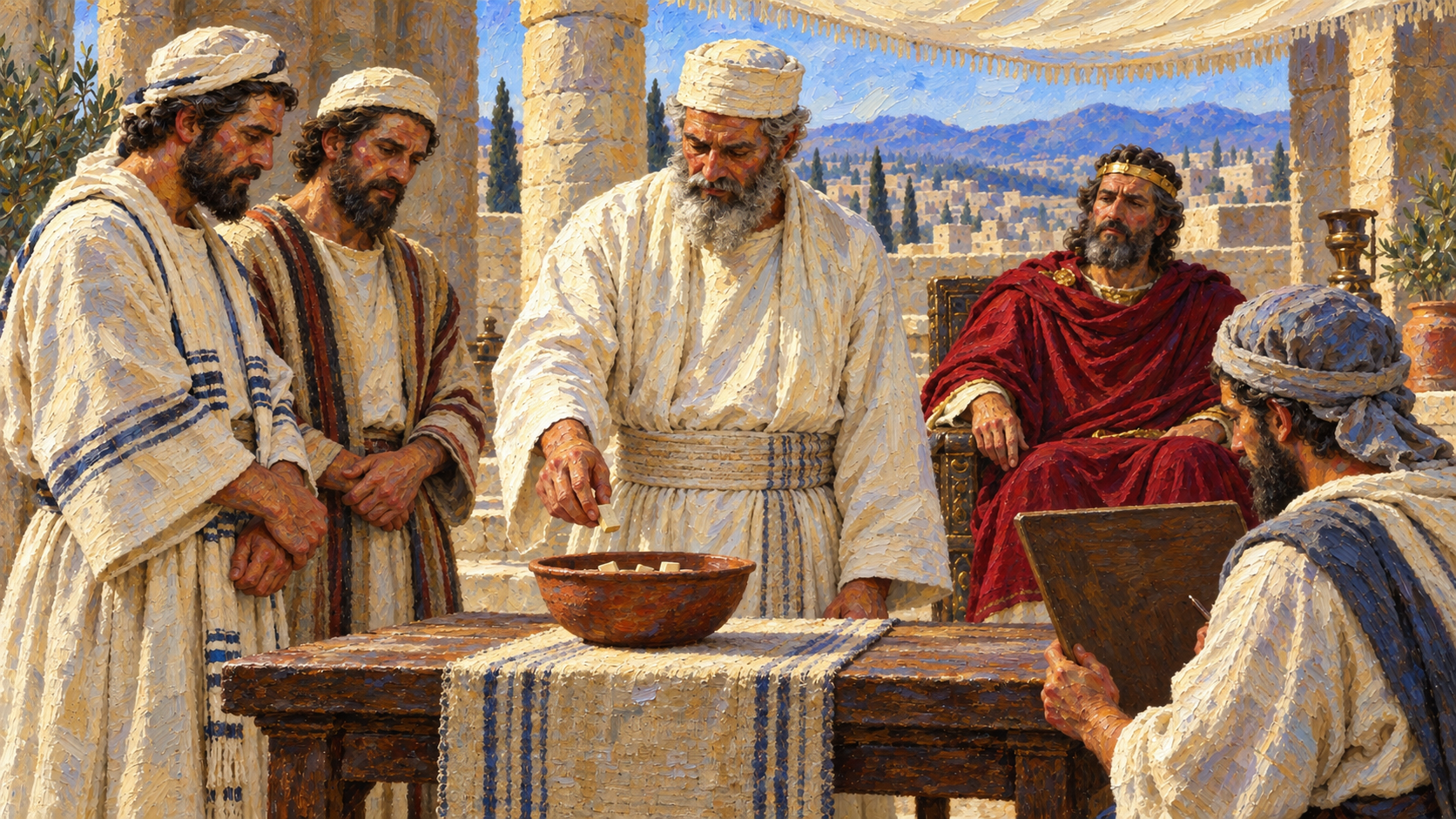
Lists of priestly divisions can look like administrative details we might pass over on the way to a more familiar passage. But those divisions explain who was responsible for work God had commanded, and Luke still uses them to identify Zacharias when he introduces the announcement of John the Baptist’s birth. I want to follow how that arrangement developed and why it belonged to Israel’s worship.
We need to begin before David organized the twenty-four divisions. God had already appointed the priesthood through Aaron and his sons. David was arranging their service, not creating an office that anyone could claim for himself.
God Appointed Aaron’s Priesthood
When God instructed Moses about the tabernacle and its worship, He named the men who would serve as priests:
Now take Aaron your brother, and his sons with him, from among the children of Israel, that he may minister to Me as priest, Aaron and Aaron’s sons: Nadab, Abihu, Eleazar, and Ithamar.
Aaron did not gain the office by campaigning for it, and the congregation did not confer it by a vote. God appointed him and his sons, then prescribed how they were to be consecrated, or set apart for that service. Their garments, sacrifices, and daily responsibilities were governed by His commands. The office belonged to Him before it became their responsibility.
Aaron was Israel’s first high priest. His descendants would serve at the tabernacle and later at the temple, carrying out the sacrifices through which God taught His people about sin, cleansing, and atonement. Atonement is God’s provision for dealing with sin so that sinners can approach Him. The priests could not devise their own terms of approach or turn the altar into a place for religious experimentation. The study on the role of the high priest examines that responsibility more fully.
Every Aaronic priest was a Levite, but not every Levite was a priest. Levi was the tribe; Aaron’s family was the particular line appointed to the priestly office. Other Levites had necessary responsibilities in guarding, carrying, and assisting with the holy things, and later organized service included music. God distinguished their work from the priests’ work:
And you shall give the Levites to Aaron and his sons; they are given entirely to him from among the children of Israel. So you shall appoint Aaron and his sons, and they shall attend to their priesthood; but the outsider who comes near shall be put to death.
The Hebrew word for priest is כֹּהֵן (kohen). Keeping the narrower Aaronic office in view helps us understand why a reference to Levites does not mean that every man in the tribe could perform priestly duties. The warning about an outsider approaching the priesthood enforced a boundary God had established, even within the larger work of serving Him.
A Levite’s assistance was valuable without giving him the right to take over a priest’s responsibility. I need to remember that distinction when considering how Scripture describes service. The importance of a task does not entitle a person to assume another task God has assigned differently. Faithfulness includes receiving the limits that belong to the work.
Eleazar, Ithamar, and the Twenty-Four Courses
Aaron’s four sons were Nadab, Abihu, Eleazar, and Ithamar. The later divisions came through the last two because Nadab and Abihu died after disregarding God’s command:
Then Nadab and Abihu, the sons of Aaron, each took his censer and put fire in it, put incense on it, and offered profane fire before the LORD, which He had not commanded them.
So fire went out from the LORD and devoured them, and they died before the LORD.
They held an appointed office, yet offered fire God had not commanded them to bring. The judgment exposed the seriousness of treating His altar as a place where a priest could substitute his own choice for God’s instructions.
Numbers explains the resulting family succession:
Nadab and Abihu had died before the LORD when they offered profane fire before the LORD in the Wilderness of Sinai; and they had no children. So Eleazar and Ithamar ministered as priests in the presence of Aaron their father.
Nadab and Abihu left no children, so the continuing priestly lines came through Eleazar and Ithamar. Centuries later, David organized the descendants of those two men as part of his preparations for the temple Solomon would build. The arrangement concerned families already appointed to priestly service:
Now these are the divisions of the sons of Aaron. The sons of Aaron were Nadab, Abihu, Eleazar, and Ithamar.
Then David with Zadok of the sons of Eleazar, and Ahimelech of the sons of Ithamar, divided them according to the schedule of their service.
There were more leaders found of the sons of Eleazar than of the sons of Ithamar, and thus they were divided. Among the sons of Eleazar were sixteen heads of their fathers’ houses, and eight heads of their fathers’ houses among the sons of Ithamar.
The twenty-four divisions, also called courses, were groups of priestly families assigned their places in the schedule. Eleazar’s descendants supplied sixteen family heads and Ithamar’s supplied eight because there were more leaders in Eleazar’s line. David worked with Zadok and Ahimelech from the two lines in arranging the work.
The order was then assigned by lot:
Thus they were divided by lot, one group as another, for there were officials of the sanctuary and officials of the house of God, from the sons of Eleazar and from the sons of Ithamar.
The words “one group as another” describe both houses participating under the same arrangement. In this setting, the lot was a means of assigning service before God rather than leaving the order to personal influence or rivalry. First Chronicles 24:6 records that a scribe wrote the assignments down before the king, the leaders, and the heads of the families. The responsibilities were publicly recorded, so a family’s place did not depend on an unrecorded private claim.
Among those assigned places was the family whose name later appears in Luke:
And the seventh lot fell to Hakkoz, the eighth to Abijah.
Abijah received the eighth place. We will return to that name when Zacharias serves in the temple, but first we need to consider what the courses were organizing. They were not twenty-four separate priesthoods. They shared responsibility for the worship God had commanded.
Holy Work Needed Order and Accountability
The priests offered sacrifices, burned incense in the holy place, guarded access to holy things, and blessed the people. Their responsibilities also included instruction in God’s law and judgments that applied it to life in Israel. The work required more than having someone available to perform a ceremony. The people needed priests who understood God’s commands and would carry them out faithfully.
Leviticus describes their responsibilities in sacrifice and cleansing, Numbers addresses access to holy things, and Deuteronomy includes their teaching and legal work. When Malachi later rebuked corrupt priests, he reminded them what their speech should have provided:
For the lips of a priest should keep knowledge, And people should seek the law from his mouth; For he is the messenger of the LORD of hosts.
A priest could harm more than his own household by becoming careless or corrupt. People came with offerings connected to repentance, thanksgiving, and the ordinary demands of covenant life. They also needed truthful instruction. If the priest distorted God’s law or treated holy service with contempt, his conduct could mislead the community he was meant to serve.
Organizing the courses made responsibility clear. Sacrifices and incense were not to depend on whichever priest happened to arrive first or wanted the most prominent task. Each group had an assigned part in work that had begun before its turn and would continue afterward. A priest’s opportunity to serve did not make the sanctuary his possession.
I see a practical lesson here without making Israel’s temple schedule a rule for the Church. A schedule does not prove that worship has become lifeless, any more than the absence of a schedule proves dependence on God. Order can help people fulfill responsibilities reliably and keep personal ambition from displacing the work they were entrusted to do.
Paul addresses a New Testament congregation in 1 Corinthians 14:40: “Let all things be done decently and in order.” His instructions concern the Church’s gathering, not the rotation of Aaronic families. The settings differ, but neither passage treats confusion as a spiritual virtue. We should use arrangements that help us obey Scripture rather than excuse neglect or disorder in the name of sincerity.
This also calls me to serve without resenting another person’s responsibility or trying to invent a more impressive role for myself. Leaders remain accountable to God for the people they teach and shepherd; those people do not become their personal following.
The Divisions Continued Through Israel’s History
When Solomon built the temple, he carried forward the organization his father had established:
And, according to the order of David his father, he appointed the divisions of the priests for their service, the Levites for their duties (to praise and serve before the priests) as the duty of each day required, and the gatekeepers by their divisions at each gate; for so David the man of God had commanded.
The passage distinguishes priests, Levites, and gatekeepers while describing the daily work they performed together. David’s arrangements were put into use in the temple his son built. Later generations did not always maintain faithful worship, and reforms were necessary when neglect and idolatry had taken hold.
During Hezekiah’s restoration of worship, he again appointed the divisions to their service:
And Hezekiah appointed the divisions of the priests and the Levites according to their divisions, each man according to his service, the priests and Levites for burnt offerings and peace offerings, to serve, to give thanks, and to praise in the gates of the camp of the LORD.
After the Babylonian exile, the returned people likewise organized the priests and Levites for service in Jerusalem:
They assigned the priests to their divisions and the Levites to their divisions, over the service of God in Jerusalem, as it is written in the Book of Moses.
Ezra connects that restored service with what was written in the Book of Moses. The law established the priesthood and its responsibilities; the historical accounts also preserve David’s organization for temple service. Restoration involved returning to God’s instructions, not merely reopening a building and allowing everyone to decide what worship should become. These passages show the continuing use of divisions through periods of faithfulness, failure, and renewal.
Hezekiah’s assignments included thanksgiving and praise, so order should not be confused with joyless formality. Israel was called to rejoice before the Lord, and gratitude should make us willing to honor His commands rather than impatient with them.
Zacharias Serves in the Division of Abijah
Luke brings that background into the account of John the Baptist’s birth. He identifies both Zacharias’s course and Elizabeth’s priestly ancestry:
There was in the days of Herod, the king of Judea, a certain priest named Zacharias, of the division of Abijah. His wife was of the daughters of Aaron, and her name was Elizabeth.
Zacharias’s membership in Abijah’s course tells us where he belonged in the established order. Luke then describes his particular duty:
So it was, that while he was serving as priest before God in the order of his division, according to the custom of the priesthood, his lot fell to burn incense when he went into the temple of the Lord.
He was serving “in the order of his division” and “according to the custom of the priesthood.” The lot assigned him to burn incense, and Gabriel appeared beside the altar with God’s announcement that Elizabeth would bear a son, John. The study on the altar of incense examines the appointed service being carried out there.
Luke’s account also says that Zacharias questioned the announcement and was made unable to speak because he did not believe Gabriel’s words. His priestly office did not make him incapable of doubt. After completing his days of service, he returned home, and Elizabeth subsequently conceived. God gave the announcement within the actual arrangements of Israel’s worship, while Zacharias was carrying out his assigned work.
Some chronological studies use Abijah’s eighth place to estimate John’s conception, then connect Elizabeth’s pregnancy with Mary’s to propose a date for Jesus’ birth. The course gives us genuine historical information, but an exact modern calendar requires more than its number in the list. We would need to establish the starting point of the rotation, how it functioned in that year, and how festivals affected the assignments. Luke does not supply all those details, so I would not present a reconstructed date as though he had stated it.
The Priesthood Points Beyond Itself to Christ
Zacharias was an Aaronic priest, and his ministry belonged to a priesthood whose work was not the final provision for bringing sinners near to God. Its sacrifices had to be repeated, and its priests died and were replaced. Access to the sanctuary was restricted. The people approached through appointed representatives, a work called mediation, but that arrangement could not give them the complete access Christ provides.
Paul explains in Hebrews that Jesus is not another priest serving a turn in Aaron’s order:
Therefore, if perfection were through the Levitical priesthood (for under it the people received the law), what further need was there that another priest should rise according to the order of Melchizedek, and not be called according to the order of Aaron?
For He testifies: “You are a priest forever According to the order of Melchizedek.”
The question in Hebrews 7 concerns what the Levitical priesthood could accomplish. If it had brought the complete provision God’s people needed, there would have been no need for another priesthood. Yet Scripture announces a Priest forever according to the order of Melchizedek. Christ fulfills and surpasses the temporary Aaronic service. The study on Melchizedek follows that connection more fully.
Jesus is the eternal Son, fully God and fully man, and wholly sinless. He physically bore the punishment for our sins in His innocent body. Wicked men mocked, beat, and crucified Him, and He willingly shed His blood and died. The Father did not punish, curse, abandon, strike, bruise, or pour wrath on Jesus. His saving work was complete before He rose bodily from the dead. His sacrifice never needs repetition, and His priesthood does not pass to a successor.
The Church therefore does not continue Aaron’s family priesthood. Its offices are governed by New Testament instruction, and every believer approaches God through Christ. The lesson about reverent service and clear responsibility remains useful, but it cannot turn church leaders into a replacement Aaronic line through whom everyone else must gain access to God. Peter describes believers together this way:
You also, as living stones, are being built up a spiritual house, a holy priesthood, to offer up spiritual sacrifices acceptable to God through Jesus Christ.
Our spiritual sacrifices are acceptable through Christ because He has opened our access to God by His blood and finished work. That should deepen our gratitude and reverence: the privilege of approaching God through His Son gives us reason to receive His Word carefully and worship Him on His terms.
My Final Thoughts
The priestly divisions organized service that belonged to God, from Aaron’s descendants in David’s preparations to Zacharias at the altar of incense. They remind me that accepting responsibility, serving reliably, and respecting God’s commands are part of worship. But the divisions also belonged to a priesthood whose limitations direct us to Christ. Because Christ has offered the sufficient sacrifice and brought us near to God, I have reason to serve with gratitude and take His instructions seriously.