
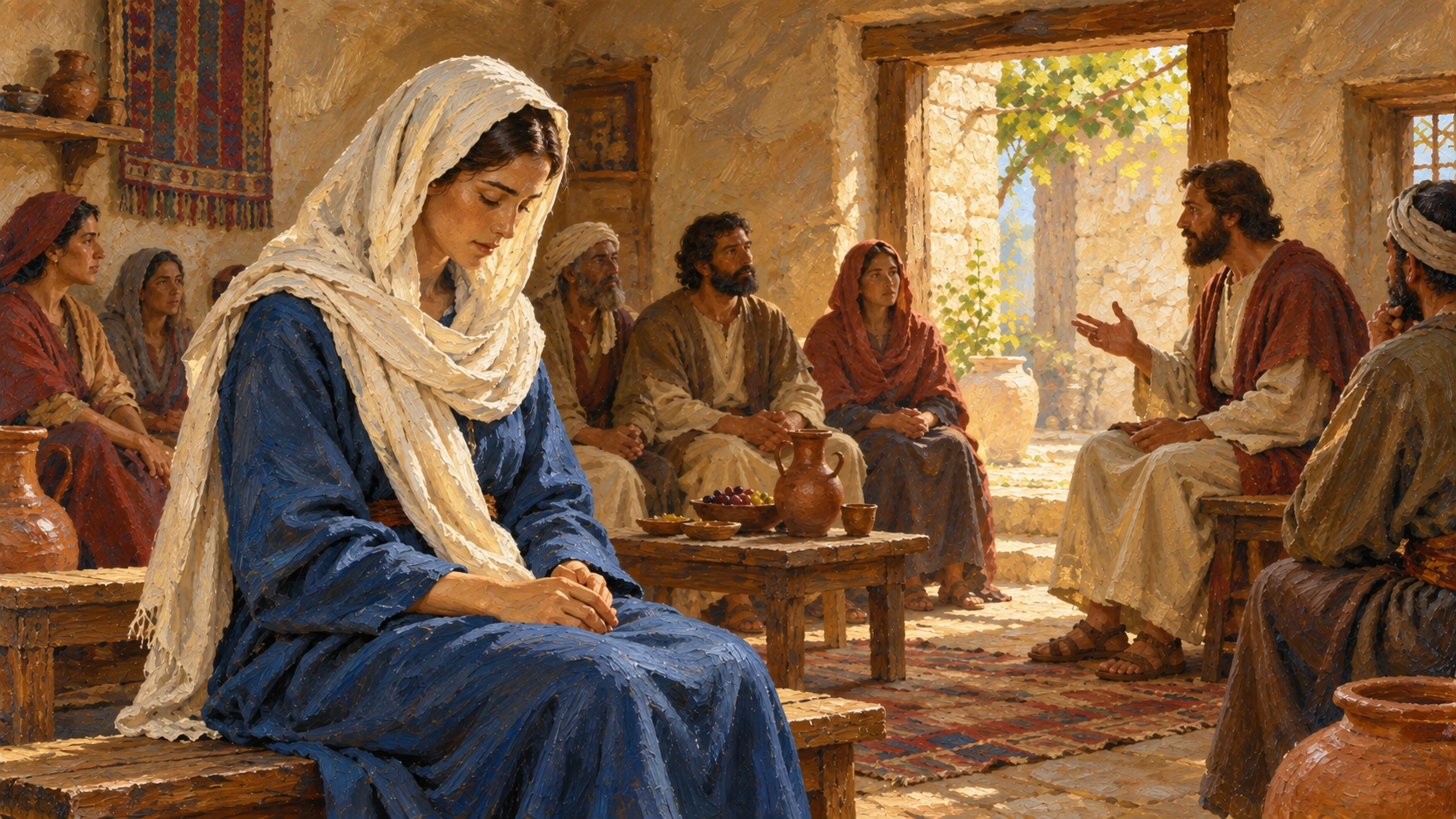
What did Paul mean when he wrote, “Let your women keep silent in the churches”? Some people use that sentence to silence women in ways the Bible never requires, while others dismiss his command as an embarrassing mistake. I want to understand it where God placed it, in a chapter about orderly worship. We also need to read it alongside what the rest of Scripture teaches about women’s ministry and church authority.
The Question in 1 Corinthians 14
Paul’s instruction is direct, and I cannot set it aside because it makes people uncomfortable. But obeying a command requires understanding what it forbids. If Paul is restricting a particular kind of speech, extending that restriction to everything a woman might say would misrepresent him.
Let your women keep silent in the churches, for they are not permitted to speak; but they are to be submissive, as the law also says.
And if they want to learn something, let them ask their own husbands at home; for it is shameful for women to speak in church.
The women he addressed were to be submissive, and those wanting to learn were to ask their own husbands at home. Those details connect the restriction with how learning and speaking were taking place in the gathering. To understand the correction, we need to follow Paul’s instructions to the other speakers as well.
The Corinthians had spiritual gifts, but possessing a gift did not give someone permission to dominate the meeting. Paul wanted the congregation to understand what was said and benefit from it. He used the word edification for that purpose: building up believers in their faith and understanding.
How is it then, brethren? Whenever you come together, each of you has a psalm, has a teaching, has a tongue, has a revelation, has an interpretation. Let all things be done for edification.
A tongue that no one understood could not instruct the congregation unless someone interpreted it. Paul therefore limited the number of speakers, required them to take turns, and told the speaker what to do when there was no interpreter:
But if there is no interpreter, let him keep silent in church, and let him speak to himself and to God.
The person still had a gift, but the congregation’s need governed whether he should exercise it aloud. Silence in that circumstance did not mean he was forbidden to speak whenever Christians assembled. It meant he was to refrain from the speech that could not benefit the people listening.
Prophets also had to exercise restraint. Others were to weigh what they said, and one speaker was not entitled to keep the floor while another received a revelation:
But if anything is revealed to another who sits by, let the first keep silent.
Paul went on to explain that the prophets could speak one at a time so everyone could learn and be encouraged. In verses 29–32, he holds speakers responsible for controlling their participation. Claiming the Spirit’s activity did not excuse talking over someone else or refusing to yield.
For God is not the author of confusion but of peace, as in all the churches of the saints.
At the end of the chapter, Paul still encourages prophecy and tells the Corinthians not to forbid speaking in tongues. He does not solve their disorder by abolishing the gifts. Those who consider themselves spiritual must acknowledge his instructions as the Lord’s commandments and use their gifts accordingly.
Let all things be done decently and in order.
Women Praying and Prophesying
Earlier in the same letter, Paul addressed women who prayed and prophesied. He corrected the way they did so without rebuking them for praying or prophesying:
But every woman who prays or prophesies with her head uncovered dishonors her head, for that is one and the same as if her head were shaved.
His concern in chapter 11 is headship and the visible way it is honored. Christians differ over the head covering, but the passage describes women exercising these spoken ministries under that order. I do not see how we can turn chapter 14 into a prohibition of every audible word without accounting for what Paul has already written.
He is not contradicting himself. A woman could pray or prophesy while honoring headship and still need to refrain from speech that disrupted learning or crossed the boundary of authority. Permission to exercise a gift did not release her from submission any more than a prophet’s gift released him from the obligation to yield to another speaker.
In chapter 14, the Greek verb translated “keep silent” is sigaō (σιγάω). Paul uses it for the tongue-speaker, the prophet, and the women he addresses. The word means to be silent; the surrounding instructions tell us when and with respect to what. We already know it does not permanently remove the tongue-speaker’s or prophet’s opportunity to speak. We must read the instruction to women with the same attention to its setting.
That does not mean the Greek word for “speak” can simply be translated as chatter or babble. It is a broad word for speaking. If I say Paul forbids only chatter because that is what the verb means, I have made the language say something it does not establish. The connection with learning and submission, together with the rest of Paul’s teaching, gives us the grounds for understanding the restriction.
His direction to ask their husbands at home suggests that questions were disrupting the gathering. Another interpretation connects the restriction more specifically with the public evaluation of prophecy in verse 29: women were not to take over a judging and teaching responsibility that conflicted with submission to male leadership. The NET Bible note on verse 34 discusses that reading. Paul does not describe the particular exchanges, so I would not insist that we know exactly what each woman had been saying. Both the reference to questions and the requirement of submission need to remain part of our explanation.
Paul directs these women to ask their husbands at home so they can learn without disrupting the gathering. He does not tell them to remain ignorant or treat their desire to learn as shameful. It also does not establish that an unmarried woman has no one to ask or may never seek instruction. Paul is addressing conduct in this gathering; the church’s responsibility to teach women does not disappear because some have no believing husband.
I therefore understand “keep silent” in chapter 14 as a restriction on improper speech within the gathering. It does not mean that women may never pray aloud, speak truth, or contribute through the gifts God gives them. We still need to ask what responsibilities Scripture assigns to church leaders, because rejecting absolute silence does not settle who should hold teaching authority.
The Boundary of Church Authority
I believe the offices of pastor and elder, together with authoritative teaching leadership over men in the local church, belong to biblically qualified men. That conclusion rests on Paul’s teaching beyond 1 Corinthians 14. When he wrote Timothy, he connected the restriction on teaching and authority with the order of creation:
Let a woman learn in silence with all submission.
And I do not permit a woman to teach or to have authority over a man, but to be in silence.
For Adam was formed first, then Eve.
Paul began with “Let a woman learn.” Women are disciples who need to understand doctrine, recognize error, and grow in obedience to Christ. A congregation that neglects their instruction has failed to carry out that command. Their learning is to be “with all submission,” and Paul then states the boundary concerning teaching and exercising authority over a man.
His appeal to Adam being formed before Eve gives the instruction a basis deeper than a temporary disturbance in Ephesus. I cannot treat the restriction as something that expired when one difficult group of women stopped causing trouble. Paul ties the responsibility to God’s ordering of creation, while affirming the woman’s place as a learner.
Paul’s reference to the law in 1 Corinthians 14:34 fits this wider reasoning. He does not identify a single Old Testament command that says women must never speak in a gathering. I understand him to be appealing to the Torah, the first five books of the Bible, and its pattern of creation order and submission. That is an interpretation of his reference, supported by his explicit appeal to creation in 1 Timothy 2 and his discussion of headship in 1 Corinthians 11.
The qualifications for local leaders follow the same pattern. An overseer is to be a man whose character, household, and ability to teach demonstrate that he is fit to care for the church:
A bishop then must be blameless, the husband of one wife, temperate, sober-minded, of good behavior, hospitable, able to teach.
Paul also instructed Titus to appoint elders and described the man who could be considered for that responsibility:
If a man is blameless, the husband of one wife, having faithful children not accused of dissipation or insubordination.
Being male does not by itself qualify anyone for this work. A man who cannot restrain his temper, manipulates people, or neglects his household cannot wave away those failures by appealing to headship. The passages entrust him with care and doctrinal oversight; they do not give him an opportunity to make other people serve his ambitions. The study on the role and qualifications of pastors, bishops, and elders examines those requirements.
Submission does not mean that the one who submits is less valuable. The Son submits to the Father in the work of redemption while remaining fully God, co-equal and co-eternal. A wife shares her husband’s humanity, and a church member has no less worth before God than an elder. Those relationships are not identical, but each prevents us from assuming that an assigned responsibility establishes superior personal worth.
We should therefore examine both what a church permits and how its leaders treat people. Calling a practice orderly cannot excuse belittling women, ignoring their counsel, or refusing to teach them. Nor does honoring their dignity allow us to discard the boundaries Paul gives. The connected study on whether women can be pastors considers the leadership question in more detail.
Women Honored and Gifted by God
The women God used in Scripture were doing substantial work. Deborah was a prophetess and judged Israel:
Now Deborah, a prophetess, the wife of Lapidoth, was judging Israel at that time.
Huldah delivered the Lord’s message when Josiah’s representatives came to inquire of God. Esther acted courageously to preserve her people. These women had different responsibilities, but none can fairly be described as insignificant or incapable of communicating God’s truth.
Later, Mary received God’s word in faith and bore the Messiah. Anna served God in the temple and spoke about Jesus to those awaiting redemption in Jerusalem. Luke introduces her as a prophetess:
Now there was one, Anna, a prophetess, the daughter of Phanuel, of the tribe of Asher. She was of a great age, and had lived with a husband seven years from her virginity.
These passages do not describe appointments to the office of elder in a New Testament church. They do show why it is reckless to defend male church leadership by claiming that women cannot understand, speak, or serve usefully. The Bible honors work that such an argument would dismiss.
Paul’s greetings in Romans 16 bring the discussion directly into the church’s ministry. He commended Phoebe to the Roman believers:
I commend to you Phoebe our sister, who is a servant of the church in Cenchrea.
He also named a husband and wife as his fellow workers:
Greet Priscilla and Aquila, my fellow workers in Christ Jesus.
In that chapter, Mary is remembered for abundant labor, and Tryphena, Tryphosa, and Persis are also honored for laboring in the Lord. Paul did not regard these women as a problem to be kept out of the way. He publicly recognized their service. A congregation following his teaching should be able to do the same without making every honored worker an elder.
Priscilla’s ministry also helps us understand the difference between instructing someone and occupying the church’s pastoral office. Apollos spoke boldly and knew much about the Scriptures, but his understanding needed further instruction:
So he began to speak boldly in the synagogue. When Aquila and Priscilla heard him, they took him aside and explained to him the way of God more accurately.
The husband and wife gave this instruction together. Luke does not present Priscilla as the gathered church’s authoritative teacher. He does describe her helping a man understand the truth. I should receive sound correction from a woman rather than dismiss it because she cannot hold the office of elder. The study on Priscilla follows her work more fully.
Galatians 3:28 addresses another aspect of this discussion: our equal standing in Christ.
There is neither Jew nor Greek, there is neither slave nor free, there is neither male nor female; for you are all one in Christ Jesus.
Paul is explaining justification by faith, our being counted righteous through Christ rather than earning acceptance by keeping the law. Jewish ancestry does not give a believer a superior salvation, and a slave receives the same saving grace as a free person. Men and women are redeemed by the same blood and belong to the same Lord. No male leader has a closer claim to Christ simply because he is male.
That equality does not cancel the responsibilities Paul describes in 1 Timothy, Titus, 1 Corinthians, and Ephesians. If I use one statement about salvation to erase his instructions about the church and home, I have set his teaching against itself instead of understanding how it fits together.
Women also share in the Spirit’s gifts. Joel foretold an outpouring that included both sons and daughters:
And it shall come to pass afterward That I will pour out My Spirit on all flesh; Your sons and your daughters shall prophesy, Your old men shall dream dreams, Your young men shall see visions.
Peter quoted that promise in Acts 2:17 when the Holy Spirit came at Pentecost. Women who belong to Christ have His Spirit living in them and receive gifts for service. A church has no biblical reason to assume that the Spirit supplies men with everything useful while leaving women with nothing to contribute.
Gifts still operate under the instructions God gives. That has been Paul’s argument throughout 1 Corinthians 14, where even prophets must accept limits on when they speak. Honoring women’s gifts and obeying the boundaries of church authority are responsibilities the congregation must carry out together.
Ordered Honor in the Local Church
In practice, a church should provide women with serious instruction in Scripture and opportunities to serve through what they learn. Older women teach younger women, mothers disciple their children, and women offer wise counsel, hospitality, prayer, and help in spreading the gospel. Those ministries require understanding and discernment. They cannot flourish if a church treats women as spectators whose only responsibility is to stay out of the discussion.
For example, if a woman notices that a teaching contradicts Scripture, her concern deserves a careful answer. Calling it unsubmissive simply because a woman raised it would protect the teacher from correction rather than preserve God’s order. She should raise the concern respectfully, and the men responsible for doctrine should examine it honestly. Neither sex has permission to be disruptive, and leadership does not place a man beyond accountability to the Word he teaches.
A congregation must also resist the pressure to make pastoral office the measure of whether someone’s service is valued. Assigning a woman authoritative teaching leadership over men would cross the boundary I understand Paul to give. Providing thorough discipleship, listening to sound counsel, and supporting the ministries Scripture permits honors her without asking her to take that responsibility.
Men entrusted with leadership need to do the work. A title cannot substitute for studying Scripture, correcting error, welcoming people into our lives, and dealing gently with those who need help. If I insist on the privileges of leadership while leaving its burdens to everyone else, I am neglecting the responsibility I claim to defend.
The church is the body of Christ, and its members serve one another. God’s instructions should produce a congregation in which people can learn, pray, and minister without competing for control. We need leaders who obey those instructions and members whose gifts are welcomed within them.
My Final Thoughts
I do not believe “keep silent” forbids every audible ministry from women. Paul is correcting speech that violates the order of the gathered church, while his instructions to Timothy and Titus reserve authoritative teaching leadership and elder oversight for qualified men. We need to receive both parts of his teaching without using either to evade the other.
Women should be taught deeply, heard respectfully, and encouraged in the service God gives them. Men who lead must be qualified, accountable, and willing to care for the people entrusted to them. I want our churches to follow Scripture carefully enough that God’s order is evident in both our responsibilities and the way we treat one another.