
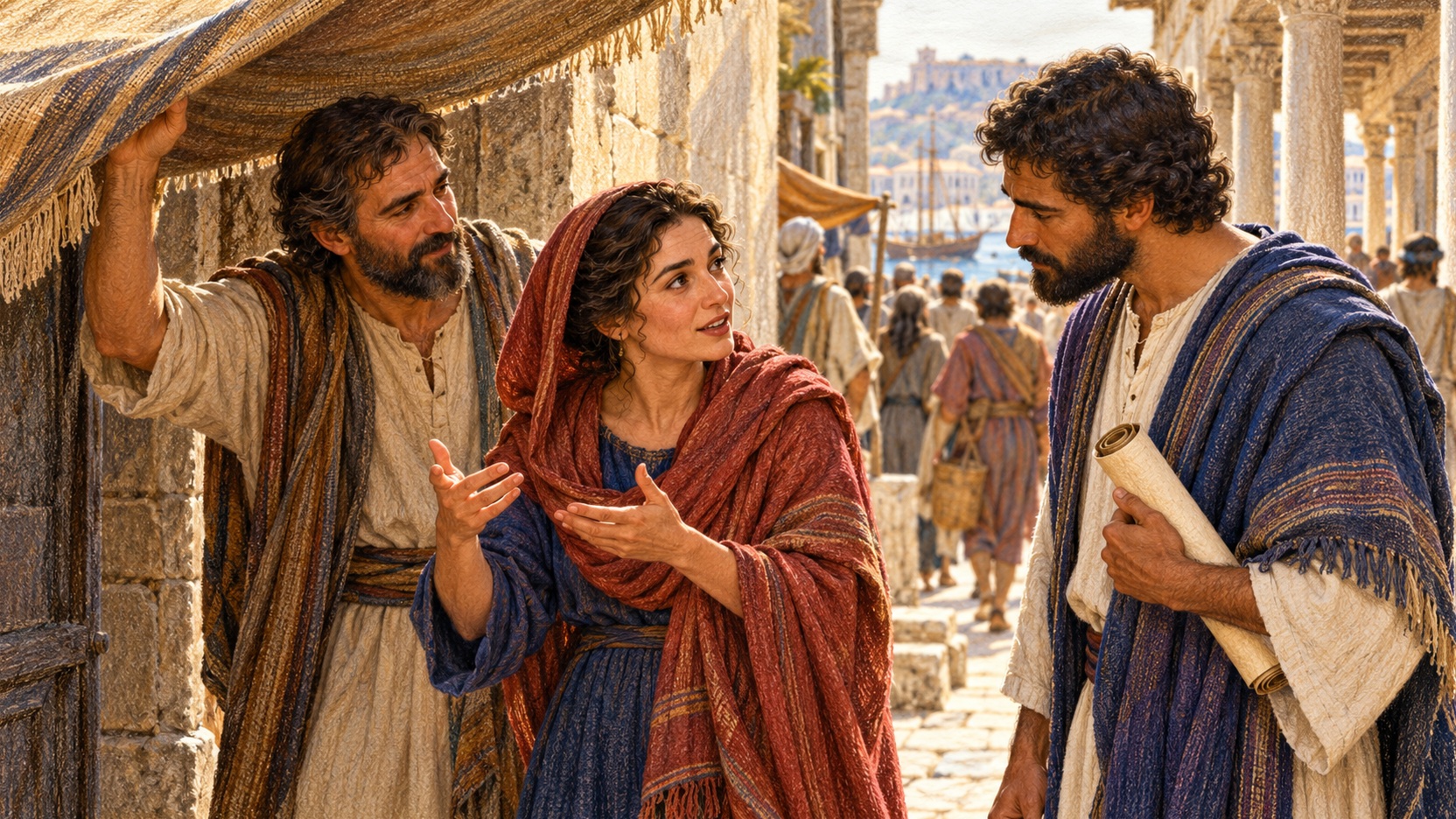
Priscilla and her husband Aquila had recently come from Italy when the apostle Paul met them in Corinth. They shared his trade, so he stayed with them and worked alongside them. Paul would later call both of them his fellow workers in Christ, and the account of their service shows how a household could help other believers understand God’s Word and give them a place to gather.
Follow Every Reference Without Filling the Silences
Luke, who records these events in Acts, explains why the couple had moved. Claudius, the Roman emperor, had ordered Jews to leave Rome. Aquila and Priscilla were among those whose lives were disrupted, and Paul found them after leaving Athens for Corinth, a city in Greece:
And he found a certain Jew named Aquila, born in Pontus, who had recently come from Italy with his wife Priscilla (because Claudius had commanded all the Jews to depart from Rome); and he came to them. So, because he was of the same trade, he stayed with them and worked; for by occupation they were tentmakers.
The first person Luke identifies is Aquila. He was Jewish and had been born in Pontus, a region along the southern coast of the Black Sea. Priscilla was his wife, and they had recently arrived from Italy. Those details help us follow their movements, but Luke does not tell us how much they had left behind or what they felt about leaving. I do not want to add an imagined account of their losses when the passage gives us their actions instead.
Paul came to them, discovered that they shared a trade, and stayed to work with them. The NKJV calls them tentmakers. The work involved making the kind of shelter travelers used, although the precise materials and range of their work are not specified here. We can understand the partnership without pretending to know what was on their workbench.
While working in Corinth, Paul also went to the synagogue every Sabbath, where he reasoned with Jews and Greeks (Acts 18:4). A synagogue was a Jewish place of gathering and instruction. Paul was explaining the message about Jesus there, and his work with this couple provided an ordinary setting for the relationship that continued through his ministry. Earning a living did not place them outside the work God was doing.
I find it interesting that we meet Priscilla through a move and a shared occupation, rather than through an announcement that she has been given a prominent position. Her circumstances had changed, but there was still work to do and there were people to serve. That does not promise that every unwanted move will quickly lead to a visible success. A person may face loneliness and difficult work for a long time. It does show that being displaced did not leave this couple beyond God’s care or prevent their usefulness to Him.
Honest work can supply food and shelter, and it also gives us something with which to help another person. In their case, a common trade brought Paul into their household. Our work may bring us into relationships where hospitality and a faithful witness become possible. I need to keep that purpose in view, because a career becomes an idol when its demands or its rewards begin deciding whether I will obey Christ.
Scripture gives us six references to Priscilla, and each one names her with Aquila. Three occur in Acts 18, at verses 2, 18, and 26. The others are in Romans 16:3, 1 Corinthians 16:19, and 2 Timothy 4:19. As we go through them, we see the couple working with Paul, traveling, helping a teacher, and making their home available to believers. Those references give us enough to recognize substantial service without constructing a biography from things the Bible never tells us.
For example, Scripture does not identify Priscilla’s birthplace or ethnicity. Aquila’s Jewish background and birthplace belong to him, so I cannot simply transfer them to his wife. We are not given her age, social rank, or education. Her conversion is not described, and the passages do not tell us whether she had children or how she died. Where Scripture is silent, a familiar tradition or an attractive possibility must not become a fact in our explanation.
We also encounter two forms of her name. The NKJV calls her Priscilla in Acts, Romans, and 1 Corinthians, and Prisca in 2 Timothy. These names refer to the same woman. The change in form is not presented as a conversion name or a change in spiritual standing.
The order in which the spouses are named varies as well. In the NKJV and its received Greek text, Aquila is named first in Acts 18:2 and 18:26, and in 1 Corinthians 16:19. Priscilla or Prisca is first in Acts 18:18, Romans 16:3, and 2 Timothy 4:19. Each appears first three times. We should check the actual wording before building an argument on the order.
Priscilla is plainly recognized in her own right. But the order of the names does not tell me that she was wealthier, more educated, or socially superior to Aquila. It does not establish that she ruled her husband or held a pastor’s office. Their repeated appearance together gives us much firmer evidence of a husband and wife sharing their lives in service to Christ.
Marriage and Shared Service Under Christ
That shared service raises a practical question about marriage. How should a husband and wife use their knowledge and abilities together? Paul answers the broader question in Ephesians 5 by placing their responsibilities under Christ. He tells wives to submit to their own husbands, and he tells husbands to love their wives as Christ loved the church and gave Himself for her (Ephesians 5:22-25). He closes that instruction with these words:
Nevertheless let each one of you in particular so love his own wife as himself, and let the wife see that she respects her husband.
A husband cannot read his responsibility as head of the household while passing over the way Christ cares for His church. Paul tells him to nourish and cherish his wife as he would care for his own body (Ephesians 5:28-29). His leadership is to seek her good at a cost to himself. It does not make him a superior kind of person, and it does not give him ownership of her conscience before God.
A wife is responsible to respect her husband and submit to him under the Lord. That responsibility does not require her to stop learning, stop thinking, or withhold something true that would help him. The woman beside a husband is someone he is commanded to love. Keeping her ignorant of Scripture, or refusing to acknowledge the abilities God has given her, would work against the care Paul describes.
Priscilla and Aquila’s life together gives us a concrete example of shared work. They traveled together, made room for believers, and both participated in explaining doctrine. We are not given every detail of their household decisions, so I would not pretend to reconstruct their conversations. What we are given shows that Priscilla’s knowledge contributed to their service. Being a faithful wife did not require her to be incapable or idle.
The study on Being a Biblical Wife and Mother examines the household responsibilities in greater detail. Priscilla gives us an example of a wife using her knowledge and abilities beside her husband. Their home and their shared work became ways of helping other believers, so serving the church did not require them to set their marriage aside.
After Paul had spent a considerable time teaching in Corinth, the couple traveled with him. Luke records their departure and the next place where they stayed:
So Paul still remained a good while. Then he took leave of the brethren and sailed for Syria, and Priscilla and Aquila were with him. He had his hair cut off at Cenchrea, for he had taken a vow. And he came to Ephesus, and left them there; but he himself entered the synagogue and reasoned with the Jews.
Cenchrea was Corinth’s eastern port, and Ephesus was across the Aegean Sea in the Roman province of Asia, in what is now western Turkey. Luke includes the detail about the vow and the cutting of hair at Cenchrea, then follows the travelers to Ephesus. The detail we need for Priscilla’s service is that she and Aquila stayed there when Paul continued his journey.
Paul entered the synagogue in Ephesus and reasoned with the Jews. They asked him to remain longer, but he left, saying that he would return if God willed (Acts 18:20-21). Priscilla and Aquila therefore remained where there were people to meet and opportunities to serve. Luke does not say that Paul appointed either of them as an elder when he left them there.
We should allow the account to describe trusted companions without supplying an office it does not mention. The study on Aquila follows her husband’s part in this partnership. Their time in Ephesus soon brought them into contact with a man whose knowledge of Scripture was considerable, but who still needed help.
Apollos and Personal Doctrinal Correction
Apollos was a Jewish teacher from Alexandria in Egypt. When he arrived in Ephesus, he spoke boldly in the synagogue, where Priscilla and Aquila heard him. Luke explains both what he knew and the limit in his instruction:
Now a certain Jew named Apollos, born at Alexandria, an eloquent man and mighty in the Scriptures, came to Ephesus. This man had been instructed in the way of the Lord; and being fervent in spirit, he spoke and taught accurately the things of the Lord, though he knew only the baptism of John. So he began to speak boldly in the synagogue. When Aquila and Priscilla heard him, they took him aside and explained to him the way of God more accurately. And when he desired to cross to Achaia, the brethren wrote, exhorting the disciples to receive him; and when he arrived, he greatly helped those who had believed through grace; for he vigorously refuted the Jews publicly, showing from the Scriptures that Jesus is the Christ.
Apollos could speak well, and he had a strong grasp of the Scriptures. Luke also describes him as fervent in spirit, which tells us that he brought earnestness to what he taught. His need for further instruction did not cause Luke to dismiss those qualities. He was accurately teaching what he understood about the Lord, while his knowledge extended only to John’s baptism.
John was the prophet who prepared people for Jesus’ public ministry. He called people to repent, and those coming to him were baptized while confessing their sins. John also told them that a mightier One was coming after him (Matthew 3:1-12). His ministry directed people toward the Messiah, the promised Christ, rather than presenting John as their Savior.
Knowing that background helps us hear Luke’s description of Apollos. He had received instruction, and what he taught had real accuracy, but there was more about God’s way that he needed to understand. Luke does not give us a list of the things he had not yet learned. I should not turn that gap in our information into a claim that he knew nothing of Jesus’ work.
Acts 19 describes a different encounter that can help us understand the transitional setting. Paul found disciples in Ephesus who knew John’s baptism, and he explained that John had pointed people to belief in Jesus. Those men were then baptized in the name of the Lord Jesus, and the chapter describes the Holy Spirit coming upon them. That is their account. It does not authorize me to take every detail of their experience and insert it into Luke’s account of Apollos.
What Luke does tell us is that Aquila and Priscilla took him aside and explained God’s way more accurately. Some translations describe them bringing him into their home, but the Greek wording does not name a house. They made an opportunity to speak with him personally and supply the understanding he lacked. We can recognize their help without claiming to know exactly where that conversation took place.
Both of them participated. I cannot give Aquila all the credit when Luke names Priscilla with him. At the same time, Luke describes the couple helping one teacher; he does not describe Priscilla taking charge of the synagogue or governing a congregation. Giving her full credit for the instruction does not require assigning her a role the passage never gives her.
I find their approach useful because they listened to an able man and still recognized that he needed fuller understanding. A teacher can communicate clearly and speak with conviction while having something left to learn. If I assume that a confident delivery proves complete understanding, I may fail to notice the very point that needs correction.
The way that correction is given also has to agree with the truth being taught. In 2 Timothy 2, Paul tells Timothy, his fellow worker, to handle the Word faithfully and avoid disputes that produce strife. He has already named teachers who were upsetting believers by saying that the resurrection had happened. Even in dealing with serious error, he gives this instruction:
And a servant of the Lord must not quarrel but be gentle to all, able to teach, patient, in humility correcting those who are in opposition, if God perhaps will grant them repentance, so that they may know the truth, and that they may come to their senses and escape the snare of the devil, having been taken captive by him to do his will.
Paul wants the person caught in error to come to know the truth and escape the devil’s snare. That aim explains the patience he requires. The correction must be clear enough to address what is wrong, but quarrelling for the pleasure of defeating someone does not serve the purpose Paul describes.
Apollos’s situation should not be confused with every case of deliberate false teaching. Luke identifies incomplete understanding in a man already teaching accurately in what he knew. That calls for care in how we describe him. A capable teacher can need correction without every part of his teaching becoming worthless, and a teacher who needs help should not have to be humiliated before we are willing to give it.
Luke does not record a speech in which Apollos admits his mistake. Instead, he describes the instruction and then tells us about his continued work. When Apollos wanted to travel to Achaia, the region of Greece that included Corinth, the brethren wrote to encourage the disciples there to receive him. He arrived and greatly helped those who had believed through grace.
His public work there showed people from Scripture that Jesus is the Christ. The sequence supports the conclusion that he received the couple’s help and went on serving with fuller understanding. It does not tell us exactly what he felt during the conversation or give us words of gratitude to quote. His ministry continued, and the people who heard him benefited.
That is what I should want when I help someone understand a passage. I want him to be better able to serve Christ, rather than feeling that he must always depend on me to tell him what to think. Where a personal conversation can resolve confusion, I should be willing to have it. When public harm calls for public correction, I still need to represent the evidence accurately and keep my own pride out of the answer. The study on Apollos follows his ministry further.
Fellow Workers Who Served With Courage and Hospitality
Priscilla’s part in helping Apollos was one part of a longer life of service. When Paul wrote to the believers at Rome, he greeted the couple personally and recalled what they had done for him:
Greet Priscilla and Aquila, my fellow workers in Christ Jesus, who risked their own necks for my life, to whom not only I give thanks, but also all the churches of the Gentiles. Likewise greet the church that is in their house. Greet my beloved Epaenetus, who is the firstfruits of Achaia to Christ.
Paul calls them his fellow workers in Christ Jesus. They had worked for the same Lord and had helped sustain the ministry in which Paul served. The description recognizes their contribution, but it is not an office title. Being called a fellow worker does not by itself make a person an apostle or an elder.
The next words tell us how costly their help had become. Both Priscilla and Aquila had risked their lives for Paul’s life. He does not identify the incident. Suggestions have been made about danger in Corinth or Ephesus, but I cannot choose an event and describe it as though Paul had named it. We know the danger was grave because he says they risked their own necks.
His gratitude reached beyond his own survival. The churches of the Gentiles, meaning congregations among the non-Jewish peoples to whom he ministered, also had reason to thank this couple. Their willingness to help Paul benefited people who depended on his ministry. Priscilla is included in that thanks as someone who had faced the cost herself.
I do not think we should give a man all the credit for courage and then describe his wife’s involvement as though it were incidental. Paul names both of them. Recognizing a particular responsibility for male elders does not require us to overlook a woman’s costly obedience. Nor does courage require manufacturing danger. It means being willing to obey when helping another person carries a real cost, while still taking whatever wise precautions the circumstances allow.
Paul’s greeting also tells us that a church met in their house at Rome. This was not the only place where their household served a congregation. In 1 Corinthians, written before Romans, Paul says he intends to remain in Ephesus for a time (1 Corinthians 16:8). From that setting in Asia, he sends this greeting:
The churches of Asia greet you. Aquila and Priscilla greet you heartily in the Lord, with the church that is in their house.
So we find a congregation in their house in Asia, and later another reference to a congregation in their house at Rome. Their hospitality continued as their circumstances changed. Scripture does not tell us whether they owned those homes or rented them. What we can say is that they made the place where they lived available for believers to gather.
A church meeting in a home was still a local church. The believers needed instruction and prayer, and they had responsibilities toward one another. A meeting place made that shared life possible. Priscilla and Aquila were using something already part of their household for the good of the congregation.
Peter places this kind of welcome alongside prayer and earnest love for other believers. His instruction recognizes that hospitality and other gifts are ways of serving with what God has supplied:
Be hospitable to one another without grumbling. As each one has received a gift, minister it to one another, as good stewards of the manifold grace of God.
A steward is someone entrusted to use what belongs to another. Peter describes believers that way because their abilities and opportunities are gifts of God’s grace. He goes on to say that service is to be done with the strength God supplies, so that God will be glorified through Jesus Christ (1 Peter 4:11). Making room for another person belongs within that responsibility.
The command to be hospitable without grumbling also makes me consider the work involved. Someone has to prepare a place and welcome the people coming into it. Depending on the occasion, there may be food to provide or cleaning to do, and opening a home can bring interruptions and difficult relationships. In a hostile setting, being known as a place where Christians meet could also bring risk. We are not told how this couple divided those tasks, but we should not treat providing a meeting place as effortless.
Neither should we infer that the host must have been the pastor. Paul requires an overseer to be hospitable, but many believers can obey the command to welcome others without holding that office. Priscilla’s hospitality had value because it served real people, not because we can attach an unrecorded title to it.
Our homes may serve in different ways. A visiting missionary may need a place to stay, or a grieving person may need someone willing to sit with him through a meal. A younger believer may need an unhurried conversation about a passage he does not understand. A household may be able to welcome a Bible study. These are opportunities to strengthen the life of a faithful local church, with its accountability and shared care, rather than draw people into an isolated group centered on ourselves.
Paul still remembered Priscilla and Aquila near the end of his recorded ministry. In 2 Timothy 4, he tells Timothy that his departure is near and asks him to come. Among the personal greetings that follow is this one:
Greet Prisca and Aquila, and the household of Onesiphorus.
Prisca and Aquila are still named together among Paul’s personal greetings. The verse itself does not give their location, so I would not use it alone to draw another precise stage on their itinerary. It does show that these companions remained in Paul’s thoughts when he was facing the end of his life.
We have followed them from Italy to Corinth, then to Ephesus, and later back to Rome. Their repeated service is recorded across those changes. I need to ask what faithfulness requires in the place where I actually live, rather than waiting for an ideal setting. Sometimes obedience involves staying and putting down roots; sometimes circumstances require a move. Their example also gives me a reason to value the friendships formed through service. The work may change, but the people who shared it are not disposable once a particular task is finished.
Women Learn and Serve Within Biblical Church Order
Priscilla’s help to Apollos requires us to take a woman’s knowledge of Scripture seriously. She could not have helped him understand God’s way more accurately if she had nothing to contribute. That should affect the way a church teaches its women. The instruction Paul gives about church order includes a command for them to learn.
Paul had left Timothy in Ephesus to address people teaching contrary doctrine (1 Timothy 1:3-7). His letter tells Timothy how people ought to conduct themselves in God’s household, the church (1 Timothy 3:14-15). Within that instruction, he writes:
Let a woman learn in silence with all submission. And I do not permit a woman to teach or to have authority over a man, but to be in silence. For Adam was formed first, then Eve. And Adam was not deceived, but the woman being deceived, fell into transgression. Nevertheless she will be saved in childbearing if they continue in faith, love, and holiness, with self-control.
Paul begins by telling a woman to learn. Quietness and submission describe the way she is to receive instruction; they do not describe an inability to understand it. I cannot use these words to justify keeping women away from substantial biblical teaching. A church should want its women to recognize what Scripture says and to distinguish truth from error.
Paul also sets a boundary on a woman teaching or exercising authority over a man. He gives a reason that reaches back to the creation of Adam and Eve, the first man and woman, and to Eve’s deception. His argument is not simply that a particular group in Ephesus lacked enough education. Learning more does not cancel an instruction he grounds in creation.
There is a difficult phrase at the end of this passage that we should not ignore simply because our immediate question concerns teaching. Paul’s statement about being saved in childbearing has been understood in several ways. Some understand it in relation to a woman’s faithful life within God’s created order, with childbearing representing the maternal calling. Others understand the reference to childbearing as pointing to Christ’s birth through a woman.
The latter reading looks back to Genesis 3:15. After the serpent deceived Eve and Adam and Eve sinned, God spoke of the woman’s Seed bruising the serpent’s head. I understand that promise to point forward to Christ’s victory. It gives a biblical reason to consider the connection, but I would not insist that it settles every question about Paul’s wording in 1 Timothy 2:15.
What I cannot do is make motherhood a second way to be saved. Earlier in this very chapter, Paul says there is one Mediator between God and men, Christ Jesus, who gave Himself as a ransom for all (1 Timothy 2:5-6). His difficult expression about childbearing must agree with that gospel. Nor does it promise that every faithful woman will survive giving birth. The verse calls for continued faith and holy conduct; it does not give us permission to condemn a woman who suffers or to regard a woman without children as spiritually defective.
Paul’s instruction about church leadership continues into the next chapter. He describes the person who is to take responsibility for overseeing the congregation:
This is a faithful saying: If a man desires the position of a bishop, he desires a good work. A bishop then must be blameless, the husband of one wife, temperate, sober-minded, of good behavior, hospitable, able to teach; not given to wine, not violent, not greedy for money, but gentle, not quarrelsome, not covetous; one who rules his own house well, having his children in submission with all reverence (for if a man does not know how to rule his own house, how will he take care of the church of God?);
A bishop is an overseer, someone entrusted with care for the church. Paul describes a man whose conduct can be examined, including the way he leads his own household. The ability to teach belongs with gentleness and freedom from greed or a quarrelsome spirit. Being male does not by itself qualify a person to lead. The man must meet the qualifications God gives.
Paul gives another fellow worker, Titus, the same pattern when he tells him to appoint elders in the churches of Crete. He speaks of an elder and then describes the bishop as a steward of God, able to encourage believers through sound doctrine and correct those who contradict it (Titus 1:5-9). In Acts 20:17 and 28, Paul calls the Ephesian elders overseers and tells them to shepherd the church. These passages connect the terms elder, overseer, and the pastoral work of shepherding.
I therefore understand the office of pastor, bishop, or elder, together with the local church’s authoritative teaching leadership, to belong to biblically qualified men. I came to that conclusion by reading Paul’s restriction alongside the qualifications he gives for those who govern and teach the congregation. Priscilla’s conversation with Apollos does not overturn either passage. Luke records personal instruction alongside her husband, without placing her in an elder’s office or giving her authority over a gathered church.
That conclusion still leaves us responsible to obey what Scripture commands women to do. In the chapter after his instructions about elders, Paul tells Titus to teach conduct that agrees with sound doctrine. He includes this responsibility for older women:
the older women likewise, that they be reverent in behavior, not slanderers, not given to much wine, teachers of good things– that they admonish the young women to love their husbands, to love their children, to be discreet, chaste, homemakers, good, obedient to their own husbands, that the word of God may not be blasphemed.
The older women are to teach good things and help younger women live faithfully in their households. Paul takes that instruction seriously enough to connect it with how God’s Word will be regarded. These women need to understand what they are teaching, and their own conduct must support it. Their responsibility is not a lesser substitute for work that would have mattered more if it came with an elder’s title.
Women can also teach children, explain the gospel to an unbeliever, and give biblical counsel in an appropriate personal conversation. Priscilla’s help to Apollos shows that explaining a doctrinal truth to a man is not automatically the same thing as taking authority over him. She and Aquila helped him understand, and he continued in his own ministry. The text gives us reason to encourage knowledgeable service while retaining the distinction between that conversation and governing the church.
I do not want the boundary around pastoral leadership to become an excuse for leaving women uninstructed. If a church gives women little opportunity to learn and then complains that they know too little to help anyone, it has contributed to the problem. Equal worth does not require every responsibility to be interchangeable, but different responsibilities do require us to prepare people for the work God actually gives them.
Prayer and spiritual gifts also have to be considered within this order. Paul discusses women praying and prophesying in 1 Corinthians 11, where he begins with the relationships of headship that govern the instruction:
But I want you to know that the head of every man is Christ, the head of woman is man, and the head of Christ is God. Every man praying or prophesying, having his head covered, dishonors his head. But every woman who prays or prophesies with her head uncovered dishonors her head, for that is one and the same as if her head were shaved.
Paul recognizes women praying and prophesying, and he requires their conduct to honor headship. His directions about the covering make that order visible rather than treating a spiritual activity as a reason to disregard it. We should not read the passage as granting an elder’s office to every person who prays or prophesies.
Later, in 1 Corinthians 14, he addresses what happens when believers gather. The chapter repeatedly asks whether what is being said will build up the church and whether people will be able to understand. Within those directions he writes:
For God is not the author of confusion but of peace, as in all the churches of the saints. Let your women keep silent in the churches, for they are not permitted to speak; but they are to be submissive, as the law also says. And if they want to learn something, let them ask their own husbands at home; for it is shameful for women to speak in church.
We need to hear the command within the chapter’s treatment of speech. A person speaking in a tongue, a language the listeners do not understand, is told to remain silent if there is no interpreter. Without someone explaining what has been said, the congregation cannot benefit from it. A prophet is also told to be silent when another receives a revelation, so that speakers are heard in order (1 Corinthians 14:27-30). Possessing a gift does not give anyone permission to speak whenever he chooses.
The instruction to women likewise requires submission and an orderly gathering. Paul tells them to ask their own husbands at home if they want to learn something. The desire to learn does not excuse speaking in a way that disregards the order he commands. His concern throughout is that the church be built up in peace, and he closes by requiring everything to be done decently and in order (1 Corinthians 14:40).
I do not understand this as forbidding every sound a Christian woman might make in every church setting. The prayer and prophecy recognized in chapter 11 prevent me from treating silence as a universal ban on those activities. At the same time, those activities cannot be used to dismiss the submission required in chapter 14 or the teaching boundary in 1 Timothy 2. We have to receive the instructions together.
Paul also tells anyone who regards himself as a prophet or spiritual to acknowledge that his written instructions are the Lord’s commandments (1 Corinthians 14:37-38). A claim to a gift must remain subject to the Word. I believe the Spirit’s gifts continue, but their use must honor the order He gave, and the gathered church remains under qualified male leadership.
Priscilla helps us keep that distinction concrete. She knew enough to assist Apollos, and Luke credits her for doing so. He does not describe her assuming control of a congregation’s authoritative teaching. We can honor the knowledgeable wife and fellow worker Scripture records while obeying the qualifications Scripture gives for elders. Her service has value without our adding a title.
Serve Christ With Truth, Grace, and the Resources He Gives
Priscilla’s knowledge was useful because she used it to help someone. The same life included work with her husband, hospitality to congregations, and costly help for Paul. Her understanding of God’s truth did not remain detached from the people around her. It found expression in the way she served them.
That makes me consider how I measure usefulness. If I am waiting for a public opportunity before I regard my service as worthwhile, I may overlook the person who already needs help. Someone may be confused about a passage and need a conversation in which there is time to explain it. An exhausted worker may need a meal and a place to rest. A household able to welcome believers may provide the place where they can pray and learn together.
Those opportunities require attention. Honest work can provide resources to share, but I still have to notice the need and be willing to use them. Prayer and the counsel of qualified church leaders can help me judge what is wise. The purpose is to help people grow in their obedience to Christ, rather than make them dependent on my advice or on access to my home.
Yet none of these actions can remove a person’s sins. Priscilla needed the Savior she helped others understand, just as Paul and Apollos did. A capable marriage, a hospitable home, or a courageous act cannot purchase forgiveness. Peter explains where that forgiveness comes from when he directs believers who are suffering unjustly to the sinless Christ:
who Himself bore our sins in His own body on the tree, that we, having died to sins, might live for righteousness–by whose stripes you were healed.
The tree is the cross on which Jesus died. Peter has been describing the Lord’s refusal to retaliate when He suffered, but he does not stop with an example for us to imitate. Christ bore our sins in His own body so that we might live for righteousness. Our service follows what He has done for us; it cannot take His place.
Paul makes that saving work central when he reminds the Corinthians of the gospel they received. Some among them were denying the resurrection of the dead, so he brings them back to what had been proclaimed about Jesus:
For I delivered to you first of all that which I also received: that Christ died for our sins according to the Scriptures, and that He was buried, and that He rose again the third day according to the Scriptures,
Jesus truly died for our sins, was buried, and rose bodily on the third day. Paul continues by naming witnesses who saw Him alive. The church’s hope therefore rests in the risen Savior, not in preserving the memory of a good teacher or in the achievements of those who serve Him. Priscilla and Aquila were fellow workers in Christ because He was the Lord they belonged to and served.
This Savior is the eternal Son, fully God and fully man. John 1 identifies Him as the divine Word through whom all things were made, and then says that the Word became flesh. Matthew 1 records His birth from the virgin Mary through the work of the Holy Spirit. He was completely without sin, and He willingly gave Himself to be slain as the perfect sacrifice for our sins.
Wicked men inflicted real bodily torture and death, shedding His innocent blood. His saving work through that blood and death was complete before His burial, and He rose bodily. I understand the Father, Son, and Holy Spirit to have acted in unity to accomplish redemption. The Father did not punish, curse, abandon, strike, bruise, or pour wrath on Jesus. Hebrews 9:14 describes Christ offering Himself without spot to God through the eternal Spirit.
Christ died for the whole world, and God’s offer of salvation is genuine for every person. People can resist His grace and reject Him. Those who repent and believe in Jesus are forgiven and justified, which means they are declared righteous before God. Everlasting life is received by grace through faith, apart from works, and the person who is born again is made new.
The Holy Spirit indwells every genuine believer and seals him as belonging to God. Ephesians 1:13-14 calls Him the guarantee of our inheritance. I understand everyone genuinely born again to be eternally secure because Christ keeps those He saves. Our obedience is evidence of new life; it does not earn salvation or keep it in force.
That assurance gives no permission for lawlessness, and a superficial claim to believe does not prove that the new birth has occurred. Ephesians 2:8-10 places good works after salvation by grace: God makes us new in Christ for a life of obedience. Priscilla’s service belongs within that order. She served the Savior whose grace she had received, rather than creating a standing before God through her usefulness.
A woman learning theology is therefore preparing for obedience, just as a man is. She may use that understanding with her children, in a conversation with an unbeliever, or in the instruction Scripture directs older women to give younger women. Men should welcome that maturity. A church needs qualified elders, and it also needs believers whose knowledge of Scripture equips them to serve in the responsibilities God has given them.
Working together requires us to acknowledge one another’s contribution while remaining within biblical order. Priscilla’s example gives me no reason to overlook a person because her work receives little attention. A household that welcomes believers and a woman who helps someone understand God’s Word are contributing to the church’s life. Christ sees that work even when it never brings a public platform.
My Final Thoughts
Priscilla served beside Aquila as a woman who knew God’s Word and was willing to use what she knew. Luke credits her with helping Apollos, and Paul thanks her for service that included risking her life for him. Their home also gave believers a place to gather. Those passages establish substantial ministry without placing her in the governing and teaching office Scripture assigns to qualified male elders.
I want our churches to teach women Scripture deeply and to value the work God gives them to do. I also need to use what Christ has entrusted to me with the same willingness to help another person. We serve because the risen Savior has saved us by grace. Priscilla’s example leaves me looking at the people, responsibilities, and opportunities already before me, where obedience can begin.