
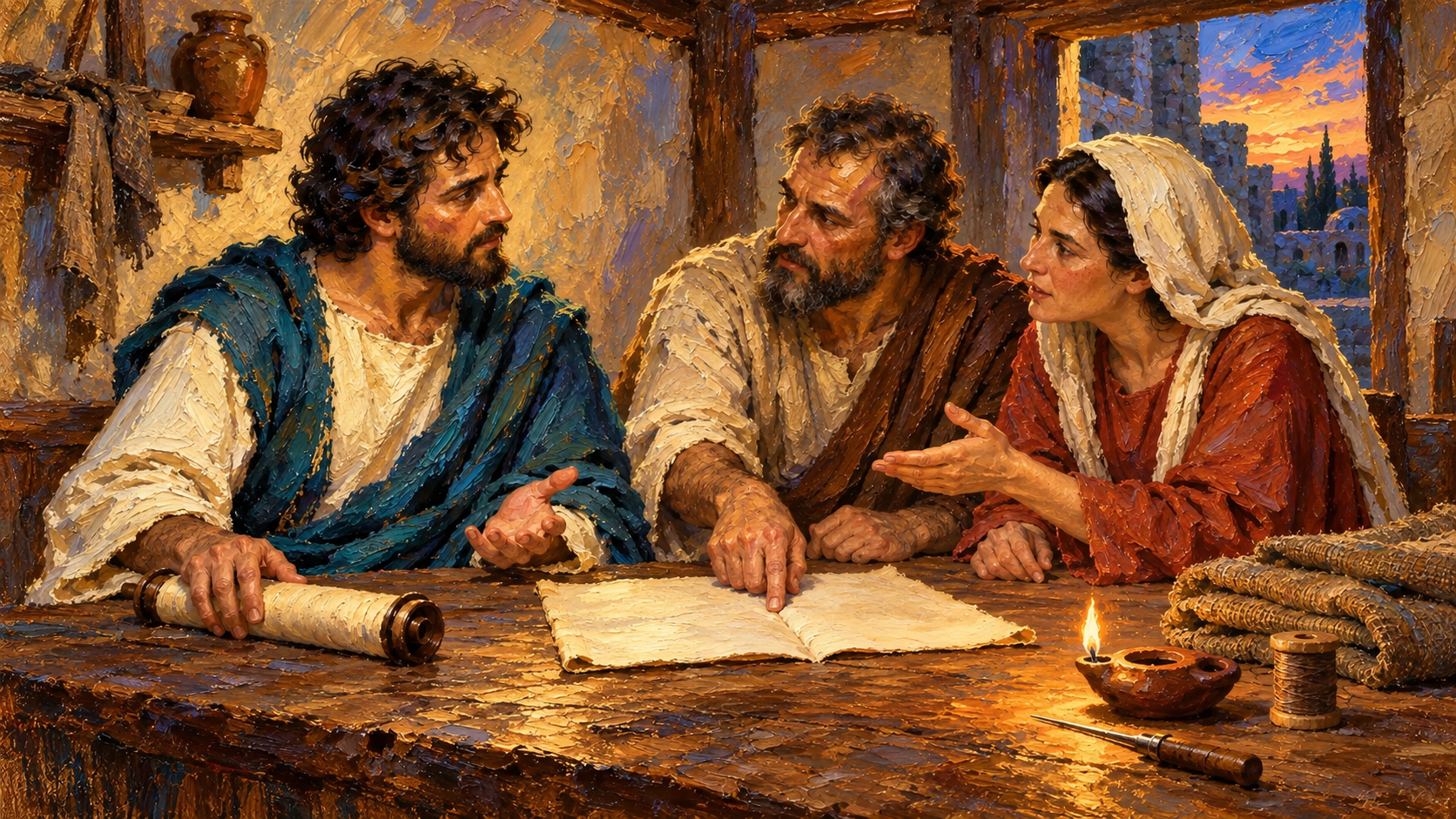
Apollos was an eloquent Bible teacher who still needed help understanding the message he preached. Aquila and Priscilla gave him that help privately, and he went on to strengthen believers in another city. I need to remember his willingness to learn when I am tempted to treat correction as an insult.
Apollos Arrives in Ephesus
Paul had already spent a year and a half teaching in Corinth, in the Roman province of Achaia, before he sailed east with Aquila and Priscilla. They stopped at Ephesus, where Paul left the couple while he continued toward Jerusalem and Antioch. Apollos arrived in Ephesus before Paul’s return, and Aquila and Priscilla were there to hear him and help him.
Ephesus was an important port in the Roman province of Asia and would become a center of Paul’s ministry. But the work there did not depend on Paul being present for every conversation. The Book of Acts introduces Apollos as another teacher through whom the gospel would spread, although he was not one of the apostles.
Now a certain Jew named Apollos, born at Alexandria, an eloquent man and mighty in the Scriptures, came to Ephesus.
Alexandria, on Egypt’s Mediterranean coast, had a large Jewish population and a reputation for learning. Apollos came from that setting, but Luke does not tell us where he studied or which manuscripts he used. His birthplace does not settle later disputes about Alexandrian manuscripts or give us a reason to abandon the received-text foundation.
The Greek word logios, translated “eloquent,” can describe a learned man or someone skilled in speech. Luke also calls Apollos mighty in the Scriptures, using dunatos for someone strong or capable. He could do more than speak persuasively; he knew the Bible well enough to explain and defend its teaching.
This man had been instructed in the way of the Lord; and being fervent in spirit, he spoke and taught accurately the things of the Lord, though he knew only the baptism of John.
Luke describes both the accuracy of his teaching and the limit of his knowledge. The phrase “fervent in spirit” conveys his earnestness, though interpreters differ over whether the phrase refers to his own spirit or emphasizes the Holy Spirit’s activity. An English capital letter cannot decide that question for us. Either way, Luke is describing a man who taught with conviction and took Scripture seriously.
I am thankful for a teacher who can explain the Bible clearly and hold people’s attention. Eloquence is useful when it helps listeners understand the truth, but it cannot make an inaccurate explanation true. Knowing the Bible well gives me no permission to belittle someone who is still learning. Apollos’s knowledge and zeal were strengths that fuller instruction could put to better use.
John’s Baptism and the Truth Apollos Still Needed
Apollos knew only the baptism of John, whose ministry had prepared Israel for the Messiah. John had not taught a false message. He had called people to repent and receive the One who was coming after him.
John came baptizing in the wilderness and preaching a baptism of repentance for the remission of sins.
People confessed their sins and were baptized in response to that call. The water did not purchase forgiveness or produce the new birth. John directed them beyond himself, and when Jesus appeared he identified Him as the Lamb of God who takes away the sin of the world. Following John’s teaching meant being ready to receive the Messiah he announced.
After Jesus had died for sins and risen bodily, the apostles could proclaim His completed work. They could announce what the Messiah had accomplished, rather than simply prepare people for His coming. Apollos needed to understand John’s ministry in light of that fulfillment. Luke does not list which facts he had already heard about Jesus and which Aquila and Priscilla explained to him.
Christian water baptism follows salvation and publicly identifies the believer with Christ’s death, burial, and resurrection. It does not place someone into Christ or complete a salvation that faith left unfinished; the believer is already saved when he comes to be baptized.
Acts 19 describes a separate group in Ephesus after Apollos had gone on to Corinth. When Paul returned, he met about twelve disciples who had not heard that the Holy Spirit had been given. He explained that John had told people to believe in the coming Christ, Jesus. They were then baptized in the Lord Jesus’ name, and the Spirit came upon them when Paul laid his hands on them.
Their experience helps explain how John’s message could still be circulating without the full apostolic teaching, but it does not tell us everything Apollos lacked. Luke does not say whether he was already a believer with incomplete understanding or whether the couple’s instruction brought him to saving faith. He does commend the accuracy of what Apollos taught. I think it would be unfair to call him a deliberate deceiver or dismiss his whole ministry when Luke describes him this way.
Correction That Made a Strong Teacher Stronger
In Apollos’s case, the fuller instruction came from Aquila and Priscilla before Paul returned to Ephesus. They heard him speaking boldly in the synagogue, a Jewish gathering place where Scripture was read and prayer offered. They had worked alongside Paul in Corinth as fellow tentmakers. Earning their living through a trade had not prevented them from learning doctrine carefully enough to help this gifted speaker.
So he began to speak boldly in the synagogue. When Aquila and Priscilla heard him, they took him aside and explained to him the way of God more accurately.
Luke had already said that Apollos taught accurately; now the couple explained God’s way “more accurately.” The Greek akribesteron means with greater accuracy or precision. They were supplying what he lacked and helping him understand the truth more fully. They did not need to dismiss everything he knew in order to correct a genuine deficiency.
Aquila and Priscilla took him aside rather than turning the synagogue discussion into a public humiliation. Luke does not give us Apollos’s reply, but his continued ministry and the believers’ subsequent support give us good reason to conclude that he received their instruction.
Priscilla’s contribution deserves to be recognized alongside her husband’s. She helped explain God’s way to a man who was already an accomplished teacher. Her participation in that private conversation does not overturn Scripture’s requirement that local church offices and authoritative teaching leadership be held by biblically qualified men. Honoring her service does not require us to disregard those qualifications.
If I have explained a passage poorly, I ought to be willing to say so and correct it. Years of study or a reputation for sound teaching do not make that particular explanation right. I can be grateful for whatever ability God has given me and still admit that another believer has shown me something I missed. Refusing to listen because I do not want to lose face would place my reputation above the truth I claim to teach.
I also need to consider how I approach a teacher who needs correction. Aquila and Priscilla addressed the deficiency without treating Apollos as an enemy. Private instruction was appropriate here, but a teacher who persists in spreading harmful error may require a public answer. We should respond to the actual problem and the people being affected. Neither humiliating someone to display our own knowledge nor remaining silent while others are misled serves the truth.
Helping Believers Through Grace
After this instruction, Apollos wanted to cross the Aegean Sea to Achaia, the province that included Corinth. The believers in Ephesus wrote to the disciples there, urging them to receive him. He went with their commendation, giving the receiving church a reason to welcome him beyond his reputation as an impressive speaker.
And when he desired to cross to Achaia, the brethren wrote, exhorting the disciples to receive him; and when he arrived, he greatly helped those who had believed through grace; for he vigorously refuted the Jews publicly, showing from the Scriptures that Jesus is the Christ.
The people he helped had already believed through grace. Salvation was God’s undeserved gift, received by faith in Christ. Apollos could strengthen their understanding and equip them to answer objections, but he had not created the new life in them. His contribution was valuable without making him the source of their salvation.
He publicly answered Jewish opponents by showing from the Scriptures that Jesus is the Christ. The same man who had needed private instruction could now defend the gospel publicly. His eloquence served an argument drawn from God’s Word, which gave his listeners more to consider than how convincingly he could speak.
That is what apologetics, or defending the faith, should accomplish. If I win an argument but leave people occupied with my cleverness rather than with what Scripture says about Jesus, I have failed to use my ability well. I want people to be persuaded of the truth and helped by it, rather than recruited to admire me.
Servants, Factions, and the God Who Gives Growth
Apollos’s name appears again in Paul’s letters to the Corinthians, where the congregation had turned its teachers into reasons for quarreling. Paul had first preached the gospel there, and Apollos had followed him to strengthen the believers. By the time Paul wrote 1 Corinthians, reports from Chloe’s household revealed that people were claiming allegiance to different teachers.
Now I say this, that each of you says, “I am of Paul,” or “I am of Apollos,” or “I am of Cephas,” or “I am of Christ.” Is Christ divided? Was Paul crucified for you? Or were you baptized in the name of Paul?
Paul brought them back to the Savior who had been crucified for them. Neither he nor Apollos had died for their sins, and baptism had not made them Paul’s property. They belonged to Christ. Using His servants’ names to divide His people contradicted the message those servants taught.
Even “I am of Christ” can express pride when we mean that our group alone belongs to Him and everyone else is beneath us. Paul was correcting that divisive spirit, not telling believers to stop confessing loyalty to Jesus. We can appreciate faithful ministers without making their names a means of claiming superiority.
Paul then explained his work and Apollos’s work through the ordinary labor of tending a crop.
I planted, Apollos watered, but God gave the increase. So then neither he who plants is anything, nor he who waters, but God who gives the increase.
Paul had done the early gospel work in Corinth; Apollos had come afterward to strengthen the believers. Later in the chapter Paul changes the illustration to building and identifies Jesus Christ as the only foundation. In both descriptions, the workers have real responsibilities without becoming the source of spiritual life. God gives the growth they cannot produce by their own ability.
There was no reason to make Apollos Paul’s rival. They were serving the same Lord in the same field, and Paul rebuked the congregation’s partisanship without accusing Apollos of competing with him. If the work bears visible fruit, I have no grounds for taking credit for what God has done. When growth is slow, I should not assume that patient teaching and care have been wasted simply because I cannot yet see what they will accomplish.
Paul also used himself and Apollos as examples of how Scripture should govern the Corinthians’ judgments.
Now these things, brethren, I have figuratively transferred to myself and Apollos for your sakes, that you may learn in us not to think beyond what is written, that none of you may be puffed up on behalf of one against the other.
“What is written” limits the claims we are entitled to make about teachers as well as the doctrine we teach. The Corinthians could not justify their pride by inventing standards that made one servant superior to another. In the next verse, Paul asks what they have that they did not receive. Their gifts and privileges were received from God, leaving them no reason to boast as though they had supplied those things themselves.
I can prefer one teacher’s way of explaining a passage without treating believers who benefit from another faithful teacher as an inferior group. The same danger arises when loyalty to a denomination or movement becomes more important than whether its claims agree with Scripture. A favorite author, podcast, or conference can begin to command an allegiance that belongs to Christ.
Keeping our judgments within Scripture does not mean ignoring a teacher’s doctrine or conduct. I need to distinguish a biblical requirement from my own preference before I use it to judge another servant or defend the one I favor.
Brother Apollos and His Later Ministry
Paul’s later request for Apollos to revisit Corinth confirms that he still welcomed his ministry there.
Now concerning our brother Apollos, I strongly urged him to come to you with the brethren, but he was quite unwilling to come at this time; however, he will come when he has a convenient time.
Paul strongly urged him to go, but Apollos was unwilling to travel at that time. Other obligations may have affected his decision; some readers suggest that he wanted to avoid encouraging Corinth’s factions. The letter does not tell us his reason. Paul reports that he would come when he had a convenient time and still calls him “our brother Apollos.”
A strong request from Paul was not treated here as a divine command to travel immediately. Apollos could wait without being denounced as disloyal, and Paul could urge the visit without claiming ownership of another servant’s schedule. We should be able to discuss such decisions frankly without treating every difference as rebellion against God.
Paul also mentions him in his letter to Titus, whom he had left in Crete to bring order to the churches. Apollos was still a trusted fellow worker, and Paul wanted practical provision made for his journey with Zenas.
Send Zenas the lawyer and Apollos on their journey with haste, that they may lack nothing.
Travel required supplies and hospitality, which other believers could provide even if they never taught publicly. Apollos had benefited from a couple’s instruction and a church’s recommendation; now Titus was to make sure these travelers lacked nothing. I do not want to overlook the people who made that ministry possible simply because their work was less conspicuous than his preaching.
Some interpreters have proposed Apollos as the author of Hebrews because he was learned and eloquent. Those abilities do not identify him as the author of a particular book. I remain convinced that Paul wrote Hebrews, while recognizing that objections to Pauline authorship deserve an honest answer. We should not assign the book to Apollos merely because his known gifts make him an attractive candidate.
The ministry Scripture does attribute to Apollos was valuable because it directed people to Christ. Neither he nor those who supported him could provide the salvation they preached.
Jesus Christ is the eternal Son, fully God and fully man, who lived without sin. Wicked men tortured Him and put Him to death, but He willingly bore the punishment for our sins in His innocent body and shed His blood. He completed that saving work through His death, was buried, and rose bodily from the grave. The Father did not punish, curse, abandon, strike, bruise, or pour wrath on Jesus.
Christ died for the whole world, and God’s offer of salvation is genuine for every person. His grace can be resisted and finally rejected, but He calls everyone to repent and trust in Jesus Christ. The believer is forgiven and regenerated, meaning genuinely born again as a new creation. The Holy Spirit indwells him and seals him for the promised inheritance, and he is eternally secure because Christ saves completely. That assurance gives no permission for lawlessness. A shallow profession does not establish that someone has received new life; we should see its evidence in his conduct. The teacher can explain this salvation, but only God can give it.
My Final Thoughts
Apollos’s knowledge did not make him unwilling to learn, and correction did not put an end to his service. I need to be just as willing to let another believer show me from Scripture where my explanation falls short. Whatever ability God has given me, protecting my reputation cannot take precedence over teaching His Word accurately. I want to help people trust Christ and understand His Word, while remaining receptive to the instruction I still need.