
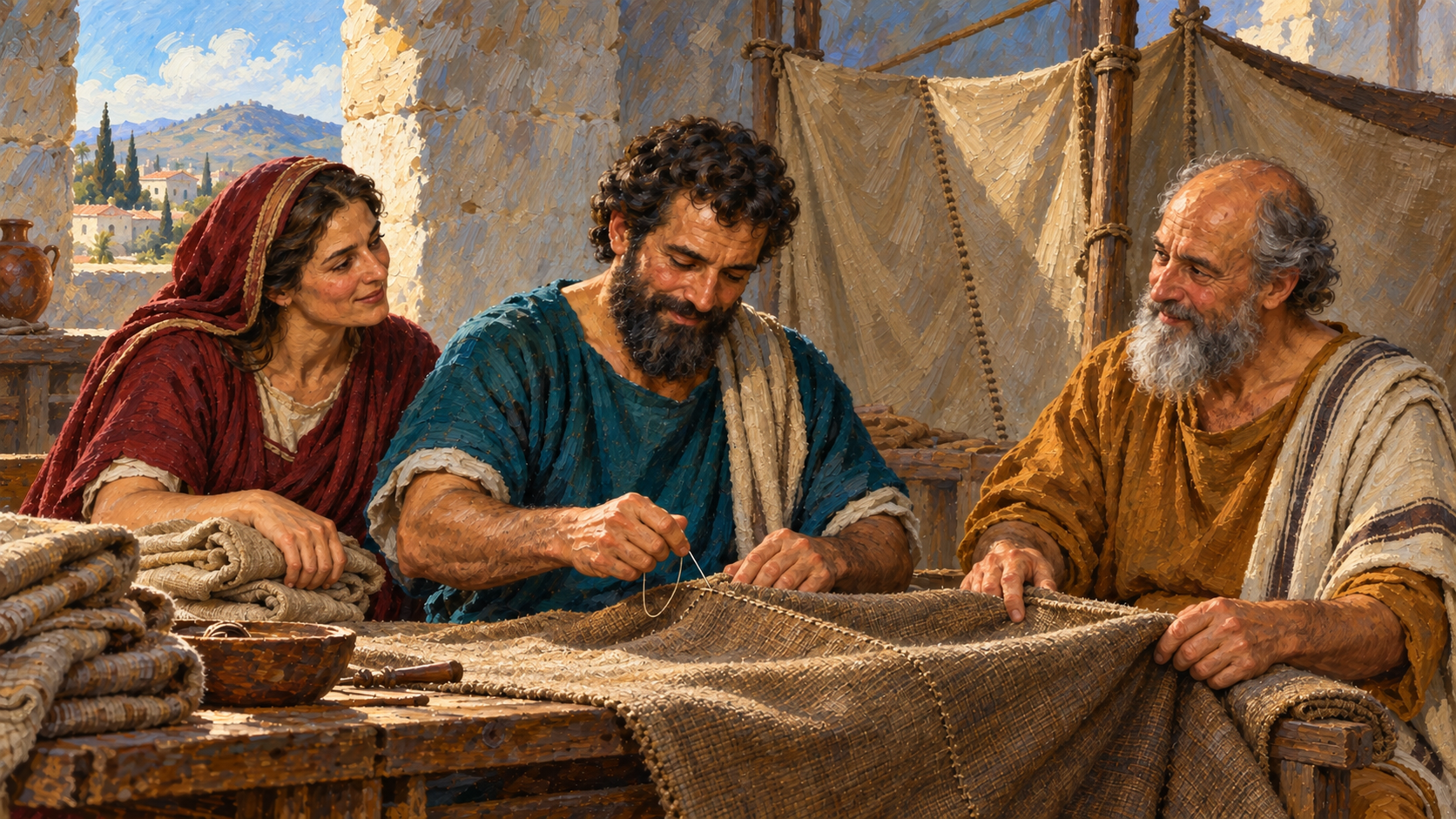
Aquila appears in only a few brief passages beside his wife Priscilla, without a long speech or a chapter devoted to him. Yet his ordinary work and open home helped strengthen the early church. I want to look at how this tentmaker served Christ, because much of what he did was out of public view and still made a difference to other believers.
From Rome to Corinth and Work With Paul
The New Testament records no sermon or inspired letter from Aquila. He did not lead an army or become the subject of a long account. Instead, we find his name in a handful of passages, usually beside Priscilla, who is also called Prisca. Those notices show him strengthening Paul and helping equip Apollos. He also opened his home to a congregation and continued serving through years of movement and danger.
It is easy to notice a public speaker or author. Musicians and leaders also receive attention, but Scripture remembers believers whose service took place through ordinary work and hospitality. Some offered time and shelter or taught someone patiently, and they kept serving when it became costly. Aquila makes me reconsider how I measure usefulness in God’s kingdom. A Christian who belongs to Christ and serves with what God has given him is not insignificant simply because few people notice.
We know Aquila was a Jew from Pontus and was married to Priscilla. At different times he lived in Rome, Corinth, and Ephesus, and perhaps later returned to Rome. He worked in the same trade as Paul, hosted churches in his household, and risked his life for Paul alongside Priscilla. I am grateful for what those facts let us see, but I don’t want to turn them into a biography Scripture never gives us. We need to leave the gaps unfilled.
Acts 18 introduces Aquila after Paul leaves Athens and arrives in Corinth:
a certain Jew named Aquila, born in Pontus, who had recently come from Italy with his wife Priscilla (because Claudius had commanded all the Jews to depart from Rome)
Pontus lay along the southern coast of the Black Sea, so Aquila had already moved across the Roman world before meeting Paul. The Roman writer Suetonius also mentions the emperor Claudius’s expulsion of Jews from Rome. His brief note connects disturbances with someone he calls “Chrestus.” Many historians see a possible link between that name and early disputes about Christ within Rome’s Jewish community.
That connection is plausible, but the historical record does not establish the exact circumstances behind Aquila and Priscilla’s departure or what they experienced in Rome. Scripture also leaves their conversion unexplained. We are not told when they came to faith or whether Aquila believed before he met Paul, so I would not fill those gaps with details God has not supplied.
Being forced from Rome could have led Aquila and Priscilla into bitterness or isolation. It may also have brought fear and painful disruption, but their upheaval did not end their usefulness. Their path brought them to Corinth, where the Lord joined them to Paul. We are not told how they felt about the upheaval. What we can see is God’s providence at work as they served in their new setting. I may not choose a move or a loss, and an unexpected change at work may upset my plans. Aquila’s life gives me reason to trust that God can work through such changes and make my faith a source of strength and shelter for others.
Trusting God’s providence does not require us to call every hardship good in itself. Exile is painful, yet God can work through the disruptions of a fallen world and even through what people intend for harm. Before Paul reached Corinth, the Lord who guided him there already knew the couple who would receive him.
Luke explains why Paul stayed with Aquila and Priscilla:
So, because he was of the same trade, he stayed with them and worked; for by occupation they were tentmakers
The Greek word behind “tentmakers” can refer broadly to tentmaking, leatherworking, or related work. The traditional translation fits, but the range of the word should not distract us from Luke’s clear point: Paul shared their trade and worked beside them.
Paul was set apart as an apostle to preach the gospel, but he did not despise ordinary work. In Corinth he worked during the week and reasoned in the synagogue each Sabbath (Acts 18:4). His letters defend the right of gospel workers to receive support. They also explain why he chose to labor with his own hands in some settings: he did not want to put an obstacle in the way of the gospel (1 Corinthians 9; 1 Thessalonians 2:9). Aquila’s workshop gave him a place to do that work as part of his ministry.
Aquila did not have to abandon his trade to serve Jesus. His work made room for a missionary and built fellowship, and it probably gave them daily opportunities to talk about the gospel. That helps me see the dignity of a job done in faith. Earning an income and developing useful skills have value, and the relationships formed at work can provide opportunities for honest witness. Work does not need to resemble ministry on a stage before it can serve Christ.
Our work belongs to Christ, though that does not make every business decision spiritual or require a sermon at every lunch break. If I belong to Him, people should be able to expect honesty from me. They should be able to trust my promises and know I will treat coworkers with dignity. I should refuse dishonest gain and be generous with what God provides. Such faithfulness can belong in a workshop or classroom as readily as in an office. The same is true of work in a kitchen, hospital, shop, or home when we do it before the Lord.
Aquila and Priscilla Served Together
Aquila is consistently named with Priscilla, and their marriage was closely involved in the life of the church. They worked and welcomed others together. They also shared travel and teaching, and faced danger as a couple. After leaving Corinth with Paul, they went as far as Ephesus and remained there when he departed for other ministry (Acts 18:18-19).
Sometimes Priscilla is named first in the New Testament, and sometimes Aquila is. Scripture does not explain each change in order, so I would not use it as a code to decide who held authority in every setting. We can say clearly that Priscilla was an honored co-laborer, not an invisible assistant. Paul calls both of them his “fellow workers in Christ Jesus” (Romans 16:3).
The Bible reserves the authoritative teaching leadership and offices of a gathered local church for biblically qualified men. Aquila and Priscilla’s example does not cancel that teaching. A husband and wife can serve together through hospitality and private discipleship while praying for believers and caring for them. Their work and generosity also belong in that shared service. The church needs faithful men and women who use their gifts under Scripture rather than compete for recognition.
The heart of this partnership was shared devotion to Christ. Married believers can learn from it without assuming that every couple must share a job or ministry assignment, or have the same personalities and opportunities. A husband should love sacrificially, and a wife should honor the Lord. Together they can consider how to use their home and resources for the saints, along with the time and relationships God has given them. Aquila and Priscilla’s example need not become a burden laid on unmarried believers or spouses in difficult circumstances.
Teaching Apollos and Opening Their Home
In Ephesus, Aquila and Priscilla met Apollos, an eloquent man from Alexandria who was mighty in the Scriptures. He had been instructed in the way of the Lord and taught the things of the Lord accurately and with a fervent spirit. Yet he knew only the baptism of John (Acts 18:24-25). I want to hold those descriptions together. His knowledge was real, but he still needed fuller instruction about Christ’s completed work and the new-covenant message the apostles proclaimed.
When Aquila and Priscilla heard Apollos speaking boldly in the synagogue, they responded with wisdom:
they took him aside and explained to him the way of God more accurately
They spoke to Apollos privately and gave him clear, personal instruction. His earnestness did not keep them from addressing a serious gap in his message, but neither did that gap become an occasion to humiliate him before the crowd. They cared about more than his eloquence.
People need the true gospel, so sound doctrine cannot be reduced to a matter of preference. But if I am correcting someone, I also need to consider how I am speaking to him. A gifted and sincerely devoted person can still need instruction. Mature believers listen carefully and explain Scripture patiently because they want that person to serve Christ more faithfully. Another person’s incomplete knowledge is no opportunity to display our superiority.
Apollos received their instruction and went on to be a powerful help to believers in Achaia. He publicly refuted opponents from the Scriptures and showed that Jesus is the Christ (Acts 18:27-28). Aquila and Priscilla had taught him privately, yet the benefit reached people who heard him publicly. That encourages me to take an ordinary conversation about Scripture seriously. A Bible opened with a younger believer, perhaps across a table, can strengthen someone God later uses in ways we never see.
Paul’s greetings also show that Aquila and Priscilla repeatedly opened their home for God’s people:
Likewise greet the church that is in their house
1 Corinthians 16:19 includes a similar greeting from Aquila and Priscilla in Asia, “with the church that is in their house.” They had made their home a gathering place for believers as well as a private refuge.
Early Christians often met in homes because they lacked the buildings and institutional resources many later churches enjoyed. They also lacked the same legal security. A home offered a place to pray and teach, where believers could share fellowship and the Lord’s Supper. They could give and care for one another there as well. Hosting them required work and expense, and could involve real risk. Aquila and Priscilla accepted those demands instead of treating their space as an untouchable possession.
Romans 12:13 tells believers to be given to hospitality, and 1 Peter 4:9 says to practice it without grumbling. An impressive meal is not the measure of that service. Sometimes hospitality means offering someone a place to sit and talk honestly. It may be practical help for a family or a welcome for someone who is lonely. Regular fellowship can also keep believers connected to the body. These ordinary acts are holy work.
Aquila’s example makes me consider whether my possessions are only private comforts or things I am willing to place before the Lord. That does not depend on having a living room large enough for a congregation. Hospitality begins with what God has provided, even if we invite just one person or share a simple meal. Others may be able to offer transportation or keep in touch by phone. A temporary place to sleep can also be a gift to someone. We should not measure a Christian’s hospitality by the size of his home.
Courage and Faithfulness Across the Years
In Romans 16, Paul describes Aquila and Priscilla as fellow workers who faced real danger for him:
risked their own necks for my life, to whom not only I give thanks, but also all the churches of the Gentiles
Paul does not identify the event, so I cannot confidently connect their risk with a particular riot or arrest, or with some journey they made. Those suggestions remain guesses. What Scripture does let us say with confidence is that Aquila and Priscilla risked their lives for Paul and the work of the gospel.
Christian courage is obedience to God when love becomes costly. Aquila and Priscilla’s example calls us to that faithfulness, not to seek danger for its own sake. Sheltering a persecuted believer or protecting someone vulnerable may require courage. So may refusing dishonest profit or speaking truth when a lie is popular. Standing beside an abandoned brother or sister can be costly too, even if few people notice. Much Christian courage is quiet faithfulness under pressure.
Paul’s ministry involved public preaching and letters, along with travel and suffering. But apostles did not carry the gospel work alone. Other believers received him and worked beside him, offering prayer and financial help. Some traveled with him or stood with him when danger came. The Gentile churches had reason to thank Aquila and Priscilla because their faithfulness sustained work that reached far beyond their household.
Aquila and Priscilla appear in Corinth in Acts 18 and in Ephesus later in that chapter. They are included in a greeting sent from Asia to Corinth, then in Paul’s letter to Rome, and once more near the end of 2 Timothy:
Greet Prisca and Aquila
We cannot reconstruct every date or location from these passages. They do suggest a long pattern of movement and service in which Aquila and Priscilla’s names remained connected with the work of Christ.
A new ministry or Bible study can bring fresh energy, as can a move to another city or a new friendship. Faithfulness becomes more demanding when the work is familiar and that initial excitement has passed. Will I still serve when hospitality costs money or someone disappoints me? Correction can feel awkward, and faithful work can receive little notice. Yet Aquila’s brief record gives no impression of a man chasing novelty. We see him continuing ordinary acts of love where the church needed him. That kind of endurance is one of the quiet signs of spiritual maturity.
Hebrews 6:10 says that God is not unjust to forget the work and labor of love believers have shown toward His name while ministering to the saints. People may forget to thank a quiet servant as often as he deserves, but the Lord sees every act done in faith. I can appreciate recognition without making it the reason I serve. Knowing that God remembers frees me from needing someone else’s notice to make the work worthwhile.
Service Without a Platform
God uses preaching and public teaching, and churches should honor qualified men who carry those responsibilities faithfully. Still, Aquila’s life gives me no reason to equate Christian service with celebrity. Churches also depend on people who pray and support gospel work through honest labor and generous giving. Some welcome strangers or help younger believers grow. Others care for children or visit the sick. All can strengthen Christ’s body as they speak the truth in love.
Some Christians feel disqualified because their lives seem ordinary. Yet look at what God did through Aquila’s trade and household. His work helped support the gospel, his marriage became a place of discipleship, and his home sheltered a church. A private conversation helped equip Apollos, while a courageous choice may have saved Paul’s life. God often does extraordinary good through that sort of ordinary faithfulness. None of it required public attention to be real ministry.
I also need to distinguish serving Christ from staying busy around Christian activity while neglecting Christ Himself. Aquila’s worth did not come from how useful he was, but from being a fellow worker in Christ Jesus. His service flowed from the gospel. The number of people we host and the hours we volunteer cannot save us. We are saved by grace through faith in the Savior who gave Himself for us.
Aquila encourages us by his example, but even a worker as faithful as he was needed God’s grace. He could not be our Savior. Jesus Christ, the eternal Son of God, became fully man without ceasing to be God and obeyed the Father completely. He welcomed the weak and taught truth, serving without seeking His own glory. Then He gave His life for sinners.
At the cross, Jesus bore the punishment for our sins in His innocent body. He suffered physical torture and shed His blood. After He died and was buried, He rose bodily from the grave on the third day. Our salvation rests in His blood, so it cannot depend on how useful we make ourselves. Through faith in Him, a person receives forgiveness and new life and is given the Holy Spirit.
Because Christ has secured my standing before God, I can serve without turning work into an idol. I can welcome people without demanding praise and correct someone without using his need to feed my pride. His grace also enables me to endure hardship without despair. We are not trying to become celebrities for Jesus. We belong to Him and can serve faithfully wherever He sends us.
Several related studies develop these themes further. The Life of the Apostle Paul traces Paul’s calling, travels, letters, and enduring service to Christ, while Epaphroditus considers another faithful servant whose costly care strengthened the early church. The Body of Christ explains the church’s shared service, and Priscilla examines the faithful woman who served beside Aquila in the work of the gospel.
My Final Thoughts
What stays with me about Aquila is how much good God did through a man Scripture describes so briefly. He offered Christ his ordinary work, and he and Priscilla used their home and shared life to serve other believers. His doctrinal care and willingness to endure, even at personal risk, helped strengthen the church. We do not need a public platform to serve the Lord, and our usefulness never earns His grace. Having received the gospel, we can offer Him the work and relationships already in our hands, trusting that He sees every labor of love done in His name.