
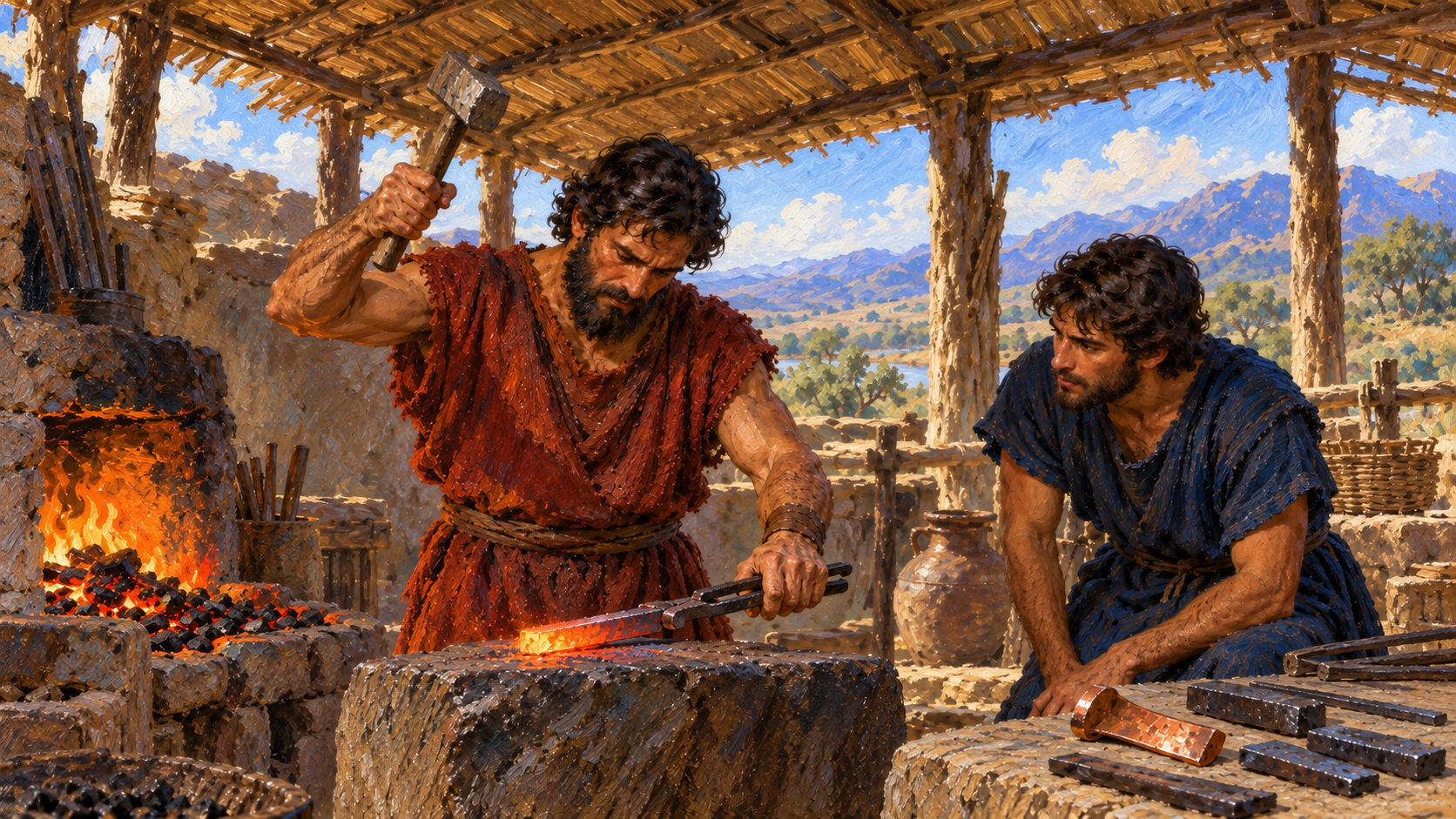
Tubal-Cain gets only one verse in Genesis, but his place in the account tells us about the world before the Flood. I see the remarkable ability God gave early humanity in his work with metal. The family around him also shows the danger of using those abilities while living far from God.
Tubal-Cain in the Line of Cain
Tubal-Cain appears among Cain’s descendants after Cain murdered Abel and went out from the presence of the Lord. Before looking at the metalwork, I want to understand that family setting. Genesis describes a culture developing within a line already marked by exile and rebellion. Human pride belonged to that setting too, so this is more than an isolated detail about an early craft.
Then Cain went out from the presence of the LORD and dwelt in the land of Nod on the east of Eden. And Cain knew his wife, and she conceived and bore Enoch. And he built a city, and called the name of the city after the name of his son, Enoch.
Cain built a city and named it after his son Enoch. Several generations later, Lamech became the first recorded polygamist and boasted about killing a man. Within that account, Genesis also names men known for life in tents with livestock, as well as men who made music and worked with metal. I need to consider those abilities alongside Cain’s city and Lamech’s violent song, because Genesis shows human achievement and human sin developing together.
Being made in God’s image gives human beings real creative ability, but that ability does not prove spiritual health. A city can grow while its builders remain alienated from God, and music can develop even as violence increases. We may find ways to make better tools without becoming holy. That is why I cannot read this passage simply as a celebration of technology.
The genealogy does not tell us everything about Tubal-Cain’s workshop or tools, nor does it give a full account of his family or tell us how far his own influence reached. Yet it gives us enough to understand the point of this chapter. Cain’s line was productive even while pride and violence spread within it. Sin affected how these people used their lives, but it did not take away the dignity and abilities God had given them as His image-bearers.
If I read the genealogy only as a list of names, I miss what it shows about the society growing around them. Cain left the Lord’s presence, but his descendants could still organize their lives and pass knowledge on. Their achievements showed the abilities God had given humanity. Their rebellion also showed what people could do with those abilities when they refused the God whose image they bore.
Jabal, Jubal, and the Abilities of Early Humanity
Genesis names Jabal in connection with tents and livestock, then his brother Jubal in connection with musical instruments. Their half-brother Tubal-Cain worked with bronze and iron. These brief descriptions let us see early people building and organizing their society. They knew how to make music and shape materials as well.
And Adah bore Jabal. He was the father of those who dwell in tents and have livestock. His brother’s name was Jubal. He was the father of all those who play the harp and flute.
And as for Zillah, she also bore Tubal-Cain, an instructor of every craftsman in bronze and iron. And the sister of Tubal-Cain was Naamah.
Jabal’s tents and livestock show an organized way of life centered on herding. Jubal’s harp and flute show artistic development, while Tubal-Cain’s metalwork required technical knowledge. All of this belongs before the Flood, among the earliest generations Scripture records after Cain.
Calling Jabal and Jubal the “father” of these practices identifies them as leading figures in ways of life that others could learn and continue. Consider what those skills required. A herder had to understand his animals to provide for them, and a musician needed an instrument designed to produce ordered sound. Working metal required knowing where useful material could be found and how it would respond to being worked. Genesis presents people learning and using their abilities, not developments that happened without thought.
People capable of that work fit the Bible’s account of creation. Human beings did not begin as mindless or subhuman creatures. He made responsible people in His image who could speak, and He gave them dominion in His world.
Then God said, “Let Us make man in Our image, according to Our likeness; let them have dominion…”
So God created man in His own image; in the image of God He created him; male and female He created them.
Dominion includes taking responsibility for the world God gave us to work in. He filled it with useful materials and made people able to discover and shape them. The fall corrupted humanity without erasing intelligence or creativity. Cain’s descendants could still care for animals and make music, and they could learn how to work the metals they found.
Genesis places music and metalwork beside each other. Jubal’s instruments brought beauty and order to sound, while Tubal-Cain applied knowledge to the physical world. I see in both the capacity God gave His image-bearers to make something beautiful or useful. But I cannot tell from the gift alone whether its possessor is walking with God.
Practical work and artistic work both belong in this account. Tents and livestock served everyday needs, and metal tools could help with many kinds of labor. Music may not feed a body, but it reveals the human capacity to recognize rhythm and tone and appreciate beauty. God made them able to do more than survive, and those capacities remained after the fall.
What Genesis Says About Tubal-Cain’s Metalwork
Tubal-Cain is often called the first blacksmith, but I would call him the earliest metalworker named in Scripture. Genesis never says that no one before him had shaped metal. It identifies him as a leading early figure associated with craftsmen who worked in bronze and iron. That gives us a definite place for him without claiming more than the passage tells us.
Genesis 4:22 calls Tubal-Cain “an instructor of every craftsman in bronze and iron.” That is the NKJV’s rendering of the compact Hebrew phrase lotesh kol choresh nechosheth uvarzel. The wording can describe sharpening or hammering, forging or otherwise working in connection with craftsmen and metals. Knowing that range helps me understand why translations express the relationship differently. Their wording varies, but Tubal-Cain’s association with metalworking skill remains clear: he was known as a source of that knowledge.
The term translated “bronze” can refer to copper or a copper alloy, which explains another difference between English translations. Whether a translation uses copper or bronze, Genesis pairs the material with iron and identifies Tubal-Cain with shaping metal. I can follow that clear statement without making the teaching depend on an exact alloy the passage does not specify.
His Hebrew name is written תּוּבַל קַיִן (Tubal Qayin). Scripture does not explain its meaning, so we should not build doctrine from a proposed definition. The inspired text puts its emphasis on his family setting and his craft, not on a hidden message in his name.
Genesis gives us enough to reject the idea that early people were barely human or incapable of complex work. It does not describe the size of Tubal-Cain’s workshop or the tools and methods he used. We are not told how widely his knowledge spread, either. I would also stop short of claiming that the pre-Flood world had every technology developed later. Respecting Scripture means keeping those limits as well as accepting what it tells us.
That helps me distinguish the biblical account from labels such as Stone Age, Bronze Age, and Iron Age. Archaeologists use those terms for patterns in surviving artifacts from particular regions and periods. Those classifications are neither Scripture nor a universal history of human intelligence. The pattern of what has survived cannot overturn God’s revealed account of the earliest generations.
Recovered artifacts can tell researchers something about a place without giving them the whole history of mankind. Some materials decay and some sites remain undiscovered. Different peoples may also use different tools during the same broad period. I would not give an archaeological label the authority to redefine what a human being is. Genesis tells us that by telling us who made us.
I believe the strongest challenge to evolutionary timelines comes from what Genesis actually records. Humanity began with Adam and Eve, whom God made directly in His image. Genesis describes people who could speak and work, marry and worship. It also records murder, for which people were morally responsible. The account also describes city building and animal husbandry, along with music and metal craft. Genesis 4 places workmanship in bronze or copper and iron before the Flood. When Genesis 6 describes the corruption of that world, the failure is moral, not evidence that its people were intellectually subhuman.
Unsupported claims cannot strengthen that biblical case. Genesis gives us neither modern archaeological dates nor a complete inventory of pre-Flood inventions. What it does reveal is enough to challenge an account of humanity that explains our minds and creative power apart from the Creator. Our moral responsibility belongs in that challenge too.
If I imagine an advanced pre-Flood world beyond the evidence, my defense of Scripture starts to depend on that imagination. Genesis already gives us a restrained account of people who could think and create. They worshiped and made moral choices for which they answered to God as fully human beings. Staying with what God has said gives us a stronger argument than speculation can supply.
Other passages remind us that the raw materials themselves belong to God’s creation:
Iron is taken from the earth, And copper is smelted from ore.
“A land in which you will eat bread without scarcity, in which you will lack nothing; a land whose stones are iron and out of whose hills you can dig copper.”
Before anyone mines iron or copper, the ore is already in God’s earth. People do not create it out of nothing. A craftsman may heat and shape what he finds, but both the material and the skill he brings to it depend on the Creator. That remains true whether the craftsman acknowledges Him or not.
Skill Could Not Save the World Before the Flood
Tubal-Cain’s work belongs before the Flood, within the account that develops from Genesis 4 to Genesis 6. This was a world with families and cities, where people raised livestock and made instruments. They could work metal, yet they also committed violence. By Genesis 6, God’s judgment addresses their moral corruption. The problem was not an absence of culture.
Then the LORD saw that the wickedness of man was great in the earth, and that every intent of the thoughts of his heart was only evil continually.
So God looked upon the earth, and indeed it was corrupt; for all flesh had corrupted their way on the earth.
I need to remember both the abilities and the corruption described in these chapters. Pre-Flood people were not unintelligent creatures without a developed culture, but their achievements give us no reason to romanticize their world. Men and women can make remarkable things while becoming increasingly corrupt in thought and conduct.
The Flood came because “all flesh had corrupted their way.” Humanity’s failure was not a lack of inventions. Better tools could not make people better worshipers, and more knowledge could not remove their guilt. Their sin called for God’s judgment and mercy. Another stage of cultural development could not answer it.
Lamech makes the warning painfully clear. The genealogy that remembers Jabal, Jubal, and Tubal-Cain also records his polygamy and his celebration of revenge.
Then Lamech said to his wives: “Adah and Zillah, hear my voice; Wives of Lamech, listen to my speech! For I have killed a man for wounding me, Even a young man for hurting me. If Cain shall be avenged sevenfold, Then Lamech seventy-sevenfold.”
Lamech’s ability to sing did not keep him from glorifying himself and magnifying violence in his song. Culture developed while sin deepened, which shows why I cannot equate progress in knowledge with righteousness. Civilization can restrain some evils and make daily life easier. It cannot forgive sin or give anyone a new heart.
Tubal-Cain’s work belongs within that history of sin and judgment. The fall brought sin and death, but people retained the abilities God had given His image-bearers. Cain’s descendants used those abilities to develop their culture even as their rebellion intensified. Judgment came because of corruption in the human heart, not because people lacked intelligence or had failed to develop art and industry.
That leaves me with a question about the tools we use: will we submit what we make to the Lord who made us? Technology can protect life and help us care for our neighbors, but it can also serve greed and violence. Knowing what we are able to make does not tell us whether we are willing to use it under God’s authority.
Genesis 4:22 also names Tubal-Cain’s sister, Naamah, without telling us her occupation or role. I can wonder why the Holy Spirit preserved her name, but I cannot turn that curiosity into a biography Scripture never gives. The same limit applies to Tubal-Cain. His family setting and his work with metal are stated; other questions have to remain unanswered where Scripture leaves them that way.
When Craft and Music Serve God
The appearance of music and metalwork in Cain’s line does not make either one evil. Later Scripture shows skilled craft used in God’s service. The Lord filled Bezalel with His Spirit and gave him wisdom for the work of the tabernacle.
“And I have filled him with the Spirit of God, in wisdom, in understanding, in knowledge, and in all manner of workmanship, to design artistic works, to work in gold, in silver, in bronze…”
Music also has a proper place in praise:
Praise Him with the sound of the trumpet; Praise Him with the lute and harp! Praise Him with the timbrel and dance; Praise Him with stringed instruments and flutes!
Genesis 4 describes these abilities developing in Cain’s rebellious line, while Exodus and Psalms show craftsmanship and music used for God’s glory. That comparison helps me locate the problem in sin, not in the abilities themselves. Sin turns God’s gifts toward pride. Faith receives them gratefully and puts them to use in obedience.
Bezalel’s craftsmanship belonged to his spiritual life without taking its place. God gave him wisdom for work He had commanded, and Bezalel had to use his judgment and practiced skill with the materials before him. All of it was to be done in obedience. Psalm 150 gives the same answer for music: instruments find their proper purpose when their sound becomes praise to the One who made the musician and the world of sound.
We can apply this beyond work that looks religious. Builders and musicians work in God’s world, as do people who repair engines or tend fields. Teaching a child and designing something new also call for abilities God has given. Cain’s line gives us no reason to despise those skills. It gives us reason to place them under Christ.
The same tool can be used as a weapon or to help build shelter. In music, too, ability may lead the heart toward worship or feed vanity. Knowledge can benefit a neighbor, but it can also become a way to exalt ourselves. Genesis 4 makes me look beyond the brilliance of the work and ask whom the ability is serving.
For more background, the related studies on the literal six days of creation, the image of God, and Lamech from the line of Cain develop the larger biblical setting.
My Final Thoughts
Tubal-Cain was the earliest metalworker named in Scripture, and his place beside Jabal and Jubal shows that early people possessed practical and artistic skill. God made them in His image and gave them a world they could study and cultivate. I cannot read Genesis and treat those first generations as barely human, but neither can I read about this family and put my faith in human progress. Cain built a city and his descendants developed useful arts, yet Lamech still sang about revenge. Skill cannot reconcile us to God. Our abilities are rightly ordered only when we receive them humbly from the Creator and use them under His rule, so our work should serve the Lord who made us.