
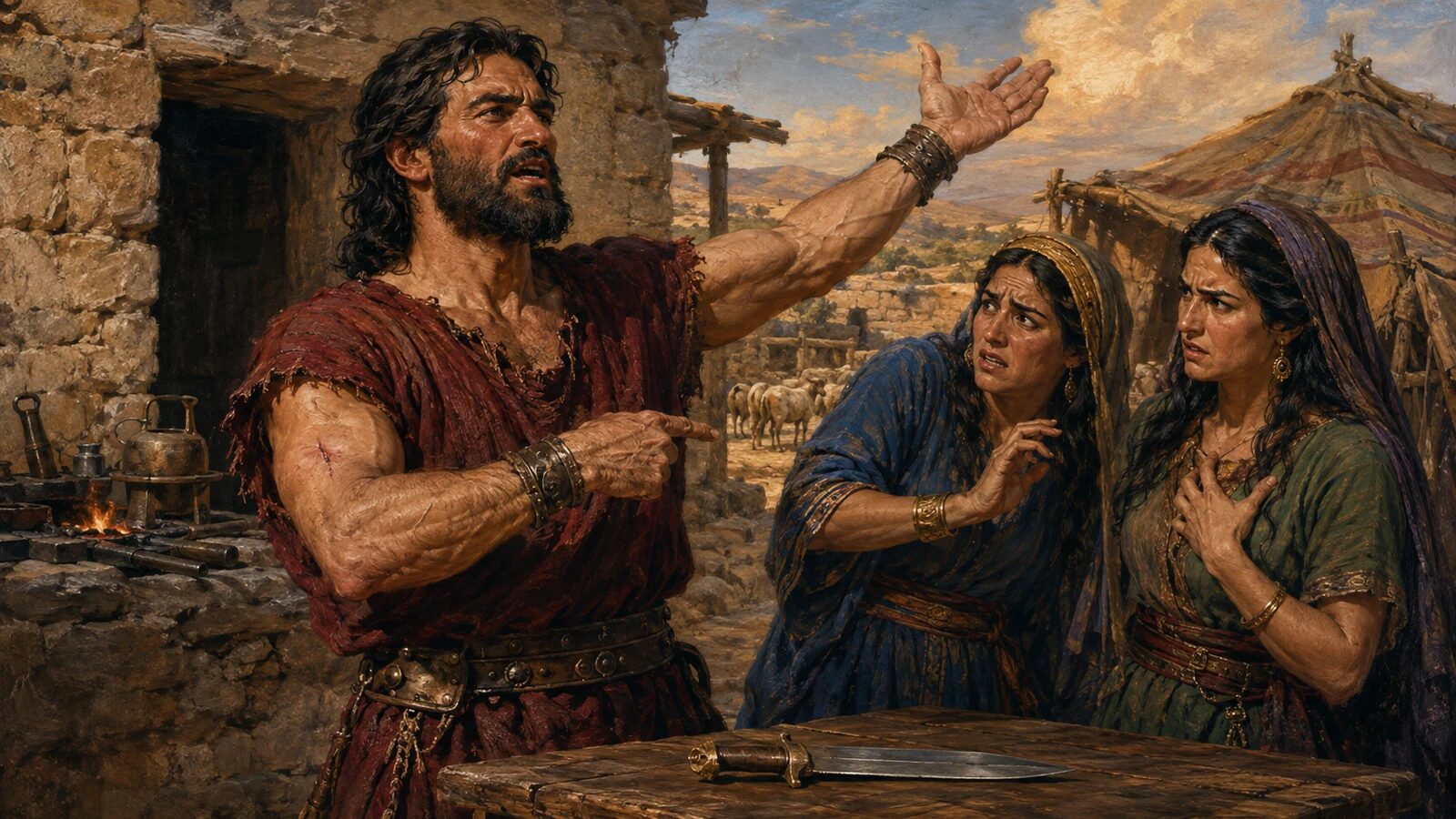
Genesis names two men called Lamech, and we need to distinguish them before looking at either man’s life. The Lamech in Genesis 4 descended from Cain and is remembered for taking two wives and boasting about violence. The Lamech in Genesis 5 belonged to Seth’s line and became Noah’s father. Here I want to look at Cain’s descendant, whose words help us understand what was happening in the household Scripture describes.
Two Lamechs and the Direction of Genesis 4
After the fall, Cain resisted God’s warning and murdered Abel. He lied when the LORD questioned him and eventually went out from God’s presence. Genesis 4 then follows his family far enough for us to see rebellion spreading beyond one man’s private act. It began shaping a household and the culture around it, until Lamech openly boasted about violence.
Genesis follows selected family lines rather than naming every son and daughter born to Adam and Eve. Cain’s genealogy passes through Enoch, Irad, Mehujael, and Methushael before reaching Lamech. Seth and his son Enosh appear at the end of the chapter, and Genesis 5 follows Seth’s descendants to the other Lamech, Noah’s father. The repeated name does not make these two men the same person.
Genesis 5 tells us that Adam had other sons and daughters, so Cain and Seth were not Adam and Eve’s only children. The record follows particular descendants because of what those families show us. Through Cain’s line, we see sin spreading. Through Seth’s line, we follow the family in which God’s promise continued.
Cain was a murderer, but we should not assume that all his descendants committed the same sins. Nor does Genesis condemn the work associated with his family. Cain built a city, and his descendants developed livestock keeping along with music and metalworking. Those activities can serve ordinary human needs. What concerns me is that growing skill does not necessarily mean a heart is drawing nearer to God.
Genesis gives us more than Lamech’s name in a genealogy. It names his wives and tells us about his children’s work before preserving his poem. When we reach that poem, we hear a man boasting about violence rather than worshiping God. He wanted his household to admire his power, and he borrowed God’s language about vengeance to defend himself.
Lamech shows what happens when a person defends sin instead of confessing it. His household also makes us consider whether we are mistaking ability for righteousness or revenge for justice. Leading a home does not give a man permission to reshape God’s design around his desires. Lamech wanted people to admire him, while the chapter ends with people calling on the name of the LORD.
Lamech’s Household and a Capable Culture
The first detail Genesis gives about Lamech is not his trade or worldly success. Scripture directs our attention to the household he chose to build.
Then Lamech took for himself two wives: the name of one was Adah, and the name of the second was Zillah.
Genesis names Adah and Zillah, the women who lived in the home Lamech chose to build. It says he took two wives for himself, drawing attention to his own decision. To understand that choice, we need to remember the pattern God had already established for marriage before sin entered the world.
Therefore a man shall leave his father and mother and be joined to his wife, and they shall become one flesh.
God’s pattern joins one man to his wife in a one-flesh covenant. Genesis and later books also record polygamy, which means being married to more than one spouse at the same time. But I cannot take the fact that Scripture records something as proof that God approves it. The Bible tells us about deception and favoritism without praising them. It also shows the damage caused by drunkenness, cowardice, and betrayal. We need to compare the conduct with what God has already said and consider what it produces. Genesis 2 gives us the standard by which to understand Lamech’s departure from it in Genesis 4.
The question is more than whether an action appears in a biblical account. We need to ask how it agrees with God’s earlier command and what follows from it. Lamech’s decisions show self-rule taking hold of the home, just as it had governed Cain’s anger. His later boast reveals the same desire for control.
Genesis then describes work associated with Lamech’s children that helped shape early culture. Jabal was connected with tents and livestock, while Jubal developed music. Tubal-Cain worked with bronze and iron.
And Adah bore Jabal. He was the father of those who dwell in tents and have livestock. His brother’s name was Jubal. He was the father of all those who play the harp and flute. And as for Zillah, she also bore Tubal-Cain, an instructor of every craftsman in bronze and iron.
Those skills could serve useful purposes. Tents and livestock met practical needs, while music could enrich worship as well as ordinary life. Metalworking could support honest labor and protection. Genesis does not condemn these abilities or oppose the beauty human creativity can produce. It does, however, keep us from assuming that ability proves a person’s heart is right with God.
Lamech’s boast appears beside those achievements, so I cannot read them as proof that his family was spiritually healthy. A society can become more capable while losing humility. Someone may do useful work that others admire and still be ruled by pride in private. Greater ability gives us more ways to act, but it cannot cleanse the heart directing those actions.
We naturally measure ourselves by what we can build or produce, but God sees beneath that success. Cain’s family was capable, not useless or unintelligent, even as the genealogy exposed moral corruption. When a heart refuses God, creativity and organization can give its sin a wider reach.
A Song of Violence and Twisted Vengeance
Lamech called Adah and Zillah to listen, then made violence the subject of his poem. He was neither praying nor confessing. He was boasting before his household.
Then Lamech said to his wives: “Adah and Zillah, hear my voice; Wives of Lamech, listen to my speech! For I have killed a man for wounding me, Even a young man for hurting me. If Cain shall be avenged sevenfold, Then Lamech seventy-sevenfold.”
He addressed the women by name and then called them “wives of Lamech.” I notice how he wanted their attention centered on himself. Instead of showing shame over the man he had killed, he announced the killing as evidence of his own importance.
We are not told the victim’s name or given a full account of what happened. Lamech said the young man had wounded him, but we should not invent the missing circumstances to defend him. What we do have is his own boast. He treated an injury as reason to kill, responding with violence far beyond the harm he had received.
Cain feared what others might do after he murdered Abel. Though he showed no repentance, he knew he stood under God’s hand, and his response involved fear and hiding. Lamech spoke to his wives about his own greatness instead of turning to God about judgment. The violence Cain feared answering for had become something Lamech displayed with pride.
I see sin hardening in that change. Cain feared vengeance after killing his brother, while Lamech spoke as though vengeance belonged to him. Where Cain had feared answering for murder, Lamech celebrated his own violence as strength.
Lamech’s final line borrowed something the LORD had said about Cain and used it for a different purpose. After Cain killed Abel, God marked him to keep others from killing him in revenge.
And the LORD said to him, “Therefore, whoever kills Cain, vengeance shall be taken on him sevenfold.” And the LORD set a mark on Cain, lest anyone finding him should kill him.
God’s warning restrained further bloodshed by reserving vengeance to Himself. It did not reward Cain’s murder or give him permission to act as though he were untouchable. The LORD prevented one death from becoming an excuse for another.
The Hebrew verb naqam means to avenge or repay. Understanding that word helps us follow the connection between these passages, but we also need to notice who is claiming the right to repay. In Genesis 4:15, God spoke as Judge concerning Cain. Lamech borrowed that language to claim even greater vengeance for himself, as though he could make his own law and require others to live under it.
God had never promised Lamech seventy-sevenfold protection or authorized him to take private revenge. Lamech presumed a right that did not belong to him. Later Scripture makes the distinction clear: God upholds justice and allows lawful authority to punish evil, but He forbids personal vengeance driven by wounded pride. Being offended does not appoint a person judge and executioner.
Beloved, do not avenge yourselves, but rather give place to wrath; for it is written, “Vengeance is Mine, I will repay,” says the Lord.
Lamech’s boast went beyond expressing anger. He borrowed language about God to defend retaliation and made it part of how he presented himself. Instead of leaving judgment with the Lord, he claimed it for himself.
The Image of God and the Other Line
Lamech treats another human life as something he may take to answer an injury. Scripture later states why the shedding of human blood is uniquely serious.
“Whoever sheds man’s blood, By man his blood shall be shed; For in the image of God He made man.”
God made mankind in His image, and that is what gives human life its sacred value. A person’s usefulness or strength does not determine that worth. Neither does being wanted or having an important place in society. Murder attacks someone who bears God’s image, making it rebellion against the Creator as well as an offense against society.
The young man’s value did not depend on Lamech’s respect for him or on how serious Lamech thought his injury was. Lamech behaved as though being hurt gave him the right to decide another person’s worth. But his wounded pride could not change the value God had placed on that life.
We should still distinguish murder from other forms of killing. Scripture recognizes lawful justice and speaks of war under God’s command. It also allows the protection of innocent life. Lamech was not acting as a lawful judge administering measured justice. He was announcing the repayment he had chosen because he was offended.
Jesus presses the command against murder down into the heart where violence begins.
“You have heard that it was said to those of old, ‘You shall not murder,’ and whoever murders will be in danger of the judgment. But I say to you that whoever is angry with his brother without a cause shall be in danger of the judgment.”
Jesus’ words help me see why Lamech’s poem reveals more than a violent act. Murder begins in a heart that treats another person’s life as cheap, before someone picks up a weapon. Pride excuses anger, and anger feeds contempt until doing harm begins to seem reasonable.
Genesis 4 does not end with Lamech’s voice. After recording the boast of Cain’s descendant, Genesis returns to Adam and Eve and the birth of another son.
And Adam knew his wife again, and she bore a son and named him Seth, “For God has appointed another seed for me instead of Abel, whom Cain killed.” And as for Seth, to him also a son was born; and he named him Enosh. Then men began to call on the name of the LORD.
Lamech told his wives to listen to him, while people in Seth’s line began calling on the LORD. Their attention turned toward God rather than human greatness. Calling on His name means more than saying LORD. Throughout Scripture it expresses worship and dependent trust. We acknowledge that we cannot save ourselves and that our judgment is imperfect. Pride cannot give us the security we need from Him.
That does not make everyone in Seth’s line sinless. Genesis soon records corruption spreading before the Flood. Yet God was preserving a worshiping line and keeping His promise alive. Alongside the growing violence, we see people looking to the LORD.
I am grateful that Genesis ends the chapter there. Human progress had not cured Cain’s rebellion, but Lamech’s boast was not the only voice to be heard. God appointed Seth and preserved His promise as the account turned toward people depending on Him in worship. Their answer to proud self-protection was to acknowledge their need for the LORD.
Jesus Answers Lamech’s Spirit
Lamech used seventy-sevenfold language to magnify his claim to vengeance. Much later, Peter asked Jesus how often he should forgive a brother who sinned against him. Jesus answered with similar language, reversing the spirit of Lamech’s boast.
Then Peter came to Him and said, “Lord, how often shall my brother sin against me, and I forgive him? Up to seven times?” Jesus said to him, “I do not say to you, up to seven times, but up to seventy times seven.”
Jesus was confronting the desire to keep score, not giving him a ledger in which to count acts of forgiveness. Lamech wanted payback without limit. Jesus calls His people to forgive without letting revenge determine how they treat others.
Forgiveness does not erase justice or require someone who has been wronged to enable evil. Romans 12 leaves personal vengeance to God, while Romans 13 describes governing authority bearing the sword. I can leave repayment with God without calling wrongdoing acceptable. Mercy and lawful justice can operate together, but my heart must not be governed by the desire to make someone pay.
The gospel gives us the deepest reason to leave revenge behind. Jesus did not save us by retaliating against our sin. Wicked men tortured and killed Him, and He physically bore that punishment for our sins in His innocent body while shedding His blood. The Father did not punish, curse, abandon, strike, bruise, or pour wrath on Jesus. Christ died and rose bodily from the grave. Having received His mercy, we should not make revenge the object of our devotion. Forgiveness expresses trust that God remains the Judge and that Christ is sufficient.
The same desire for control can appear in ordinary life. A husband may call himself a leader while arranging the family around his own will. In a church conflict or online argument, someone may speak about justice while enjoying the thought of payback. Private bitterness can also lead a person to use Scripture to defend harshness instead of accepting God’s correction. In each case, anger seeks approval rather than correction.
Lamech’s words make me examine what I do with anger. If I rehearse ways to make someone pay, I am treating my injury as permission to hurt them. Calling that pride conviction will not make it right, even if I borrow God’s words to defend it. I need to let Him correct me. Genesis directs us beyond self-examination to the better response: call on the LORD.
Calling on the LORD means confessing sin instead of displaying it for others to admire. As we trust His justice, we stop letting anger rule us and submit our homes to His creation pattern. Christ died for the whole world, though His genuine offer can be resisted or rejected. Everyone who truly repents and believes is born again. The Holy Spirit indwells and seals that believer, who is eternally secure. That security never permits violence or lawlessness. New life brings us under Christ’s rule.
For related studies, see Who Cain’s Wife Was, The Age of the Earth, and Testing vs Temptation.
My Final Thoughts
When I read about Lamech in Genesis 4, I see what happens when sin settles into a home and gains influence without repentance. His family’s abilities did not keep him from becoming proud of violence. But Genesis does not leave us listening only to his boast. It turns us toward people calling on the LORD, and Jesus teaches forgiveness grounded in trust that God judges rightly. When I want others to admire my anger, I need to stop defending it and confess what is ruling my heart. We can call on the God who saves instead of trying to secure ourselves through revenge.