
When I read that mankind is made in God’s image, I cannot leave the words as an abstract idea. Genesis gives human dignity a foundation that no culture, employer, or changing opinion can remove. It also places us under the authority of the God whose image we bear.
Genesis gives the foundation for understanding God’s image, while Genesis 9 and James show that it remains after the fall. Their teaching brings the subject into how we treat people now. From there, the New Testament directs us to Christ as the perfect image and explains how God renews believers to resemble Him.
God Is Spirit
Jesus’ statement that God is Spirit helps us understand what His image means. We should not picture God as having a physical body with human features. He can appear and reveal Himself, and He uses human language to teach us truly, but His nature is not flesh and bone. Jesus said:
God is Spirit, and those who worship Him must worship in spirit and truth.
We represent God as creatures. Bearing His image does not mean He has a physical body that we resemble. Because He is personal, we are personal, and His holiness and moral law give us moral responsibility. We can reason and speak, and we can enter real relationships. Our creativity and rule must also remain under His authority. We are called to worship Him and answer to Him in ways no animal does.
Bearing God’s image does not make us divine. We are His creatures, not little gods or fragments of Him. I can honor human life without forgetting that distinction: we bear His image, but we are not the One whose image we bear.
Image and Likeness
Genesis 1 introduces the doctrine with solemn language. The creation of mankind is set apart from the creation of the animals. God speaks in a way that draws attention to His purpose: “Let Us make man in Our image, according to Our likeness.”
Then God said, “Let Us make man in Our image, according to Our likeness; let them have dominion over the fish of the sea, over the birds of the air, and over the cattle, over all the earth and over every creeping thing that creeps on the earth.” So God created man in His own image; in the image of God He created him; male and female He created them.
The Hebrew word tselem, translated “image,” can carry the idea of representation. Demuth, translated “likeness,” points to resemblance. Together they teach that mankind was made to represent and resemble God in ways fitting for creatures.
Ancient kings could place images in a territory to mark their rule. Genesis extends the dignity of bearing God’s image to all mankind, including male and female. It does not reserve it for kings or priests. Wealth and education cannot increase that worth, and poor health or loss of social favor cannot take it away.
Genesis 1:27 deliberately repeats that God created mankind in His own image, then identifies them as male and female. I notice that this dignity was given before sin entered or nations appeared. Israel and civil law came much later. No human system of status can claim to have created the worth God had already given every human life.
Dominion Under God
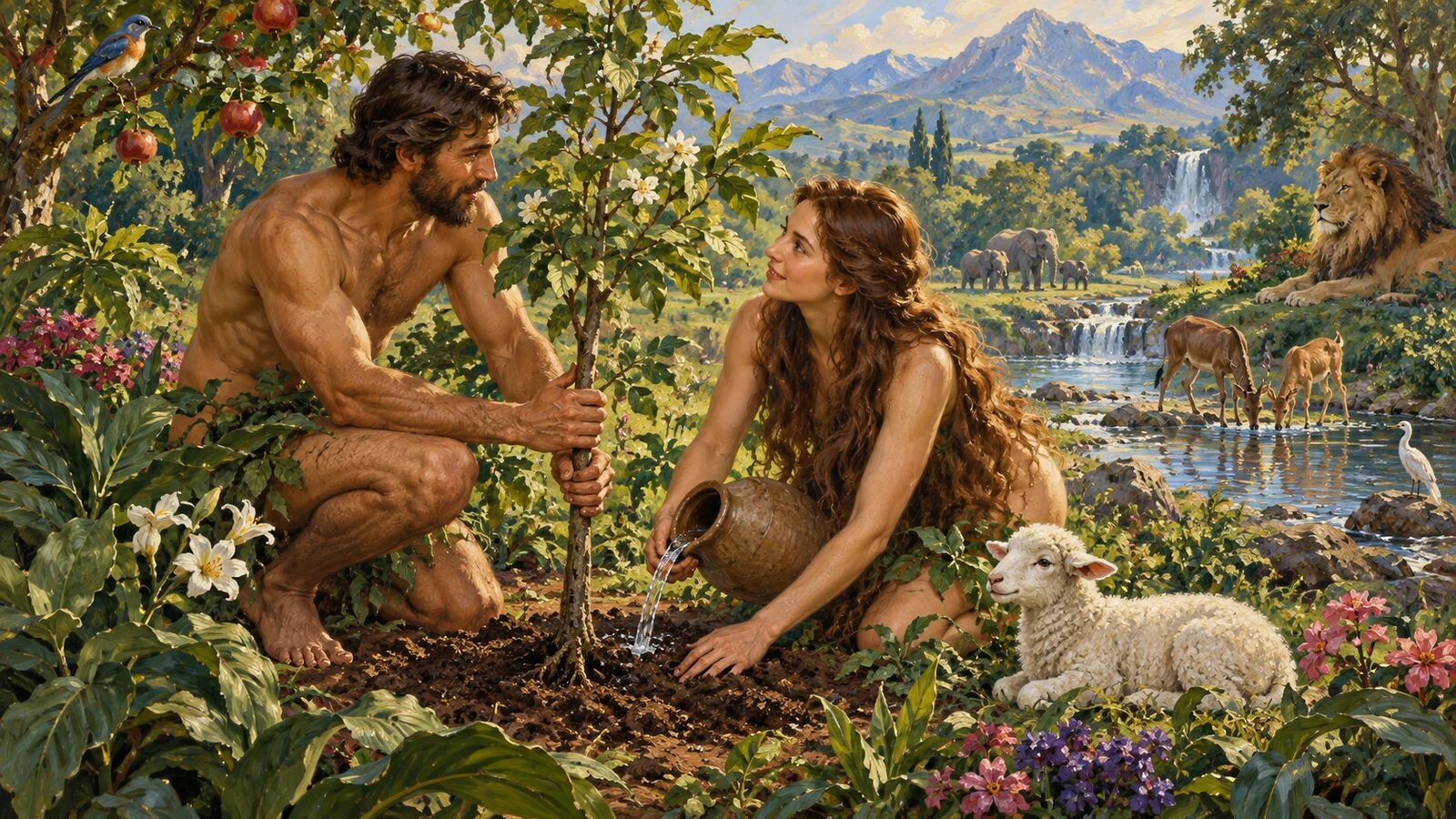
Genesis joins the image of God with the rule He gave man and woman over the creatures. That rule is a stewardship, meaning responsibility for what belongs to someone else. God owns the world, and we govern within it as representatives who must answer to Him. His gift of dominion gives us no right to dominate selfishly.
That responsibility gives purpose to ordinary work. Cultivating and protecting what God made belongs to our calling as His creatures. Learning helps us carry it out, whether we are building something, repairing it, or leading others. The curse makes work painful and frustrating, but responsible work itself was part of creation before the curse.
A cruel king misrepresents the God whose authority he is supposed to reflect. The same is true when a worker steals or a leader manipulates people. Parents who crush their children and husbands who abuse their wives are not exercising godly dominion, nor is a culture that discards the weak. I need to judge the use of authority by God’s character. Faithful stewardship requires truth and justice along with mercy and care.
God’s ownership should keep us from both arrogance and passivity. We need to care for His earth rather than treat it as ours to ruin. Animals must not become objects of worship, but cruelty to them still misrepresents their Creator. Our abilities are gifts to use for good, not an ultimate power of our own. Dominion calls us to serve Him in the world He owns.
Genesis 2 places human dignity beside our dependence on God. He formed man from dust and gave him life by His breath. I can recognize the honor He gave us while remembering that we owe our very existence to Him.
And the LORD God formed man of the dust of the ground, and breathed into his nostrils the breath of life; and man became a living being.
God made us as embodied persons, not machines or animals with religion added afterward. Our bodies belong to His good creation, and the breath of life reminds us that we depend on Him every moment. Human life is sacred without being self-sustaining. We live because He gives life.
Because both body and soul matter, I cannot treat physical life as meaningless or reduce a person to chemistry. Neither productivity nor appearance can account for who someone is. The whole person belongs to God. He made us to live in bodies, dependent on Him and accountable to Him, with the capacity for communion with our Creator.
The Image Remains After the Fall
Genesis 3 records how rebellion damaged human life. The serpent tempted the woman, and Adam sinned. Guilt and shame entered the human family as relationships broke under the weight of that rebellion. Pain followed, along with difficult toil and death. People remained human, but sin distorted what they had been made to reflect.
The image remains, though rebellion distorts it. Reason can become proud and desire can turn away from its proper order. Speech becomes false instead of truthful, while work and authority may be used to exploit others. Selfishness harms relationships and worship turns to idols. People made to represent God begin trying to replace Him.
Scripture describes fallen people as morally accountable and spiritually dead because they have rebelled against the God whose image they bear. Their dignity has not disappeared. If anything, recognizing what God made us to be should deepen our understanding of sin’s seriousness. It is rebellion against our Creator, not simply failure to fulfill our potential.
Bearing God’s image and being right with Him are different things. Every person bears His image, and every person needs the Savior. When I speak to someone who is lost, I owe that person honor and patience without withholding the truth. They still need forgiveness and the new birth to receive reconciliation and eternal life through Jesus Christ.
Genesis 9 gives some of the clearest evidence that God’s image remained after the fall. Sin had entered the world and the Flood had judged it, yet God still pointed to His image when explaining why shedding human blood is so serious.
“Whoever sheds man’s blood, By man his blood shall be shed; For in the image of God He made man.”
God grounds the value of human life in His image, so usefulness or social approval cannot determine its worth. Neither does that worth depend on innocence. Murder is uniquely serious because it assaults an image-bearer whose life belongs first to the Creator. It is rebellion against the One who made that person.
That worth belongs to an unborn child as much as to an elderly person whose memory is fading. Disability does not remove it, nor does poverty or imprisonment. The stranger and even the enemy bear God’s image. I need to remember that the person whose sin grieves me is still someone God made in His likeness.
Recognizing that dignity does not erase justice or moral accountability. Scripture distinguishes murder from lawful justice and truth from lies. Repentance is not rebellion, and righteousness is not wickedness. Yet even when seeking justice, we must remember who stands before us. No person is disposable or less than human, and no one falls outside the Creator’s claim.
The Tongue Test
James applies this teaching to our speech when he rebukes people who bless God and curse those made in His likeness. His concern goes deeper than manners. The words we direct at someone must take account of who made that person.
With it we bless our God and Father, and with it we curse men, who have been made in the similitude of God. Out of the same mouth proceed blessing and cursing. My brethren, these things ought not to be so.
The Greek word translated “similitude” in James 3:9 points to likeness. James applies creation truth to fallen people in daily life, showing that the image doctrine still governs how believers speak.
James’s rebuke makes me examine more than openly cruel words. Harsh speech treats someone with contempt, and sarcasm or gossip can reduce that person to their worst moment. The person we are speaking about was made by God and should not become a punchline.
We can name sin plainly without speaking as though the sinner were less than human. Scripture calls for discernment and reproof, and it commands church discipline and justice. None of those duties requires pretending evil is good, but neither does truth permit contempt. James will not let us separate how we speak about people from our worship of God.
Christ the True Image
Jesus Christ shows us what bearing God’s image was meant to look like. He is the eternal Son, fully God and fully man, who has no sin. He did not improve Himself from a sinner into someone godly. In His true human life, He makes the invisible God known.
He is the image of the invisible God, the firstborn over all creation.
Colossians 1 immediately explains why the Son cannot be a created being: all things were created by Him and for Him, and He is before them all. The title “Firstborn” speaks of His rank and inheritance and His preeminence over creation. His supremacy belongs to Him as Creator, not as the first creature.
Hebrews calls the Son the brightness of God’s glory and the express image of His person. As the eternal Son, He reveals the Father perfectly, and in becoming man He revealed God in real human flesh. His authority has no corruption and His compassion no selfishness. He is holy without pride and humble without weakness. His love never compromises, and He speaks truth without manipulating anyone.
Christ gives us more than an example to follow. Sin has distorted God’s image in us, and we cannot make ourselves righteous by trying to repair the damage. We need Him to save us. Jesus physically bore the punishment for our sins in His innocent body on the cross. He shed His blood and died, then rose bodily from the dead. The perfect Man redeems ruined men and women by grace through faith.
Renewed Into His Image
God forgives us and renews us through salvation. We are justified, or declared righteous, through faith in Christ rather than works. That does not mean He leaves us unchanged. The Holy Spirit indwells those who are born again and seals them for the day of redemption. God gradually conforms them to the image of His Son.
For whom He foreknew, He also predestined to be conformed to the image of His Son.
God’s work in us does not turn us into divine beings. He restores our likeness to Christ as creatures whose lives increasingly reflect the Son. Holiness and truth begin to mark us, while fellowship with God in Christ produces growing humility and obedience.
But we all, with unveiled face, beholding as in a mirror the glory of the Lord, are being transformed into the same image from glory to glory.
The Spirit transforms us as we behold the Lord. We do that by looking in faith to Christ as Scripture reveals Him, not by inventing a religious image in our minds. Through the Word, the Spirit exposes sin and convicts us. He also comforts and strengthens us as He reshapes us to resemble Christ.
Ephesians 4:24 describes the new man as created according to God in true righteousness and holiness. Colossians 3:10 adds that he is renewed in knowledge according to his Creator’s image. Salvation restores what sin bent. That helps me understand why the Christian life cannot be a project of inventing myself. The Spirit is making me more like Christ.
Image, Ownership, and Allegiance
Jesus once used a coin to expose a deeper question of ownership. The coin bore Caesar’s image and inscription. His instruction was to render to Caesar the things that are Caesar’s and to God the things that are God’s.
And He said to them, “Whose image and inscription is this?” They said to Him, “Caesar’s.” And He said to them, “Render therefore to Caesar the things that are Caesar’s, and to God the things that are God’s.”
Caesar’s image marked the coin, while God’s image marks human beings. That comparison gives civil authority a real place without granting it God’s ultimate claim. The state may require taxes and lawful respect, but it cannot rightly demand worship. It may not redefine humanity against its Creator or require what He forbids. Nor may it forbid what God commands.
Revelation’s image of the beast presents a wicked counterfeit of that rightful allegiance. The world will face pressure to worship falsely, with loyalty to the counterfeit enforced through coercion and death. I need to receive that warning soberly rather than use it to fuel speculation. It calls me to remain loyal to God and refuse to worship what people make.
He was granted power to give breath to the image of the beast, that the image of the beast should both speak and cause as many as would not worship the image of the beast to be killed.
We were made to bear God’s image and worship Him, but sin turns that calling toward idols. Christ redeems people back to God. The final pressure of the age will involve worship, not merely politics or economics. Knowing whose image we bear teaches us where our loyalty belongs before that pressure arrives. We belong to God.
My Final Thoughts
After following these passages, I believe the image of God gives every human being both dignity and responsibility. No culture can grant that worth, and no human failure can erase the Creator’s claim. Sin has marred what we were made to reflect, but Christ is the true image of the invisible God and renews those who trust Him. When I remember whose image another person bears, I want that truth to govern my speech and move me to protect the vulnerable. It should also keep me calling every sinner to the Savior who alone can make us new.