
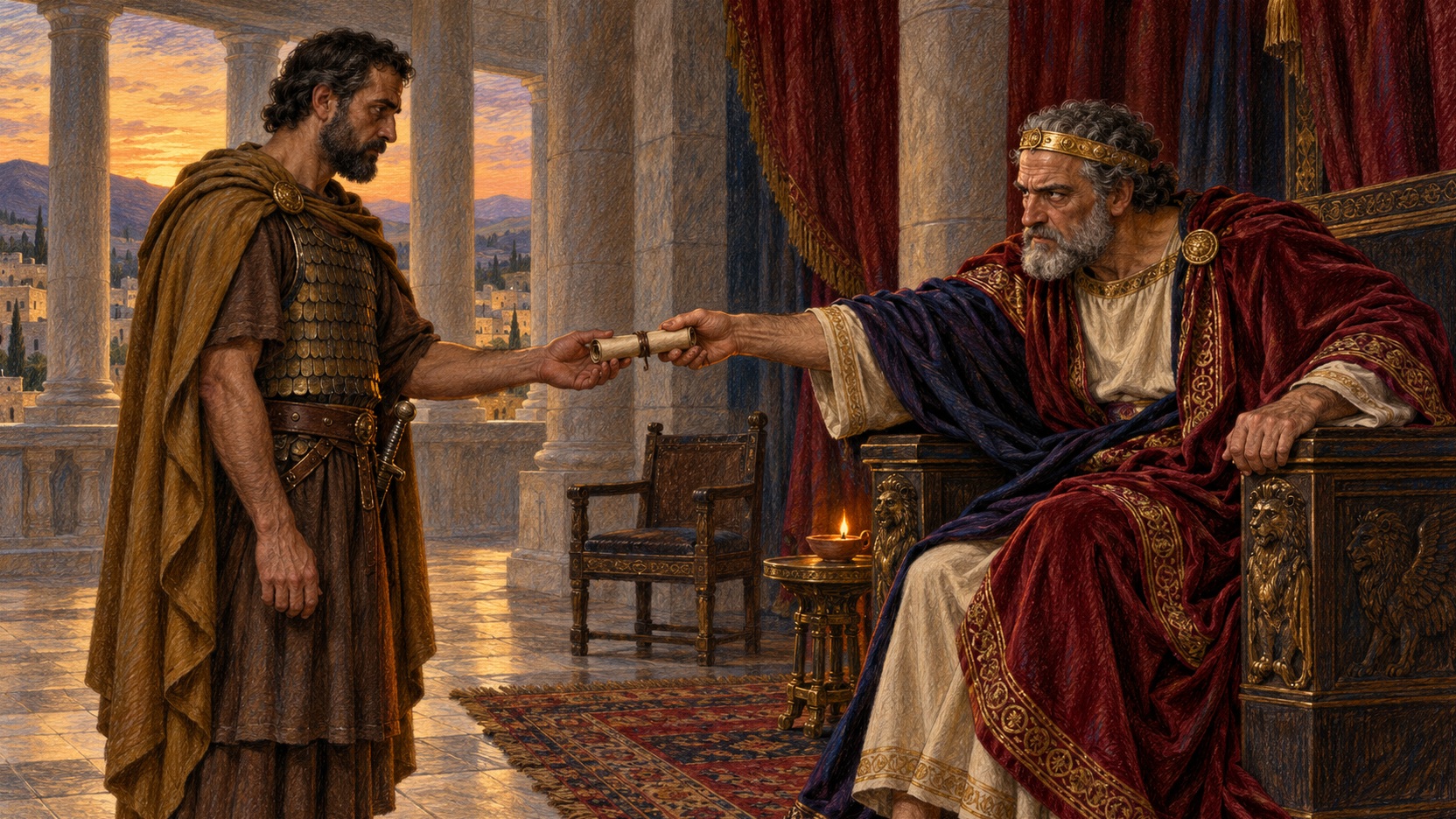
Herod told the wise men that he wanted to worship Jesus. He asked them to find the Child and then come back with His location, but Matthew 2 reveals that he intended to kill Him. I find that deception especially disturbing because Herod had just asked the religious leaders where God’s promised King would be born. He was using what Scripture told him to plan an attack on the One it announced.
God preserved Jesus through that danger, yet Matthew also records the children Herod killed and the families who mourned them. Both belong in our reading of the account. We can follow how the king failed to stop God’s promise without passing over the people who suffered because of his wickedness.
Herod Hears That the True King Has Come
The ruler here is Herod the Great, the king governing Judea under Roman authority when Jesus was born. The name Herod appears again in later New Testament events, but those later references do not all describe this same man.
Herod’s father came from Idumea, the region associated with Edom, and Herod gained his kingship with Roman backing. He knew how to secure political support, and he also undertook substantial building projects, including the rebuilding of Jerusalem’s temple. The Jewish historian Josephus describes that background in Antiquities of the Jews, Books 14 and 15. Those achievements help us understand his position, but they do not tell us that he was a righteous ruler. Matthew shows us how he reacted when visitors arrived looking for another King:
Now after Jesus was born in Bethlehem of Judea in the days of Herod the king, behold, wise men from the East came to Jerusalem, saying, “Where is He who has been born King of the Jews? For we have seen His star in the East and have come to worship Him.” When Herod the king heard this, he was troubled, and all Jerusalem with him.
The wise men, also called the Magi, had come from the East because they had seen His star. They were asking where the King had been born, not whether He had been born. Their intention was to find Him and worship Him. Herod’s response to the same news was to become troubled.
Matthew shows us how Herod responded through the actions that followed. He treated the Child as someone to be removed. I understand his attempt to kill Jesus as the action of a ruler determined to protect his own power, even when the One he opposed was the King God had promised.
Matthew says that all Jerusalem was troubled with him. That does not mean every person in the city shared his intention to murder the Child. The verse does not explain each person’s fear. I think the danger posed by an alarmed ruler helps us understand why others would also be troubled. The rest of the chapter shows just how much suffering Herod was willing to cause when he thought his position was threatened.
To find the Child, he summoned the chief priests and scribes. These were the religious leaders and men responsible for teaching the Scriptures. Herod asked them where the Christ would be born. Christ is the title for the Messiah, God’s promised anointed King, and they knew which prophecy answered his question:
And when he had gathered all the chief priests and scribes of the people together, he inquired of them where the Christ was to be born. So they said to him, “In Bethlehem of Judea, for thus it is written by the prophet.”
“But you, Bethlehem, in the land of Judah, Are not the least among the rulers of Judah; For out of you shall come a Ruler Who will shepherd My people Israel.”
The location came from Micah 5:2, which names Bethlehem as the place from which Israel’s Ruler would come. Bethlehem was also associated with David, the king whose family line led to Jesus. The language about shepherding recalls God’s words concerning David in 2 Samuel 5:2. When Israel’s leaders came to acknowledge David as their king, they recalled that the LORD had appointed him to shepherd His people.
A shepherd cares for the flock entrusted to him. The promised Ruler would lead God’s people in that way. Herod now knew the place where this King was to be found, but he did not respond by going there to honor Him. He began using the answer to arrange His death.
The Magi Find the Child, and Herod Hides His Purpose
Herod called the Magi privately and asked when the star had appeared. That gave him information about the time as well as the location he had received from the religious leaders. He then sent the visitors to Bethlehem and asked them to report back when they found the Child, saying that he wanted to worship Him too (Matthew 2:7-8).
His words sounded like agreement with the purpose of their journey. In fact, he was trying to use their search to locate the Child he wanted to destroy. The deceit becomes plain when we read the angel’s later warning about Herod’s intentions and then his order to kill the boys in Bethlehem. His claim about worship cannot be separated from those actions.
The Magi left Jerusalem, and the star went before them until it stood over the place where Jesus was. They rejoiced when they saw it. Matthew then describes what happened when they entered:
And when they had come into the house, they saw the young Child with Mary His mother, and fell down and worshiped Him. And when they had opened their treasures, they presented gifts to Him: gold, frankincense, and myrrh.
These men actually did what Herod had only claimed he wanted to do. They bowed before Jesus and presented their gifts. Gold was a precious metal, while frankincense and myrrh were valuable aromatic substances. The gifts honored the dignity of the One they had come to worship. Matthew names them, but he does not assign a separate prophetic meaning to each one.
There are other details about the visitors that Matthew leaves open. His Greek word magoi is translated wise men and is the source of our term Magi. He tells us that they came from the East, but he gives us neither their names nor their number, and he does not call them kings. Three kinds of gifts do not establish that there were three men. We can appreciate what they did without making later traditions part of Matthew’s account. The studies on the Magi and their journey and the Star of Bethlehem examine their journey and the sign more fully.
Matthew’s description of a house also helps us keep his account distinct from Luke’s description of the birth. In Luke 2, shepherds heard an angel announce that the Savior had been born, and they went to find Him lying in a manger. The Magi in Matthew enter a house after His birth. The word paidion, translated young Child, can refer to a young child or an infant, so that word alone cannot tell us exactly how old Jesus was when they arrived.
Many familiar nativity scenes place the shepherds and the Magi together, but the passages do not say that both groups came on the night Jesus was born. I would let each account give us its own details instead of making the arrangement of a display decide the chronology. The separate question of celebrating His birth is considered in the study on whether Christians can celebrate Christmas.
As we compare the responses to the news, the religious leaders’ accurate answer also deserves attention. They could tell Herod where the Messiah would be born, but Matthew does not record them accompanying the Magi to Bethlehem. He does not tell us enough to pronounce on every individual’s decision. What their answer does make me consider is whether I act on the Scripture I understand.
I can explain a passage correctly and still resist what God is saying to me through it. Herod’s refusal was far more deliberate than simple inattention. He received the location from the Scriptures and used that knowledge in his effort to destroy the Messiah. Knowing the answer did not make him willing to submit to the King it revealed.
God Warns the Magi and Sends Joseph to Egypt
Herod’s plan depended on the Magi returning with news. After they had found Jesus, God warned them against going back:
Then, being divinely warned in a dream that they should not return to Herod, they departed for their own country another way.
They left for their own country by another route. Matthew does not say how much they knew about Herod’s intentions, but they knew that God had told them not to return. That instruction was enough to settle what they should do. The request of a king could not take priority over the warning God had given them.
The next warning went to Joseph, Mary’s husband. Matthew 1 has already explained that Mary conceived Jesus by the Holy Spirit before she and Joseph came together. Joseph was not Jesus’ biological father, but he had taken Mary as his wife and had the responsibility of caring for her and the Child. After the Magi departed, an angel spoke to him in a dream:
Now when they had departed, behold, an angel of the Lord appeared to Joseph in a dream, saying, “Arise, take the young Child and His mother, flee to Egypt, and stay there until I bring you word; for Herod will seek the young Child to destroy Him.”
Joseph was told both the danger and what to do about it. He was to take Jesus and Mary to Egypt and stay there until he received further instruction. Matthew records his response:
When he arose, he took the young Child and His mother by night and departed for Egypt, and was there until the death of Herod, that it might be fulfilled which was spoken by the Lord through the prophet, saying, “Out of Egypt I called My Son.”
He took them away by night. God’s promise about Jesus and His warning to Joseph belonged together. The warning was part of His care for the Child, and Joseph acted on it. He protected those entrusted to him by taking them out of danger and remaining where God had told him to stay.
Matthew also explains how this journey relates to an earlier passage. The words he quotes come from Hosea 11:1–4, where God recalls bringing Israel out of Egypt. Israel had lived under slavery there, and God delivered the nation through Moses. Hosea describes God’s love for Israel as His son, then recounts how the people turned away from Him and offered sacrifices to idols.
Hosea is first looking back at that historical exodus. Matthew identifies a further fulfillment in Jesus, the Son who also comes out of Egypt. I understand the connection as a pattern brought to fulfillment in the faithful Son. Israel had responded to God’s fatherly care with repeated disobedience, while Jesus would obey His Father. Matthew’s explanation does not erase the earlier deliverance; it shows us how the history of God’s people points forward to Christ.
The Child Joseph carried into Egypt was the eternal Son who had become truly human. His need to be cared for as a child did not mean He had ceased to be God. The Father preserved Him through the warnings He gave and Joseph’s obedience to them. The study on the virgin birth explains His coming into the world more fully.
Bethlehem Weeps, but Herod Does Not Win
When the Magi did not return, Herod realized that his plan to obtain the location from them had failed. He responded by expanding the attack to the children throughout Bethlehem and its surrounding districts:
Then Herod, when he saw that he was deceived by the wise men, was exceedingly angry; and he sent forth and put to death all the male children who were in Bethlehem and in all its districts, from two years old and under, according to the time which he had determined from the wise men.
The age limit came from the information he had obtained about the star’s appearance. It tells us which children his order covered, but it does not establish Jesus’ exact age when the Magi visited. Herod was willing to kill every boy two years old and under in that area in an attempt to reach one Child.
This event is often called the Massacre of the Innocents. The children had done nothing to threaten Herod’s rule, yet they were killed because he ordered it. Their families endured a loss his fear and anger had brought into their homes. Jesus’ escape must not become a reason for us to treat those deaths as a small detail on the way to a happy ending.
Matthew gives their mourning a place in the account. He connects what happened in Bethlehem with words spoken through the prophet Jeremiah:
Then was fulfilled what was spoken by Jeremiah the prophet, saying: “A voice was heard in Ramah, Lamentation, weeping, and great mourning, Rachel weeping for her children, Refusing to be comforted, Because they are no more.”
Rachel was married to Jacob, the father of the family from which Israel’s tribes descended. Genesis 35:16-20 records that she died while giving birth to Benjamin and was buried on the way to Bethlehem. Jeremiah uses the picture of Rachel weeping for her children to express the nation’s grief over its loss. In Jeremiah 31:15–17, the prophet pictures her descendants away in the land of the enemy, and the LORD promises that they will return to their own land.
Ramah is the place named in that lament, and the grief belongs to the setting of Israel’s exile. Matthew sees the lament fulfilled again in the mourning that Herod caused around Bethlehem. He is not saying that Rachel was physically present among those mothers. The voice of a mother grieving for her children expresses the anguish of the people whose children were gone.
Jeremiah’s chapter also contains hope of restoration. Later in the chapter, God promises a new covenant with Israel and Judah, including forgiveness of their sins and His law written on their hearts (Jeremiah 31:31-34). Matthew’s use of the lament does not cancel that larger hope, but neither does hope require us to deny the sorrow he records.
I think we need to allow both to remain in our explanation. God was bringing redemption through Jesus, and Bethlehem’s families were truly grieving children who had been murdered. Calling the event a fulfillment of Scripture does not turn Herod’s command into obedience to God. Matthew lets us hear the weeping without rebuking the mothers for their grief.
He then returns to Joseph and the family in Egypt. After Herod died, Matthew 2:19–23 records an angel telling Joseph to bring Jesus and Mary back to Israel. Joseph obeyed, but when he heard that Archelaus, Herod’s son, was ruling Judea, he was afraid to go there. Another warning directed him away, and he went to Galilee and settled in Nazareth.
The change of ruler did not mean Joseph could ignore God’s direction. He continued to respond to it as he cared for Jesus and Mary. Herod the Great, meanwhile, had died without accomplishing what he intended. The Child he had tried to destroy was living beyond his reach.
Wicked Power Cannot Overthrow God’s Promise
Herod’s attack was aimed at Jesus, but Scripture records earlier attempts against the people through whom the Messiah would come. I understand those events within the conflict first announced in Genesis 3. Adam and Eve were the first man and woman. After the serpent deceived Eve and both she and Adam disobeyed God, the LORD addressed the serpent with this promise:
And I will put enmity Between you and the woman, And between your seed and her Seed; He shall bruise your head, And you shall bruise His heel.
The woman’s Seed refers to her offspring, and I understand the promised victory over the serpent to point forward to Christ’s victory over Satan. The promise includes suffering, but it also announces the defeat of the enemy. Later attempts to destroy God’s people could not prevent Him from bringing the promised Savior into the world.
For example, Exodus 1 describes Pharaoh, the king of Egypt, becoming afraid of Israel’s growing population. He first oppressed them with hard labor. When that did not stop their increase, he ordered midwives to kill Hebrew boys at birth, and afterward commanded that newborn sons be thrown into the river. His attack threatened the people God would later bring out of Egypt.
In 2 Kings 11, the danger reached the royal family of Judah, the family line descended from David. After King Ahaziah died, his mother Athaliah began killing the royal heirs and took power herself. Ahaziah’s sister Jehosheba rescued his young son Joash from among the children being killed and hid him. He survived, and the line through which God had promised the coming King was preserved.
Haman’s attack was directed against the Jewish people more widely. He was a powerful official under the Persian king, and he became furious when Mordecai, a Jew, refused to bow to him. Instead of acting against Mordecai alone, Haman obtained a royal decree to destroy the Jews throughout the kingdom. Esther 3 describes that decree, and Esther 8 records Queen Esther pleading for her people after Haman himself had been executed. His attempt did not bring the nation to an end.
Herod’s order came after the Messiah Himself had been born. The attack was now aimed directly at the Child. I trace the promise underlying these events further in the study on the promise of the serpent’s head being crushed, but I would not assume that every ruler understood his place in that spiritual conflict. Matthew tells us what Herod did, not that he understood the whole conflict between Satan and God’s promised Son.
When we speak about God carrying out His promises despite these attacks, we must still recognize the responsibility of the people who committed them. Read again who gives the order in Matthew’s account:
Then Herod, when he saw that he was deceived by the wise men, was exceedingly angry; and he sent forth and put to death all the male children who were in Bethlehem and in all its districts, from two years old and under, according to the time which he had determined from the wise men.
Herod became angry, sent out the order, and had the boys killed. God did not make him an innocent instrument who had no choice and bore no guilt. His failure to kill Jesus does not lessen the evil he did to other people. God’s providence, His care and direction over events, must never become an excuse we offer for the person who harms someone else.
Jesus would later face men who did put Him to death. His preservation as a child did not mean He had come to avoid every danger for the rest of His earthly life. He came to redeem sinners, and Herod could not take His life before the appointed time. When Jesus later spoke of Himself as the good shepherd who gives His life for the sheep, He explained that He would give it willingly:
Therefore My Father loves Me, because I lay down My life that I may take it again. No one takes it from Me, but I lay it down of Myself.
The One who spoke those words is fully God and fully man, and He lived without sin. He voluntarily gave Himself to be slain as the perfect sacrifice for our sins. Wicked men inflicted His bodily suffering and death; the Father did not punish Him. Jesus shed His innocent blood and died, completing His saving sacrifice before His burial and bodily resurrection.
His willingness does not excuse the people who tortured and killed Him. He accomplished redemption despite their wickedness, and we receive His salvation through repentance and faith in Him. Religious knowledge cannot save us, and we cannot earn that salvation through our achievements. Herod’s knowledge of the prophecy had certainly not brought him into submission to the Savior it promised.
Herod failed to destroy Christ as a child, and Satan could not defeat His saving work through His death and resurrection. His promised return is also beyond their power to cancel. I can trust that promise without assuming God will always remove His people from immediate danger. Matthew has already shown us both the preservation of Jesus and the grief of the families in Bethlehem. Confidence in the Lord’s final victory should help us endure suffering and care for those who are suffering now.
Herod’s conduct also helps us understand why the authority of a government cannot be unlimited. His position as king did not make murder right. We saw that same conflict in Pharaoh’s command to the midwives. These women were responsible for helping Hebrew mothers give birth, and the king told them to kill the boys. They answered his command by preserving the children’s lives:
But the midwives feared God, and did not do as the king of Egypt commanded them, but saved the male children alive.
Their fear of God kept them from carrying out what the ruler demanded. In Acts 5, the apostles faced a different conflict. These were the men Jesus had sent to bear witness to Him, yet the religious authorities ordered them to stop teaching in His name. After they had been imprisoned, an angel released them and told them to return to the temple and speak to the people. When they were brought before the council again, the high priest reminded them of the prohibition. They answered:
But Peter and the other apostles answered and said: “We ought to obey God rather than men.”
They could not obey an instruction to stop doing what God had commanded. The Magi had faced a similar question of whose direction to follow when God warned them not to return to Herod. The circumstances differ, but in each case the human demand conflicted with the duty owed to God.
That does not make every inconvenience an act of persecution, or give me permission to ignore ordinary obligations because I dislike them. Romans 13:1-7 teaches believers to honor governing authorities and pay what they owe. I need to take those commands seriously while also recognizing that no ruler has the authority to require me to sin.
If an order contradicts God’s Word, I cannot excuse my participation by saying that someone with a title required it. But I also need to be honest about whether there is a real contradiction. The Magi changed their route because God had warned them, not because another road suited their preference. Faithful obedience begins with receiving what God has said, and it may require us to act even when a powerful person wants something else.
My Final Thoughts
Herod learned where God’s promised King would be born and used that information in an attempt to kill Him. The Magi found Jesus and worshiped, and Joseph acted on God’s warnings to care for the Child. Their responses show why understanding a passage must lead beyond being able to explain its words. I want to be willing to obey what God shows me, especially when it challenges something I am determined to protect.
Herod did not stop God’s promise, but his failure did not undo the grief he caused. Matthew records both, and our confidence in God’s care should leave room for the tears of those who have been harmed. The Savior preserved in this account later gave His life willingly for us, and He rose again. I can entrust my future to Him while refusing to call evil right simply because a ruler commands it.