
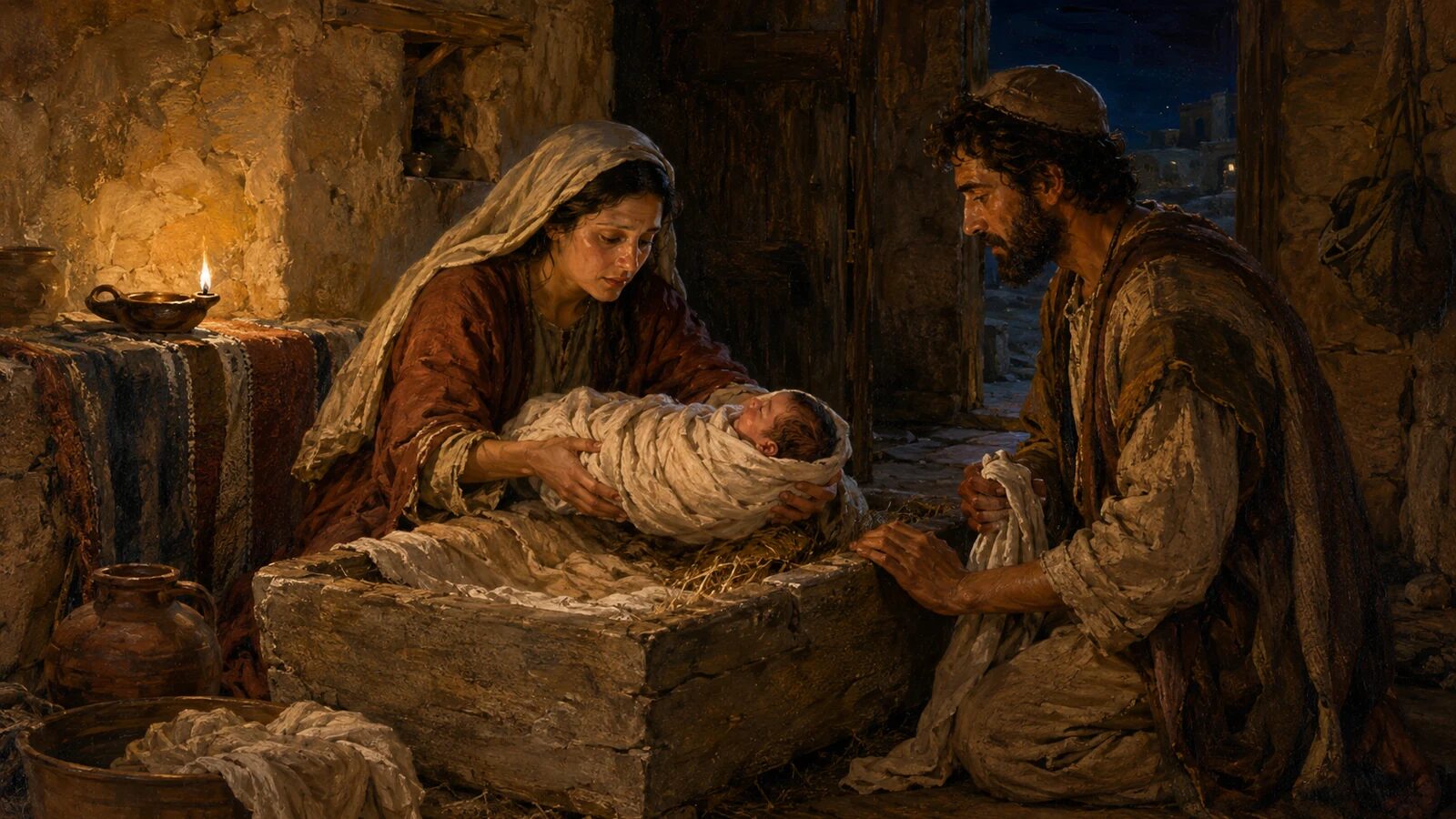
The virgin birth tells us something essential about who Jesus is, as well as how He entered the world. The Father sent His eternal Son to become fully man without ceasing to be God. He was conceived by the Holy Spirit and born of the virgin Mary. I want to follow the promise and its fulfillment through Genesis, Isaiah, Matthew, and Luke because they show us God keeping His word. The child born of Mary would shed His blood and die for the world, so His birth gives us reason for worship, not simply curiosity about a miracle.
The Promise of the Woman’s Seed
The first gospel promise came immediately after Adam and Eve disobeyed God and sin brought death into human experience. The serpent appeared to have drawn mankind into ruin, yet the Lord pronounced judgment against it and announced a conflict that would end in its defeat.
“And I will put enmity between you and the woman, and between your seed and her Seed; He shall bruise your head, and you shall bruise His heel.”
The promise in Genesis 3:15 comes before the fuller details revealed later in Scripture. Mary and Joseph are not named, nor are Bethlehem and Nazareth, and the Roman cross is not yet described. But our hope is directed to the Seed of the woman. That wording makes me pay attention to how the rest of Scripture explains His coming. The Deliverer would enter human history through the woman and suffer a real wound, yet He would crush the serpent’s head.
The Hebrew word zera is translated “seed.” It can refer to a whole line of descendants or focus on one particular descendant, so we need the context to understand how it is being used. In Galatians 3:16, Paul is explaining the later promises to Abraham and his Seed, “who is Christ.” He is not claiming to quote Genesis 3:15. Those Abrahamic promises continue the hope announced after the fall, and the promised line becomes more specific until we reach Jesus the Messiah.
I understand the connection to the virgin birth through the way Scripture develops the promise, rather than by reading every later detail into Genesis 3:15. The Seed came through the woman, yet He was no ordinary son of Adam. By the Holy Spirit’s power, He entered the human family without a human father and was truly human and holy from conception.
In Isaiah 7, the promise came during a crisis for David’s house. Ahaz, king of Judah, was afraid because Syria and the northern kingdom of Israel had joined together to threaten it. The Lord told him to ask for a sign, but Ahaz refused. His response sounded pious while revealing unbelief, so the Lord gave His own sign to the house of David.
“Therefore the Lord Himself will give you a sign: Behold, the virgin shall conceive and bear a Son, and shall call His name Immanuel.”
Children were born in Judah every year, so the promised sign involved more than a young woman having a child. The Lord would give the sign Himself, and the child’s identity was central to it. He was connected to the preservation of David’s house, and His name means “God with us.” Matthew treats Isaiah’s words as a promise fulfilled in Jesus’ virgin conception, not a vague thought to use for devotion.
The Hebrew word almah refers to a young woman of marriageable age and carries the expectation of sexual purity in its biblical settings. I would not claim that the noun alone must mean virgin in every imaginable sentence. We need to read the Masoretic wording with Isaiah’s promised sign and its context. Matthew gives the most decisive explanation: his received Greek uses parthenos, the ordinary word for a virgin, and directly says Mary conceived before knowing a man. The Greek translation of Isaiah made before Christ also used parthenos. That supports the reading without overruling the Hebrew base text. Understanding these words helps us follow how Scripture explains Scripture.
Isaiah 9:6 adds to the expectation with the words “For unto us a Child is born, unto us a Son is given.” The Child is born in time, while the Son is given. Isaiah names Him Wonderful, Counselor, Mighty God, Everlasting Father, and Prince of Peace. Everlasting Father can describe His enduring, fatherly rule and care, but it does not identify the Son as the same Person as God the Father. Scripture clearly distinguishes the Father who sends from the Son who is sent. We are being shown a true child in David’s line whose identity goes far beyond that of a human king.
Matthew, Joseph, Luke, and Mary
Matthew approaches Jesus’ birth through Joseph, whose genealogy at the beginning of the Gospel identifies him as a legal son of David. Jesus was not his biological son. Yet by obediently receiving Mary and naming her child, Joseph publicly placed Jesus in the royal line. Matthew gives us reason to recognize both His right as the Son of David and His conception by the Holy Spirit.
“After His mother Mary was betrothed to Joseph, before they came together, she was found with child of the Holy Spirit.”
Matthew says Mary was pregnant “before they came together” and records this as sober history without embarrassment. She had not had marital relations with Joseph. As a just man, Joseph planned to put her away privately rather than expose her to public shame, but the angel of the Lord came and told him the truth.
“Joseph, son of David, do not be afraid to take to you Mary your wife, for that which is conceived in her is of the Holy Spirit.”
The angel addressed Joseph as “son of David,” which directs our attention to the house through which the promised King must come. He told Joseph to take Mary as his wife and name the child Jesus, “for He will save His people from their sins” in Matthew 1:21. The name Jesus expresses the truth that Yahweh saves, matching the mission announced before His birth. That helps me keep His purpose clear: He came to save sinners from sin, not merely improve their behavior.
Matthew then quotes Isaiah 7:14 and says these events fulfilled what the Lord spoke through the prophet. He connects the virgin birth to a public prophecy and names the people involved, rather than presenting a private legend. Joseph obeyed by taking Mary as his wife, but he had no marital relations with her until she had brought forth her firstborn Son. He then named the child Jesus, and his obedience tied Jesus legally to David’s house.
Luke describes what happened to Mary when Gabriel came to her. She was a virgin betrothed to Joseph, a man of David’s house, and Luke repeats her virginity because it is central to the announcement. He is describing a young woman receiving God’s word in a particular place, not using her as a mythical symbol.
“Then Mary said to the angel, ‘How can this be, since I do not know a man?'”
Unlike Zechariah’s earlier response, Mary’s question did not express unbelief. She asked how the promise would be fulfilled since she had not known a man. Gabriel answered by explaining what God would do, with no human father involved.
“The Holy Spirit will come upon you, and the power of the Highest will overshadow you.”
The Greek verb episkiazo, translated “overshadow,” describes God’s powerful presence coming upon Mary. The Holy Spirit created life in her womb by divine power, not through a physical union. This gives no support to pagan ideas of a god having relations with a woman. Luke speaks reverently of the child’s conception by the Holy Spirit and explains its result: “that Holy One who is to be born will be called the Son of God.”
Mary answered, “Behold the maidservant of the Lord! Let it be to me according to your word.” She received God’s word humbly despite the great personal cost. I appreciate her faith without losing sight of where Luke directs our attention: the Lord’s mercy and the child she would bear. Mary was blessed because she believed God, but salvation would come from the Savior in her womb, not from Mary herself.
Immanuel, True Humanity, and Sinlessness
Immanuel means “God with us.” We can take comfort in that name because of what it tells us about the incarnation. God did not save us from a distance; the eternal Son took flesh and dwelt among us. John says “the Word was God” before declaring “the Word became flesh.” The virgin birth is part of this same revelation of the One who is truly man and truly God.
Isaiah 9:6 helps us see both truths in the promise. The Child being born would truly enter human life, while the Son being given points to the Father’s gift and the eternal Son’s mission. Mighty God describes who the Messiah is, so the titles are more than ordinary royal language. The child in the manger is the Son who upholds all things.
Jesus’ humanity was more than an appearance, as though He were wearing a body like a costume. He was born and grew into manhood, experiencing hunger and weariness. He knew genuine grief and faced temptation without sin in a human body that could die. At the same time, He was not an ordinary man who later became divine. The Father sent His eternal Son to take flesh, and the virgin birth marked His unique coming.
The virgin birth does not make Jesus less human. Hebrews says He shared flesh and blood, and Paul says He was born of a woman. The Gospels describe a real child born from Mary’s womb, not an apparition passing through human life. I need to keep that humanity in view because He could not stand in our place without it. Yet a sinner would need a Savior himself, so His sinlessness is essential too. The Christ Scripture reveals is completely sinless and fully human while remaining eternally God.
“Inasmuch then as the children have partaken of flesh and blood, He Himself likewise shared in the same.”
Jesus shares our human nature without sharing our sin. Hebrews 7:26 describes Him as “holy, harmless, undefiled” and “separate from sinners.” 2 Corinthians 5:21 likewise says He “knew no sin.” That does not mean Mary passed sinlessness to Him from her own nature, since Scripture never teaches that she was sinless. His holiness rests in who He is and in the Holy Spirit’s work in His conception.
I can come to this Savior knowing He understands human weakness without ever having committed sin Himself. He can sympathize with our infirmities and still cleanse us as the spotless Lamb. His body was real, as was the blood He shed in death, and His holiness makes His sacrifice sufficient.
Remembering why Jesus came keeps Christmas from becoming only sentiment. The child born of the virgin would physically bear the punishment for our sins in His innocent body on the cross. He endured real suffering and shed His blood before dying, then rose bodily from the dead. His birth and the purpose of His death belong together in God’s saving plan.
Mary’s Proper Place and Common Errors
Scripture gives us reason to honor Mary warmly. Blessed among women, she believed God’s word and accepted a calling that would bring misunderstanding and danger before the deep sorrow she would later face. Her answer to Gabriel showed submission to the Lord, and her song magnified Him with joy in His mercy. We should not speak coldly about the woman Scripture honors in this way.
That honor does not mean we should worship Mary or pray to her. Scripture gives no such instruction and does not present her as divine or sinless. Nor does it make her a co-redeemer or a mediator between sinners and Christ. In Luke 1:47, Mary rejoices in God her Savior. Her own words help me understand her place: she knew she needed God’s mercy rather than claiming to be the source of grace.
Mary faithfully served as the woman through whom the Lord brought the promised Messiah into the world. Her blessedness came from what God graciously chose to do through her, so the glory belongs to Him. The virgin birth magnifies Christ. Using it to make Mary an object of devotion or to support unscriptural claims about her takes our attention away from what the passage teaches.
Many people have inherited traditions about Mary without being taught to test them by Scripture, and I need to speak gently to them. Mockery will not help them understand what the Bible says, but patient correction can. We honor Mary truly by letting Scripture define her place instead of assigning her honors God has not given.
Matthew and Luke give us no reason to dismiss the virgin birth as a myth or a later embellishment meant to make Jesus impressive. They name identifiable people and places, and connect what happened to prophecy and family lines. Their claims are historical. If I reject their testimony simply because the conception was supernatural, I have already ruled out the God who acts in history.
Some argue that Isaiah 7:14 referred only to an ordinary young woman in Ahaz’s day and had no true virgin fulfillment in Christ. We need to take Isaiah’s immediate setting seriously while also receiving Matthew’s inspired explanation of the fulfillment. A promise can address its first hearers and still have a greater Messianic fulfillment. The promise concerns the house of David, and Christ is the final Son of David.
The suggestion that the virgin birth was borrowed from pagan myths overlooks what the accounts actually describe. Matthew and Luke draw on Jewish Scripture and belief in the one true God, recording a fulfillment of prophecy that reflects His holiness. Pagan stories describe lustful gods or divine violence within mythical cycles. The Gospel accounts describe the Holy Spirit’s creative work and the birth of the promised Messiah in history. Those differences make the proposed comparison superficial.
A miraculous conception does not erase Jesus’ humanity. He was born of Mary and truly took flesh and blood, entering our weakness without sin. The virgin birth tells us how the eternal Son assumed that real human nature through God’s holy action.
Nor can we keep only Jesus’ moral teaching and treat His birth as optional. The Gospels tell us who He is before recording much of what He taught. His teaching cannot be separated from His identity, and His saving mission rests on who He is. Separating them would leave us with less than the Savior they reveal.
The Virgin Birth and the Gospel
The eternal Son who was born of the virgin is the One who died for the whole world. He is fully God and fully man, and He was completely sinless. Wicked men physically tortured Jesus and inflicted the punishment that killed Him. He willingly bore that real punishment for our sins in His innocent body, shedding His blood and dying for us. He was buried and rose bodily. The Father did not punish or curse Jesus, nor did He abandon Him. He did not strike or bruise His Son or pour wrath on Him.
Matthew says His name is Jesus because “He will save His people from their sins.” His mission was clear before He was born. Neither sentiment nor a moral example can remove sin and guilt, and we cannot save ourselves through religious effort or an inherited identity. We need the Savior who came by the Holy Spirit and the virgin Mary. He gave His life as the offering no sinner could provide.
2 Corinthians 5:21 says God made Him who knew no sin to be sin for us, that we might become the righteousness of God in Him. We should not read this as Jesus becoming sinful or the Father punishing Him. The sinless Son offered Himself for sinners and bore in His body the real punishment wicked people inflicted. Being truly born of a woman enabled Him to stand in humanity’s place, while being God with us means He can save completely.
People can resist and reject God’s genuine offer, but everyone who repents and believes is forgiven and justified, or declared righteous before God. The believer is born again and made new. The Holy Spirit indwells and seals that person, whose salvation is eternally secure. Such security never excuses lawlessness. Nor does a superficial profession prove that someone has truly been born again.
God promised salvation long before any of us were born and faithfully carried that promise through Israel’s history. He fulfilled it by His power in the virgin conception, and Christ went on to purchase our redemption with His blood. His bodily resurrection vindicated that saving work. I see no room here to take credit for what God has done, but every reason to trust the Savior He has given. That faith turns us to Him in repentance and worship and gives us confidence to rest in His work.
For related teaching, see A Complete Bible Study on The Deity of Jesus, A Complete Bible Study on the Trinity, and Soteriology: The Study of Salvation.
My Final Thoughts
The virgin birth tells us about the Savior Himself, not just the circumstances surrounding Christmas. The promised Seed came through the woman, and Isaiah’s sign was fulfilled when the eternal Son took real human flesh without sin. Mary deserves honor as His faithful servant, while Jesus alone is the Savior and Mediator. God’s faithfulness is what gives me confidence as I follow these passages: He kept His promise and guarded David’s line, then brought His Son into the world by the Holy Spirit. That saving purpose continued through the cross and bodily resurrection. We can trust Jesus as truly God with us and rest in the salvation He secured.