
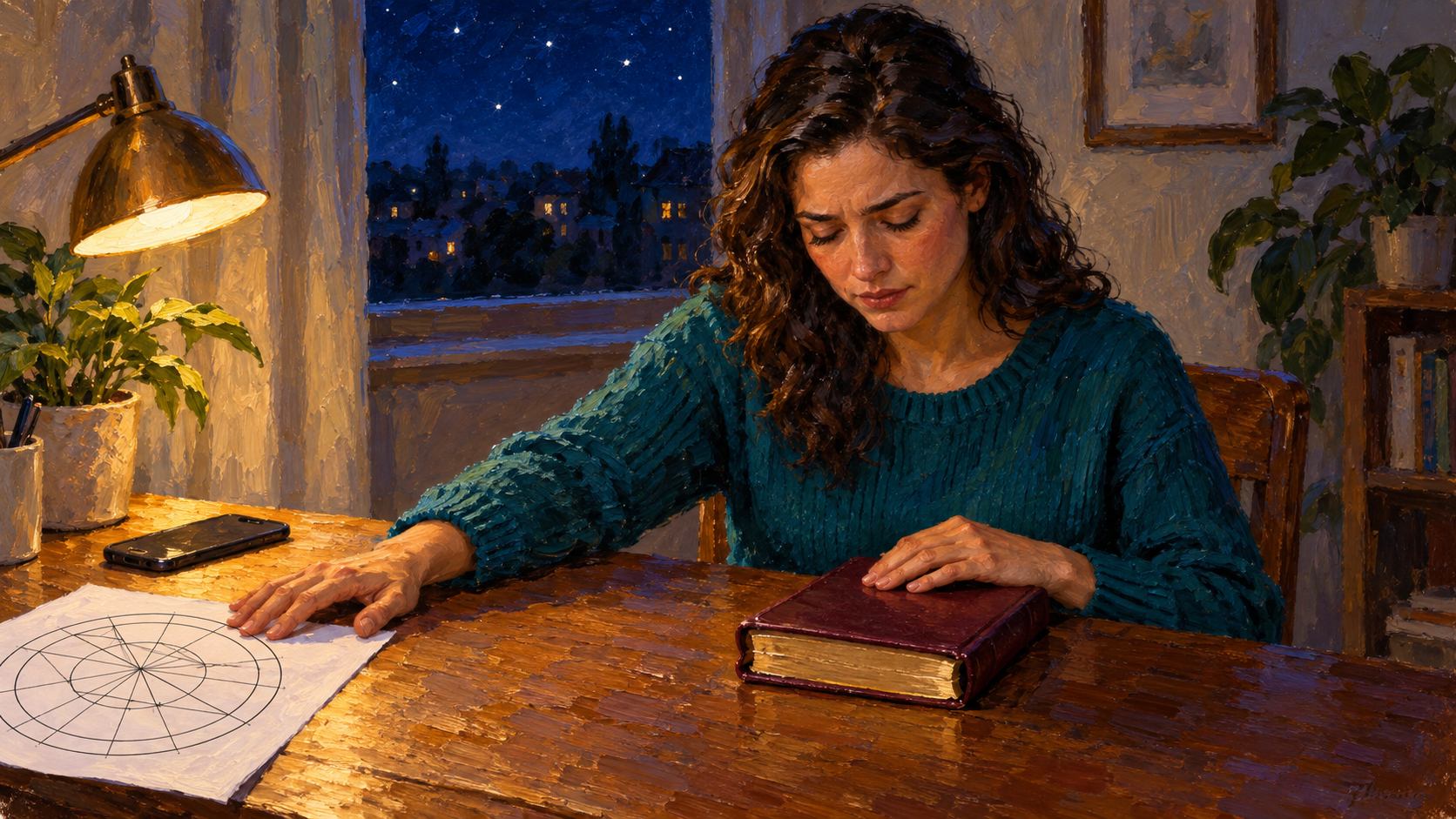
A horoscope may arrive as a joke, a daily message on a phone, or advice from someone who takes astrology seriously. Does the way we encounter it make it harmless? I think we need to ask a more basic question: what are we being encouraged to believe, and where are we being told to seek guidance? Scripture gives the heavens an important purpose, but it does not authorize us to use them to read our private future.
What Astrology Asks Us to Trust
Astrology interprets the positions and movements of heavenly bodies as revealing human personality, relationships, or future events. Different systems use the sun, moon, planets, and constellations in different ways. A daily horoscope offers a brief reading; a birth chart develops a more elaborate account based on the heavens at someone’s birth. Zodiac compatibility and lunar guidance apply related claims to relationships and decisions.
Not everyone who reads a horoscope takes those claims equally seriously. Someone may enjoy a joke about his sign without thinking of himself as seeking spiritual counsel. But an entertaining presentation does not establish that the advice is true or appropriate. If I begin looking to a chart to explain my character, excuse my behavior, or decide whom to trust, I am receiving guidance from it, whatever name I give the activity.
I distinguish that from astronomy, the study of the heavens themselves. Observing planetary motion, marking seasons, and navigating by the stars are ways of studying and using God’s creation. Astrology adds a different claim: that those arrangements disclose personal meaning or hidden knowledge for directing our lives. In that role, it functions as divination, an attempt to obtain hidden spiritual guidance through signs.
Even a prediction that appears accurate would not settle whether I should follow the practice. The question is whether God authorized that source of guidance. A favorable result cannot make it right to seek what He has forbidden. We need to examine the claim by His Word instead of letting curiosity or apparent success decide it for us.
The Heavens Point to Their Creator
Genesis begins with God creating the heavens and the earth. The lights in the heavens are His workmanship, assigned their purposes by Him:
Then God said, “Let there be lights in the firmament of the heavens to divide the day from the night; and let them be for signs and seasons, and for days and years.”
The heavens declare the glory of God; And the firmament shows His handiwork.
Some appeal to the word signs in Genesis 1:14 as permission to practice astrology. Yet the verse connects the lights with the ordering of days, seasons, and years. It does not assign personality traits to birth signs or instruct us to derive relationship advice from planetary positions. God can use something He made as a sign without authorizing a system of divination built around it.
Psalm 19 tells us what the heavens declare: God’s glory. Their order and grandeur should lead us to honor the Maker. If I turn them into a source of personal spiritual counsel, I am giving created things an authority the passage does not give them. The study on what idolatry is examines that larger problem of giving creation the place that belongs to God.
Job 38 makes the same relationship plain when God questions Job about the constellations and the ordinances of heaven. God knows and governs what Job cannot control. Naming heavenly bodies or describing their order does not endorse pagan methods for reading a person’s destiny. A farmer who observes the seasons and a sailor who uses the stars for navigation are not doing what an astrologer does when interpreting a birth chart.
The star in Matthew 2 also needs to be understood within its account. The wise men came seeking the King of the Jews after seeing His star. In Jerusalem, the chief priests and scribes identified Bethlehem from the written prophecy. The star later went before the wise men and stood over the place where the Child was, and they entered the house and worshiped Him. Matthew describes a sign directing them to Christ, not a lesson in casting personal horoscopes. We do not need to identify the star’s physical nature to recognize the difference. The study on the true roots of Christ-Mas also examines customs associated with Christ’s birth by testing them against Scripture.
Biblical prophecy likewise speaks of signs in the sun, moon, and stars, but God explains their significance through His revelation. Such passages do not make the sky a private source of daily counsel.
Scripture Forbids Divination
Deuteronomy 18 gives Israel a direct prohibition. As they entered the land, they were not to adopt the religious practices of the nations God was driving out:
There shall not be found among you anyone who makes his son or his daughter pass through the fire, or one who practices witchcraft, or a soothsayer, or one who interprets omens, or a sorcerer, or one who conjures spells, or a medium, or a spiritist, or one who calls up the dead.
For all who do these things are an abomination to the LORD, and because of these abominations the LORD your God drives them out from before you.
The list includes a soothsayer and one who interprets omens, people seeking hidden guidance through forbidden means. Israel was to hear and obey the Lord rather than imitate those practices. This was a command, not a warning to use occult counsel only when it seemed reliable.
Astrology belongs within this category when it interprets celestial signs to provide hidden knowledge about our lives. Calling a reading psychology or wellness does not change the claim being made. We can discuss personality and make sensible plans without assigning spiritual significance to the position of the planets at our birth.
I do not need to prove that every person reading a horoscope consciously intends to worship the stars before addressing the practice. The question is what authority he gives its claims. If a chart tells him a relationship is destined to fail, a day is dangerous, or a sinful tendency is part of his fixed identity, it is offering counsel about how he should understand and conduct his life. Scripture gives us good reason to refuse that counsel.
Astrology Cannot Reveal or Rescue
Isaiah 47 addresses Babylon, with its many counselors and its confidence in astrological advice. God challenges those advisers to do something their knowledge cannot accomplish:
You are wearied in the multitude of your counsels; Let now the astrologers, the stargazers, And the monthly prognosticators Stand up and save you From what shall come upon you.
Behold, they shall be as stubble, The fire shall burn them; They shall not deliver themselves From the power of the flame; It shall not be a coal to be warmed by, Nor a fire to sit before!
The astrologers could not rescue Babylon from the judgment God announced. They could not even deliver themselves. The passage also describes Babylon as wearied by its multitude of counsels. All that advice had not given the city either safety or an escape from accountability to God.
Daniel 2:27–28 confronts the same failure in Babylon’s court. Nebuchadnezzar demanded that his advisers disclose both his dream and its interpretation. Daniel explained that the wise men, astrologers, magicians, and soothsayers could not reveal the secret, “but there is a God in heaven who reveals secrets.” God made known what their arts could not discover. Daniel was not offering the king a more effective form of astrology.
The desire for certainty helps explain astrology’s appeal. Someone anxious about a relationship or an opportunity may hope that a reading will prepare him for what is coming. But if his confidence rests on the next favorable sign, another uncertainty can send him back for another reading. A practice sought for reassurance can become something he feels unable to make decisions without. Jeremiah addresses the fear attached to heavenly signs:
Thus says the LORD: “Do not learn the way of the Gentiles; Do not be dismayed at the signs of heaven, For the Gentiles are dismayed at them.”
God told Israel not to learn the nations’ fear of the heavens. The rest of Jeremiah 10 contrasts the living God with idols made by craftsmen. Created things cannot take His place simply because people approach them with elaborate explanations instead of carving them into an image. His people were to revere Him, not live under the supposed sentence of an omen.
Astrological labels can also become excuses. If I am harsh with someone, my responsibility does not disappear because a horoscope describes my sign as forceful or volatile. Nor can a chart tell me whether another person’s birth makes him trustworthy. I need to judge conduct truthfully and receive God’s correction of my own sin instead of treating a celestial arrangement as an explanation I cannot challenge.
Accepting one source of hidden spiritual guidance may also make related practices seem more reasonable. Tarot, energy readings, mediumship, manifestation rituals, or charms may be offered as additional ways to gain knowledge or control. Not everyone who encounters astrology proceeds into all of these practices, but the claim to hidden guidance is reason for discernment at the beginning. We should not wait until a practice dominates someone’s life before testing it by Scripture.
When the Future Feels Uncertain
It is understandable to want assurance about a marriage, a job, or a difficult decision. Jesus directs that concern toward the Father who knows our needs. In Matthew 6, He calls His followers to seek God’s kingdom and righteousness rather than let anxiety about tomorrow govern today:
Therefore do not worry about tomorrow, for tomorrow will worry about its own things. Sufficient for the day is its own trouble.
That command does not forbid planning. Proverbs commends preparation and wise counsel, and we should consider the likely consequences of our decisions. The difference is between using the knowledge and responsibilities God has given us and seeking forbidden spiritual knowledge to master an uncertain future. I can prepare carefully without claiming that a chart has revealed what God has not told me.
God has not promised to show us every detail in advance. He does invite us to seek the wisdom we need to respond faithfully:
If any of you lacks wisdom, let him ask of God, who gives to all liberally and without reproach, and it will be given to him.
We can ask Him for help, study His Word, and seek counsel from people who will help us apply it honestly. If a decision involves wrongdoing, I do not need a favorable sign to tell me whether to proceed; I need to obey what God has already said. Where Scripture permits a choice, I can weigh it responsibly without demanding certainty about everything that may follow. The study on how to study the Bible properly develops the use of Scripture as our guide.
This calls for an honest examination of our habits. Have I allowed a birth chart to define my character? Do I seek reassurance from a horoscope before making decisions? Am I using a sign to soften my responsibility for sin? Those questions can expose misplaced trust without requiring panic. Once we recognize what we have been following, we can turn from it and seek the Lord.
Turning from Astrology to Christ
If you have practiced astrology, confess it honestly and stop seeking its guidance. A clean break may include deleting an app, discarding charts, or refusing another reading. The purpose is to stop returning to the practice, not to perform a ritual that gives the objects greater spiritual authority than they possess. Bring the questions you were asking to God and learn to make decisions under His Word.
Acts 19:18–20 records believers in Ephesus confessing their deeds, followed by people who had practiced magic parting with costly books:
Also, many of those who had practiced magic brought their books together and burned them in the sight of all. And they counted up the value of them, and it totaled fifty thousand pieces of silver.
So the word of the Lord grew mightily and prevailed.
They rejected the means of their former practice instead of preserving it for later use. Luke records the value of the books, showing that their rejection involved a substantial material loss. Their action did not purchase salvation. It made their repudiation of magic concrete as the Lord’s Word took its rightful place in their lives.
The answer to false guidance is to trust the true Savior. Jesus Christ is the eternal Son, fully God and fully man. He willingly shed His blood and died for sinners, completing His saving work before He rose bodily from the dead. He gives new life to those who receive Him by faith. Turning to Him in repentance is more than replacing one method of predicting tomorrow with another; we entrust ourselves to the Lord who made and rules His creation.
Proverbs describes that trust and the direction God provides:
Trust in the LORD with all your heart, And lean not on your own understanding; In all your ways acknowledge Him, And He shall direct your paths.
I must acknowledge the Lord in my decisions and receive His correction when my understanding is wrong. His Word gives the truth I need, and the Holy Spirit helps His people obey it. Following Christ does not mean every choice will be easy or that I will know every outcome beforehand. It means I no longer need to treat created signs as a spiritual authority over my life.
My Final Thoughts
I do not believe astrology is harmless guidance for a Christian. God made the heavens to serve His purposes and display His glory; He did not appoint our birth signs to define our character or direct our decisions. We can appreciate His creation, plan responsibly, and admit uncertainty without seeking answers through divination. If we have been looking to charts for reassurance or identity, we should turn from them and trust Christ. The Lord calls us to seek His wisdom and obey His Word today, even when we do not know what tomorrow will bring.