
What does Revelation mean when it speaks of “the seven Spirits of God”? The phrase can sound as though John is describing seven different spirits, yet the rest of Scripture plainly teaches that there is one Holy Spirit. I want to understand why John uses this image, and the answer comes into view as we follow it through Revelation and consider the Old Testament passages behind it.
Revelation often teaches through symbols, including the lamps and eyes John saw. Its larger patterns of seals, trumpets, and bowls also help us understand what God reveals. These images are meant to show His people Christ’s glory and the certainty of God’s victory from the throne, not to hide the truth from them. The seven Spirits belong within that symbolic language, and the truth they reveal is real.
How Revelation Uses the Seven Spirits
John first mentions the seven Spirits in his greeting to the seven churches. He says grace and peace come from the eternal One and from the seven Spirits before His throne, as well as from Jesus Christ. I notice that the seven Spirits stand alongside the Father and the Son as the source of grace and peace. That helps me understand why John cannot be inserting seven angels or another group of created spirits into this greeting.
“Grace to you and peace from Him who is and who was and who is to come, and from the seven Spirits who are before His throne.”
In Revelation 3, Jesus speaks to the church in Sardis as the One who has the seven Spirits of God and the seven stars. He reigns in fullness and has authority over the churches, so His words describe what He possesses rather than anything He lacks. The exalted Christ has the Spirit and sends what His churches need.
“These things says He who has the seven Spirits of God and the seven stars.”
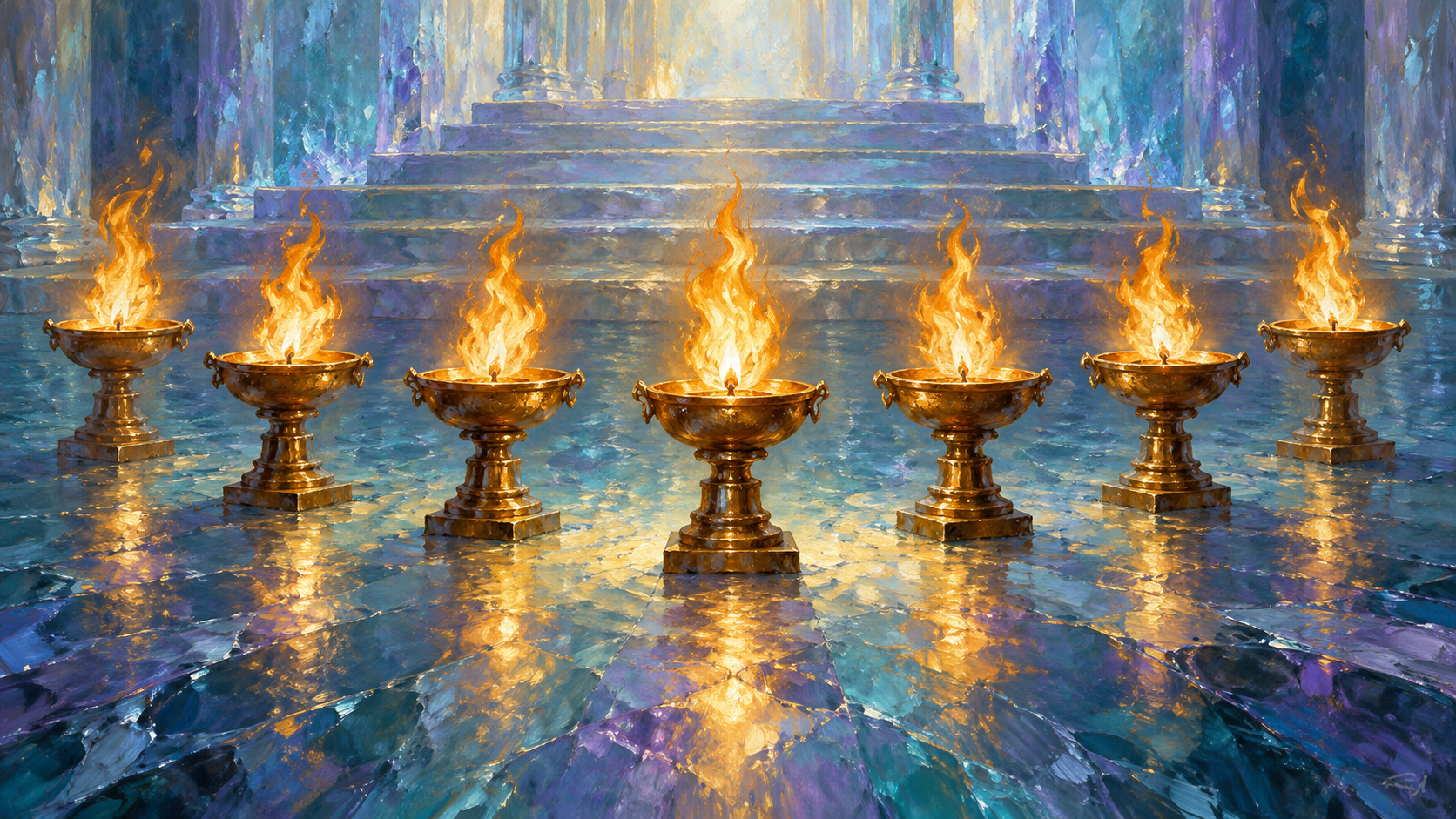
Revelation 4 moves into the throne room. John sees seven lamps of fire burning before the throne, and the passage identifies them for us.
“And there were seven lamps of fire burning before the throne, which are the seven Spirits of God.”
Then, in Revelation 5, John saw the Lamb standing even though He appeared as though slain. The Lamb had seven horns and seven eyes, and those eyes are again identified with the seven Spirits.
“Stood a Lamb as though it had been slain, having seven horns and seven eyes, which are the seven Spirits of God sent out into all the earth.”
Reading these four passages together helps me understand how the images fit. The seven Spirits are before the throne and belong to Christ, whether John pictures them as lamps of fire or as the Lamb’s eyes sent throughout the earth. The Holy Spirit is fully present before God, and His work is inseparable from Christ’s reign. Wherever God carries out His purpose, the Spirit is active. The images change, but they keep showing us that same fullness of presence and work.
One Spirit Shown in Perfect Fullness
The phrase cannot mean that there are seven separate Holy Spirits. Paul speaks plainly of one Spirit when he explains the unity of Christ’s body.
“There is one body and one Spirit, just as you were called in one hope of your calling.”
Scripture teaches one God in three coequal and coeternal Persons: Father, Son, and Holy Spirit. The Spirit is a divine Person, not an impersonal force or one spirit among many. We can see this in what He does, as the fuller study of the person of the Holy Spirit explains. He speaks and teaches as He guides God’s people, and He bears witness to Christ. Scripture also says He can be grieved, which would make no sense if He were mere power. The study of the Trinity helps us read Revelation’s throne-room language with that biblical confession of one God in three Persons in mind.
The number seven often communicates completeness or fullness, expressing divine perfection. Revelation addresses seven churches, and its visions include patterns of seven seals, seven trumpets, and seven bowls. John’s use of seven is deliberate. In the seven Spirits, he shows the one Holy Spirit in the perfection of His presence and work. Other groups of seven, including the seven trumpets, also help us see that symbolic patterns can reveal real judgment and victory.
I can recognize symbolic language here without treating the Spirit as vague or unreal. We already do something similar when we read about the Lamb: He is Christ, truly slain and risen, rather than a literal animal with horns and eyes. His seven eyes therefore do not describe physical eyes across an animal’s head. They show the fullness of Christ’s all-seeing rule through the Spirit and the worldwide reach of His mission. In the same way, “seven Spirits” describes the perfect fullness of the one Holy Spirit.
Isaiah 11 and the Spirit Upon the Messiah
Isaiah 11 helps us understand the Old Testament background to this image. The prophet speaks of a Rod from Jesse’s stem and a Branch growing from his roots, describing the promised King from David’s line. This King will reign in righteousness, and Isaiah says the Spirit of the LORD will rest upon Him.
“There shall come forth a Rod from the stem of Jesse, And a Branch shall grow out of his roots. The Spirit of the LORD shall rest upon Him, The Spirit of wisdom and understanding, The Spirit of counsel and might, The Spirit of knowledge and of the fear of the LORD.”
Christians have often recognized a sevenfold description here, beginning with the Spirit of the LORD and continuing with wisdom and understanding. Counsel and might follow, then knowledge and the fear of the LORD. These describe the fullness of the Spirit’s work upon the Messiah, not seven different Spirits.
When I read that the Spirit rests upon Jesus, I need to remember that Jesus is fully God and fully man. He is the eternal Son and is no less divine than the Spirit, yet as the incarnate Messiah He truly carried out His ministry in the Spirit’s power. At His baptism, the Spirit descended like a dove while the Father declared Him to be the beloved Son.
“When He had been baptized, Jesus came up immediately from the water; and behold, the heavens were opened to Him, and He saw the Spirit of God descending like a dove and alighting upon Him.”
The Father, Son, and Holy Spirit are personally distinct and work in perfect unity. The Spirit’s anointing shows the incarnate Son fulfilling His mission as the Servant-King promised by the prophets; it does not make Him dependent in His deity. This is the Messiah who was slain and rose again, the Lamb now standing in heaven. The Spirit’s fullness remains inseparable from His reign and authority. The study on the deity of Jesus explains why the Lamb who has the seven Spirits is fully God, fully man, and worthy of worship.
Isaiah begins with the broad title, “the Spirit of the LORD.” This is God’s divine Spirit, who gives gifts for service and always glorifies Christ. When Jesus preached in Nazareth, He applied Isaiah’s Spirit-anointed mission to Himself. In doing so, He revealed how He carried out His messianic work as the incarnate Son without denying His deity.
The same Holy Spirit indwells believers, although we do not receive Him in Christ’s unique messianic office. All who belong to Christ are indwelt and sealed by the Spirit. The distinction between His work in different biblical settings is developed further in the study of the Holy Spirit indwelling and coming upon.
The Spirit’s presence makes the truth of Christ living and powerful in believers. He opens the Word He inspired and forms Christ’s character in His people, so His work does not replace Scripture or lead us beyond Christ. I can appreciate His presence in us without confusing it with the Messiah’s unique anointing, because every believer truly receives the Spirit. We do not receive lesser portions of a Spirit divided among us.
“Do you not know that you are the temple of God and that the Spirit of God dwells in you?”
Wisdom, Counsel, Might, Knowledge, and Fear
Isaiah’s sevenfold description helps us appreciate the beauty of the Spirit’s ministry upon Christ. It also helps us understand His work in God’s people as He makes them more like Christ. Each word deserves attention, though we should not turn the description into a mechanical formula.
Wisdom involves more than having information. It is the ability to judge and live according to God, and we see it perfectly in Christ. He answered His enemies and taught His disciples with complete discernment. When He exposed hypocrisy, outward appearances never deceived Him. He could also welcome sinners without excusing their sin, and everything He did fulfilled Scripture without error.
“But of Him you are in Christ Jesus, who became for us wisdom from God; and righteousness and sanctification and redemption.”
Understanding means true spiritual perception. Isaiah says the Messiah will not judge merely by what His eyes see or His ears hear, because He sees beneath appearances and judges righteously. I need the Spirit’s help to understand spiritual things too. The natural man does not receive the things of God, but the Spirit opens Scripture to believers so we can see Christ and learn to recognize falsehood.
“But the natural man does not receive the things of the Spirit of God, for they are foolishness to him; nor can he know them, because they are spiritually discerned.”
Counsel concerns wise purpose and direction, which we see in the Messiah’s obedience. He knew the Father’s will and carried it out rather than stumbling into His plan. Jesus also promised that the Holy Spirit, whom He called the Spirit of truth, would guide the apostles into truth while glorifying Christ. The Spirit’s counsel never competes with Christ’s Word.
“However, when He, the Spirit of truth, has come, He will guide you into all truth.”
Might is the power to accomplish God’s will, and Jesus displayed that power in His ministry. He cast out demons by the Spirit of God and healed the sick. His ministry also included proclaiming the kingdom. His victory goes beyond those signs: He conquers sin and death and will finally defeat every enemy. We also need the Spirit to strengthen us inwardly. I cannot rely on my own strength to resist sin or endure suffering, and the strength to love enemies and serve faithfully must come from Him.
“That He would grant you, according to the riches of His glory, to be strengthened with might through His Spirit in the inner man.”
Knowing God involves more than collecting facts about Him. Through His Word we learn His character and His ways. Christ truly knows the Father and reveals Him without error. God also reveals Himself as the One who keeps His promises, so knowing Him includes taking His covenant faithfulness seriously. The knowledge the Spirit gives leads to worship and obedience. I should respond that way rather than become proud of what I know. If a person claims to know Him while refusing His commands, that person has separated knowledge from the life it should produce.
“By this we know that we know Him, if we keep His commandments.”
The fear of the LORD is holy reverence and awe before His majesty. For those who belong to Christ, this is different from the terror of an unbeliever facing judgment. We know God is holy and worthy, and that reverence joins submission to delight in Him. Isaiah describes the Messiah Himself as having this reverence.
“The fear of the LORD is the beginning of wisdom, And the knowledge of the Holy One is understanding.”
The Spirit produces that reverence in believers. He brings us near to the Father through Christ without making us casual about God. Our worship should grow in humility and obedience as we know Him better.
Lamps, Eyes, and the Spirit’s Worldwide Mission
Revelation’s lamps and eyes also echo Zechariah. The prophet saw a lampstand with seven lamps, and the word given to Zerubbabel explained where the strength for God’s work would come from.
“So he answered and said to me: ‘This is the word of the LORD to Zerubbabel: Not by might nor by power, but by My Spirit,’ Says the LORD of hosts.”
Zechariah also speaks of the eyes of the LORD ranging throughout the earth. Revelation 5 connects that picture with the Lamb’s seven eyes, identified as the seven Spirits sent into all the earth. I understand this as a picture of divine knowledge and presence extending everywhere God carries out His mission. The Spirit is not divided into pieces. The exalted Lamb sees and reigns, sending the Spirit in perfect fullness.
Zechariah gave that promise to a returned remnant facing weakness and opposition. Their temple work looked small compared with its former glory, yet God told them His work would not finally depend on human strength. Revelation shows the same truth on a much larger scale. Its churches faced pressure and persecution, with some tempted to compromise and others becoming spiritually sleepy. Whatever condition those churches were in, the Spirit before the throne is neither weak nor absent.
It comforts me to know that the Lord saw Sardis as surely as He saw Philadelphia and Laodicea. Suffering saints are still seen by Him, and compromised churches cannot hide from Him either. The Spirit searches and convicts, and He also strengthens Christ’s people as He bears witness to their Savior.
The Spirit’s Work in Believers and the Gospel
The seven Spirits of God should move us toward worship rather than wild speculation. The church does not need a partial spirit or a vague religious feeling. We need the Holy Spirit Himself, the divine Person who glorifies Christ and applies His truth to us.
Isaiah’s description also speaks to our needs. When I ask God for wisdom, I can open the Scriptures His Spirit inspired, knowing that His understanding will never lead me away from His Word. When we are uncertain, His counsel calls us to submit to Christ’s teaching. We depend on Him for inward strength too, and as He teaches us the fear of the LORD, pride gives way to reverent worship.
Keeping the Spirit’s present work together with His faithfulness to Scripture helps us avoid two opposite errors. We should reject the hyper-charismatic approach that separates spiritual claims from Scripture and pursues them without testing them. But I also do not want to speak as though the Spirit were distant or inactive and expect nothing from His work today. That is what I mean by becoming functionally cessationist in the heart. He remains the personal, holy Spirit who is faithful to the Word He inspired.
The gifts of the Holy Spirit are His provision for service rather than a reason for spiritual pride. Every claim must still be tested by Scripture, but careful testing should not become an excuse to ignore the Spirit’s real work. Revelation presents Him as active before the throne and throughout the earth.
In Revelation 5, John saw the Lamb standing in the midst of the throne as though slain. The seven Spirits appear in connection with Him, so we should understand the Spirit’s fullness together with Christ’s redemptive victory.
Jesus is the eternal Son of God, fully God and fully man. Conceived by the Holy Spirit and anointed for His messianic ministry, He lived without sin. Wicked men physically tortured and killed Him, yet in His innocent body He willingly bore real punishment for our sins. That punishment involved suffering and bloodshed ending in death, after which He was buried and rose bodily. The Father did not hate or abandon the Son, nor did He personally abuse Him. The Son offered Himself willingly, and the Spirit bears witness to the risen Christ.
“And when He has come, He will convict the world of sin, and of righteousness, and of judgment.”
The Holy Spirit never draws attention away from Jesus. He glorifies Christ and convicts sinners. Those who receive Christ by faith are given new birth by the Spirit, who then indwells and seals them. His work continues as He makes them holy and produces fruit in their lives. Understanding the seven Spirits should lead us to worship this one Holy Spirit, who points us to the Lamb who was slain and now reigns.
My Final Thoughts
I do not believe Revelation describes seven separate spirits. John shows us the one Holy Spirit in perfect fullness before the throne, inseparably joined to Christ’s reign and active throughout the earth. Isaiah helps us see how the Spirit rests upon the Messiah in wisdom and might, while Zechariah reminds us that God’s work does not depend on human strength. I can take confidence in that because nothing is lacking in the Spirit God has given His people. His work always glorifies the slain and risen Lamb, and knowing that should deepen my reverence too. As we submit to the Word He inspired, we can trust His presence with us. The triune God has not left His people without light or hope, and He is worthy of our worship.