
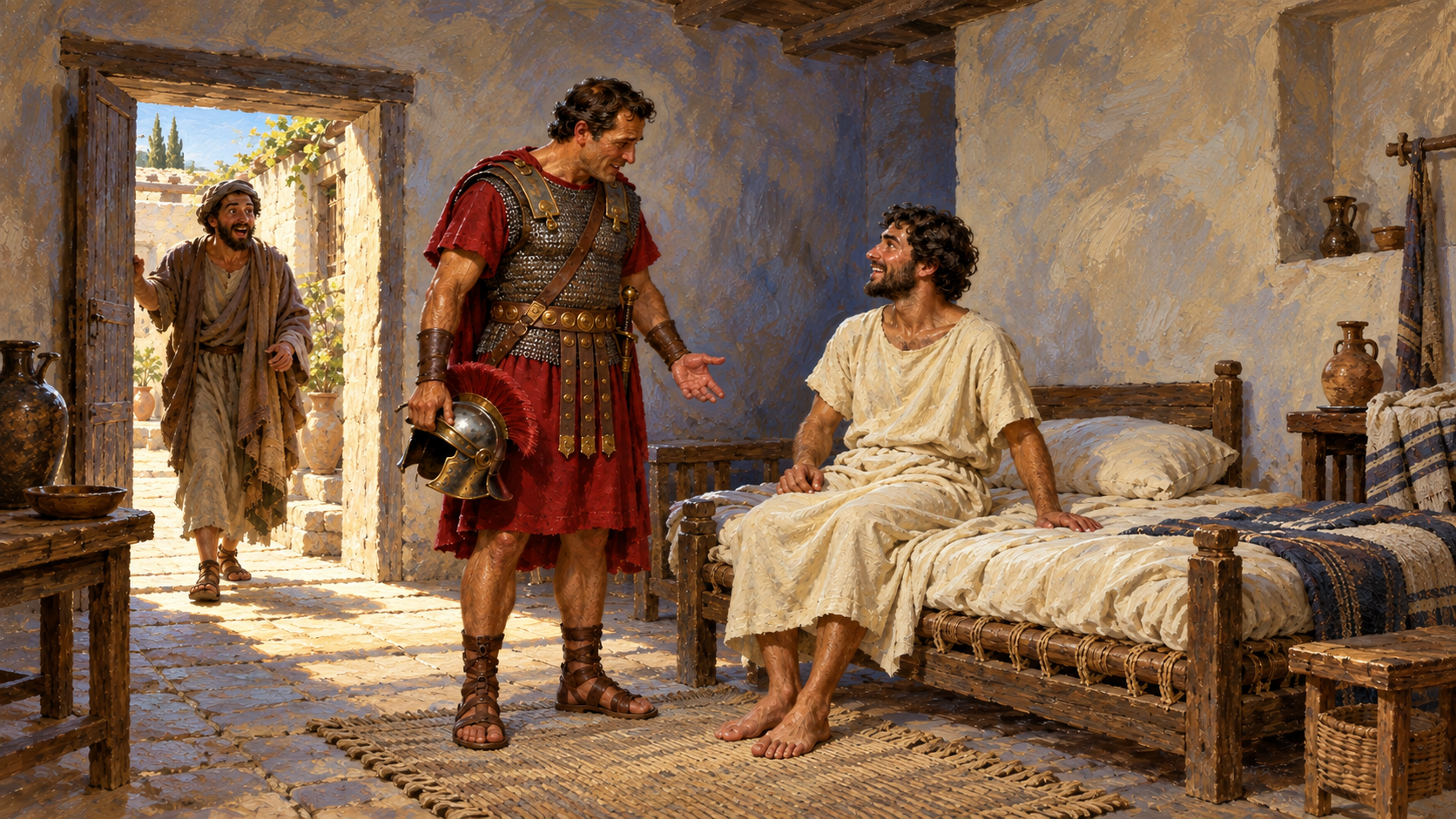
The centurion approached Jesus with a concern his military position could not resolve. A servant he valued was suffering and close to death. Other people spoke highly of the officer’s generosity, but he did not ask Jesus to repay a favor. He believed the Lord could heal his servant without even entering the house. I want to consider why Jesus commended that confidence so strongly, because we can admire the centurion’s faith while overlooking what he actually believed about Christ.
A Roman Officer Comes to Jesus
Matthew 8:5–13 and Luke 7:1–10 describe this encounter in Capernaum. A centurion was an officer in the Roman military system, with a title traditionally associated with command over a hundred men, although actual unit sizes could vary. Matthew and Luke do not identify his particular unit. They do make clear that he was a Gentile who understood both taking orders and giving them. His experience of authority would become central to his request.
Now when Jesus had entered Capernaum, a centurion came to Him, pleading with Him, saying, “Lord, my servant is lying at home paralyzed, dreadfully tormented.”
Luke adds that the servant was dear to the centurion and was about to die. This was no minor inconvenience in the household. The officer could command soldiers and direct his servants, but he could not order an illness to release someone he cared about. Having heard about Jesus, he sought help from Him.
Luke explains how that appeal reached the Lord.
And when he heard about Jesus, he sent elders of the Jews to Him, pleading with Him to come and heal his servant.
Here readers sometimes see a difficulty: Matthew says the centurion came, while Luke says he sent Jewish elders and later sent friends. I understand Matthew to be describing the centurion’s appeal through the representatives who carried it. We commonly attribute an action to the person responsible for it, even when someone else performs it on his behalf. The request belonged to the centurion, and the words his messengers delivered expressed his faith. Luke supplies the chain of communication that Matthew leaves unstated.
The elders were willing to plead earnestly for him, and they explained why:
And when they came to Jesus, they begged Him earnestly, saying that the one for whom He should do this was deserving, “for he loves our nation, and has built us a synagogue.”
The elders’ reference to the synagogue is another example of attributing an action to the person responsible for it: the centurion provided for its construction. Calling it his work does not require him to have laid every stone, just as calling the appeal his own does not require him to have delivered every word personally.
His love for their nation and his provision of a synagogue had earned their respect. Although he was outside Israel by birth, he had established goodwill through real generosity toward the Jewish people. The elders knew someone who had helped their community, and now they wanted Jesus to help him.
Calling him deserving did not mean his good works had placed Jesus in his debt. The elders were describing a man they regarded as worthy of help. The centurion himself would speak very differently about his standing before the Lord. A person can have an honorable reputation among his neighbors and still recognize that he cannot purchase God’s mercy. I can appreciate what this officer had done without treating the healing as wages Jesus owed him.
“Only Speak a Word”
Jesus went with the elders toward the house. Before He arrived, the centurion sent friends with a further message. Luke records the man’s explanation that he did not consider himself worthy to come to Jesus personally or receive Him under his roof. Matthew preserves his confidence that a word from the Lord would be enough.
The centurion answered and said, “Lord, I am not worthy that You should come under my roof. But only speak a word, and my servant will be healed. For I also am a man under authority, having soldiers under me. And I say to this one, ‘Go,’ and he goes; and to another, ‘Come,’ and he comes; and to my servant, ‘Do this,’ and he does it.”
By describing himself as “a man under authority,” the centurion explained why he expected his own commands to be obeyed. He occupied a place within an established military order. When he told a soldier to go somewhere, the soldier did not need his commander to walk beside him before carrying out the order. His servants likewise understood that an instruction required a response.
The Greek word exousia means authority, the right or power to act. It appears here in the centurion’s description of being “under authority,” and his examples show how delegated authority worked in his daily life. I understand him to be reasoning from the lesser to the greater. He was not assigning Jesus a place in the Roman chain of command. If a human officer could issue effective commands without accompanying the people who obeyed, why would Jesus need to stand beside the sickbed to heal?
The comparison did not mean military rank gave anyone power over disease. The centurion knew the limits of his position; that was why he had asked Jesus for help. He believed Christ possessed authority that could reach his servant where human commands were useless. Distance would not prevent the Lord from doing what He said.
The word logos means “word.” There was no secret formula hidden in the centurion’s request. He trusted the Person who would speak, because Christ’s word carried Christ’s authority. He did not ask for particular syllables, a ceremony, or a visible demonstration before he would believe.
We misuse this passage if we turn the centurion’s request into a method for controlling an outcome. He asked Jesus to speak; he did not claim that his own declarations now carried the same authority. Repeating forceful words cannot obligate the Lord to perform a miracle. I should learn from this man to bring a need to Christ and trust His ability to act, without pretending I can direct His power by adopting the right manner of speaking.
Jesus Marveled at Great Faith
When Jesus heard it, He marveled, and said to those who followed, “Assuredly, I say to you, I have not found such great faith, not even in Israel!”
Matthew says Jesus marveled, and we should take that description seriously. The eternal Son is fully God and fully man. The incarnation means that the eternal Son took on human flesh. He lived a genuine, sinless human life. He grew through normal human development, experienced hunger, needed sleep, and could weep or rejoice. His response to the centurion was also real. Recognizing His humanity does not require us to deny His deity or treat His human experiences as a performance.
Luke says Jesus turned to the crowd following Him and commended the centurion’s faith. The people around Him were being asked to notice something remarkable in this Gentile officer: he trusted Jesus’ authority so fully that he did not require the Lord to enter his house. His awareness of his own unworthiness had not kept him from asking. He had no claim on Jesus, yet he had confidence in what Jesus could do.
Mark 6:6 records Jesus marveling on another occasion, when people in Nazareth refused to believe. They knew His family and had heard His teaching, but their familiarity became an occasion for taking offense at Him. The centurion responded differently to what he had heard about Jesus. Where others found reasons to dismiss the Lord, he recognized authority worthy of his trust.
I need to hear that warning if I have spent years around Scripture. Familiar language, attendance at worship, and knowledge of biblical facts do not automatically mean I am trusting the Lord those Scriptures reveal. The centurion did not impress Jesus with emotional intensity or elaborate religious speech. He understood enough about Christ’s authority to entrust his servant’s desperate need to Him. The study A Complete Bible Study on Faith considers more fully what it means to trust God.
Many Will Come from East and West
Jesus then used the Gentile officer’s faith to speak about who would enter the kingdom.
And I say to you that many will come from east and west, and sit down with Abraham, Isaac, and Jacob in the kingdom of heaven. But the sons of the kingdom will be cast out into outer darkness. There will be weeping and gnashing of teeth.
The people coming from east and west picture the welcome of people from the nations into the promised kingdom. They sit with Abraham, Isaac, and Jacob, the patriarchs to whom God gave His promises. The centurion’s faith anticipates that welcome: a Gentile can trust Israel’s Messiah and receive mercy from Him.
The warning concerns people who presume that their inherited place guarantees their entrance. Those Jesus calls sons of the kingdom possess the privilege of belonging to the people among whom the kingdom was promised. Yet ancestry cannot take the place of faith in the King. The “outer darkness” describes their exclusion from the kingdom feast, accompanied by weeping and gnashing of teeth. Jesus is warning of the terrible grief of final loss, not merely the embarrassment of having misunderstood Him.
This gives Christians no grounds for contempt toward Jewish people. Abraham, Isaac, and Jacob are still at the feast when people from the nations arrive. Jesus is not announcing that God has discarded Israel or that being Jewish is itself the reason for exclusion. He is confronting unbelief and presumption. Gentiles who boast in their own religious position would be ignoring the very warning they claim to understand.
Ephesians 2 later explains that Gentiles who were far off are brought near by Christ’s blood. Their welcome rests on what the Messiah has done, not on a superior ancestry or a better record of achievement. I cannot rely on a Christian family, moral reputation, or familiarity with the Bible to accomplish what only Christ can do. The invitation to the nations magnifies God’s mercy while leaving every hearer responsible to believe. For the kingdom language itself, see The Kingdom of Heaven vs the Kingdom of God.
The Servant Was Healed That Same Hour
Then Jesus said to the centurion, “Go your way; and as you have believed, so let it be done for you.” And his servant was healed that same hour.
The healing occurred just as the centurion had believed it could. Jesus did not need to enter the house, perform a ceremony, or make physical contact with the servant. Luke says the messengers returned and found him well. The officer’s confidence had rested in the right Person, and the servant received the mercy for which he had pleaded.
The centurion’s concern for his servant also deserves attention. He used the access available to him to seek help for someone under his care. Authority can be abused by people who regard those beneath them as disposable, but this man pleaded for his servant’s life. If someone depends on me at home or at work, I should take that person’s suffering seriously rather than assume my responsibilities end when the work is done. Bringing another person’s need to the Lord is one way love puts faith into practice. We are asking Christ to help; we are not taking His unique place as the Savior and Mediator between God and people.
As we bring those needs to Him, we should be careful about making this particular healing a promise governing every request. Paul left Trophimus sick in Miletus, and Timothy suffered frequent infirmities. Paul himself asked for the removal of his thorn and received sustaining grace instead. Scripture does not identify the thorn precisely enough for us to insist that it was a particular disease, but the refusal of Paul’s request is clear. A faithful believer can ask for relief and receive an answer other than the one he sought.
I think it is reckless to blame a suffering Christian’s continued illness on a lack of faith. We can ask boldly for healing because Jesus has power to heal, while recognizing that His actions follow the Father’s wisdom. The centurion’s faith did not make him the Lord’s commander, and ours does not give us that position either. When Christ does grant healing in this life, the person still awaits the resurrection, when death will finally be removed from His people. A temporary recovery is a real mercy without being the full deliverance still to come.
John 4 provides another example of Christ healing across a distance. This is a separate event: a nobleman came to Jesus in Cana because his son was near death in Capernaum. He initially asked Jesus to come down before the child died. Jesus told him that his son lived, and the man believed His word and went home. His servants met him with news of the recovery, and he learned that it had happened at the hour Jesus spoke.
The nobleman’s son should not be confused with the centurion’s servant. The people, location of the request, and circumstances differ. Both healings nevertheless show why trusting Christ’s word is reasonable. Neither father nor officer had to see the recovery before believing that Jesus could act where they could not. A Bible Study on the Miracles of Jesus examines more of these demonstrations of His authority.
Acts 10 develops the welcome to Gentiles that Jesus anticipated in Matthew 8. It introduces another centurion, Cornelius, who feared God, prayed, and gave generously. God heard his prayers and directed him to send for Peter, but his good conduct did not remove his need to hear the gospel. Peter came and preached Christ, describing His ministry, His death on the tree, and His bodily resurrection. He declared Jesus to be the appointed Judge and proclaimed forgiveness through His name to everyone who believes.
While Peter was speaking, the Holy Spirit fell on the Gentile hearers. Their reception of the Spirit made their inclusion unmistakable to the Jewish believers accompanying him. Peter later explained that Cornelius had been directed to hear words by which he and his household would be saved (Acts 11:14). His generosity was not the purchase price of salvation. God brought the gospel to his household so they could hear and believe in Christ.
My Final Thoughts
The centurion’s humility did not make him hesitant about Christ’s ability to help. He knew he was unworthy, yet he trusted the Lord enough to bring his servant’s suffering before Him. I should approach Jesus with the same willingness to ask, while refusing to turn my service, generosity, or reputation into a demand that He answer on my terms.
The One who healed this servant is the eternal Son who took on human flesh, fully God and fully man, and lived without sin. He willingly endured the bodily punishment wicked people inflicted, shed His blood, and died for our sins. The Father did not punish Him. His saving work through His blood and death was complete when He died; afterward He was buried and rose bodily from the grave. We can trust the word of this risen Lord. That confidence should move us to care for people who need His mercy and bring their needs to Him, leaving the answer in His hands.