
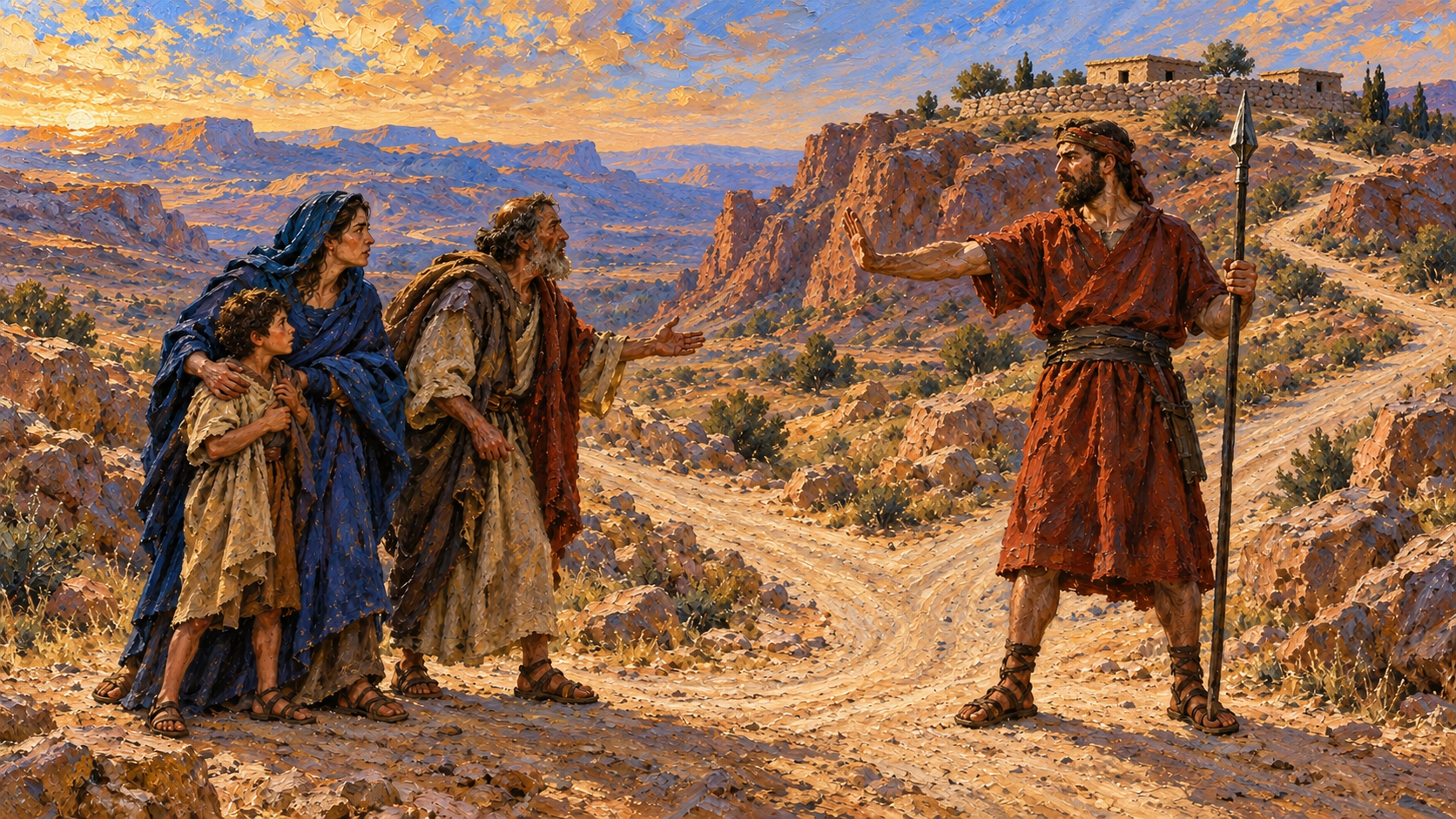
Obadiah confronts a nation that watched its brother’s disaster with satisfaction and then joined in the harm. Edom trusted its strongholds, wealth, and allies, but none could shield it from the Lord’s judgment. I want to follow the accusation carefully, because this short prophecy leads from Edom’s betrayal to the Day of the Lord and the promise that Israel will receive its inheritance under His rule.
Reading Obadiah as a Whole
The vision of Obadiah. Thus says the Lord GOD concerning Edom (We have heard a report from the LORD, And a messenger has been sent among the nations, saying, "Arise, and let us rise up against her for battle"): "Behold, I will make you small among the nations; You shall be greatly despised. The pride of your heart has deceived you, You who dwell in the clefts of the rock, Whose habitation is high; You who say in your heart, 'Who will bring me down to the ground?' Though you ascend as high as the eagle, And though you set your nest among the stars, From there I will bring you down," says the LORD. "If thieves had come to you, If robbers by night– Oh, how you will be cut off!– Would they not have stolen till they had enough? If grape-gatherers had come to you, Would they not have left some gleanings? "Oh, how Esau shall be searched out! How his hidden treasures shall be sought after! All the men in your confederacy Shall force you to the border; The men at peace with you Shall deceive you and prevail against you. Those who eat your bread shall lay a trap for you. No one is aware of it. "Will I not in that day," says the LORD, "Even destroy the wise men from Edom, And understanding from the mountains of Esau? Then your mighty men, O Teman, shall be dismayed, To the end that everyone from the mountains of Esau May be cut off by slaughter. "For violence against your brother Jacob, Shame shall cover you, And you shall be cut off forever. In the day that you stood on the other side– In the day that strangers carried captive his forces, When foreigners entered his gates And cast lots for Jerusalem– Even you were as one of them. "But you should not have gazed on the day of your brother In the day of his captivity; Nor should you have rejoiced over the children of Judah In the day of their destruction; Nor should you have spoken proudly In the day of distress. You should not have entered the gate of My people In the day of their calamity. Indeed, you should not have gazed on their affliction In the day of their calamity, Nor laid hands on their substance In the day of their calamity. You should not have stood at the crossroads To cut off those among them who escaped; Nor should you have delivered up those among them who remained In the day of distress. "For the day of the LORD upon all the nations is near; As you have done, it shall be done to you; Your reprisal shall return upon your own head. For as you drank on My holy mountain, So shall all the nations drink continually; Yes, they shall drink, and swallow, And they shall be as though they had never been. "But on Mount Zion there shall be deliverance, And there shall be holiness; The house of Jacob shall possess their possessions. The house of Jacob shall be a fire, And the house of Joseph a flame; But the house of Esau shall be stubble; They shall kindle them and devour them, And no survivor shall remain of the house of Esau," For the LORD has spoken. The South shall possess the mountains of Esau, And the Lowland shall possess Philistia. They shall possess the fields of Ephraim And the fields of Samaria. Benjamin shall possess Gilead. And the captives of this host of the children of Israel Shall possess the land of the Canaanites As far as Zarephath. The captives of Jerusalem who are in Sepharad Shall possess the cities of the South. Then saviors shall come to Mount Zion To judge the mountains of Esau, And the kingdom shall be the LORD's.
Obadiah is the shortest book in the Old Testament, with one chapter of twenty-one verses. It belongs to the Twelve Minor Prophets; Minor refers to length, not lesser authority. References are often written simply as Obadiah 10 or Obadiah 21. The book moves from the collapse of Edom’s supposed security to the violence that brought judgment, then widens to the nations and ends with deliverance on Zion. The final declaration places every ruler under the Lord: “the kingdom shall be the LORD’s.”
We know little about the prophet. His name means a servant or worshiper of Yahweh, but several biblical men bore that name. He gives no father, hometown, or reigning king by which to identify him with one of them. The date is also disputed. Verses 10–14 fit Edom’s conduct when Babylon destroyed Jerusalem in 586 BC, and Psalm 137 remembers Edom urging that destruction onward. Other readers connect the prophecy with the earlier attack by Philistines and Arabians during Jehoram’s reign.
Jeremiah 49 shares striking language with Obadiah. One prophet may have used the other’s words, or both may have drawn on an earlier prophetic message; Scripture does not settle the direction of that relationship. The precise date remains open, but the accusation does not: foreigners entered Jerusalem, and Edom used Judah’s distress to its own advantage. We need to understand those peoples and their relationship before making the prophecy a lesson about our own attitudes.
Brothers Who Became Nations
This is the genealogy of Isaac, Abraham's son. Abraham begot Isaac. Isaac was forty years old when he took Rebekah as wife, the daughter of Bethuel the Syrian of Padan Aram, the sister of Laban the Syrian. Now Isaac pleaded with the LORD for his wife, because she was barren; and the LORD granted his plea, and Rebekah his wife conceived. But the children struggled together within her; and she said, "If all is well, why am I like this?" So she went to inquire of the LORD. And the LORD said to her: "Two nations are in your womb, Two peoples shall be separated from your body; One people shall be stronger than the other, And the older shall serve the younger." So when her days were fulfilled for her to give birth, indeed there were twins in her womb. And the first came out red. He was like a hairy garment all over; so they called his name Esau. Afterward his brother came out, and his hand took hold of Esau's heel; so his name was called Jacob. Isaac was sixty years old when she bore them. So the boys grew. And Esau was a skillful hunter, a man of the field; but Jacob was a mild man, dwelling in tents. And Isaac loved Esau because he ate of his game, but Rebekah loved Jacob. Now Jacob cooked a stew; and Esau came in from the field, and he was weary. And Esau said to Jacob, "Please feed me with that same red stew, for I am weary." Therefore his name was called Edom. But Jacob said, "Sell me your birthright as of this day." And Esau said, "Look, I am about to die; so what is this birthright to me?" Then Jacob said, "Swear to me as of this day." So he swore to him, and sold his birthright to Jacob. And Jacob gave Esau bread and stew of lentils; then he ate and drank, arose, and went his way. Thus Esau despised his birthright.
Jacob and Esau were twin sons of Isaac and Rebekah. Before their birth, God told Rebekah that two nations would come from them and that the older would serve the younger. Esau was born first; Jacob followed holding his heel. Later, Esau sold his birthright, the privileges belonging to him as the firstborn, for a meal. Genesis connects the name Edom with the red stew.
God’s covenant choice of Jacob does not excuse Jacob’s conduct. He took advantage of Esau’s hunger and later joined Rebekah in deceiving Isaac to obtain the blessing. God’s purpose did not rest on Jacob being morally superior to his brother. The deception also brought consequences within the family.
Now it happened, as soon as Isaac had finished blessing Jacob, and Jacob had scarcely gone out from the presence of Isaac his father, that Esau his brother came in from his hunting. He also had made savory food, and brought it to his father, and said to his father, "Let my father arise and eat of his son's game, that your soul may bless me." And his father Isaac said to him, "Who are you?" So he said, "I am your son, your firstborn, Esau." Then Isaac trembled exceedingly, and said, "Who? Where is the one who hunted game and brought it to me? I ate all of it before you came, and I have blessed him–and indeed he shall be blessed." When Esau heard the words of his father, he cried with an exceedingly great and bitter cry, and said to his father, "Bless me–me also, O my father!" But he said, "Your brother came with deceit and has taken away your blessing." And Esau said, "Is he not rightly named Jacob? For he has supplanted me these two times. He took away my birthright, and now look, he has taken away my blessing!" And he said, "Have you not reserved a blessing for me?" Then Isaac answered and said to Esau, "Indeed I have made him your master, and all his brethren I have given to him as servants; with grain and wine I have sustained him. What shall I do now for you, my son?" And Esau said to his father, "Have you only one blessing, my father? Bless me–me also, O my father!" And Esau lifted up his voice and wept. Then Isaac his father answered and said to him: "Behold, your dwelling shall be of the fatness of the earth, And of the dew of heaven from above. By your sword you shall live, And you shall serve your brother; And it shall come to pass, when you become restless, That you shall break his yoke from your neck." So Esau hated Jacob because of the blessing with which his father blessed him, and Esau said in his heart, "The days of mourning for my father are at hand; then I will kill my brother Jacob."
Esau’s grief became hatred, and he resolved to kill Jacob after Isaac’s death. Jacob fled. The brothers eventually met peacefully, and Esau settled in Seir, but their descendants had a troubled relationship over many generations. The study on Esau considers his life further. Obadiah’s charge concerns what Edom later did to brother Jacob when that family bond should have called for mercy. Centuries before Jerusalem’s fall, Moses had appealed to the same kinship.
Now Moses sent messengers from Kadesh to the king of Edom. "Thus says your brother Israel: 'You know all the hardship that has befallen us, how our fathers went down to Egypt, and we dwelt in Egypt a long time, and the Egyptians afflicted us and our fathers. When we cried out to the LORD, He heard our voice and sent the Angel and brought us up out of Egypt; now here we are in Kadesh, a city on the edge of your border. Please let us pass through your country. We will not pass through fields or vineyards, nor will we drink water from wells; we will go along the King's Highway; we will not turn aside to the right hand or to the left until we have passed through your territory.'" Then Edom said to him, "You shall not pass through my land, lest I come out against you with the sword." So the children of Israel said to him, "We will go by the Highway, and if I or my livestock drink any of your water, then I will pay for it; let me only pass through on foot, nothing more." Then he said, "You shall not pass through." So Edom came out against them with many men and with a strong hand. Thus Edom refused to give Israel passage through his territory; so Israel turned away from him.
Moses addressed Edom’s king as a brother and asked for peaceful passage along the King’s Highway. Israel promised to leave fields and vineyards alone and offered payment for any water used. Edom answered with the threat of the sword and came out in strength, so Israel turned away. Even after that refusal, God’s law explicitly forbade Israel to abhor an Edomite because he was a brother.
"He who is emasculated by crushing or mutilation shall not enter the assembly of the LORD. "One of illegitimate birth shall not enter the assembly of the LORD; even to the tenth generation none of his descendants shall enter the assembly of the LORD. "An Ammonite or Moabite shall not enter the assembly of the LORD; even to the tenth generation none of his descendants shall enter the assembly of the LORD forever, because they did not meet you with bread and water on the road when you came out of Egypt, and because they hired against you Balaam the son of Beor from Pethor of Mesopotamia, to curse you. Nevertheless the LORD your God would not listen to Balaam, but the LORD your God turned the curse into a blessing for you, because the LORD your God loves you. You shall not seek their peace nor their prosperity all your days forever. "You shall not abhor an Edomite, for he is your brother. You shall not abhor an Egyptian, because you were an alien in his land. The children of the third generation born to them may enter the assembly of the LORD.
That command prevents us from turning Obadiah into permission to despise someone because of his ancestry. God judged Edom’s violence and hostility, not an offense inherent in having Edomite forebears. The nations’ relationship included periods of subjugation and revolt: David placed garrisons in Edom, and Edom later regained independence from Judah during Jehoram’s reign.
In his days Edom revolted against Judah's authority, and made a king over themselves. So Jehoram went out with his officers, and all his chariots with him. And he rose by night and attacked the Edomites who had surrounded him and the captains of the chariots. Thus Edom has been in revolt against Judah's authority to this day. At that time Libnah revolted against his rule, because he had forsaken the LORD God of his fathers. Moreover he made high places in the mountains of Judah, and caused the inhabitants of Jerusalem to commit harlotry, and led Judah astray. And a letter came to him from Elijah the prophet, saying, Thus says the LORD God of your father David: Because you have not walked in the ways of Jehoshaphat your father, or in the ways of Asa king of Judah, but have walked in the way of the kings of Israel, and have made Judah and the inhabitants of Jerusalem to play the harlot like the harlotry of the house of Ahab, and also have killed your brothers, those of your father's household, who were better than yourself, behold, the LORD will strike your people with a serious affliction–your children, your wives, and all your possessions; and you will become very sick with a disease of your intestines, until your intestines come out by reason of the sickness, day by day. Moreover the LORD stirred up against Jehoram the spirit of the Philistines and the Arabians who were near the Ethiopians. And they came up into Judah and invaded it, and carried away all the possessions that were found in the king's house, and also his sons and his wives, so that there was not a son left to him except Jehoahaz, the youngest of his sons. After all this the LORD struck him in his intestines with an incurable disease. Then it happened in the course of time, after the end of two years, that his intestines came out because of his sickness; so he died in severe pain. And his people made no burning for him, like the burning for his fathers. He was thirty-two years old when he became king. He reigned in Jerusalem eight years and, to no one's sorrow, departed. However they buried him in the City of David, but not in the tombs of the kings.
Jehoram’s reign included both Edom’s revolt and an invasion by Philistines and Arabians. That is why some interpreters place Obadiah against this earlier background. It does not prove the date, but it helps explain the alternative to the Babylonian setting. In either reading, the descendants of Esau exploited the calamity of Jacob’s descendants.
Pride, False Security, and the Collapse of Edom
The opening title, Lord GOD, joins Adonai, meaning Lord or Master, with Yahweh, God’s covenant name. The summons to the nations comes from Him. Edom’s collapse would involve human armies and political decisions, yet the Lord announced the judgment and would bring it about. His use of nations to carry out that sentence did not make their chosen violence righteous or remove their responsibility.
Edom’s homeland in Seir lay south and southeast of Judah, where cliffs, ravines, and elevated strongholds offered genuine protection. Petra’s later rock architecture illustrates the region’s dramatic terrain, but Obadiah is not a description of every feature of that later city. The prophecy begins with real defensive advantages and carries the nation’s imagined security as high as an eagle’s nest among the stars.
The Lord named the deception: Edom’s own pride. Its heart asked, “Who will bring me down to the ground?” The answer was, “I will bring you down.” Military strength and difficult approaches did not make the nation independent of the One who made those mountains. Edom had mistaken a useful defense against an enemy for protection from accountability to God. His announced sentence would make it small and despised despite its confidence.
The comparison with thieves and grape gatherers explains how thorough the loss would be. Thieves ordinarily stop when they have enough, and harvesters leave some gleanings behind. Edom’s hidden treasures would be searched out, leaving it without the reserves it believed no enemy could reach. Jeremiah’s prophecy against Edom uses the same language of exposed hiding places and failed security.
Against Edom. Thus says the LORD of hosts: "Is wisdom no more in Teman? Has counsel perished from the prudent? Has their wisdom vanished? Flee, turn back, dwell in the depths, O inhabitants of Dedan! For I will bring the calamity of Esau upon him, The time that I will punish him. If grape-gatherers came to you, Would they not leave some gleaning grapes? If thieves by night, Would they not destroy until they have enough? But I have made Esau bare; I have uncovered his secret places, And he shall not be able to hide himself. His descendants are plundered, His brethren and his neighbors, And he is no more. Leave your fatherless children, I will preserve them alive; And let your widows trust in Me." For thus says the LORD: "Behold, those whose judgment was not to drink of the cup have assuredly drunk. And are you the one who will altogether go unpunished? You shall not go unpunished, but you shall surely drink of it. For I have sworn by Myself," says the LORD, "that Bozrah shall become a desolation, a reproach, a waste, and a curse. And all its cities shall be perpetual wastes." I have heard a message from the LORD, And an ambassador has been sent to the nations: "Gather together, come against her, And rise up to battle! "For indeed, I will make you small among nations, Despised among men. Your fierceness has deceived you, The pride of your heart, O you who dwell in the clefts of the rock, Who hold the height of the hill! Though you make your nest as high as the eagle, I will bring you down from there," says the LORD. "Edom also shall be an astonishment; Everyone who goes by it will be astonished And will hiss at all its plagues. As in the overthrow of Sodom and Gomorrah And their neighbors," says the LORD, "No one shall remain there, Nor shall a son of man dwell in it. "Behold, he shall come up like a lion from the floodplain of the Jordan Against the dwelling place of the strong; But I will suddenly make him run away from her. And who is a chosen man that I may appoint over her? For who is like Me? Who will arraign Me? And who is that shepherd Who will withstand Me?" Therefore hear the counsel of the LORD that He has taken against Edom, And His purposes that He has proposed against the inhabitants of Teman: Surely the least of the flock shall draw them out; Surely He shall make their dwelling places desolate with them. The earth shakes at the noise of their fall; At the cry its noise is heard at the Red Sea. Behold, He shall come up and fly like the eagle, And spread His wings over Bozrah; The heart of the mighty men of Edom in that day shall be Like the heart of a woman in birth pangs.
Teman was associated with Edom’s wisdom; Job calls Eliphaz a Temanite, and Jeremiah asks whether counsel has vanished there. Obadiah does not commend ignorance. Wisdom serves us when it begins with the fear of the Lord, but clever planning cannot make proud violence acceptable or devise an escape from a judgment God has fixed.
The allies Edom counted on would also turn against it. People at peace with the nation would deceive and overpower it, and those who ate its bread would lay a trap. The people it welcomed as friends would help bring it down. Its confidence in its own understanding would leave it unable to recognize the danger.
Geography, wealth, military strength, counsel, and alliances all had practical value. Edom’s error was treating them as grounds for refusing God’s authority. The nation that had betrayed brother Jacob would discover that its political friends could not provide the faithfulness it had refused to show.
Violence Against Jacob and the Day of the Lord
Obadiah 10 gives the reason for the sentence: violence against brother Jacob. Ezekiel’s prophecy against Mount Seir exposes the same ancient hatred, bloodshed, and desire to seize Israel’s land.
Moreover the word of the LORD came to me, saying, "Son of man, set your face against Mount Seir and prophesy against it, and say to it, 'Thus says the Lord GOD: "Behold, O Mount Seir, I am against you; I will stretch out My hand against you, And make you most desolate; I shall lay your cities waste, And you shall be desolate. Then you shall know that I am the LORD. "Because you have had an ancient hatred, and have shed the blood of the children of Israel by the power of the sword at the time of their calamity, when their iniquity came to an end, therefore, as I live," says the Lord GOD, "I will prepare you for blood, and blood shall pursue you; since you have not hated blood, therefore blood shall pursue you. Thus I will make Mount Seir most desolate, and cut off from it the one who leaves and the one who returns. And I will fill its mountains with the slain; on your hills and in your valleys and in all your ravines those who are slain by the sword shall fall. I will make you perpetually desolate, and your cities shall be uninhabited; then you shall know that I am the LORD. "Because you have said, 'These two nations and these two countries shall be mine, and we will possess them,' although the LORD was there, therefore, as I live," says the Lord GOD, "I will do according to your anger and according to the envy which you showed in your hatred against them; and I will make Myself known among them when I judge you. Then you shall know that I am the LORD. I have heard all your blasphemies which you have spoken against the mountains of Israel, saying, 'They are desolate; they are given to us to consume.' Thus with your mouth you have boasted against Me and multiplied your words against Me; I have heard them." 'Thus says the Lord GOD: "The whole earth will rejoice when I make you desolate. As you rejoiced because the inheritance of the house of Israel was desolate, so I will do to you; you shall be desolate, O Mount Seir, as well as all of Edom–all of it! Then they shall know that I am the LORD."'
Edom wanted both countries for itself even though the Lord was there. It treated God’s presence and covenant promise as obstacles it could disregard when the land seemed available. Jerusalem’s sins had brought real discipline, but that did not give Edom authority to hate the people, shed their blood, or take pleasure in their ruin. God can discipline His people and judge those who exploit their suffering.
When foreigners entered Jerusalem and carried Judah’s forces captive, Edom stood “on the other side.” Obadiah nevertheless counted it as one of the invaders. Its position apart from the attacking force did not establish innocence when its conduct served the attackers. Psalm 137 remembers Edom’s encouragement of Jerusalem’s destruction.
By the rivers of Babylon, There we sat down, yea, we wept When we remembered Zion. We hung our harps Upon the willows in the midst of it. For there those who carried us away captive asked of us a song, And those who plundered us requested mirth, Saying, "Sing us one of the songs of Zion!" How shall we sing the LORD's song In a foreign land? If I forget you, O Jerusalem, Let my right hand forget its skill! If I do not remember you, Let my tongue cling to the roof of my mouth– If I do not exalt Jerusalem Above my chief joy. Remember, O LORD, against the sons of Edom The day of Jerusalem, Who said, "Raze it, raze it, To its very foundation!" O daughter of Babylon, who are to be destroyed, Happy the one who repays you as you have served us! Happy the one who takes and dashes Your little ones against the rock!
The call to raze Jerusalem came from people watching a real catastrophe. The psalm’s grief and longing for judgment should not be softened until the victims’ suffering disappears, nor turned into permission for us to take violent revenge. Edom’s involvement added the betrayal of kin to the violence Judah was already enduring.
Obadiah’s charges move from looking on with satisfaction to rejoicing and proud speech, then to entering the city and taking its property. Finally, Edom stood at the crossroads to cut off fugitives and handed survivors over. This was more than failing to feel enough sympathy. People escaping danger found a brother nation helping to close their way of escape.
In Obadiah 15, the prophecy widens from Edom to the Day of the Lord upon all nations. Joel likewise joins judgment of the nations with the restoration of Judah and Jerusalem, including judgment on those who scattered God’s people, divided His land, and sold vulnerable people for gain.
"For behold, in those days and at that time, When I bring back the captives of Judah and Jerusalem, I will also gather all nations, And bring them down to the Valley of Jehoshaphat; And I will enter into judgment with them there On account of My people, My heritage Israel, Whom they have scattered among the nations; They have also divided up My land. They have cast lots for My people, Have given a boy as payment for a harlot, And sold a girl for wine, that they may drink. "Indeed, what have you to do with Me, O Tyre and Sidon, and all the coasts of Philistia? Will you retaliate against Me? But if you retaliate against Me, Swiftly and speedily I will return your retaliation upon your own head; Because you have taken My silver and My gold, And have carried into your temples My prized possessions. Also the people of Judah and the people of Jerusalem You have sold to the Greeks, That you may remove them far from their borders. "Behold, I will raise them Out of the place to which you have sold them, And will return your retaliation upon your own head. I will sell your sons and your daughters Into the hand of the people of Judah, And they will sell them to the Sabeans, To a people far off; For the LORD has spoken." Proclaim this among the nations: "Prepare for war! Wake up the mighty men, Let all the men of war draw near, Let them come up. Beat your plowshares into swords And your pruning hooks into spears; Let the weak say, 'I am strong.'" Assemble and come, all you nations, And gather together all around. Cause Your mighty ones to go down there, O LORD. "Let the nations be wakened, and come up to the Valley of Jehoshaphat; For there I will sit to judge all the surrounding nations. Put in the sickle, for the harvest is ripe. Come, go down; For the winepress is full, The vats overflow– For their wickedness is great." Multitudes, multitudes in the valley of decision! For the day of the LORD is near in the valley of decision. The sun and moon will grow dark, And the stars will diminish their brightness. The LORD also will roar from Zion, And utter His voice from Jerusalem; The heavens and earth will shake; But the LORD will be a shelter for His people, And the strength of the children of Israel. "So you shall know that I am the LORD your God, Dwelling in Zion My holy mountain. Then Jerusalem shall be holy, And no aliens shall ever pass through her again." And it will come to pass in that day That the mountains shall drip with new wine, The hills shall flow with milk, And all the brooks of Judah shall be flooded with water; A fountain shall flow from the house of the LORD And water the Valley of Acacias. "Egypt shall be a desolation, And Edom a desolate wilderness, Because of violence against the people of Judah, For they have shed innocent blood in their land. But Judah shall abide forever, And Jerusalem from generation to generation. For I will acquit them of the guilt of bloodshed, whom I had not acquitted; For the LORD dwells in Zion."
Edom’s judgment belongs within that wider reckoning and provides a pattern of it. The Lord will confront rebellious powers in judgment and wrath while delivering His people. Historical judgments anticipate that intervention, but they have not exhausted the promises of Israel’s restoration and God’s public kingdom. Joel names Edom as a desolate wilderness because of violence against Judah; these are actual peoples and places, not merely pictures of private spiritual experience. The study on the Day of the Lord examines the wider prophetic passages.
“As you have done, it shall be done to you” describes fitting judgment from the Lord. It is not karma or a claim that events somehow balance themselves. God knows the intention, the opportunity abused, and the harm inflicted. Edom’s strength could not entitle it to escape consequences while its victims suffered them.
I understand the drinking on God’s holy mountain in Obadiah 16 as Edom celebrating Jerusalem’s defeat, followed by the nations drinking the cup of judgment. Some readers instead understand the first drinkers as Judah already experiencing judgment; the Hebrew plural makes the addressees a debated question, as the NET translators’ notes explain. The judgment on the nations is clear in either reading. Their proud power will end under God’s sentence. His offer of grace does not make Him indifferent to bloodshed and betrayal.
Zion Restored and the Kingdom Belonging to the Lord
Obadiah 17 turns toward Mount Zion, where there will be deliverance and holiness. Jacob’s house will possess its inheritance. This includes physical restoration and spiritual renewal: the people are restored to what God promised, and Zion is holy under His rule. Returns from exile gave historical expressions of that hope, but Jerusalem has not yet experienced the full holiness and security the prophets connect with Messiah’s government.
Jacob and Joseph appear as fire and flame, picturing reunited Israel, while Esau is the stubble consumed. The Lord will use restored Israel to carry out His sentence. The statement that no survivor remains of Esau’s house concerns the hostile nation being judged; I would not turn it into a claim that every possible biological descendant must be erased.
Edom ceased to exist as an independent kingdom, while people and traditions associated with it continued in Idumea. Idumeans were still known in the New Testament period and became involved in the surrounding Jewish religious and political world. Amos also places a remnant of Edom within the restoration of David’s fallen house.
"On that day I will raise up The tabernacle of David, which has fallen down, And repair its damages; I will raise up its ruins, And rebuild it as in the days of old; That they may possess the remnant of Edom, And all the Gentiles who are called by My name," Says the LORD who does this thing. "Behold, the days are coming," says the LORD, "When the plowman shall overtake the reaper, And the treader of grapes him who sows seed; The mountains shall drip with sweet wine, And all the hills shall flow with it. I will bring back the captives of My people Israel; They shall build the waste cities and inhabit them; They shall plant vineyards and drink wine from them; They shall also make gardens and eat fruit from them. I will plant them in their land, And no longer shall they be pulled up From the land I have given them," Says the LORD your God.
Messiah is David’s greater Son. He gathers Gentiles called by God’s name and will rule literally from David’s throne. Their inclusion does not cancel Israel’s promised planting in its own land. I cannot make the church’s spiritual blessings an explanation for God abandoning those national promises.
Obadiah 19–20 names the territories of restoration. People of the South possess the mountains of Esau, and those of the lowland possess Philistia. The fields of Ephraim and Samaria are included, and Benjamin possesses Gilead to the east. These named lands give concrete meaning to the reversal of displacement. They cannot be reduced to an inward feeling, though prophetic geography can gather peoples and territories from different periods without supplying every detail of a future boundary.
The exiles’ possessions reach as far as Zarephath, on the Phoenician coast between Tyre and Sidon. Jerusalem’s captives in Sepharad possess cities of the South. Sepharad’s location is uncertain: proposals include Sardis in Asia Minor, Sparta in Greece, and Spain, the name’s later Jewish association. The NET notes on verse 20 summarize those possibilities. The promise does not depend on our settling the location. God knows where His scattered people are and can gather them to the inheritance He has promised.
The saviors of Obadiah 21 are deliverers who come to Zion to judge the mountains of Esau. The plural can describe governors or other agents through whom God administers deliverance and judgment, as He used deliverers in Judges. They serve under His authority; they do not compete with Jesus as the only Savior and Mediator. The final declaration that the kingdom belongs to the Lord keeps His servants in their proper place. Every judge, governor, and deliverer remains accountable to Him.
Revelation brings the public victory of that King into view as Christ returns to confront the nations gathered against Him.
Now I saw heaven opened, and behold, a white horse. And He who sat on him was called Faithful and True, and in righteousness He judges and makes war. His eyes were like a flame of fire, and on His head were many crowns. He had a name written that no one knew except Himself. He was clothed with a robe dipped in blood, and His name is called The Word of God. And the armies in heaven, clothed in fine linen, white and clean, followed Him on white horses. Now out of His mouth goes a sharp sword, that with it He should strike the nations. And He Himself will rule them with a rod of iron. He Himself treads the winepress of the fierceness and wrath of Almighty God. And He has on His robe and on His thigh a name written: KING OF KINGS AND LORD OF LORDS. Then I saw an angel standing in the sun; and he cried with a loud voice, saying to all the birds that fly in the midst of heaven, "Come and gather together for the supper of the great God, that you may eat the flesh of kings, the flesh of captains, the flesh of mighty men, the flesh of horses and of those who sit on them, and the flesh of all people, free and slave, both small and great." And I saw the beast, the kings of the earth, and their armies, gathered together to make war against Him who sat on the horse and against His army. Then the beast was captured, and with him the false prophet who worked signs in his presence, by which he deceived those who received the mark of the beast and those who worshiped his image. These two were cast alive into the lake of fire burning with brimstone. And the rest were killed with the sword which proceeded from the mouth of Him who sat on the horse. And all the birds were filled with their flesh.
Christ returns bodily as Faithful and True, judges righteously, and defeats the rebellious armies. Revelation 20 then describes His thousand-year reign. I understand Obadiah’s promised kingdom within that future rule: Messiah will restore Israel and reign from David’s throne. Jesus is not one regional victor among others. Every nation will answer to the King of kings.
That coming judgment makes me consider what I use to avoid accountability now. Money, citizenship, reputation, technology, and access to information can give real protection or advantage. None can conceal sin from God. I need to confess pride before it turns those benefits into excuses for wrongdoing or makes cleverness a means of defending what Scripture condemns. The study on the pride of men considers that deception further.
I also need to hear how Obadiah’s charges move from gloating to active harm. Enjoying someone’s distress can make contemptuous speech seem acceptable, and contempt can prepare us to participate in the harm. The passage names Edom’s acts rather than letting it shelter behind the claim that others began the invasion. It had choices about its own conduct, and the Lord held it responsible for them.
When another person is in danger, we should help protect him rather than use his vulnerability for gain. When we have an opportunity to help, watching with satisfaction is already a corrupt response. Friendship and kinship bring responsibilities that cannot be set aside simply because betrayal offers an advantage.
Our refuge is Jesus Christ, the eternal Son, fully God and fully man, born of a virgin and without sin. Wicked men tortured and killed Him, and He willingly bore that physical punishment for our sins in His innocent body. He voluntarily shed His blood and died, completing His saving work before His burial and bodily resurrection. The Father did not punish, curse, abandon, strike, bruise, or pour wrath on Jesus.
Christ died for the whole world, and God’s offer of salvation is genuine, though people can resist and reject Him. Everyone who repents and believes in Jesus is forgiven, declared righteous before God, and born again as a new creation. The Holy Spirit indwells and seals that believer, whose salvation is eternally secure. Obedience neither earns salvation nor keeps us saved, but the new life should be evident in how we live. Security does not permit lawlessness, and a shallow profession cannot establish that someone has truly been born again. The coming King offers mercy now.
My Final Thoughts
Edom trusted real advantages until they became reasons to ignore God and exploit a brother’s calamity. The Lord saw the rejoicing, the plunder, and the fugitives handed over, and His judgment answered those acts. He also promised deliverance on Zion and Israel’s inheritance under His King. I want that warning to correct how I use my own advantages and how I treat people who need help. Since the kingdom belongs to the Lord, we have reason to humble ourselves, receive His mercy, and trust Him to keep His promises.