
Pride is easy to recognize when someone openly boasts, but it can also appear in a refusal to receive correction or a constant need to compare ourselves with others. Even claims of unworthiness can sometimes become a way to draw attention back to ourselves. I want to understand what Scripture condemns without confusing humility with self-hatred, incompetence, or surrendering a responsibility God has given us.
What Pride Is—and What It Is Not
The preparations of the heart belong to man, But the answer of the tongue is from the LORD. All the ways of a man are pure in his own eyes, But the LORD weighs the spirits. Commit your works to the LORD, And your thoughts will be established. The LORD has made all for Himself, Yes, even the wicked for the day of doom. Everyone proud in heart is an abomination to the LORD; Though they join forces, none will go unpunished. In mercy and truth Atonement is provided for iniquity; And by the fear of the LORD one departs from evil. When a man's ways please the LORD, He makes even his enemies to be at peace with him. Better is a little with righteousness, Than vast revenues without justice. A man's heart plans his way, But the LORD directs his steps. Divination is on the lips of the king; His mouth must not transgress in judgment. Honest weights and scales are the LORD's; All the weights in the bag are His work. It is an abomination for kings to commit wickedness, For a throne is established by righteousness. Righteous lips are the delight of kings, And they love him who speaks what is right. As messengers of death is the king's wrath, But a wise man will appease it. In the light of the king's face is life, And his favor is like a cloud of the latter rain. How much better to get wisdom than gold! And to get understanding is to be chosen rather than silver. The highway of the upright is to depart from evil; He who keeps his way preserves his soul. Pride goes before destruction, And a haughty spirit before a fall. Better to be of a humble spirit with the lowly, Than to divide the spoil with the proud. He who heeds the word wisely will find good, And whoever trusts in the LORD, happy is he.
Proverbs begins with people making plans and thinking their own ways are pure, while the Lord weighs their motives and directs their steps. Its warning about pride belongs with its instructions about honest scales, righteous government, and receiving wisdom. A proud heart does not remain a private feeling. It affects what we plan, how we speak, and whether we believe anyone has the right to correct us.
Sinful pride claims glory, control, or independence that does not belong to us. It resents our dependence on God and treats His moral authority as an intrusion. That same disposition can turn other people into rivals to surpass or obstacles to remove. Humility receives the truth about our place before God and lets that truth govern how we treat them.
The words translated pride need to be read in context. In the Masoretic text, the traditional Hebrew text of the Old Testament, ga’on can describe majesty or arrogant exaltation. Isaiah 2:10 uses it for the Lord’s rightful majesty. Zadon concerns insolence or presumption, as the NET note on Proverbs 11:2 explains. Other Hebrew expressions describe lofty hearts, raised eyes, and a haughty spirit. The context tells us whether an exalted position rightly belongs to God or is wrongly being claimed by a creature.
The New Testament likewise describes arrogance, boasting, conceit, and love of first place, including what John calls the pride of life. Its words expose pretension and the desire for personal glory. We should attend to the conduct being described rather than assume that every use of the English word pride names the same sin.
A child can be pleased to learn, a worker can value sound craftsmanship, and a persecuted person can refuse shame unjustly imposed by others. Paul rejoiced in churches and boasted in what Christ accomplished through his ministry. God’s own majesty truly belongs to Him, and recognizing His gifts need not compete with His glory. Sin enters when gratitude gives way to claiming that we are independent of Him or entitled to stand above other people.
A skilled musician does not need to deny his ability, and a leader does not need to become indecisive. Both need gratitude, a willingness to learn, and a commitment to use their gifts for others under God’s word. A person may refuse those responsibilities under a claim of humility, or repeatedly announce his unworthiness to obtain reassurance and praise. Feeling inadequate does not, by itself, establish either motive. We need to ask whether we are telling the truth and serving faithfully, or trying to manage how people regard us.
A worthless person, a wicked man, Walks with a perverse mouth; He winks with his eyes, He shuffles his feet, He points with his fingers; Perversity is in his heart, He devises evil continually, He sows discord. Therefore his calamity shall come suddenly; Suddenly he shall be broken without remedy. These six things the LORD hates, Yes, seven are an abomination to Him: A proud look, A lying tongue, Hands that shed innocent blood, A heart that devises wicked plans, Feet that are swift in running to evil, A false witness who speaks lies, And one who sows discord among brethren.
The proud look appears alongside lying, innocent bloodshed, wicked plans, false witness, and discord. Pride often gives a person permission to commit those sins because he considers his own ends more important than his neighbor’s welfare. God’s opposition to it does not come from insecurity about His position. A creature cannot diminish the infinite Creator by boasting. Pride contradicts the truth and harms people through contempt, domination, deceit, or neglect. We need the grace of the very God whom pride resists.
Pride in the Heart, Speech, Power, Knowledge, and Religion
Pride does not require an audience. Someone can privately rehearse why every success is his own achievement and every disagreement proves another person’s disloyalty. Comparison feeds the same preoccupation with rank, whether I congratulate myself for being above someone or resent the person whose position I want. Both responses keep me occupied with my importance.
Those reactions need to be brought honestly before God. Why does another person’s recognition seem like something taken from me? Why am I determined to answer correction with a counteraccusation? Have I made being noticed or having the final word into something I believe I am owed? These questions help identify a claim we need to surrender, rather than merely calling ourselves proud in general.
The claim becomes audible in boasting, flattery, and contempt. Sinful boasting claims credit we have no right to take, while flattery manipulates another person’s desire for praise. Contempt reduces a person to a weakness or group label. A confession loaded with excuses protects reputation at the expense of truth. We need speech that gives proper credit, admits what we do not know, and names our own wrongdoing without shifting the blame.
Religious language can serve the same ambition. A teacher may use technical words to make honest questioners feel foolish or speak beyond his knowledge to preserve an appearance of expertise. A testimony can become an advertisement for the speaker’s exceptional discipline. Firm correction is sometimes necessary, but a teacher who enjoys humiliating someone has his own conduct to correct.
Thus says the LORD: "Let not the wise man glory in his wisdom, Let not the mighty man glory in his might, Nor let the rich man glory in his riches; But let him who glories glory in this, That he understands and knows Me, That I am the LORD, exercising lovingkindness, judgment, and righteousness in the earth. For in these I delight," says the LORD. "Behold, the days are coming," says the LORD, "that I will punish all who are circumcised with the uncircumcised– Egypt, Judah, Edom, the people of Ammon, Moab, and all who are in the farthest corners, who dwell in the wilderness. For all these nations are uncircumcised, and all the house of Israel are uncircumcised in the heart."
Jeremiah addressed Judah as judgment approached. Neither learning, military strength, wealth, nor outward circumcision could protect an unrepentant people. Their hearts resisted God despite the covenant sign they bore. The proper boast was knowing the Lord who exercises lovingkindness, judgment, and righteousness. Knowing Him must affect how those people use their strength and treat their neighbors.
Money and authority do bring real advantages. They can supply privacy, influence, choices, and opportunities to silence disagreement. None releases us from dependence on God. Honest dealing with employees, listening to someone who offers no advantage in return, and using strength to protect vulnerable people acknowledge that our resources have been entrusted to us. Even the ability, time, and breath with which we use them are received.
Learning also calls for gratitude. We depend on God’s revelation, the Spirit’s illumination, teachers, language, and memory. Sound learning should make us better able to help someone who is still trying to understand. When I teach Scripture, I must distinguish its statements from my inferences and explain how certain a conclusion is. A public teaching error needs a public correction. Inventing a source or overstating what it says can make my own assertion sound as though it carries God’s authority.
Prayer, giving, fasting, sound doctrine, faithful ministry, and responsible conduct at home are good. Religious pride uses those duties to claim a higher place than someone else. Jesus confronted leaders who sought titles, greetings, and honored seats while neglecting justice and mercy. Their public devotion could not conceal exploitation and unbelief. If our teaching produces sneering, factions, or delight in another person’s failure, we need to examine whether we are submitting to the truth we claim to defend.
Pride in Nations, Culture, Sexuality, and Rebellious Powers
O house of Jacob, come and let us walk In the light of the LORD. For You have forsaken Your people, the house of Jacob, Because they are filled with eastern ways; They are soothsayers like the Philistines, And they are pleased with the children of foreigners. Their land is also full of silver and gold, And there is no end to their treasures; Their land is also full of horses, And there is no end to their chariots. Their land is also full of idols; They worship the work of their own hands, That which their own fingers have made. People bow down, And each man humbles himself; Therefore do not forgive them. Enter into the rock, and hide in the dust, From the terror of the LORD And the glory of His majesty. The lofty looks of man shall be humbled, The haughtiness of men shall be bowed down, And the LORD alone shall be exalted in that day. For the day of the LORD of hosts Shall come upon everything proud and lofty, Upon everything lifted up– And it shall be brought low– Upon all the cedars of Lebanon that are high and lifted up, And upon all the oaks of Bashan; Upon all the high mountains, And upon all the hills that are lifted up; Upon every high tower, And upon every fortified wall; Upon all the ships of Tarshish, And upon all the beautiful sloops. The loftiness of man shall be bowed down, And the haughtiness of men shall be brought low; The LORD alone will be exalted in that day, But the idols He shall utterly abolish. They shall go into the holes of the rocks, And into the caves of the earth, From the terror of the LORD And the glory of His majesty, When He arises to shake the earth mightily. In that day a man will cast away his idols of silver And his idols of gold, Which they made, each for himself to worship, To the moles and bats, To go into the clefts of the rocks, And into the crags of the rugged rocks, From the terror of the LORD And the glory of His majesty, When He arises to shake the earth mightily. Sever yourselves from such a man, Whose breath is in his nostrils; For of what account is he?
Isaiah addressed Judah and Jerusalem, where wealth, military resources, foreign practices, and idols had displaced trust in the Lord. His picture moves from high trees and mountains to towers, walls, and ships, gathering the things people associate with strength and achievement. The Day of the Lord will expose their inability to shelter proud humanity. The Lord alone will be exalted.
Gratitude for our people and country can be proper. It becomes sinful when heritage excuses injustice, power is treated as proof of moral right, or outsiders are regarded with contempt. My loyalty to a country must remain subject to obedience to God. No present nation’s government can claim to be His kingdom, and every nation will answer to Christ. Obadiah exposes that accountability in Edom, where confidence in its defenses went with pride and betrayal of its brother nation. National advantages cannot excuse wrongdoing or put a people beyond God’s judgment.
The word pride also appears in modern debates about sexuality, where its intended meaning needs to be understood before we assess the conduct associated with it. The LGBTQ use includes a refusal of imposed shame and a response to mistreatment. The Library of Congress’s account of the first Pride marches documents that protest against abuse and discrimination. The English label therefore cannot, by itself, establish that every participant has the inward haughtiness Scripture condemns. We need to reason from Scripture’s teaching about conduct and allegiance, rather than rely on wordplay.
God created humanity male and female and established marriage as a covenant between one man and one woman. Same-sex sexual acts fall outside that design, as do adultery, fornication, pornography, and lust. Celebrating what God calls sin can become boastful rebellion, but that judgment must be applied consistently. Heterosexual immorality and exploitation cannot be excused while we condemn someone else’s conduct.
For the wrath of God is revealed from heaven against all ungodliness and unrighteousness of men, who suppress the truth in unrighteousness, because what may be known of God is manifest in them, for God has shown it to them. For since the creation of the world His invisible attributes are clearly seen, being understood by the things that are made, even His eternal power and Godhead, so that they are without excuse, because, although they knew God, they did not glorify Him as God, nor were thankful, but became futile in their thoughts, and their foolish hearts were darkened. Professing to be wise, they became fools, and changed the glory of the incorruptible God into an image made like corruptible man–and birds and four-footed animals and creeping things. Therefore God also gave them up to uncleanness, in the lusts of their hearts, to dishonor their bodies among themselves, who exchanged the truth of God for the lie, and worshiped and served the creature rather than the Creator, who is blessed forever. Amen. For this reason God gave them up to vile passions. For even their women exchanged the natural use for what is against nature. Likewise also the men, leaving the natural use of the woman, burned in their lust for one another, men with men committing what is shameful, and receiving in themselves the penalty of their error which was due. And even as they did not like to retain God in their knowledge, God gave them over to a debased mind, to do those things which are not fitting; being filled with all unrighteousness, sexual immorality, wickedness, covetousness, maliciousness; full of envy, murder, strife, deceit, evil-mindedness; they are whisperers, backbiters, haters of God, violent, proud, boasters, inventors of evil things, disobedient to parents, undiscerning, untrustworthy, unloving, unforgiving, unmerciful; who, knowing the righteous judgment of God, that those who practice such things are deserving of death, not only do the same but also approve of those who practice them.
Paul begins with suppression of truth, refusal to honor and thank the Creator, and the exchange of His glory for created images. God gives people over to desires bound up with that rejection. Paul includes female and male same-sex relations in this account, then continues through covetousness, envy, murder, strife, deceit, slander, arrogance, boasting, disobedience, untrustworthiness, and the refusal of love or mercy.
Romans 2 turns to the person who judges others while practicing evil himself. We cannot receive Paul’s accusation only where it names a sin we find easy to condemn. Judgment must begin within the church, and everyone needs the same gospel. Mockery, harassment, violence, and delight in a person’s condemnation contradict the mercy by which Christians stand. Self-righteous contempt is another sin to repent of.
The refusal to honor the Creator also raises the question of pride in the devil’s rebellion. Isaiah 14 addresses Babylon’s king and describes ambition to ascend and be like the Most High. Ezekiel 28 addresses the ruler and king of Tyre and moves from commercial pride to language about Eden and a cherub. I think it is reasonable to see the spiritual adversary reflected behind these rulers, provided we keep the earthly kings in view. Their identity in the passages cannot simply be erased when we speak of satanic pride.
Other Scriptures plainly describe the devil as a liar, murderer, tempter, and accuser who seeks worship belonging to God. A creature’s attempt to take the Creator’s place resembles that rebellion. It does not follow that Scripture conclusively identifies pride as the first sin or the root of every individual sin. Unbelief, desire, fear, deception, and lawlessness must be understood in their own settings, rather than all being renamed pride.
Proud Rulers, Self-Righteous Worship, and Heaven’s Rule
Pharaoh questioned the Lord’s authority and refused His command to release Israel. Uzziah, strengthened by success, entered the temple to burn incense, taking a priestly responsibility God had not assigned him. The priests opposed him, and he was struck with leprosy. Neither royal office nor earlier achievement entitled those kings to disregard God’s command.
Haman’s demand for honor became a murderous campaign against Mordecai’s people. Herod accepted praise that called his voice divine and came under judgment. Diotrephes wanted first place in the church, rejected apostolic messengers, and acted against believers who received them. Pride can demand worship, usurp responsibility, or use a church position to control others. It is not confined to a loud or confident personality.
Nebuchadnezzar received a warning before his public collapse. Daniel explained the dream of a great tree cut down and urged him to turn from sin and show mercy to the poor. Twelve months later, the king was still crediting Babylon’s greatness to his own power and majesty.
All this came upon King Nebuchadnezzar. At the end of the twelve months he was walking about the royal palace of Babylon. The king spoke, saying, "Is not this great Babylon, that I have built for a royal dwelling by my mighty power and for the honor of my majesty?" While the word was still in the king's mouth, a voice fell from heaven: "King Nebuchadnezzar, to you it is spoken: the kingdom has departed from you! And they shall drive you from men, and your dwelling shall be with the beasts of the field. They shall make you eat grass like oxen; and seven times shall pass over you, until you know that the Most High rules in the kingdom of men, and gives it to whomever He chooses." That very hour the word was fulfilled concerning Nebuchadnezzar; he was driven from men and ate grass like oxen; his body was wet with the dew of heaven till his hair had grown like eagles' feathers and his nails like birds' claws. And at the end of the time I, Nebuchadnezzar, lifted my eyes to heaven, and my understanding returned to me; and I blessed the Most High and praised and honored Him who lives forever: For His dominion is an everlasting dominion, And His kingdom is from generation to generation. All the inhabitants of the earth are reputed as nothing; He does according to His will in the army of heaven And among the inhabitants of the earth. No one can restrain His hand Or say to Him, "What have You done?" At the same time my reason returned to me, and for the glory of my kingdom, my honor and splendor returned to me. My counselors and nobles resorted to me, I was restored to my kingdom, and excellent majesty was added to me. Now I, Nebuchadnezzar, praise and extol and honor the King of heaven, all of whose works are truth, and His ways justice. And those who walk in pride He is able to put down.
The sentence fell while Nebuchadnezzar was speaking. He could not preserve his reason or royal position, and he lived in degradation until the appointed time passed. When his understanding returned, praise of the Most High replaced his boasting. He acknowledged the rule of heaven and received his kingdom back. His warning about pride came from the humiliation he had undergone.
Architecture, competent government, and achievement were not themselves the offense. Nebuchadnezzar really had built and ruled, but every worker and resource, and even his own ability to think, depended on what God supplied. He claimed independent glory for received gifts. God’s patience had given him time to repent, and the delay had not made the warning empty. Jesus exposed the same need for humility in people whose confidence rested on religious discipline rather than royal achievement:
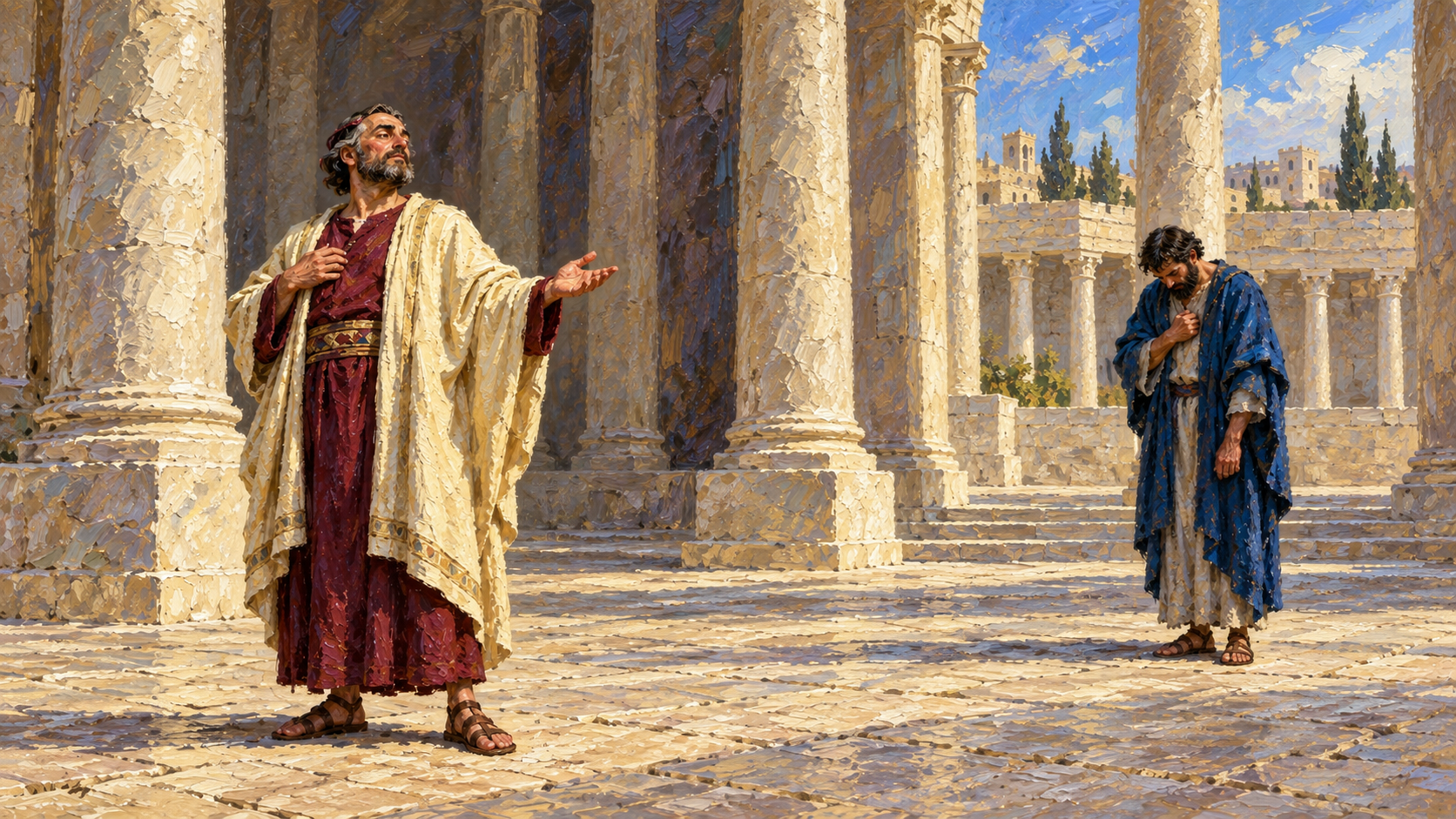
Also He spoke this parable to some who trusted in themselves that they were righteous, and despised others: "Two men went up to the temple to pray, one a Pharisee and the other a tax collector. The Pharisee stood and prayed thus with himself, 'God, I thank You that I am not like other men–extortioners, unjust, adulterers, or even as this tax collector. I fast twice a week; I give tithes of all that I possess.' And the tax collector, standing afar off, would not so much as raise his eyes to heaven, but beat his breast, saying, 'God, be merciful to me a sinner!' I tell you, this man went down to his house justified rather than the other; for everyone who exalts himself will be humbled, and he who humbles himself will be exalted." Then they also brought infants to Him that He might touch them; but when the disciples saw it, they rebuked them. But Jesus called them to Him and said, "Let the little children come to Me, and do not forbid them; for of such is the kingdom of God. Assuredly, I say to you, whoever does not receive the kingdom of God as a little child will by no means enter it."
Jesus addressed people who trusted in their own righteousness and despised others. The Pharisee’s prayer began with thanks to God but became an inventory of his superiority: sins he did not commit, disciplines he practiced, and the tax collector he stood above. Even prayer could be used to defend his status.
The tax collector stood at a distance, would not lift his eyes, beat his breast, and asked for mercy as a sinner. He made no comparison and offered no merit. Jesus said this man went home justified, declared righteous before God. The children who follow in Luke’s account reinforce the need to receive God’s kingdom as a gift. Humility tells the truth about our need; it does not win righteousness by performing a more impressive display of sorrow.
Humility, the Mind of Christ, and Grace
Where do wars and fights come from among you? Do they not come from your desires for pleasure that war in your members? You lust and do not have. You murder and covet and cannot obtain. You fight and war. Yet you do not have because you do not ask. You ask and do not receive, because you ask amiss, that you may spend it on your pleasures. Adulterers and adulteresses! Do you not know that friendship with the world is enmity with God? Whoever therefore wants to be a friend of the world makes himself an enemy of God. Or do you think that the Scripture says in vain, "The Spirit who dwells in us yearns jealously"? But He gives more grace. Therefore He says: "God resists the proud, But gives grace to the humble." Therefore submit to God. Resist the devil and he will flee from you. Draw near to God and He will draw near to you. Cleanse your hands, you sinners; and purify your hearts, you double-minded. Lament and mourn and weep! Let your laughter be turned to mourning and your joy to gloom. Humble yourselves in the sight of the Lord, and He will lift you up. Do not speak evil of one another, brethren. He who speaks evil of a brother and judges his brother, speaks evil of the law and judges the law. But if you judge the law, you are not a doer of the law but a judge. There is one Lawgiver, who is able to save and to destroy. Who are you to judge another?
James traces fighting to desires already at war within his hearers. Calling their friendship with the world spiritual adultery, he summons them to submit to God, resist the devil, cleanse their conduct, and turn from double-mindedness. Mourning sin is a proper response when we have been defending it. God gives greater grace, and humbling ourselves brings us toward His mercy without earning it.
Such humility can act firmly. Moses confronted Pharaoh, Paul defended his apostleship, and Jesus exposed hypocrisy. Faithfulness exercises responsibility under God for the sake of truth. It does not require calling evil good or surrendering lawful authority. A humble person can acknowledge praise, apologize without excuses, ask for help, and endure misunderstanding without having to control everyone’s opinion. He does not need another person’s humiliation to establish his worth.
The elders who are among you I exhort, I who am a fellow elder and a witness of the sufferings of Christ, and also a partaker of the glory that will be revealed: Shepherd the flock of God which is among you, serving as overseers, not by compulsion but willingly, not for dishonest gain but eagerly; nor as being lords over those entrusted to you, but being examples to the flock; and when the Chief Shepherd appears, you will receive the crown of glory that does not fade away. Likewise you younger people, submit yourselves to your elders. Yes, all of you be submissive to one another, and be clothed with humility, for "God resists the proud, But gives grace to the humble." Therefore humble yourselves under the mighty hand of God, that He may exalt you in due time, casting all your care upon Him, for He cares for you. Be sober, be vigilant; because your adversary the devil walks about like a roaring lion, seeking whom he may devour. Resist him, steadfast in the faith, knowing that the same sufferings are experienced by your brotherhood in the world. But may the God of all grace, who called us to His eternal glory by Christ Jesus, after you have suffered a while, perfect, establish, strengthen, and settle you. To Him be the glory and the dominion forever and ever. Amen.
Peter applies humility to the whole congregation. Elders must shepherd willingly and eagerly, without dishonest gain or domination; their example should serve the people entrusted to them. Younger believers must receive their elders’ leadership, and all must be clothed with humility toward one another. Casting our cares on God belongs within that dependence. We acknowledge our limits and His care instead of pretending we can carry everything ourselves.
Peter also addresses suffering and resisting the devil steadfastly in faith. Humility does not guarantee an easy life or immediate public vindication. We trust God to establish His people and exalt them in His time, rather than trying to secure our importance through control. The study on true humility considers that willing submission more fully. In Philippians, Paul directs us to Christ Himself as the example of humility that should govern our life together:
Therefore if there is any consolation in Christ, if any comfort of love, if any fellowship of the Spirit, if any affection and mercy, fulfill my joy by being like-minded, having the same love, being of one accord, of one mind. Let nothing be done through selfish ambition or conceit, but in lowliness of mind let each esteem others better than himself. Let each of you look out not only for his own interests, but also for the interests of others. Let this mind be in you which was also in Christ Jesus, who, being in the form of God, did not consider it robbery to be equal with God, but made Himself of no reputation, taking the form of a bondservant, and coming in the likeness of men. And being found in appearance as a man, He humbled Himself and became obedient to the point of death, even the death of the cross. Therefore God also has highly exalted Him and given Him the name which is above every name, that at the name of Jesus every knee should bow, of those in heaven, and of those on earth, and of those under the earth, and that every tongue should confess that Jesus Christ is Lord, to the glory of God the Father. Therefore, my beloved, as you have always obeyed, not as in my presence only, but now much more in my absence, work out your own salvation with fear and trembling; for it is God who works in you both to will and to do for His good pleasure. Do all things without complaining and disputing, that you may become blameless and harmless, children of God without fault in the midst of a crooked and perverse generation, among whom you shine as lights in the world, holding fast the word of life, so that I may rejoice in the day of Christ that I have not run in vain or labored in vain. Yes, and if I am being poured out as a drink offering on the sacrifice and service of your faith, I am glad and rejoice with you all. For the same reason you also be glad and rejoice with me.
The Son eternally possesses equality with God, yet He took the form of a servant and became truly human. His obedience continued to death on a cross. This did not mean He stopped being God or became inferior in His divine nature. The co-equal eternal Son voluntarily served in lowliness, and the Father highly exalted Him. Every knee will bow to the Lord who humbled Himself.
Paul directs that mind toward life together in the church. We must turn from selfish ambition, value others, and attend to their interests. His command to work out salvation describes obedient life under God’s work within us, not a price paid to obtain salvation. Christ’s humility governs how the people He has saved use their position and abilities. Paul’s letter to Corinth also shows why neither ability nor social position can be the basis of our boast before God:
For the message of the cross is foolishness to those who are perishing, but to us who are being saved it is the power of God. For it is written: "I will destroy the wisdom of the wise, And bring to nothing the understanding of the prudent." Where is the wise? Where is the scribe? Where is the disputer of this age? Has not God made foolish the wisdom of this world? For since, in the wisdom of God, the world through wisdom did not know God, it pleased God through the foolishness of the message preached to save those who believe. For Jews request a sign, and Greeks seek after wisdom; but we preach Christ crucified, to the Jews a stumbling block and to the Greeks foolishness, but to those who are called, both Jews and Greeks, Christ the power of God and the wisdom of God. Because the foolishness of God is wiser than men, and the weakness of God is stronger than men. For you see your calling, brethren, that not many wise according to the flesh, not many mighty, not many noble, are called. But God has chosen the foolish things of the world to put to shame the wise, and God has chosen the weak things of the world to put to shame the things which are mighty; and the base things of the world and the things which are despised God has chosen, and the things which are not, to bring to nothing the things that are, that no flesh should glory in His presence. But of Him you are in Christ Jesus, who became for us wisdom from God–and righteousness and sanctification and redemption– that, as it is written, "He who glories, let him glory in the LORD."
Paul reminded the Corinthian believers that few of them had been considered wise, powerful, or well born. Their salvation could not be attributed to advantages that most of them had never possessed. God chose what the world dismissed as weak and foolish so no one could boast in His presence. Christ became their wisdom, righteousness, sanctification, and redemption. Through Him they were declared righteous, set apart as God’s people, and freed from sin’s bondage. They received every saving benefit through Him.
God saves people who cannot rescue themselves. Receiving His grace gives me no grounds to claim superiority over someone else. I could not reason, govern, or improve myself into the standing Christ provides. The humble response is to receive His grace and give Him the glory, rather than turn the gift into another reason to rank people.
Pride in the Church and the Way of Repentance
"And to the angel of the church of the Laodiceans write, 'These things says the Amen, the Faithful and True Witness, the Beginning of the creation of God: "I know your works, that you are neither cold nor hot. I could wish you were cold or hot. So then, because you are lukewarm, and neither cold nor hot, I will vomit you out of My mouth. Because you say, 'I am rich, have become wealthy, and have need of nothing'–and do not know that you are wretched, miserable, poor, blind, and naked– I counsel you to buy from Me gold refined in the fire, that you may be rich; and white garments, that you may be clothed, that the shame of your nakedness may not be revealed; and anoint your eyes with eye salve, that you may see. As many as I love, I rebuke and chasten. Therefore be zealous and repent. Behold, I stand at the door and knock. If anyone hears My voice and opens the door, I will come in to him and dine with him, and he with Me. To him who overcomes I will grant to sit with Me on My throne, as I also overcame and sat down with My Father on His throne. "He who has an ear, let him hear what the Spirit says to the churches."'"
Laodicea said it was rich and needed nothing. Jesus saw spiritual poverty, blindness, and nakedness. A congregation’s resources, reputation, and activity therefore cannot settle its spiritual condition. Its confident assessment may conceal the very needs the Lord is exposing.
Jesus calls Himself “the Beginning of the creation of God.” I understand that as the source and ruler of creation, not its first creature. The NET translators’ note explains the possible meanings and the connection with John 1, where all created things came into being through the Word. The eternal Son is fully God. Laodicea was being evaluated by its Creator and Lord, whose judgment could not be overturned by the congregation’s wealth.
Church pride appears when pastors dominate, teachers refuse correction, members rank spiritual gifts as celebrity credentials, or factions boast about their standing. Even public confession can become a performance for attention. Christ rebukes and disciplines those He loves and calls this church to zealous repentance and renewed fellowship. He provides what its self-sufficiency had failed to recognize it needed.
Repentance should name the claim we are defending. I may be taking credit that belongs to others, treating recognition as a debt, or insisting that ordinary obligations should not apply to me. Once the claim is named, I need to let Scripture correct it and listen to trustworthy people who have nothing to gain by flattering me. A specific apology, a corrected public error, or accepting help can give practical expression to that change. The study on repentance examines that response further.
Confessing our sin brings us to the Savior who already knows the truth about us. We can come to Him without pretending. He is the eternal Son, fully God and fully man, born of a virgin and without sin. Wicked men tortured and killed Him, and He voluntarily bore that physical punishment for our sins in His innocent body. He willingly shed His blood and died, completing His saving work before His burial and bodily resurrection. The Father did not punish, curse, abandon, strike, bruise, or pour wrath on Jesus.
Christ died for the whole world. God’s offer of salvation is genuine, though people can resist it. Everyone who repents and believes in Jesus is forgiven, declared righteous before God, and born again as a new creation. The Holy Spirit indwells and seals the believer, whose salvation is eternally secure. Obedience neither earns salvation nor keeps us saved. Security never excuses lawlessness, and religious words without evidence of new life cannot establish that someone has truly been born again.
With our standing secured in Christ, we can confess a fault without defending false superiority and rejoice in someone else’s good without treating it as a loss to ourselves. Humility grows from receiving what Christ purchased with His blood. It does not purchase our acceptance with God.
My Final Thoughts
Humility requires honesty about where our abilities, opportunities, and standing before God came from. It allows us to act responsibly and speak firmly while receiving correction and giving proper credit. I want to identify the glory or control I am trying to protect, because pride can hide in defensive speech and religious performance as readily as in an open boast. Christ served without surrendering truth, and His cross leaves us no grounds for superiority. God gives grace to the humble, and we have reason to use His gifts for other people’s good.