
Esau traded his birthright for stew, then later wept over the blessing he had lost. I want to understand what he valued and why those tears could not recover what was gone. We also need to understand why God chose Jacob, so we will follow what Genesis, Hebrews, Obadiah, and Romans tell us about Esau and his descendants.
Two Nations in a Divided Family
Esau was the firstborn son of Isaac and Rebekah and the twin brother of Jacob. He belonged to the family through which God was continuing His promises to Abraham, and ordinary family custom gave him the leading position. He grew into a skillful hunter and man of the field, became Isaac’s favored son, and later had a household of his own as a husband and father. In his dealings with Jacob, we see him despise his birthright and later bitterly mourn the blessing he lost. He planned to murder Jacob over that loss. Years later, though, the same man had become a prosperous chief and ran to embrace the brother he had once hated.
I cannot excuse Esau’s conduct simply because Jacob wronged him. Scripture calls Esau profane and records his intent to murder his brother. But I cannot excuse Jacob either just because God chose his family to carry the covenant promises. Scripture records Jacob’s manipulation and the painful consequences of his lies. God fulfilled His Word through this troubled family without ever making their evil actions righteous.
Esau also received the name Edom, and his descendants became the nation of Edom southeast of Israel. Jacob received the name Israel, which also became the name of the nation descended from him. This family connection explains why later prophets can speak of Edom as the “house of Esau” and Israel as Jacob. When we reach those prophecies, we need to notice whether they concern a brother or the nation that came from him. Esau did not personally commit every offense of his later descendants.
Isaac pleaded with the LORD because Rebekah was barren, and God granted his prayer. When the children struggled within her, Rebekah inquired of the LORD. God’s answer reached far beyond the temperaments of two brothers: two nations and peoples would come from the twins, and the older would serve the younger.
This is the genealogy of Isaac, Abraham’s son. Abraham begot Isaac. Isaac was forty years old when he took Rebekah as wife, the daughter of Bethuel the Syrian of Padan Aram, the sister of Laban the Syrian. Now Isaac pleaded with the LORD for his wife, because she was barren; and the LORD granted his plea, and Rebekah his wife conceived. But the children struggled together within her; and she said, “If all is well, why am I like this?” So she went to inquire of the LORD. And the LORD said to her: “Two nations are in your womb, Two peoples shall be separated from your body; One people shall be stronger than the other, And the older shall serve the younger.” So when her days were fulfilled for her to give birth, indeed there were twins in her womb. And the first came out red. He was like a hairy garment all over; so they called his name Esau. Afterward his brother came out, and his hand took hold of Esau’s heel; so his name was called Jacob. Isaac was sixty years old when she bore them. So the boys grew. And Esau was a skillful hunter, a man of the field; but Jacob was a mild man, dwelling in tents. And Isaac loved Esau because he ate of his game, but Rebekah loved Jacob.
God had already said which family would carry His covenant promises before either son had done good or evil. Those promises would ultimately lead to the Messiah, and the customary rights of the firstborn would not determine the family line God chose. Jacob’s descendants would become Israel, while Esau’s descendants would become Edom. I notice that God’s answer to Rebekah concerns the roles of these peoples in covenant history. It does not say that one unborn boy was irresistibly saved and the other unconditionally damned.
Esau was red and covered with hair like a garment. Genesis associates his appearance with his name, although the exact origin of the Hebrew name Esav is uncertain. He later received the name Edom, meaning red, because of the incident with the stew. The account connects these details through wordplay, but that does not give us a certain dictionary meaning for Esav.
Esau’s skill as a hunter was not his spiritual failure. Isaac ate and enjoyed the game he brought home. The trouble within the household becomes clearer at the end of the passage: Isaac loved Esau because he ate of his game, while Rebekah loved Jacob. Each parent favored a different son, so even parental affection became something the brothers competed for. That favoritism helped prepare the home for the manipulation that followed.
Birthright, Blessing, and Tears
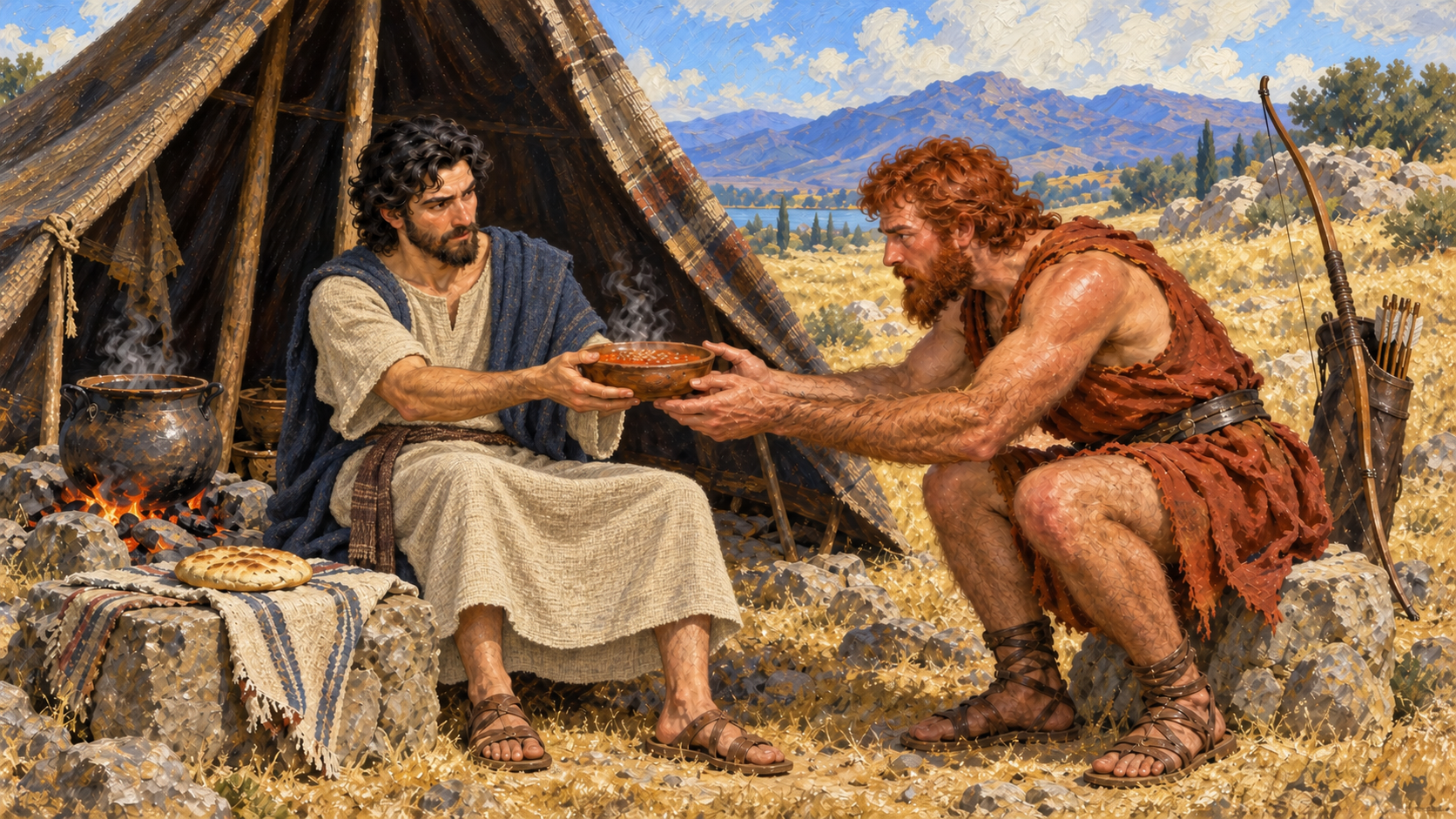
When Esau returned from the field weary, Jacob had cooked stew. Esau demanded some of the red food, and Jacob took the opportunity to require his birthright in payment. Jacob exploited Esau’s condition, while Esau treated relief from his hunger as more valuable than his inheritance as the firstborn.
Now Jacob cooked a stew; and Esau came in from the field, and he was weary. And Esau said to Jacob, “Please feed me with that same red stew, for I am weary.” Therefore his name was called Edom. But Jacob said, “Sell me your birthright as of this day.” And Esau said, “Look, I am about to die; so what is this birthright to me?” Then Jacob said, “Swear to me as of this day.” So he swore to him, and sold his birthright to Jacob. And Jacob gave Esau bread and stew of lentils; then he ate and drank, arose, and went his way. Thus Esau despised his birthright.
Esau said he was about to die, but Genesis does not say he was literally starving. After eating and drinking, he got up and went on his way. I would not let his urgent words obscure the judgment Genesis gives at the end: he despised his birthright. He treated it as worth less than the bread and stew in front of him.
The birthright gave the firstborn son recognized standing within the family and an inheritance. Deuteronomy 21 later set down the right to a double portion. Some teachers say Esau also surrendered a formal family priesthood and a detailed set of spiritual offices, but Genesis does not define those roles. I would not add them to make his loss seem more serious. His inheritance was already weighty because he belonged to the family carrying God’s promises to Abraham.
God’s promise concerning the younger brother did not justify Jacob’s demand. Jacob was responsible for how he treated Esau even though God had already chosen the family line through which His promises would continue. God did not need Jacob to sin in order to fulfill His Word.
Hebrews calls Esau bebelos, translated “profane.” The word describes what is common or unhallowed, which helps explain the judgment on his choice. He treated a sacred inheritance as an ordinary possession he could exchange for lunch.
When Isaac grew old, he planned to bless Esau after eating a meal of game. Rebekah overheard him and arranged for Jacob to impersonate his brother. Jacob brought prepared food to his blind father while wearing Esau’s clothing and goatskins to disguise himself. Isaac questioned the sound of his voice and how quickly he had returned, but Jacob continued to lie. Despite those suspicious details, Isaac gave him the blessing.
We need to distinguish that blessing from the birthright Esau had sold earlier. The birthright concerned his inherited standing as the firstborn, while the patriarchal blessing was Isaac’s solemn declaration about his sons and their future. The two were connected, but they were separate events. Buying Esau’s birthright did not give Jacob permission to impersonate him and obtain the blessing through lies.
Each member of the family bore responsibility for what happened. Isaac favored Esau and appears to have been determined to bless him despite God’s earlier word and Esau’s contempt for the birthright. Rebekah tried to secure what God had promised through deceit, and Jacob knowingly carried out her plan. Esau had despised the inheritance but still expected the leading blessing. I can recognize how one person’s sin contributed to this conflict without using it to excuse what another person did.
Now it happened, as soon as Isaac had finished blessing Jacob, and Jacob had scarcely gone out from the presence of Isaac his father, that Esau his brother came in from his hunting. He also had made savory food, and brought it to his father, and said to his father, “Let my father arise and eat of his son’s game, that your soul may bless me.” And his father Isaac said to him, “Who are you?” So he said, “I am your son, your firstborn, Esau.” Then Isaac trembled exceedingly, and said, “Who? Where is the one who hunted game and brought it to me? I ate all of it before you came, and I have blessed him–and indeed he shall be blessed.” When Esau heard the words of his father, he cried with an exceedingly great and bitter cry, and said to his father, “Bless me–me also, O my father!” But he said, “Your brother came with deceit and has taken away your blessing.” And Esau said, “Is he not rightly named Jacob? For he has supplanted me these two times. He took away my birthright, and now look, he has taken away my blessing!” And he said, “Have you not reserved a blessing for me?” Then Isaac answered and said to Esau, “Indeed I have made him your master, and all his brethren I have given to him as servants; with grain and wine I have sustained him. What shall I do now for you, my son?” And Esau said to his father, “Have you only one blessing, my father? Bless me–me also, O my father!” And Esau lifted up his voice and wept. Then Isaac his father answered and said to him: “Behold, your dwelling shall be of the fatness of the earth, And of the dew of heaven from above. By your sword you shall live, And you shall serve your brother; And it shall come to pass, when you become restless, That you shall break his yoke from your neck.” So Esau hated Jacob because of the blessing with which his father blessed him, and Esau said in his heart, “The days of mourning for my father are at hand; then I will kill my brother Jacob.”
Esau cried bitterly because his father had no duplicate of the blessing he had already given Jacob. Isaac told him that he would live by the sword and serve his brother, although he would eventually break that yoke from his neck. Those words were fulfilled as Edom later experienced periods of subjection and independence.
Esau’s grief gave way to hatred, and he planned to kill Jacob after Isaac died. Jacob had deceived him, but that wrong did not give Esau the right to murder his brother. When Rebekah heard the threat, she sent Jacob away. The separation lasted many years, and the family the parents had tried to control was fractured by their favoritism and their sons’ sins.
Hebrews uses Esau as a warning to believers who might surrender holy privilege for immediate desire. The surrounding command calls for peace and holiness and warns against a root of bitterness.
Pursue peace with all people, and holiness, without which no one will see the Lord: looking carefully lest anyone fall short of the grace of God; lest any root of bitterness springing up cause trouble, and by this many become defiled; lest there be any fornicator or profane person like Esau, who for one morsel of food sold his birthright. For you know that afterward, when he wanted to inherit the blessing, he was rejected, for he found no place for repentance, though he sought it diligently with tears.
Some preach verse 17 as though Esau sincerely sought salvation and God refused to let him repent. I do not see that in either Genesis or the wording of this warning. Hebrews says he wanted to inherit the blessing, and Genesis describes his tears as he pleaded for it. Isaac would not reverse the pronouncement, so Esau could not recover the blessing he wanted.
The Greek word metanoia means a change of mind or repentance, but we need the surrounding passage to understand which change is in view. Esau deeply regretted his loss. Scripture does not record him confessing that he had despised the birthright or turning to the LORD. His pain was genuine, but tears alone do not establish repentance. Some choices leave consequences we cannot undo, even when we desperately want back what we lost.
I should hear this warning as a reason to repent now rather than a reason to despair. The gospel genuinely calls every sinner to Christ, and God does not reject someone who comes in faith to His Son. Esau could not recover the transferred blessing. That is different from God secretly refusing to save a man who seeks Him.
Esau’s Marriages and His Brother’s Return
Before the conflict over the blessing, Esau married the Hittite women Judith and Basemath. Their presence grieved both Isaac and Rebekah. Genesis is concerned with the direction of the covenant household amid Canaanite worship rather than ethnic pride.
When Esau was forty years old, he took as wives Judith the daughter of Beeri the Hittite, and Basemath the daughter of Elon the Hittite. And they were a grief of mind to Isaac and Rebekah.
After Isaac knowingly sent Jacob to marry within Rebekah’s extended family, Esau recognized that the daughters of Canaan displeased his father. He responded by marrying Mahalath, a daughter of Ishmael.
Esau saw that Isaac had blessed Jacob and sent him away to Padan Aram to take himself a wife from there, and that as he blessed him he gave him a charge, saying, “You shall not take a wife from the daughters of Canaan,” and that Jacob had obeyed his father and his mother and had gone to Padan Aram. Also Esau saw that the daughters of Canaan did not please his father Isaac. So Esau went to Ishmael and took Mahalath the daughter of Ishmael, Abraham’s son, the sister of Nebajoth, to be his wife in addition to the wives he had.
Esau had noticed his parents’ disapproval, and the additional marriage was his response. But it did not undo his existing marriages, and Genesis does not describe it as repentance or obedience to a word from God. I see the same difficulty in much of his life: he reacted strongly to the consequence in front of him without showing sustained concern for its spiritual meaning.
During those years, Jacob was in Haran building a household of his own. He married and raised children there, acquired livestock, and experienced Laban’s deception. When God told him to return, he still had to face the brother who had threatened to kill him. His messengers reported that Esau was approaching with four hundred men. Jacob was deeply afraid, so he divided his camp and prayed to God.
Then Jacob sent messengers before him to Esau his brother in the land of Seir, the country of Edom. And he commanded them, saying, “Speak thus to my lord Esau, ‘Thus your servant Jacob says: “I have dwelt with Laban and stayed there until now. I have oxen, donkeys, flocks, and male and female servants; and I have sent to tell my lord, that I may find favor in your sight.”‘” Then the messengers returned to Jacob, saying, “We came to your brother Esau, and he also is coming to meet you, and four hundred men are with him.” So Jacob was greatly afraid and distressed; and he divided the people that were with him, and the flocks and herds and camels, into two companies. And he said, “If Esau comes to the one company and attacks it, then the other company which is left will escape.” Then Jacob said, “O God of my father Abraham and God of my father Isaac, the LORD who said to me, ‘Return to your country and to your family, and I will deal well with you’: I am not worthy of the least of all the mercies and of all the truth which You have shown Your servant; for I crossed over this Jordan with my staff, and now I have become two companies. Deliver me, I pray, from the hand of my brother, from the hand of Esau; for I fear him, lest he come and attack me and the mother with the children. For You said, ‘I will surely treat you well, and make your descendants as the sand of the sea, which cannot be numbered for multitude.'”
Jacob appealed to God’s command and promise while confessing that he was unworthy of the Lord’s mercies. He named his fear plainly and sent gifts ahead in waves. Those gifts could not erase his deception, but they expressed humility and a sincere effort to repair the relationship.
That night Jacob encountered God at Jabbok and came away limping with the new name Israel. He approached Esau bowing to the ground, a very different man from the confident schemer who had fled years earlier. His weakness was visible in his body, and his brother’s response was beyond his control.
The man who had once planned murder now ran toward Jacob and embraced him. Esau fell on his brother’s neck before kissing him as both men wept. He then saw the women and children and asked about the procession of gifts. Esau initially refused Jacob’s property because he already had enough of his own.
Now Jacob lifted his eyes and looked, and there, Esau was coming, and with him were four hundred men. So he divided the children among Leah, Rachel, and the two maidservants. And he put the maidservants and their children in front, Leah and her children behind, and Rachel and Joseph last. Then he crossed over before them and bowed himself to the ground seven times, until he came near to his brother. But Esau ran to meet him, and embraced him, and fell on his neck and kissed him, and they wept. And he lifted his eyes and saw the women and children, and said, “Who are these with you?” So he said, “The children whom God has graciously given your servant.” Then the maidservants came near, they and their children, and bowed down. And Leah also came near with her children, and they bowed down. Afterward Joseph and Rachel came near, and they bowed down. Then Esau said, “What do you mean by all this company which I met?” And he said, “These are to find favor in the sight of my lord.” But Esau said, “I have enough, my brother; keep what you have for yourself.” And Jacob said, “No, please, if I have now found favor in your sight, then receive my present from my hand, inasmuch as I have seen your face as though I had seen the face of God, and you were pleased with me. Please, take my blessing that is brought to you, because God has dealt graciously with me, and because I have enough.” So he urged him, and he took it. Then Esau said, “Let us take our journey; let us go, and I will go before you.” But Jacob said to him, “My lord knows that the children are weak, and the flocks and herds which are nursing are with me. And if the men should drive them hard one day, all the flock will die. Please let my lord go on ahead before his servant. I will lead on slowly at a pace which the livestock that go before me, and the children, are able to endure, until I come to my lord in Seir.” And Esau said, “Now let me leave with you some of the people who are with me.” But he said, “What need is there? Let me find favor in the sight of my lord.” So Esau returned that day on his way to Seir. And Jacob journeyed to Succoth, built himself a house, and made booths for his livestock. Therefore the name of the place is called Succoth.
Esau welcomed his brother generously and offered him protection. Their meeting was peaceful, and I do not want to lose sight of that while asking what else it tells us about Esau. Genesis does not quote him saying that he forgave Jacob. Nor does it record a confession of his murder plan or show him worshiping the LORD. We can appreciate the end of his hostility without claiming to know his inner spiritual state.
Jacob urged Esau to accept the gift and described the favorable reunion as though he had seen God’s face. Esau offered to travel with him or leave some of his men behind. Jacob declined and later journeyed to Succoth rather than following immediately to Seir. The brothers were at peace even though their households remained distinct. They later stood together to bury Isaac.
The brothers’ peace did not require them to begin living together again. Reconciliation does require an end to vengeance and a return to truthful conduct, with both people willing to deal peacefully. I appreciate Esau’s welcome because he chose to receive his brother peacefully after once wanting him dead. It is one of the best actions Scripture records about him.
Esau, Mount Seir, and Edom
Genesis 36 records Esau’s wives and sons before describing his possessions and move to Mount Seir. His household and livestock became so substantial that the land could not support both him and Jacob together.
Now this is the genealogy of Esau, who is Edom. Esau took his wives from the daughters of Canaan: Adah the daughter of Elon the Hittite; Aholibamah the daughter of Anah, the daughter of Zibeon the Hivite; and Basemath, Ishmael’s daughter, sister of Nebajoth. Now Adah bore Eliphaz to Esau, and Basemath bore Reuel. And Aholibamah bore Jeush, Jaalam, and Korah. These were the sons of Esau who were born to him in the land of Canaan. Then Esau took his wives, his sons, his daughters, and all the persons of his household, his cattle and all his animals, and all his goods which he had gained in the land of Canaan, and went to a country away from the presence of his brother Jacob. For their possessions were too great for them to dwell together, and the land where they were strangers could not support them because of their livestock. So Esau dwelt in Mount Seir. Esau is Edom.
God gave Esau a large family and considerable wealth even though the Abrahamic covenant line passed through Jacob. Esau also possessed land, and his descendants grew into a nation whose chiefs and kings Genesis later names. That prosperity does not establish saving faith. Still, when I read about all he received, I cannot speak as though God gave him nothing.
When Israel later approached Edomite territory, God said He had given Mount Seir to Esau. Israel was forbidden to provoke Edom or seize any of its land and was required to pay for food and water.
“And the LORD spoke to me, saying: ‘You have skirted this mountain long enough; turn northward. And command the people, saying, “You are about to pass through the territory of your brethren, the descendants of Esau, who live in Seir; and they will be afraid of you. Therefore watch yourselves carefully. Do not meddle with them, for I will not give you any of their land, no, not so much as one footstep, because I have given Mount Seir to Esau as a possession. You shall buy food from them with money, that you may eat; and you shall also buy water from them with money, that you may drink. “For the LORD your God has blessed you in all the work of your hand. He knows your trudging through this great wilderness. These forty years the LORD your God has been with you; you have lacked nothing.”‘ “And when we passed beyond our brethren, the descendants of Esau who dwell in Seir, away from the road of the plain, away from Elath and Ezion Geber, we turned and passed by way of the Wilderness of Moab.
God had appointed Edom’s land for Esau’s descendants, and He required Israel to respect their possession. Being the covenant people did not give Israel permission to take what God had given someone else. His command shows that He governed both nations and had not overlooked Edom. The judgment that later came upon the Edomites was for their actual sins, not because they were less than human.
The peace between the brothers did not prevent later conflict between their nations. In Moses’ day, Edom refused Israel passage, and in later periods the nations fought each other. Eventually Edom rejoiced over Jerusalem’s disaster. The Edomites helped Jerusalem’s enemies by cutting off fugitives and handing over survivors. Obadiah announced God’s judgment for these crimes.
“For violence against your brother Jacob, Shame shall cover you, And you shall be cut off forever. In the day that you stood on the other side– In the day that strangers carried captive his forces, When foreigners entered his gates And cast lots for Jerusalem– Even you were as one of them. “But you should not have gazed on the day of your brother In the day of his captivity; Nor should you have rejoiced over the children of Judah In the day of their destruction; Nor should you have spoken proudly In the day of distress. You should not have entered the gate of My people In the day of their calamity. Indeed, you should not have gazed on their affliction In the day of their calamity, Nor laid hands on their substance In the day of their calamity. You should not have stood at the crossroads To cut off those among them who escaped; Nor should you have delivered up those among them who remained In the day of distress. “For the day of the LORD upon all the nations is near; As you have done, it shall be done to you; Your reprisal shall return upon your own head. For as you drank on My holy mountain, So shall all the nations drink continually; Yes, they shall drink, and swallow, And they shall be as though they had never been.
The house of Esau in Obadiah is the nation of Edom. Its kinship with Israel made the violence especially treacherous, but Esau himself had been dead for generations. I need to keep that distinction in view so I do not charge him personally with crimes committed by his descendants.
Obadiah goes on to speak of the Day of the LORD upon all nations. His prophecy closes with restoration on Mount Zion and the kingdom belonging to the LORD. Edom’s judgment helps us understand why no nation can make itself secure against the righteous King. Fortifications cannot protect it from Him, nor can an inherited grievance or a political advantage. The promise of Israel’s future restoration also remains because the church does not erase God’s national promises.
Jacob and Esau in Romans 9
Paul turns to Isaac and Ishmael, then to Jacob and Esau, to answer whether God’s Word to Israel has failed. Israel had received extraordinary covenant privileges, yet many Israelites rejected the Messiah. How could that happen if God’s promises were sure? Paul follows the family line through which the promises came and explains Israel’s unbelief alongside the inclusion of Gentiles, people from other nations. Paul defends God’s freedom to fulfill His covenant purposes according to His Word.
But it is not that the word of God has taken no effect. For they are not all Israel who are of Israel, nor are they all children because they are the seed of Abraham; but, “In Isaac your seed shall be called.” That is, those who are the children of the flesh, these are not the children of God; but the children of the promise are counted as the seed. For this is the word of promise: “At this time I will come and Sarah shall have a son.” And not only this, but when Rebecca also had conceived by one man, even by our father Isaac (for the children not yet being born, nor having done any good or evil, that the purpose of God according to election might stand, not of works but of Him who calls), it was said to her, “The older shall serve the younger.” As it is written, “Jacob I have loved, but Esau I have hated.”
Paul quotes Genesis 25, where the LORD explicitly spoke of two nations and two peoples. The older serving the younger concerns their roles in history and the direction of God’s covenant promises. God spoke before the brothers were born, so neither had done anything to earn the place of carrying those promises. I cannot read that as a reason for human pride or entitlement.
The words “Jacob I have loved, but Esau I have hated” come from Malachi 1, written centuries after the brothers died. Malachi’s prophecy concerns the nations of Israel and Edom and points to Edom’s territory under judgment. In that setting, love and hate express covenant favor and rejection. I do not understand Paul to be saying that God cherished one unborn boy and arbitrarily damned the other before either could respond. He is using the national history Malachi described.
When I continue through Paul’s argument, I do not see human response disappear. Romans 9 ends by saying that Israel stumbled because the people did not seek righteousness by faith. Romans 10 offers salvation to whoever calls upon the Lord and pictures God stretching out His hands to a disobedient people. Romans 11 says Israel’s hardening is partial and temporary. Calvinistic determinism tears the quotation away from Genesis and Malachi, then separates it from Paul’s complete argument.
God was free to carry the Messiah’s line through Jacob, but His choice did not approve Jacob’s deceit. Esau likewise remained responsible for despising his birthright and planning murder. People can resist God’s genuine appeal even while He rules over history. I do not see a contradiction that requires me to deny either His sovereignty or their responsibility.
Esau’s meal was soon over, but its consequence remained. His choice makes me question what I am willing to surrender for immediate satisfaction. Tiredness or hunger can make obedience seem less urgent than relief, and loneliness can draw us toward the same reasoning. Fear can weaken our resolve until anger seems persuasive. We follow Esau’s pattern when we turn to sexual sin for comfort or dishonest money for quick relief. Intoxication can seem to offer an escape, just as public approval or revenge can seem worth the price for an hour. In each case, we sacrifice something weightier to satisfy a present desire instead of valuing what God calls holy.
Isaac and Rebekah each favored a different son and worked to secure the outcome they preferred. Their divided home should make parents consider what their affection communicates. A child’s worth does not depend on usefulness or resemblance to a parent, and love must not be earned through personality or achievement. Children should never have to compete for it.
Jacob’s conduct also makes me wary of calling manipulation faith. His goal may have appealed indirectly to God’s promise, but that could not make his deception righteous. God does not need lies or coercion to accomplish His Word, and He never requires us to exploit another person. If I pursue a spiritual objective through sin, I have already departed from obedience.
Hebrews brings us back to Esau’s tears over a blessing he could not recover. Grief over consequences can lead toward repentance, but feeling that grief is not the same as repenting. Genuine repentance tells the truth about sin and turns toward God in a way that bears fruit. I should not wait for an irreversible loss before I begin to value what God has given.
Esau welcomed Jacob before accepting his gift, having abandoned his plan to murder him. I can honor that change without claiming to know his eternal state. His embrace encourages us to seek peace wherever we can do so truthfully and safely. Hatred can end even when renewed closeness would be unwise and appropriate boundaries need to remain.
Esau sold an inheritance for one meal, and every sinner has exchanged God’s truth for lesser desires. Jesus Christ never despised the Father’s will. He is the eternal Son who became fully man while remaining fully God. He was born of a virgin and lived completely without sin. Wicked men physically tortured and punished Him before killing Him. He willingly bore that real punishment for our sins in His innocent body, shedding His blood and dying for us. He was buried and rose bodily. The Father did not punish or curse Jesus, nor did He abandon Him. He did not strike or bruise His Son or pour wrath upon Him.
Christ died for the whole world, and God’s offer of salvation is genuine even though people can resist and reject it. We cannot purchase salvation through birth order or covenant ancestry, and neither moral effort nor tears over consequences can secure it. Everyone who repents and believes in Jesus is forgiven and justified, or declared righteous before God. That person is born again and made new, with the Holy Spirit dwelling within him and sealing him. His salvation is eternally secure in Christ, which never makes lawlessness permissible. A superficial profession does not establish that someone has truly been born again. We need to answer Christ’s call rather than surrender to a passing appetite.
My Final Thoughts
Esau was neither a helpless victim nor merely a symbol in an argument. He despised something holy and planned murder, while Jacob’s place in God’s promise never excused his manipulation or lies. Esau’s tears should make me take repentance seriously now, before I lose what I cannot recover. His welcome of Jacob also encourages me to pursue truthful peace without pretending to know more about another person’s heart than Scripture reveals. We need to value what God calls holy and be willing to put vengeance aside. Our hope rests in Jesus Christ, not in our ancestry or emotions, and not in our ability to manage God’s promises for Him.