
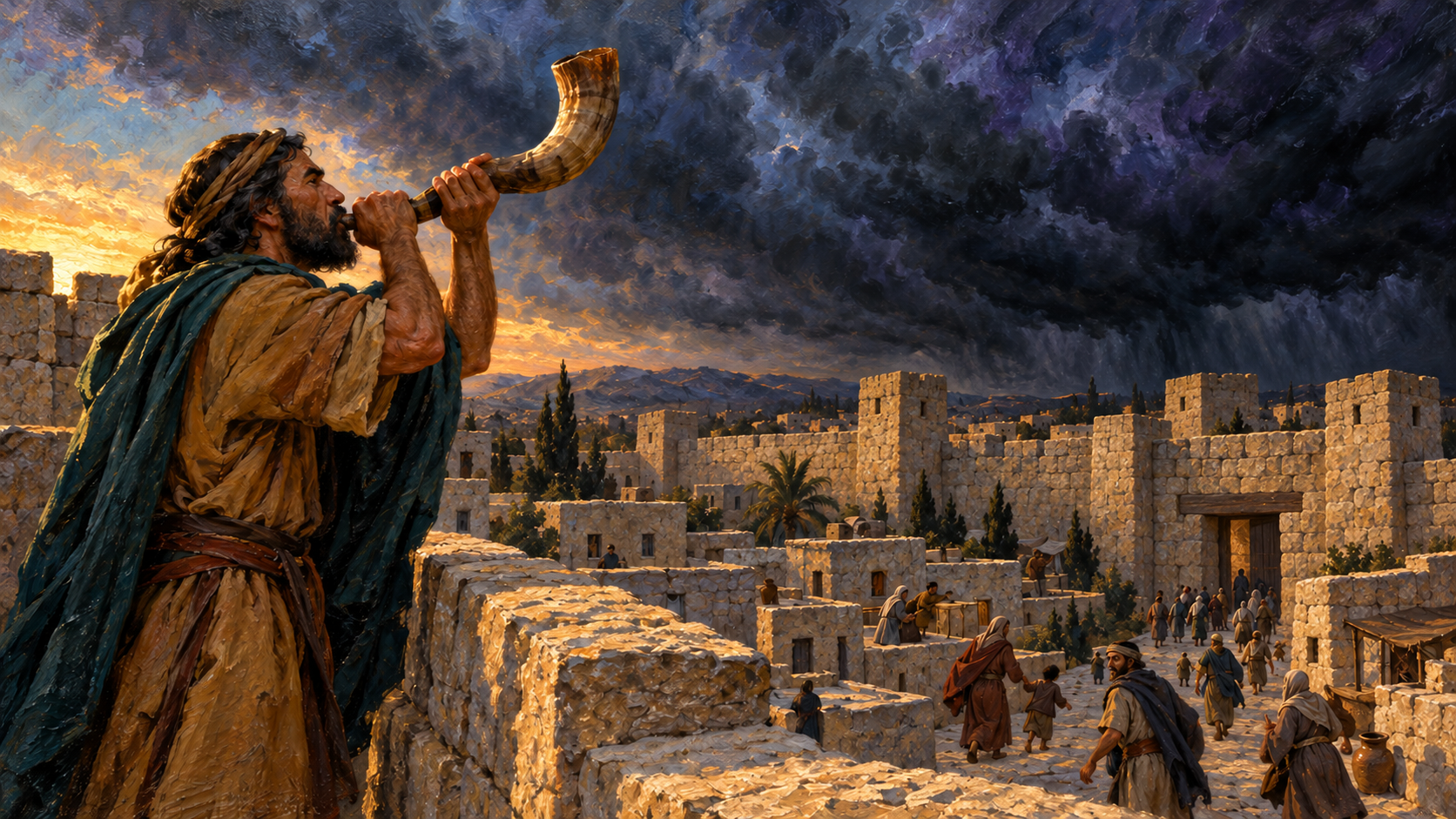
When Scripture speaks about the Day of the Lord, is it naming one moment or a whole series of events? I want to understand how the passages fit together without taking any of them out of their setting. Read together, they give us a fuller understanding of both the warning and the hope than a prophecy chart built around one verse.
The Day of the Lord Is God’s Appointed Time
The Day of the Lord is not limited to the Great White Throne, nor does it always mean a literal twenty-four-hour day. In prophecy, a day can describe an appointed time when the Lord acts openly. He confronts proud rebellion and proves His Word true. As He rescues the people to whom He has made promises, He establishes righteous rule.
The Hebrew expression yom YHWH and the Greek hemera kyriou both identify the Day as belonging to the Lord. Understanding those words helps us read the passages accurately, but it doesn’t tell us how long the Day lasts. For that, we need the context. Some prophets describe a historical judgment close to their own time, while other passages reach beyond that setting to the nations and Jerusalem at the King’s return. The Day can even include the passing away of the present heavens and earth.
The prophets spoke to actual people. Their warnings reached kings and priests as well as whole nations that had broken God’s covenant. Assyria and Babylon faced judgment in history, as did Egypt, Edom, Israel, and Judah. I don’t want to overlook those judgments by pushing every warning into the distant future. Yet some prophetic language goes beyond the fall of one ruler or city. It describes judgment on the whole world, disturbances in the heavenly lights, and the Lord openly reigning over the gathered nations.
Those near judgments proved that God meant what He said and became patterns of the final Day when He will settle rebellion completely. Prophecy sometimes places near and distant events in one line of sight, even though they are separated by time. The New Testament shows us more of that distance and the order in which the events unfold.
Wail, for the day of the LORD is at hand! It will come as destruction from the Almighty. Therefore all hands will be limp, Every man’s heart will melt, And they will be afraid. Pangs and sorrows will take hold of them; They will be in pain as a woman in childbirth; They will be amazed at one another; Their faces will be like flames. Behold, the day of the LORD comes, Cruel, with both wrath and fierce anger, To lay the land desolate; And He will destroy its sinners from it. For the stars of heaven and their constellations Will not give their light; The sun will be darkened in its going forth, And the moon will not cause its light to shine. “I will punish the world for its evil, And the wicked for their iniquity; I will halt the arrogance of the proud, And will lay low the haughtiness of the terrible. I will make a mortal more rare than fine gold, A man more than the golden wedge of Ophir. Therefore I will shake the heavens, And the earth will move out of her place, In the wrath of the LORD of hosts And in the day of His fierce anger.
Isaiah named Babylon at the beginning of this oracle, so we need to understand the warning in that historical setting first. The empire had terrified other nations, but neither its money nor its armies could prevent its fall when the Lord summoned the instruments of His judgment.
But how far does Isaiah’s warning reach? He speaks of punishing the world for evil and describes the heavens shaking as the earth moves out of its place. That language leads me beyond Babylon as one proud city. Babylon also pictures the proud world system that cannot survive the Lord’s final intervention. His patience does not mean He is indifferent to evil. Every ruler and society remains accountable to its Creator.
“And it shall come to pass afterward That I will pour out My Spirit on all flesh; Your sons and your daughters shall prophesy, Your old men shall dream dreams, Your young men shall see visions. And also on My menservants and on My maidservants I will pour out My Spirit in those days. “And I will show wonders in the heavens and in the earth: Blood and fire and pillars of smoke. The sun shall be turned into darkness, And the moon into blood, Before the coming of the great and awesome day of the LORD. And it shall come to pass That whoever calls on the name of the LORD Shall be saved. For in Mount Zion and in Jerusalem there shall be deliverance, As the LORD has said, Among the remnant whom the LORD calls.
Joel spoke after devastation had stripped the land and disrupted worship. He called the priests and elders to return to the Lord with genuine hearts, along with the people. From that immediate crisis, the prophecy reaches a wider promise. God would pour out His Spirit and display wonders, and everyone who called on the Lord’s name would be saved.
Peter quoted Joel at Pentecost because the promised outpouring of the Spirit had begun. Peter could identify the outpouring of the Spirit without saying that every part of Joel’s prophecy had been fulfilled. The sun had not turned dark that morning, nor had the moon become bloodlike. The great and awesome Day had not reached its end. Joel presented these events together, while history reveals the stages in which they unfold.
Joel’s warning includes a genuine invitation: judgment is coming, and God calls people to Himself. His promise is not confined to one ethnicity or social rank. If I spend all my attention on predicting events, I can miss the urgency of telling people that they can call on the Lord and be saved.
The great day of the LORD is near; It is near and hastens quickly. The noise of the day of the LORD is bitter; There the mighty men shall cry out. That day is a day of wrath, A day of trouble and distress, A day of devastation and desolation, A day of darkness and gloominess, A day of clouds and thick darkness, A day of trumpet and alarm Against the fortified cities And against the high towers. “I will bring distress upon men, And they shall walk like blind men, Because they have sinned against the LORD; Their blood shall be poured out like dust, And their flesh like refuse.” Neither their silver nor their gold Shall be able to deliver them In the day of the LORD’s wrath; But the whole land shall be devoured By the fire of His jealousy, For He will make speedy riddance Of all those who dwell in the land.
Zephaniah confronted Judah’s idolatry and violence along with its religious compromise. The people had grown complacent enough to think the Lord would do neither good nor evil. They had mistaken His patience for absence. Against that assumption, the prophet described a coming day of trouble and darkness with the sound of alarm. That warning made plain the seriousness of their sin before a holy God.
Wealth and human strength could not buy an escape from that judgment. Yet Zephaniah also spoke of a purified people and Israel’s restoration. The Lord would preserve a humble remnant as He confronted sin, then rejoice over His restored people. Removing rebellion would allow His promised fellowship and rule to stand openly.
Behold, the day of the LORD is coming, And your spoil will be divided in your midst. For I will gather all the nations to battle against Jerusalem; The city shall be taken, The houses rifled, And the women ravished. Half of the city shall go into captivity, But the remnant of the people shall not be cut off from the city. Then the LORD will go forth And fight against those nations, As He fights in the day of battle. And in that day His feet will stand on the Mount of Olives, Which faces Jerusalem on the east. And the Mount of Olives shall be split in two, From east to west, Making a very large valley; Half of the mountain shall move toward the north And half of it toward the south. Then you shall flee through My mountain valley, For the mountain valley shall reach to Azal. Yes, you shall flee As you fled from the earthquake In the days of Uzziah king of Judah. Thus the LORD my God will come, And all the saints with You. It shall come to pass in that day That there will be no light; The lights will diminish. It shall be one day Which is known to the LORD– Neither day nor night. But at evening time it shall happen That it will be light. And in that day it shall be That living waters shall flow from Jerusalem, Half of them toward the eastern sea And half of them toward the western sea; In both summer and winter it shall occur. And the LORD shall be King over all the earth. In that day it shall be– “The LORD is one,” And His name one.
Zechariah brings the future judgment into focus at Jerusalem. Nations will gather against the city, and the Lord will go out to fight them. His feet will stand on the Mount of Olives as He intervenes publicly and becomes King over all the earth. I cannot reduce those geographical details to a picture of religion gradually influencing society.
Jesus will return bodily and visibly, and the Mount of Olives connects this prophecy with the place from which He ascended. That connection does not give us a date to calculate, but it points us to an unmistakable arrival when the King Himself intervenes. Nor will He come only to destroy. Through His judgment He will deliver Israel and establish the kingdom He promised.
Christ Gathers His Church Before the Tribulation
The future Day covers an ordered series of events. Christ first gathers His church before the literal seven-year Tribulation. During that period, judgments fall on a rebellious world and Antichrist is exposed. His overthrow comes as Jesus returns visibly to deliver Israel and begin His literal thousand-year reign. After those thousand years, God ends Satan’s final rebellion. He then raises unbelievers for judgment and brings in the new creation.
We need to keep each part of that sequence distinct even while seeing how it belongs to the Lord’s triumph. The gathering of the church is distinct from the visible Second Coming and the Great White Throne. Each event has its own participants and purpose. Likewise, the Millennium is not the Lake of Fire. The broader meaning of the Day does not make these events interchangeable.
But I do not want you to be ignorant, brethren, concerning those who have fallen asleep, lest you sorrow as others who have no hope. For if we believe that Jesus died and rose again, even so God will bring with Him those who sleep in Jesus. For this we say to you by the word of the Lord, that we who are alive and remain until the coming of the Lord will by no means precede those who are asleep. For the Lord Himself will descend from heaven with a shout, with the voice of an archangel, and with the trumpet of God. And the dead in Christ will rise first. Then we who are alive and remain shall be caught up together with them in the clouds to meet the Lord in the air. And thus we shall always be with the Lord. Therefore comfort one another with these words.
Paul comforted grieving believers by telling them what would happen to their bodies. The Lord Himself will descend, and believers who have died will rise first. Living believers will then be caught up with them to meet Christ in the air. Through that forceful divine action, Christ’s people will be reunited in His presence forever. A private spiritual feeling or the church slowly improving the world would not fulfill that promise.
Paul used the gentle description of sleep for believers who had died because their bodies will rise. He was not teaching that their souls had become unconscious. Elsewhere he says that to be absent from the body is to be present with the Lord. I can acknowledge the pain of Christian grief while holding on to what he promises: death will give way to resurrection and reunion, so our grief need not be hopeless.
The word Rapture comes through the Latin rendering of “caught up,” but our confidence rests in what Scripture describes. The dead will be raised and the living transformed, whatever later English label we use for that gathering. I believe this gathering removes the church before the Tribulation, the appointed worldwide period of judgment at the end of the age. That promise does not exempt Christians from the ordinary suffering or persecution they may face before then.
But concerning the times and the seasons, brethren, you have no need that I should write to you. For you yourselves know perfectly that the day of the Lord so comes as a thief in the night. For when they say, “Peace and safety!” then sudden destruction comes upon them, as labor pains upon a pregnant woman. And they shall not escape. But you, brethren, are not in darkness, so that this Day should overtake you as a thief. You are all sons of light and sons of the day. We are not of the night nor of darkness. Therefore let us not sleep, as others do, but let us watch and be sober. For those who sleep, sleep at night, and those who get drunk are drunk at night. But let us who are of the day be sober, putting on the breastplate of faith and love, and as a helmet the hope of salvation. For God did not appoint us to wrath, but to obtain salvation through our Lord Jesus Christ, who died for us, that whether we wake or sleep, we should live together with Him. Therefore comfort each other and edify one another, just as you also are doing.
Paul continued his letter to the Thessalonians by moving directly from the gathering of believers in chapter 4 to the Day of the Lord in chapter 5. It will come like a thief upon those saying, “Peace and safety!” His image describes the surprise of sudden destruction overtaking an unbelieving world. It does not supply a secret code for someone clever enough to solve it.
Believers are children of light, but that does not mean they know the date. Paul grounded their readiness in who they are and called them to remain morally awake and sober. Faith and love protect them like a breastplate, while the hope of salvation serves as a helmet. God has not appointed His people to wrath but to salvation through Jesus Christ.
I understand that assurance as support for the pre-Tribulation gathering, and I also hear Paul’s call to live accordingly. Being eternally secure does not excuse carelessness. If we belong to the coming Lord, we should be morally awake as we wait for Him.
I thank my God upon every remembrance of you, always in every prayer of mine making request for you all with joy, for your fellowship in the gospel from the first day until now, being confident of this very thing, that He who has begun a good work in you will complete it until the day of Jesus Christ; just as it is right for me to think this of you all, because I have you in my heart, inasmuch as both in my chains and in the defense and confirmation of the gospel, you all are partakers with me of grace. For God is my witness, how greatly I long for you all with the affection of Jesus Christ. And this I pray, that your love may abound still more and more in knowledge and all discernment, that you may approve the things that are excellent, that you may be sincere and without offense till the day of Christ, being filled with the fruits of righteousness which are by Jesus Christ, to the glory and praise of God.
Paul also speaks of “the day of Jesus Christ,” “the day of Christ,” and “the day of our Lord Jesus Christ.” He often uses those expressions when discussing believers’ completion and blamelessness, or when speaking of their service and joy. In Philippians, the coming day gives us confidence that God will complete His work, while encouraging love shaped by knowledge and discernment.
Those passages emphasize something different from prophecies of wrath against the world. Even so, I would not build an inflexible calendar rule from the vocabulary alone. I need to see what each passage is discussing. Day-of-Christ language commonly highlights the church’s hope, while Day-of-the-Lord passages commonly emphasize God’s public judgment and kingdom. The same returning Christ will complete His work in His church and judge rebellious powers before ruling the nations.
So we are always confident, knowing that while we are at home in the body we are absent from the Lord. For we walk by faith, not by sight. We are confident, yes, well pleased rather to be absent from the body and to be present with the Lord. Therefore we make it our aim, whether present or absent, to be well pleasing to Him. For we must all appear before the judgment seat of Christ, that each one may receive the things done in the body, according to what he has done, whether good or bad.
Every believer will appear before the Judgment Seat of Christ. This evaluation concerns service and reward; it does not put salvation back on trial. A born-again believer is a new creation, indwelt and sealed by the Holy Spirit, and eternally secure. Salvation is God’s gift received by faith rather than wages earned by ministry.
Knowing that eternal life is secure should make me grateful, not indifferent to how I serve. Jesus sees the motives behind our work and knows whether we have been faithful with each opportunity. Our treatment of people is open to Him, as is our honesty in handling truth. We need not serve in fear of losing eternal life, but we are accountable to the Savior and should sincerely want to please Him.
The Tribulation Ends With Christ’s Visible Return
The Tribulation corresponds to Daniel’s seventieth week and lasts a literal seven years. In Daniel 9, each prophetic week represents seven years. Sixty-nine weeks lead to Messiah’s first coming and death, leaving one final week in the prophecy about Daniel’s people and holy city. The coming ruler will make a covenant and violate it halfway through that last week. His action explains why Scripture describes both the full seven years and its two halves.
As judgments grow more severe during the Tribulation, the man of sin will rise and human rebellion will become openly defiant. Deception and persecution will spread, yet God will continue working in Israel and among the nations. The church will already have been gathered, but people will still come to Christ during that period. Some will lose their lives for doing so.
Revelation describes that increasing severity through its seals, trumpets, and bowls. They are ordered judgments, not recurring pictures of ordinary history. Alongside them, John shows us faithful witnesses and saints who refuse the beast. Even as God judges, He continues to call people to repentance and remains faithful to every promise.
We can recognize the direction of the age without treating every election or war as the final sign. Eclipses and illnesses have also been used to support predictions, as have new technologies. I need to test those claims by what Scripture actually says, rather than assume that an alarming event proves them. Watchfulness begins with obedience to revealed truth. God has not supplied a date or a private key to the timeline.
Now I saw heaven opened, and behold, a white horse. And He who sat on him was called Faithful and True, and in righteousness He judges and makes war. His eyes were like a flame of fire, and on His head were many crowns. He had a name written that no one knew except Himself. He was clothed with a robe dipped in blood, and His name is called The Word of God. And the armies in heaven, clothed in fine linen, white and clean, followed Him on white horses. Now out of His mouth goes a sharp sword, that with it He should strike the nations. And He Himself will rule them with a rod of iron. He Himself treads the winepress of the fierceness and wrath of Almighty God. And He has on His robe and on His thigh a name written: KING OF KINGS AND LORD OF LORDS. Then I saw an angel standing in the sun; and he cried with a loud voice, saying to all the birds that fly in the midst of heaven, “Come and gather together for the supper of the great God, that you may eat the flesh of kings, the flesh of captains, the flesh of mighty men, the flesh of horses and of those who sit on them, and the flesh of all people, free and slave, both small and great.” And I saw the beast, the kings of the earth, and their armies, gathered together to make war against Him who sat on the horse and against His army. Then the beast was captured, and with him the false prophet who worked signs in his presence, by which he deceived those who received the mark of the beast and those who worshiped his image. These two were cast alive into the lake of fire burning with brimstone. And the rest were killed with the sword which proceeded from the mouth of Him who sat on the horse. And all the birds were filled with their flesh.
In Revelation 19, John saw heaven opened and Jesus appearing as Faithful and True. He will come as the divine Warrior and King of kings rather than a vulnerable claimant competing for a throne. His judgment will be righteous as He destroys the rebellion led by the beast and the kings of the earth.
We should distinguish that public appearing from the church’s earlier meeting with the Lord in the air. At the Rapture, dead believers will be raised and living believers transformed as they are caught up to Christ. At the later appearing, He will come with the armies of heaven to confront the rebellious world. He will then establish His earthly kingdom.
These distinctions do not create two saviors or unrelated returns. The same bodily risen Jesus fulfills different promises in their appointed order. His church’s blessed hope and His public overthrow of evil both depend on His personal coming.
The Thousand-Year Kingdom Leads to Final Judgment
Then I saw an angel coming down from heaven, having the key to the bottomless pit and a great chain in his hand. He laid hold of the dragon, that serpent of old, who is the Devil and Satan, and bound him for a thousand years; and he cast him into the bottomless pit, and shut him up, and set a seal on him, so that he should deceive the nations no more till the thousand years were finished. But after these things he must be released for a little while. And I saw thrones, and they sat on them, and judgment was committed to them. Then I saw the souls of those who had been beheaded for their witness to Jesus and for the word of God, who had not worshiped the beast or his image, and had not received his mark on their foreheads or on their hands. And they lived and reigned with Christ for a thousand years. But the rest of the dead did not live again until the thousand years were finished. This is the first resurrection. Blessed and holy is he who has part in the first resurrection. Over such the second death has no power, but they shall be priests of God and of Christ, and shall reign with Him a thousand years. Now when the thousand years have expired, Satan will be released from his prison and will go out to deceive the nations which are in the four corners of the earth, Gog and Magog, to gather them together to battle, whose number is as the sand of the sea. They went up on the breadth of the earth and surrounded the camp of the saints and the beloved city. And fire came down from God out of heaven and devoured them. The devil, who deceived them, was cast into the lake of fire and brimstone where the beast and the false prophet are. And they will be tormented day and night forever and ever.
Revelation repeatedly says “a thousand years.” During that period Satan will be bound and the saints will live and reign with Christ. The rest of the dead will not live again until it ends. With those events tied to the stated duration, I see no reason in the context to turn the number into a symbol for the present church age.
The Millennium will fulfill the promises of Messiah’s public government and Israel’s restoration. Jesus will rule the nations with justice, bringing ordered blessing to creation. The church cannot establish that kingdom by gaining political control. It belongs to Christ to establish it when He returns as the rightful King.
What catches my attention about the end of the Millennium is that people will still choose rebellion after generations of righteous rule. Ideal surroundings cannot regenerate a heart, so people born during the kingdom will still need personal faith. When Satan is released, he will find nations willing to follow him. They will surround the saints and the beloved city, but God will consume them with fire rather than allow a long contest.
Satan will then be cast into the Lake of Fire, where the beast and false prophet will already be. Revelation specifically says that these three will be tormented day and night forever. I accept that statement as written, but I also need to keep its subjects clear. We should not automatically transfer their punishment to the human beings judged later in the chapter, whose end Scripture describes as the second death.
Then I saw a great white throne and Him who sat on it, from whose face the earth and the heaven fled away. And there was found no place for them. And I saw the dead, small and great, standing before God, and books were opened. And another book was opened, which is the Book of Life. And the dead were judged according to their works, by the things which were written in the books. The sea gave up the dead who were in it, and Death and Hades delivered up the dead who were in them. And they were judged, each one according to his works. Then Death and Hades were cast into the lake of fire. This is the second death. And anyone not found written in the Book of Life was cast into the lake of fire.
The Great White Throne comes after the Millennium and final rebellion. Every unbelieving person who has died will stand before God, regardless of how small or great that person seemed in life. Wealth and rank will offer no shelter. Neither education nor a religious appearance can hide anyone, and an obscure life will not escape God’s notice. The sea will give up its dead as Death and Hades release those they held. Unbelievers will be raised for judgment rather than remain asleep forever.
This is a bodily reality under God’s perfect knowledge. It is not the Judgment Seat of Christ and not a second opportunity for salvation. Those who are born again already possess everlasting life and do not come into condemnation.
Revelation describes books that record deeds and sins, then distinguishes them from another book called the Book of Life. The record of each person’s works will demonstrate the justice of God’s judgment by showing what that person loved and served. Those works cannot provide an alternative way to eternal life.
Every person begins written in the Book of Life. That is why I take Scripture’s warnings about names being blotted out in their natural sense. Those who finally reject the Messiah are blotted out, while believers remain because Christ’s blood has blotted out their sins. At the throne, anyone whose name is not found in the Book of Life is cast into the Lake of Fire. The decisive issue is whether that person received God’s Son or remained in unbelief, still bearing his own recorded sins.
The Second Death Gives Way to a New Creation
Revelation calls the Lake of Fire the second death. The first death is followed by resurrection and judgment; the second is the final and irreversible destruction of the lost. Jesus likewise warned that God can destroy both soul and body in Gehenna.
We should not assume that every human soul has an indestructible life. Eternal life is God’s gift in Christ, and souls are not inherently immortal. For the lost, Scripture describes an end in death and destruction. They perish as God’s judgment consumes body and soul.
I do not believe Scripture teaches soul sleep, because it describes conscious existence between death and resurrection. Nor can I accept universalism when judgment and the second death are final. Yet final judgment does not mean that human beings will suffer eternal conscious torment. Their destruction is fearful and its result everlasting. Revelation 20:10 specifically names Satan, the beast, and the false prophet as those who suffer endless torment.
But, beloved, do not forget this one thing, that with the Lord one day is as a thousand years, and a thousand years as one day. The Lord is not slack concerning His promise, as some count slackness, but is longsuffering toward us, not willing that any should perish but that all should come to repentance. But the day of the Lord will come as a thief in the night, in which the heavens will pass away with a great noise, and the elements will melt with fervent heat; both the earth and the works that are in it will be burned up. Therefore, since all these things will be dissolved, what manner of persons ought you to be in holy conduct and godliness, looking for and hastening the coming of the day of God, because of which the heavens will be dissolved, being on fire, and the elements will melt with fervent heat? Nevertheless we, according to His promise, look for new heavens and a new earth in which righteousness dwells.
Peter answered scoffers who mistook God’s patience for a failure to keep His promise. The Lord has not forgotten what He said. His longsuffering gives people a genuine opportunity to repent, but it will not postpone the Day forever. The present heavens and earth will come to an end.
Peter includes the passing away of the heavens and the burning of the earth and its works within the Day of the Lord. In Revelation’s sequence, those events occur after the thousand years. That gives me a decisive reason not to limit the Day to one instant at the beginning of the Tribulation.
Peter then asks how that future should affect our conduct. Since the present order will be dissolved, we should live in holiness and godliness now. We are not preparing for an empty future. We await God’s promised new heavens and new earth, where righteousness dwells.
Now I saw a new heaven and a new earth, for the first heaven and the first earth had passed away. Also there was no more sea. Then I, John, saw the holy city, New Jerusalem, coming down out of heaven from God, prepared as a bride adorned for her husband. And I heard a loud voice from heaven saying, “Behold, the tabernacle of God is with men, and He will dwell with them, and they shall be His people. God Himself will be with them and be their God. And God will wipe away every tear from their eyes; there shall be no more death, nor sorrow, nor crying. There shall be no more pain, for the former things have passed away.” Then He who sat on the throne said, “Behold, I make all things new.” And He said to me, “Write, for these words are true and faithful.” And He said to me, “It is done! I am the Alpha and the Omega, the Beginning and the End. I will give of the fountain of the water of life freely to him who thirsts. He who overcomes shall inherit all things, and I will be his God and he shall be My son. But the cowardly, unbelieving, abominable, murderers, sexually immoral, sorcerers, idolaters, and all liars shall have their part in the lake which burns with fire and brimstone, which is the second death.”
John saw the holy city coming down and heard that God would dwell with His people. Death would be gone, and sorrow and crying would cease. Pain too would belong to the former things that had passed away. The One seated on the throne will make all things new, completing the work that His judgment against rebellion began.
Even here, the promise of living water freely offered to the thirsty stands beside a warning. God genuinely offers His grace to all, but unbelief cannot enter the new creation unchanged. Those who finally reject His offer face irreversible judgment in the Lake of Fire, which remains the second death.
Watchfulness Means Faithful Living
The major events belong together, though each has its own place. The church will be gathered before the seven-year Tribulation, and Day-of-Christ language emphasizes believers’ completion as well as their service and reward. After the Tribulation, Jesus will return visibly to establish His thousand-year reign. The Great White Throne follows that reign and the last rebellion. The Day of the Lord covers this broader span of God’s public judgment and vindication. It reaches through the kingdom and final judgment into the new creation.
I would always let a passage’s own context govern a chart or summary, including the one just given. These distinctions protect the hope Scripture gives believers: the Rapture is not the Great White Throne, and we are not waiting to be condemned with the lost. The Great White Throne concludes the Day’s judicial work, but it does not exhaust everything Scripture means by the Day.
Scripture repeatedly calls us to sober readiness. Sound doctrine and prayer should shape the way we work and show mercy, while watchfulness strengthens us to endure hardship. We need to remain committed to church fellowship and gospel witness, testing every spiritual claim by Scripture. If my interest in prophecy draws me toward sensational predictions while I neglect ordinary obedience, I am missing what these passages ask of me.
For Christians suffering injustice, the coming Day gives reason to endure. Evil has not escaped the Lord’s notice, and it will not last forever. Jesus will judge righteously and keep every covenant promise. His future work includes raising the dead and defeating Satan before renewing creation, so our confidence does not depend on present circumstances getting better.
The Judge we are waiting for is also the Savior who shed His blood for us. Jesus is the eternal Son, fully God and fully man. He was born of a virgin and lived without sin, and He genuinely offers salvation to the whole world.
On the cross, Jesus physically bore the punishment for our sins in His innocent body through real torture, the shedding of His blood, and death. The Father did not punish, curse, abandon, strike, bruise, or pour wrath on Jesus. Wicked men tortured and killed Him, and He willingly gave Himself for us. He was buried and rose bodily from the grave.
Christ died for every person, though people can resist or reject God’s genuine offer. Everyone who repents and believes receives forgiveness and everlasting life apart from works. A true believer is born again and made a new creation. The Holy Spirit comes to live within that person and seals the believer as eternally secure.
While time remains, the warning of the Day invites us to come to Christ. Attending church and knowing prophecy cannot save us. Neither can comparing ourselves favorably with others or making a superficial profession of faith. We need the living Christ, whose blood cleanses sin and whose bodily resurrection guarantees His promise. Those who belong to Him can comfort one another and live openly as children of light.
My Final Thoughts
These passages leave me with confidence in the Lord who patiently warns the world and keeps His promises to Israel and the church. Prophecy is not a puzzle that rewards the most dramatic guess. All of history is moving toward the open reign of Jesus Christ. He will gather His people and judge rebellion. The dead will rise at His command, and He will make all things new. Knowing that the coming Day belongs to Him should steady the way we live now. Trusting the Savior, we can speak His gospel plainly and remain awake to the responsibilities He has given us.