
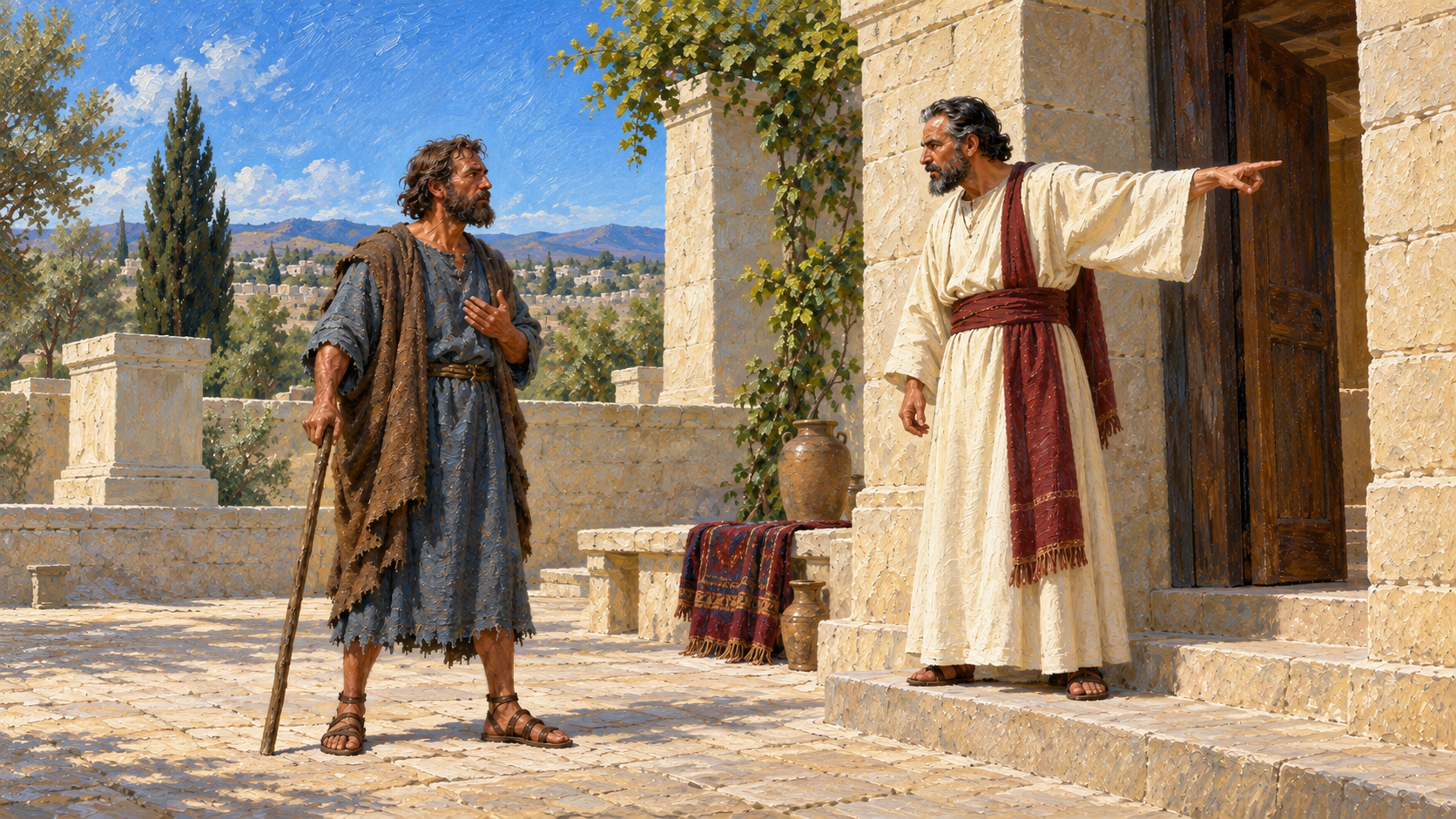
Israel looked prosperous when Amos came to warn her. The nation had recovered territory, wealthy households enjoyed comfort, and people continued their religious observances. Yet the LORD saw the corruption those appearances concealed. I want to follow how Amos exposes that contradiction, because a comfortable life can make us reluctant to hear a warning we badly need. The book also ends with a promise that judgment will not cancel God’s purpose to restore.
Amos Carried God’s Word From Tekoa
Amos came from Tekoa, a village in Judah south of Jerusalem. He worked with flocks and tended sycamore figs. His name is commonly associated with carrying or bearing a burden. He did not receive his commission from Israel’s king or claim a position within Bethel’s priesthood. The LORD took him from his work and sent him to prophesy to Israel.
The words of Amos, who was among the sheepbreeders of Tekoa, which he saw concerning Israel in the days of Uzziah king of Judah, and in the days of Jeroboam the son of Joash, king of Israel, two years before the earthquake.
The kings named here place Amos in the period of Uzziah’s reign in Judah and Jeroboam II’s reign in the Northern Kingdom of Israel. Amos was a Judean sent north with a message for another kingdom. His prophecy also preceded a memorable earthquake by two years. Zechariah 14:5 later refers to the earthquake in Uzziah’s days, showing how long the event remained in the nation’s memory.
Jeroboam II’s military successes and expanded borders had encouraged national confidence. Amos nevertheless describes rich people enjoying their houses while others suffered oppression. Courts failed to protect the vulnerable, commerce was corrupted by deceit, and sexual immorality continued. Religious activity had survived alongside conduct that contradicted the LORD’s commands.
Prosperity did not establish that God approved what Israel was doing. Nor does Amos teach that every comfortable household is under condemnation merely because it is comfortable. He identifies the wrongs people were committing and the warnings they refused to hear. I need to examine my conduct by God’s Word, rather than assume that good circumstances settle the question of whether I am living rightly.
The book develops that examination in stages. Chapters 1–2 announce judgments against neighboring nations before addressing Judah and Israel. Chapters 3–6 explain Israel’s guilt and call her to return. Chapters 7–9 present visions of judgment and record opposition to Amos, before ending with the restoration of David’s fallen house. The message moves from what Israel could recognize as evil elsewhere to what she needed to confront at home.
Judgment Circled the Nations and Landed on Israel
Amos repeatedly introduces judgment with the words, “For three transgressions … and for four.” This is a poetic description of accumulated guilt, rather than a requirement that each nation’s indictment list exactly four sins. God had seen the slave trading, broken agreements, and brutality that rulers and peoples might excuse as necessary for their advantage.
The judgments name Damascus, Gaza, Tyre, Edom, Ammon, and Moab. Even the treatment of the dead comes under God’s scrutiny: Moab is condemned for burning the bones of Edom’s king to ashes. These charges concern what the nations had actually done to others. Their power, their customs, or their hostility toward one another did not place those acts beyond the Creator’s judgment.
Then Amos addresses Judah for despising the law of the LORD and being led astray by falsehood. Possessing Scripture and temple worship had given Judah greater responsibility. Those privileges could not protect a people who rejected what God had taught them. The longest indictment then falls on Israel, the nation receiving Amos’s message.
Israel’s hearers could readily recognize cruelty when enemies committed it. Amos required them to consider the same holy God examining their own lives. I find it easier to welcome a rebuke when I can apply it to someone else. If I appeal to God’s justice against another person while defending similar wrongdoing in myself, I am refusing the standard I claim to honor.
The surrounding nations did not possess Israel’s covenant privileges, yet they still answered to the LORD for their conduct. God’s concern was never confined to Israel’s ceremonies. Romans 2:11–12 later expresses the related truth that God shows no partiality and judges people who sin with or without possessing the law. Amos’s movement toward Israel does not lessen the nations’ guilt; it removes Israel’s excuse for ignoring her own.
Covenant Privilege Increased Israel’s Accountability
You only have I known of all the families of the earth; Therefore I will punish you for all your iniquities.
God’s use of “known” describes His special covenant relationship with Israel. It cannot mean that He was simply aware of that nation while overlooking everyone else. He had delivered these people, given them His law, and claimed them as His own. That relationship made their disobedience more serious.
Israel was treating God’s choice as protection against discipline. Amos answers that presumption by describing what the people were doing. They sold the righteous for silver and the needy for the price of sandals, corrupted justice, tolerated sexual sin, and tried to silence prophetic correction. Their relationship with God called for holiness and mercy in ordinary life, yet they used their advantages while resisting His requirements. Hosea also confronts this covenant unfaithfulness, describing Israel’s pursuit of other gods despite the LORD’s care for her.
Amos 4 repeatedly returns to the statement, “Yet you have not returned to Me.” Famine, drought, blight, mildew, pestilence, and military defeat had already interrupted the nation’s life. God identifies these troubles as warnings to this covenant people. They were not an explanation Amos invented for every hardship anyone might suffer. Here the LORD Himself explains both the correction and Israel’s refusal to respond. Joel likewise connects a devastating crop disaster with a call for the people to return to Him.
“Therefore thus will I do to you, O Israel; Because I will do this to you, Prepare to meet your God, O Israel!”
The summons “Prepare to meet your God” comes after those repeated refusals. The people who assumed their relationship guaranteed safety would have to face the God whose warnings they had rejected. He had shown patience and called them back. Their insistence on continuing in sin had not made the warnings disappear.
I need to hear this as someone who has received instruction from Scripture. Familiarity with biblical language, membership in a respected church, and memories of earlier blessings cannot substitute for repentance now. God’s gifts give us reason to obey Him. They do not establish that disobedience has become harmless.
God Rejected Worship That Covered Rebellion
Israel still had feast days, assemblies, offerings, songs, and instruments. Amos’s warning was not directed at a nation that had simply stopped holding services. People wanted to continue the religious life they knew while refusing the obedience it required.
“I hate, I despise your feast days, And I do not savor your sacred assemblies. Though you offer Me burnt offerings and your grain offerings, I will not accept them, Nor will I regard your fattened peace offerings. Take away from Me the noise of your songs, For I will not hear the melody of your stringed instruments. But let justice run down like water, And righteousness like a mighty stream.”
God was rejecting their hypocrisy. This passage does not condemn music, offerings, or gathered worship in themselves. It confronts people who brought those things before Him while defending oppression and sin. Their ceremonies could not make their conduct acceptable.
Amos gives a concrete example in chapter 8:5. Merchants were impatient for the new moon festival and Sabbath to end so they could resume selling grain. They reduced the measure delivered to the customer, increased the weight used to calculate payment, and manipulated the scales. The buyer received less while paying more. Outward observance of sacred days had not restrained their willingness to cheat.
The Hebrew mishpat describes judgment or justice according to God’s standard, and tsedaqah describes righteousness or uprightness. Amos’s call for these things reaches the courthouse, marketplace, and treatment of the poor. I cannot replace that standard with a political program I happen to favor. Neither can I turn it into a private religious feeling that leaves dishonest dealings untouched.
The flowing stream pictures conduct that continues, rather than a brief display during worship. A song about God’s goodness does not give me permission to shortchange someone afterward. Public generosity does not cancel deceit in the way I earned the money. Amos calls people to bring their dealings with others under the same LORD they claim to praise.
For thus says the LORD to the house of Israel: “Seek Me and live;”
The Hebrew darash, translated “seek,” includes turning toward, inquiring of, or resorting to someone. Israel needed to turn to the LORD Himself. Going to Bethel, Gilgal, or Beersheba could not stand in for that response. Amos’s demand for justice was therefore inseparable from repentance and faithful worship.
We should not reduce the book to social reform without God, or use its concern for worship to avoid confronting public injustice. Amos requires both devotion to the LORD and upright treatment of people. When someone genuinely seeks Him, obedience should become visible in those relationships.
The Visions Measured Israel and Amos Faced Opposition
Chapters 7–9 show judgment through a series of visions. In the first, locusts threaten the late crop after the king’s mowing. Amos pleads for forgiveness, asking how small Jacob could survive. The LORD relents and says the disaster will not occur. When the next vision shows consuming fire, Amos intercedes again, and God again says it will not happen (Amos 7:1–9).
Amos understood how devastating these judgments would be. He pleaded for a nation too weak to withstand them, and the LORD answered him with mercy. The prophet who had to announce Israel’s guilt also interceded for her. His warnings did not come from indifference to the people who would suffer.
The plumb line then announces that Israel will be measured and will no longer be passed by without judgment. A builder uses a plumb line to test whether a wall is upright. Israel would be examined by God’s standard, rather than by a comparison with the enemies she despised. Her sanctuaries and the royal house would face the consequences.
Amaziah, the priest at Bethel, responded by accusing Amos of conspiring against Jeroboam. He told the prophet to return to Judah, earn his bread there, and stop prophesying at the king’s sanctuary. He treated God’s warning as a threat to the royal establishment. Amos answered by explaining where his commission had come from.
Then Amos answered, and said to Amaziah: “I was no prophet, Nor was I a son of a prophet, But I was a sheepbreeder And a tender of sycamore fruit. Then the LORD took me as I followed the flock, And the LORD said to me, ‘Go, prophesy to My people Israel.’
Amos did not ground his authority in a court appointment or membership in a prophetic circle. God had taken him from the flock and sent him with this message. Amaziah’s command could not cancel that commission. At the same time, I cannot use Amos to excuse self-appointed harshness. Anger and ambition do not make someone God’s spokesman; a charge against others needs the authority of His Word.
Chapter 8’s basket of summer fruit announces that Israel has reached her end. The Hebrew words for summer fruit and end sound alike, joining the object Amos sees to God’s verdict. The season of God’s patience would give way to the judgment Israel had refused to take seriously.
Later in that same chapter, Amos warns of a famine for hearing the words of the LORD. People who had refused His message would search for it and fail to find it. Their money and religious activity could not supply the word they had rejected. This was a judgment deeper than lacking food: they would be deprived of the truth they needed.
Chapter 9 then shows the Lord beside the altar. The judgment reaches people who might have treated religious space as a refuge, and Amos describes the futility of trying to escape wherever they might hide. Wealth, a sanctuary, and political influence could not shelter a people from the God they had defied.
Paul warns in 2 Timothy 4:3–4 about people who refuse sound doctrine and collect teachers who suit their desires. I should consider that warning when I look for a teacher who will reassure me instead of one who explains Scripture faithfully. If I keep dismissing correction because it is unpleasant, I can become increasingly willing to believe a lie. The study of Habakkuk also considers how to respond when God’s answer challenges what we wanted to hear.
Amos Ends With Restoration Through David’s House
After announcing judgment, the LORD promises to rebuild. Israel’s conduct had not made the covenant warnings empty, but neither could her failure cancel God’s purpose to restore. Amos ends by turning our attention to David’s house and the people the LORD will establish.
“On that day I will raise up The tabernacle of David, which has fallen down, And repair its damages; I will raise up its ruins, And rebuild it as in the days of old; That they may possess the remnant of Edom, And all the Gentiles who are called by My name,” Says the LORD who does this thing.
David’s fallen tabernacle pictures a dynasty in need of restoration. The once-united kingdom was divided, and further judgment lay ahead. God promised to repair and rebuild what had fallen. I understand the hope to center in Jesus Christ, the Son of David, and to reach its complete fulfillment in His future reign.
Acts 15 brings this passage into the discussion of Gentile believers. Some had insisted on circumcision and keeping the law of Moses as conditions of acceptance. Peter testified to God’s work among the Gentiles, and James cited Amos to show that the nations being called by God’s name agreed with His prophetic purpose. Their salvation through Christ was no accident or revision of God’s plan.
James’s use of Amos establishes that Gentiles belong within that saving purpose. It does not require us to erase Israel or abandon the Davidic kingdom. Amos’s closing verses speak of restored cities, fruitful land, and God planting His people so they will not be uprooted again. I read that settled blessing as a promise still awaiting its full fulfillment, not merely a description of private spiritual comfort.
The salvation promised through David’s house rests on what Jesus Himself has accomplished. The eternal Son, fully God and fully man, willingly endured the bodily punishment wicked people inflicted, shed His innocent blood, and died for our sins. The Father did not punish Him. His work through His blood and death was complete before His bodily resurrection. He was buried and rose from the grave, and He will reign in righteousness. No nation’s wealth, religious ceremony, or moral improvement can accomplish the salvation He provides.
My Final Thoughts
Amos makes me examine what comfort may be helping me overlook. Israel needed to hear God’s correction in her worship, courts, and business dealings, and I should welcome His Word wherever it exposes a contradiction in my own conduct. His call to seek Him requires repentance rather than a better religious appearance. I can also finish with hope: the LORD who judges wrongdoing remains faithful to His promise, and His restoration centers in the righteous King, Jesus Christ.