
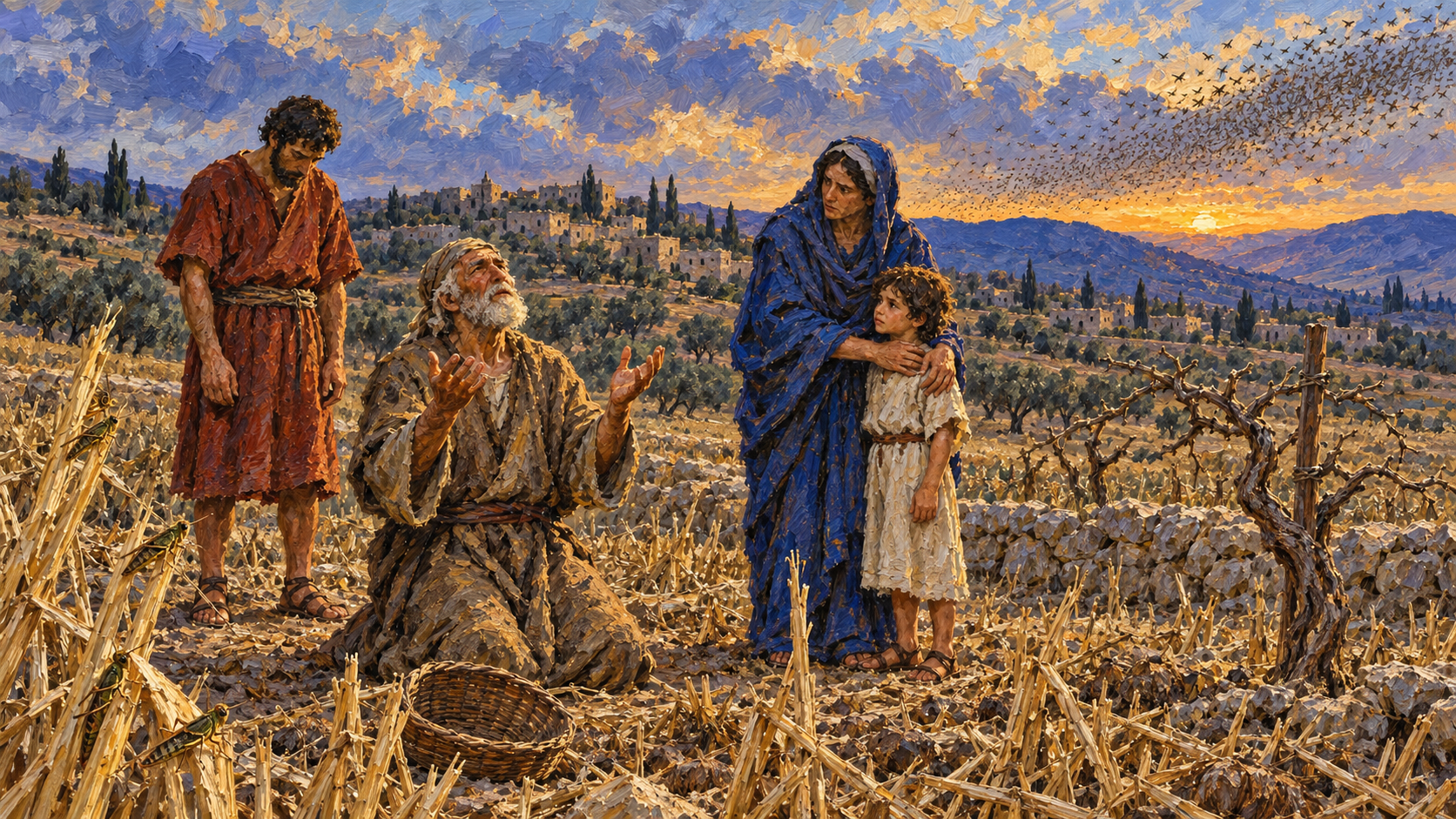
Joel begins with fields stripped bare and animals crying out for water. With the harvest gone, the people could no longer bring their offerings to the Lord. Through Joel, the Lord called them to face that ruin and return to Him while He was still offering mercy. I want to follow that appeal carefully as Joel moves from Judah’s immediate distress to the promise of the Spirit, the judgment of the nations, and the Lord dwelling in Zion.
Joel Begins With a Land in Ruins
Joel identifies himself as the son of Pethuel but gives no further account of his life. His Hebrew name, Yo’el, confesses that YHWH, the Lord’s covenant name, is God. He addressed Judah and Jerusalem, where the temple, priests, and offerings were central to the crisis he described.
The book names no king or event that settles its date. An early setting, often in Joash’s reign around 835–800 BC, remains possible. Its supporters point to the prominence of priests and the absence of a named king. Later dates draw on the nations Joel mentions, the temple setting, and possible relationships with other prophetic books. I do not need to settle the date before trusting the authority of the book God has given us. English Bibles divide the book into three chapters and the traditional Hebrew text into four; the contents are the same.
The word of the LORD that came to Joel the son of Pethuel. Hear this, you elders, And give ear, all you inhabitants of the land! Has anything like this happened in your days, Or even in the days of your fathers? Tell your children about it, Let your children tell their children, And their children another generation. What the chewing locust left, the swarming locust has eaten; What the swarming locust left, the crawling locust has eaten; And what the crawling locust left, the consuming locust has eaten. Awake, you drunkards, and weep; And wail, all you drinkers of wine, Because of the new wine, For it has been cut off from your mouth. For a nation has come up against My land, Strong, and without number; His teeth are the teeth of a lion, And he has the fangs of a fierce lion. He has laid waste My vine, And ruined My fig tree; He has stripped it bare and thrown it away; Its branches are made white. Lament like a virgin girded with sackcloth For the husband of her youth. The grain offering and the drink offering Have been cut off from the house of the LORD; The priests mourn, who minister to the LORD. The field is wasted, The land mourns; For the grain is ruined, The new wine is dried up, The oil fails. Be ashamed, you farmers, Wail, you vinedressers, For the wheat and the barley; Because the harvest of the field has perished. The vine has dried up, And the fig tree has withered; The pomegranate tree, The palm tree also, And the apple tree– All the trees of the field are withered; Surely joy has withered away from the sons of men. Gird yourselves and lament, you priests; Wail, you who minister before the altar; Come, lie all night in sackcloth, You who minister to my God; For the grain offering and the drink offering Are withheld from the house of your God. Consecrate a fast, Call a sacred assembly; Gather the elders And all the inhabitants of the land Into the house of the LORD your God, And cry out to the LORD. Alas for the day! For the day of the LORD is at hand; It shall come as destruction from the Almighty. Is not the food cut off before our eyes, Joy and gladness from the house of our God? The seed shrivels under the clods, Storehouses are in shambles; Barns are broken down, For the grain has withered. How the animals groan! The herds of cattle are restless, Because they have no pasture; Even the flocks of sheep suffer punishment. O LORD, to You I cry out; For fire has devoured the open pastures, And a flame has burned all the trees of the field. The beasts of the field also cry out to You, For the water brooks are dried up, And fire has devoured the open pastures.
One group of locusts ate what another had left until the land was stripped. Joel’s four terms may describe different species, stages of development, or several features of the same swarm. The precise classification is uncertain, but the result is clear. Vines and fig trees were ruined, wheat and barley failed, and other fruit trees withered. Farmers lost the produce of their labor, families lost their food, and herds had neither pasture nor water.
The loss reached the temple as well. Grain and drink offerings depended on the produce now missing from the fields. Priests could not continue their ministry as though the nation’s life had remained undisturbed. Joel called elders and ordinary inhabitants to remember this calamity and tell their children, who were to pass it on in turn. He described a real disaster in Judah, not merely an illustration detached from what people had suffered.
Calling the swarm a nation with a lion’s teeth prepares us for the military language of chapter 2. Meanwhile, Joel addressed those who had lived for drink, farmers who had nothing to harvest, and priests whose offerings had ceased. He called for sackcloth, a fast, and an assembly where the people would cry to the Lord. They needed to acknowledge their condition and seek Him together. Fasting could not purchase relief, and sorrow was not a performance to secure His attention.
Joel also called the disaster a warning of the Day of the Lord. The prophets use that expression for God’s decisive intervention in judgment and deliverance. Sometimes they describe a historical judgment; they also look toward the final Day when God will shake creation, judge the nations, and establish the Messiah’s kingdom. Zephaniah’s warning shows why neither complacency nor wealth can provide shelter when the Lord calls people to account:
Be silent in the presence of the Lord GOD; For the day of the LORD is at hand, For the LORD has prepared a sacrifice; He has invited His guests. "And it shall be, In the day of the LORD's sacrifice, That I will punish the princes and the king's children, And all such as are clothed with foreign apparel. In the same day I will punish All those who leap over the threshold, Who fill their masters' houses with violence and deceit. "And there shall be on that day," says the LORD, "The sound of a mournful cry from the Fish Gate, A wailing from the Second Quarter, And a loud crashing from the hills. Wail, you inhabitants of Maktesh! For all the merchant people are cut down; All those who handle money are cut off. "And it shall come to pass at that time That I will search Jerusalem with lamps, And punish the men Who are settled in complacency, Who say in their heart, 'The LORD will not do good, Nor will He do evil.' Therefore their goods shall become booty, And their houses a desolation; They shall build houses, but not inhabit them; They shall plant vineyards, but not drink their wine." The great day of the LORD is near; It is near and hastens quickly. The noise of the day of the LORD is bitter; There the mighty men shall cry out. That day is a day of wrath, A day of trouble and distress, A day of devastation and desolation, A day of darkness and gloominess, A day of clouds and thick darkness, A day of trumpet and alarm Against the fortified cities And against the high towers. "I will bring distress upon men, And they shall walk like blind men, Because they have sinned against the LORD; Their blood shall be poured out like dust, And their flesh like refuse." Neither their silver nor their gold Shall be able to deliver them In the day of the LORD's wrath; But the whole land shall be devoured By the fire of His jealousy, For He will make speedy riddance Of all those who dwell in the land.
Zephaniah condemned violence, deceit, and the settled belief that the Lord would do neither good nor evil. The people he addressed acted as though God would never intervene. Their money could not protect their houses, vineyards, or lives from His judgment. Joel’s locust plague likewise exposed how quickly familiar sources of security could disappear. His later descriptions of heavenly disturbances and all nations gathered for judgment extend beyond the loss of one harvest.
I understand the final prophetic sequence to include the church being gathered to Christ before a literal seven-year Tribulation, followed by His bodily return and literal thousand-year reign. Joel contributes to that wider revelation without supplying every detail of its chronology. We need to distinguish the immediate catastrophe from the final Day while recognizing why one warns of the other. The study on the Day of the Lord follows those connections more fully.
The Alarm Leads to a Call to Return
Blow the trumpet in Zion, And sound an alarm in My holy mountain! Let all the inhabitants of the land tremble; For the day of the LORD is coming, For it is at hand: A day of darkness and gloominess, A day of clouds and thick darkness, Like the morning clouds spread over the mountains. A people come, great and strong, The like of whom has never been; Nor will there ever be any such after them, Even for many successive generations. A fire devours before them, And behind them a flame burns; The land is like the Garden of Eden before them, And behind them a desolate wilderness; Surely nothing shall escape them. Their appearance is like the appearance of horses; And like swift steeds, so they run. With a noise like chariots Over mountaintops they leap, Like the noise of a flaming fire that devours the stubble, Like a strong people set in battle array. Before them the people writhe in pain; All faces are drained of color. They run like mighty men, They climb the wall like men of war; Every one marches in formation, And they do not break ranks. They do not push one another; Every one marches in his own column. Though they lunge between the weapons, They are not cut down. They run to and fro in the city, They run on the wall; They climb into the houses, They enter at the windows like a thief. The earth quakes before them, The heavens tremble; The sun and moon grow dark, And the stars diminish their brightness. The LORD gives voice before His army, For His camp is very great; For strong is the One who executes His word. For the day of the LORD is great and very terrible; Who can endure it?
The trumpet sounds in Zion as an overwhelming host advances. Before it lies land like Eden; behind it remains wilderness. Joel compares its movement to horses and chariots, describes ordered ranks climbing walls, and pictures the invaders entering houses through windows. Even the earth and heavens tremble before the Lord’s army.
Readers differ over the host’s identity. Some understand literal locusts described as soldiers; others see a human army compared with locusts. Another reading sees the recent plague opening into the warning of an invasion and ultimately the final judgment. Joel’s comparisons and the movement of the prophecy explain why those readings arise. We can acknowledge that uncertainty without weakening his explicit claim: the Lord commands this host, and it carries out His word.
The question “Who can endure it?” leaves the people without a defense strong enough to resist Him. Yet His next words invite the very people under warning to return:
"Now, therefore," says the LORD, "Turn to Me with all your heart, With fasting, with weeping, and with mourning." So rend your heart, and not your garments; Return to the LORD your God, For He is gracious and merciful, Slow to anger, and of great kindness; And He relents from doing harm. Who knows if He will turn and relent, And leave a blessing behind Him– A grain offering and a drink offering For the LORD your God? Blow the trumpet in Zion, Consecrate a fast, Call a sacred assembly; Gather the people, Sanctify the congregation, Assemble the elders, Gather the children and nursing babes; Let the bridegroom go out from his chamber, And the bride from her dressing room. Let the priests, who minister to the LORD, Weep between the porch and the altar; Let them say, "Spare Your people, O LORD, And do not give Your heritage to reproach, That the nations should rule over them. Why should they say among the peoples, 'Where is their God?'"
“Now, therefore” means the appeal comes while the warning is still before them. The Hebrew verb shuv means to turn or return. God called for their whole hearts, not merely regret that their circumstances had become painful. Tearing garments was a recognized expression of grief; Joel challenged the use of outward sorrow to conceal an unchanged heart. Tears and fasting could express repentance, but they could not replace turning to God.
Everyone was to come to the assembly. Elders and families were included, even nursing infants. A bride and bridegroom were to leave their wedding celebration because this emergency took precedence over an otherwise proper occasion. Infants could not consciously repent, but they belonged to the covenant community suffering the calamity and depending on God’s mercy. Nor could adults hand the responsibility to their priests and remain uninvolved.
The priests were to weep between the temple porch and the altar and plead for the Lord to spare His people. They asked Him to protect His heritage from reproach so that the nations would not question His presence and power. Their prayer brought the people’s suffering and the honor of God’s name together. They were appealing for compassion from the God to whom Judah belonged.
Joel grounded that appeal in the Lord’s revealed character, echoing Exodus 34. He is gracious and merciful, slow to anger, and abundant in covenant kindness. The people could not claim that their fasting had made them deserving of restored crops. They could ask for mercy because God had told them what He is like.
When Joel asked, “Who knows if He will turn and relent,” he was not questioning God’s goodness. He was teaching Judah to seek relief without treating the outcome as a debt God owed them. Relenting describes a real change in God’s dealings as people respond to His warning; it does not mean He became more compassionate or discovered something He had not known. His character and eternal purpose remain secure while He truly calls people to repent and responds within history.
Restoration Opens Into the Promise of the Spirit
Then the LORD will be zealous for His land, And pity His people. The LORD will answer and say to His people, "Behold, I will send you grain and new wine and oil, And you will be satisfied by them; I will no longer make you a reproach among the nations. "But I will remove far from you the northern army, And will drive him away into a barren and desolate land, With his face toward the eastern sea And his back toward the western sea; His stench will come up, And his foul odor will rise, Because he has done monstrous things." Fear not, O land; Be glad and rejoice, For the LORD has done marvelous things! Do not be afraid, you beasts of the field; For the open pastures are springing up, And the tree bears its fruit; The fig tree and the vine yield their strength. Be glad then, you children of Zion, And rejoice in the LORD your God; For He has given you the former rain faithfully, And He will cause the rain to come down for you– The former rain, And the latter rain in the first month. The threshing floors shall be full of wheat, And the vats shall overflow with new wine and oil. "So I will restore to you the years that the swarming locust has eaten, The crawling locust, The consuming locust, And the chewing locust, My great army which I sent among you. You shall eat in plenty and be satisfied, And praise the name of the LORD your God, Who has dealt wondrously with you; And My people shall never be put to shame. Then you shall know that I am in the midst of Israel: I am the LORD your God And there is no other. My people shall never be put to shame.
Joel 2:18 turns from the people’s plea to God’s compassion. The Hebrew verbs are read by some as recounting His response and by others as assuring the people of what He will do. Either reading presents the Lord’s zealous care for His land and people. His jealousy concerns His rightful covenant claim and their good, rather than the resentment of a rival who fears losing his position.
The promised restoration answers the losses of chapter 1. Rain returns, pastures grow, trees bear fruit, and grain, wine, and oil become plentiful again. The northern force is driven into a desolate place, and its foul odor rises. Even the animals, which shared the earlier distress, are told not to fear. God cares for the land He made and the creatures dependent on it. His deliverance includes food and water, as well as the renewed worship those gifts make possible.
Israel will know that the Lord is in her midst and that He alone is God. The restored harvest leads to praise of the Giver rather than renewed confidence in independence from Him. His people will not remain in shame. The promise to restore the years consumed by locusts concerns the harvests Judah had lost under covenant judgment and the abundance God would provide in mercy. He then promises a gift reaching beyond the renewed harvest:
"And it shall come to pass afterward That I will pour out My Spirit on all flesh; Your sons and your daughters shall prophesy, Your old men shall dream dreams, Your young men shall see visions. And also on My menservants and on My maidservants I will pour out My Spirit in those days. "And I will show wonders in the heavens and in the earth: Blood and fire and pillars of smoke. The sun shall be turned into darkness, And the moon into blood, Before the coming of the great and awesome day of the LORD. And it shall come to pass That whoever calls on the name of the LORD Shall be saved. For in Mount Zion and in Jerusalem there shall be deliverance, As the LORD has said, Among the remnant whom the LORD calls.
The Holy Spirit promised here is a divine Person, not an impersonal energy. He speaks and teaches, convicts people of sin, distributes gifts as He wills, and dwells in believers. Scripture also says He can be grieved. Joel’s language of pouring out describes God’s generous giving, not a substance people learn to control.
The people named in the promise explain the breadth of “All flesh.” Sons and daughters, old and young, menservants and maidservants will share in the outpouring. In the Old Testament the Spirit empowered selected people for particular service; Joel looks ahead to His work reaching across distinctions of sex, age, and social rank. A servant would not be excluded because he lacked an influential position.
This does not mean every human being will automatically be saved or indwelt, or that everyone will receive an identical gift. Joel also speaks of people calling on the Lord and of the remnant He calls. Every true believer receives the same salvation and indwelling Spirit. Sharing those gifts does not erase every responsibility within family and church order; Scripture reserves the offices and authoritative teaching leadership of the local church for biblically qualified men.
I do not believe the Spirit has ceased giving miraculous gifts, nor do I accept claims of spiritual authority merely because an experience is unusual. He still gives as He wills, and every claim must be tested by the written Word. Dreams, visions, or an apparent gift cannot authorize invented revelation, manipulation, or teaching that contradicts Scripture. An impressive experience is no substitute for holiness.
At Pentecost, the Feast of Weeks, Jerusalem was filled with Jewish worshipers from many nations. The Spirit filled Jesus’ disciples, and the visitors heard God’s wonderful works in languages they understood. Peter answered those who accused the disciples of drunkenness by directing them to Joel:
But Peter, standing up with the eleven, raised his voice and said to them, "Men of Judea and all who dwell in Jerusalem, let this be known to you, and heed my words. For these are not drunk, as you suppose, since it is only the third hour of the day. But this is what was spoken by the prophet Joel: 'And it shall come to pass in the last days, says God, That I will pour out of My Spirit on all flesh; Your sons and your daughters shall prophesy, Your young men shall see visions, Your old men shall dream dreams. And on My menservants and on My maidservants I will pour out My Spirit in those days; And they shall prophesy. I will show wonders in heaven above And signs in the earth beneath: Blood and fire and vapor of smoke. The sun shall be turned into darkness, And the moon into blood, Before the coming of the great and awesome day of the LORD. And it shall come to pass That whoever calls on the name of the LORD Shall be saved.' "Men of Israel, hear these words: Jesus of Nazareth, a Man attested by God to you by miracles, wonders, and signs which God did through Him in your midst, as you yourselves also know– Him, being delivered by the determined purpose and foreknowledge of God, you have taken by lawless hands, have crucified, and put to death; whom God raised up, having loosed the pains of death, because it was not possible that He should be held by it.
“This is what was spoken by the prophet Joel.” Peter identified what his hearers were witnessing as fulfillment, rather than a faint resemblance to an unrelated prediction. The Spirit really had been poured out. Peter then proclaimed Jesus, whose ministry God had publicly attested and whom lawless men had crucified. God’s determined saving purpose and foreknowledge neither forced their wicked choice nor excused it. God raised Jesus bodily from the dead.
That genuine fulfillment did not exhaust everything Joel announced. The cosmic signs, the judgment of the nations, and Jerusalem’s restoration in the Messiah’s kingdom still await completion. We can recognize the Spirit’s present indwelling of the church without claiming that all the promised events occurred on Pentecost. Joel’s prophecy also includes God’s future work with Israel and the nations. The study on tongues of fire at Pentecost examines the occasion Peter was explaining.
Paul later applied Joel’s promise of salvation to his proclamation of Jesus in Romans 10. He explained both whom we call upon and how people come to call on Him:
But what does it say? "The word is near you, in your mouth and in your heart" (that is, the word of faith which we preach): that if you confess with your mouth the Lord Jesus and believe in your heart that God has raised Him from the dead, you will be saved. For with the heart one believes unto righteousness, and with the mouth confession is made unto salvation. For the Scripture says, "Whoever believes on Him will not be put to shame." For there is no distinction between Jew and Greek, for the same Lord over all is rich to all who call upon Him. For "whoever calls on the name of the LORD shall be saved." How then shall they call on Him in whom they have not believed? And how shall they believe in Him of whom they have not heard? And how shall they hear without a preacher? And how shall they preach unless they are sent? As it is written: "How beautiful are the feet of those who preach the gospel of peace, Who bring glad tidings of good things!" But they have not all obeyed the gospel. For Isaiah says, "LORD, who has believed our report?" So then faith comes by hearing, and hearing by the word of God.
Paul connects calling on the Lord with believing in the heart and confessing the risen Jesus. Repeating words while remaining in unbelief is not the response he describes. His questions trace the need for gospel proclamation: people must hear of Christ before they can believe in Him and call on Him. We should tell them clearly who He is and what He has done.
Paul applies Joel’s words about YHWH to Jesus, affirming the eternal Son’s deity. The Lord upon whom we call is fully God and fully man, our only Savior and Mediator, the One through whom we come to God. Jew and Gentile have the same Lord. The breadth of “whoever” gives us reason to preach to everyone, because Christ died for the whole world. People can resist that genuine invitation, but no sincere believer will be turned away because of ethnicity, sex, age, or social position.
Joel’s promise also includes deliverance in Mount Zion and Jerusalem among the remnant the Lord calls. Salvation through Israel’s Messiah and the future deliverance of His people belong within the same prophecy. The church receives salvation through Him without turning Israel into a metaphor or canceling the promises concerning her land and people.
The Day of the Lord Brings Judgment to the Nations
The outpouring passage also places blood, fire, smoke, a darkened sun, and a blood-colored moon before the great and awesome Day. Warfare may supply some of the imagery, but the prophecy reaches toward real disturbances in the heavens. The Gospels and Revelation likewise describe creation shaken around Christ’s coming. Jesus said no one knows the day or hour, so I would neither explain every sign away nor use an ordinary astronomical event to announce a date for His return. We should respond with watchfulness and gospel proclamation.
"For behold, in those days and at that time, When I bring back the captives of Judah and Jerusalem, I will also gather all nations, And bring them down to the Valley of Jehoshaphat; And I will enter into judgment with them there On account of My people, My heritage Israel, Whom they have scattered among the nations; They have also divided up My land. They have cast lots for My people, Have given a boy as payment for a harlot, And sold a girl for wine, that they may drink. "Indeed, what have you to do with Me, O Tyre and Sidon, and all the coasts of Philistia? Will you retaliate against Me? But if you retaliate against Me, Swiftly and speedily I will return your retaliation upon your own head; Because you have taken My silver and My gold, And have carried into your temples My prized possessions. Also the people of Judah and the people of Jerusalem You have sold to the Greeks, That you may remove them far from their borders. "Behold, I will raise them Out of the place to which you have sold them, And will return your retaliation upon your own head. I will sell your sons and your daughters Into the hand of the people of Judah, And they will sell them to the Sabeans, To a people far off; For the LORD has spoken."
The Lord connects the restoration of Judah and Jerusalem with His gathering of the nations for judgment. He names what they had done: scattered His people, divided His land, cast lots over captives, sold children, and carried sacred treasure into their own temples. A boy became payment for prostitution and a girl was traded for wine. These were people being degraded and sold for someone else’s gratification. God would bring their mistreatment before His court.
Tyre, Sidon, and the coasts of Philistia would answer for their plunder and their sale of Judeans far from home. The Lord promised to reverse their position and return their conduct upon them. His announced judgment did not make the nations’ choices innocent, and it does not authorize private revenge. Israel’s offenders would face the Judge who knew exactly what they had done.
Judah, Jerusalem, Israel, and the land retain their ordinary meaning in this promised restoration. The church shares in salvation through Israel’s Messiah, but that participation does not dissolve God’s promises to this people.
The Valley of Jehoshaphat is named as the place of judgment. Jehoshaphat means YHWH judges; the name may identify a known valley or describe the place by the judgment God will render. Some readers place this future judgment in the Kidron Valley near Jerusalem. Joel does not give enough geography to establish a precise location on a present map.
Proclaim this among the nations: "Prepare for war! Wake up the mighty men, Let all the men of war draw near, Let them come up. Beat your plowshares into swords And your pruning hooks into spears; Let the weak say, 'I am strong.'" Assemble and come, all you nations, And gather together all around. Cause Your mighty ones to go down there, O LORD. "Let the nations be wakened, and come up to the Valley of Jehoshaphat; For there I will sit to judge all the surrounding nations. Put in the sickle, for the harvest is ripe. Come, go down; For the winepress is full, The vats overflow– For their wickedness is great." Multitudes, multitudes in the valley of decision! For the day of the LORD is near in the valley of decision. The sun and moon will grow dark, And the stars will diminish their brightness. The LORD also will roar from Zion, And utter His voice from Jerusalem; The heavens and earth will shake; But the LORD will be a shelter for His people, And the strength of the children of Israel. "So you shall know that I am the LORD your God, Dwelling in Zion My holy mountain. Then Jerusalem shall be holy, And no aliens shall ever pass through her again."
The nations summon warriors and turn farming implements into weapons, reversing the picture of disarmament found in other prophecies. Their preparations do not make them capable of overcoming the Lord. He summons them before His judgment, where their ripened wickedness is pictured as a harvest ready for cutting and grapes ready for the winepress.
The valley of decision concerns the Lord’s verdict upon those gathered nations. It is often preached as though Joel were describing a crowd choosing whether to accept God, but the Lord is the Judge making the decision here. The NET note on Joel 3:14 makes the same distinction. We have an urgent reason to call people to repentance before judgment comes without assigning their decision to a passage about His sentence.
The Lord’s roar from Zion shakes heaven and earth, yet He is a shelter and strength for His people. Jerusalem will be holy and free from foreign domination, and Israel will know that He dwells there. Revelation uses Joel’s harvest and winepress imagery as it describes judgment upon the earth:
Then I looked, and behold, a white cloud, and on the cloud sat One like the Son of Man, having on His head a golden crown, and in His hand a sharp sickle. And another angel came out of the temple, crying with a loud voice to Him who sat on the cloud, "Thrust in Your sickle and reap, for the time has come for You to reap, for the harvest of the earth is ripe." So He who sat on the cloud thrust in His sickle on the earth, and the earth was reaped. Then another angel came out of the temple which is in heaven, he also having a sharp sickle. And another angel came out from the altar, who had power over fire, and he cried with a loud cry to him who had the sharp sickle, saying, "Thrust in your sharp sickle and gather the clusters of the vine of the earth, for her grapes are fully ripe." So the angel thrust his sickle into the earth and gathered the vine of the earth, and threw it into the great winepress of the wrath of God. And the winepress was trampled outside the city, and blood came out of the winepress, up to the horses' bridles, for one thousand six hundred furlongs.
The Son of Man, Christ, reaps, and the earth’s grapes are gathered into the great winepress of God’s wrath. In both books wickedness has reached its appointed fullness, and the Lord brings judgment after His patience. The severity of that judgment should prevent us from treating His warnings casually. Joel then ends with the refuge and renewed abundance He provides for His people.
The Lord Will Dwell in Zion
And it will come to pass in that day That the mountains shall drip with new wine, The hills shall flow with milk, And all the brooks of Judah shall be flooded with water; A fountain shall flow from the house of the LORD And water the Valley of Acacias. "Egypt shall be a desolation, And Edom a desolate wilderness, Because of violence against the people of Judah, For they have shed innocent blood in their land. But Judah shall abide forever, And Jerusalem from generation to generation. For I will acquit them of the guilt of bloodshed, whom I had not acquitted; For the LORD dwells in Zion."
The dry streams and ruined fields of chapter 1 give way to water and fruitfulness. A fountain flows from the Lord’s house, the mountains drip with wine, and the hills flow with milk. Judah and Jerusalem endure, while Egypt and Edom become desolate because they shed innocent blood. God’s care for His people includes holding their violent oppressors accountable.
Joel closes with the Lord’s promise to acquit His people of bloodguilt and dwell in Zion. His restoration includes cleansing His people, as well as returning them to a fruitful land. He will make His presence known among a holy people. The promised earthly kingdom includes material abundance because the Creator’s redemption concerns His creation as well as individual souls.
I understand these promises as part of Christ’s literal thousand-year reign after His bodily return, with the final glory of the new creation still to follow. Judah’s land and Jerusalem’s future cannot be reduced to vague spiritual prosperity. The assurance that “The LORD dwells in Zion” answers the fear raised by the devastation. Locusts, invading armies, and gathered nations cannot overturn His purpose to remain with His people.
I would not turn Joel 2:25 into a guarantee that every Christian will recover every lost possession, relationship, or opportunity before death. Some damage remains for the rest of a person’s life, and faithful believers can live with disability and lasting grief. God can produce new fruit after devastation without recreating every earlier circumstance. Our ultimate future rests in resurrection and Christ’s kingdom; repentance does not obligate Him to reimburse every earthly loss.
Joel’s call to return should also reach our own conduct. We should not assume that every disaster proves its victims have committed a particular sin. We can mourn real loss and depend on God while examining disobedience we already know about. If I have harmed someone, repentance means more than regretting the consequences or protecting my reputation. I need to confess honestly and make restitution where I can. Removing access to temptation, changing my conduct in a relationship, extending forgiveness where Scripture requires it, or asking mature believers for accountable help may be part of that response.
A church’s leaders also need to bring the congregation together when sin or disaster has wounded it. Joel’s priests were to lead prayer among the people affected, not offer detached advice while everyone else endured the loss. Honest lament names what has happened and brings it to God. Leaders should help people pray without manufacturing emotion, and no one should measure genuine repentance by how much someone cries. The study on repentance develops that practical response.
Paul directs those who need salvation to Jesus Christ, the eternal Son, fully God and fully man, born of a virgin and without sin. Wicked men tortured Him and inflicted real physical punishment on His innocent body, while He willingly bore that punishment for our sins. He shed His blood and died, completing His saving work before His burial and bodily resurrection. The Father did not punish, curse, abandon, strike, bruise, or pour wrath on Jesus. Those who reject His saving provision must face their own judgment.
Christ died for the whole world, and God’s offer is genuine even though people can resist it. Everyone who repents and believes in Jesus is forgiven and justified, declared righteous before God. Through regeneration, genuine new birth, that person becomes a new creation. The Holy Spirit indwells and seals the believer, whose salvation is eternally secure. Obedience neither earns salvation nor keeps us saved, and security never gives permission for lawlessness. A Christian label without evidence of new life cannot establish that someone has been born again.
My Final Thoughts
Judah’s ruined harvest did not leave the people without anyone to call upon. The Lord who warned them also invited them to return because He is gracious and merciful. I want to respond honestly when His word exposes sin, without using outward sorrow to avoid a change in conduct. His Spirit has truly been poured out, and His remaining promises give us reason to await Christ’s return with faithful obedience. The coming judgment is real, and so is the invitation to call on Jesus while there is opportunity to respond.