
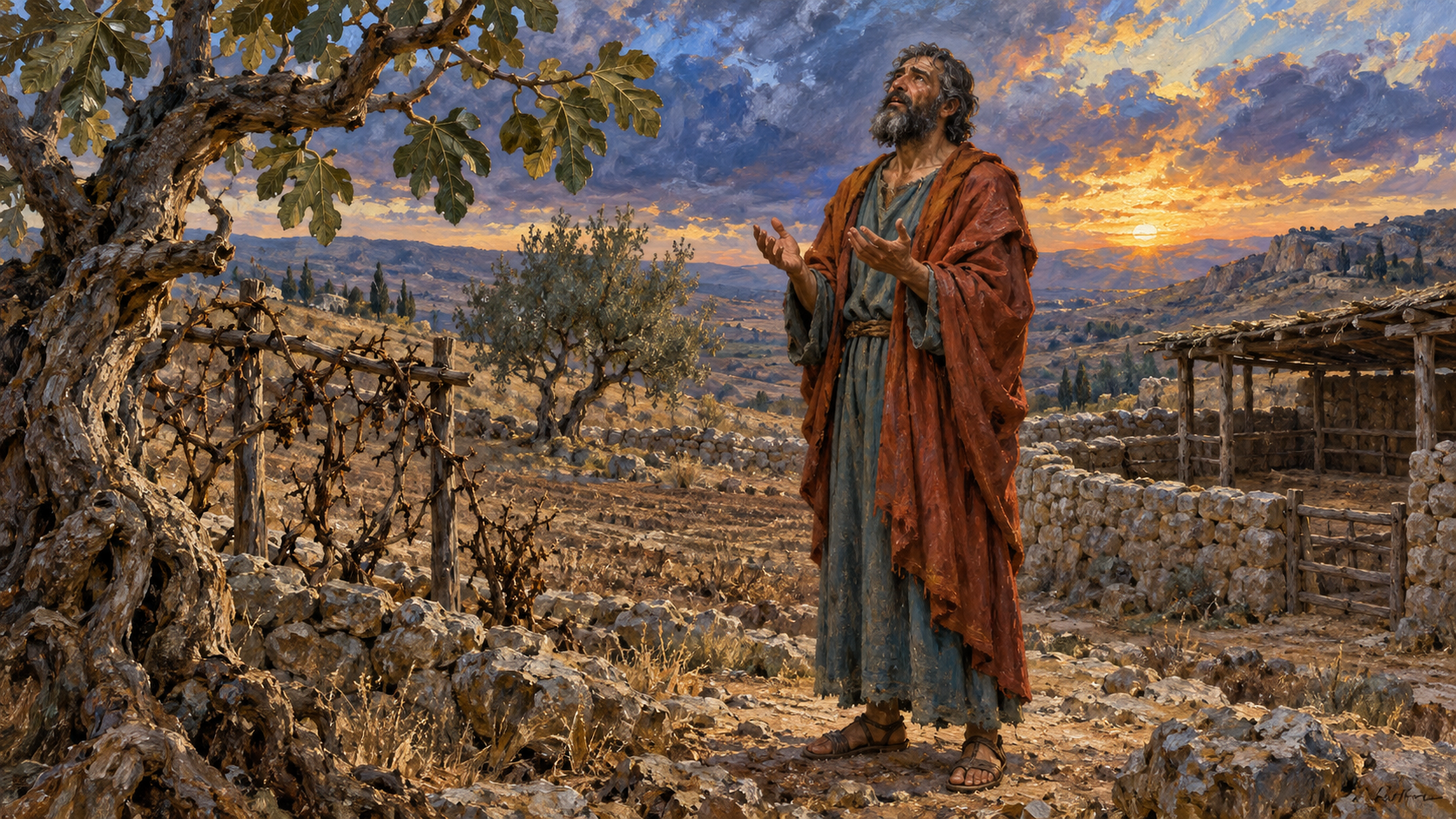
What do we do when injustice goes unanswered, and God’s response is harder to understand than the trouble we brought to Him? Habakkuk asked why the LORD allowed violence among His own people. God answered, but the judgment He announced frightened the prophet. By the end of the book, Habakkuk could rejoice in God even while contemplating the loss of his livelihood. I want to follow how he reached that confidence without overlooking the hard questions along the way.
Habakkuk Brings Judah’s Violence Before God
Habakkuk brings two complaints to the LORD, who answers each one. Chapter 1 moves from Judah’s corruption to the rise of Babylon, the nation God would use to judge it. Chapter 2 announces that Babylon will also face judgment and calls the righteous to live by faith while waiting. In chapter 3, the prophet turns what he has heard into a prayer. His questions have not driven him away from God; he has brought them to the One whose holiness makes the injustice so difficult to understand.
We know little about Habakkuk himself. Scripture calls him a prophet but gives no genealogy, hometown, or reigning king. His name is often connected with a Hebrew root meaning to embrace, although its derivation is uncertain. The book does not explain his name or use it to establish its message.
The Chaldeans were the rising Babylonian power that would invade Judah. A late-seventh-century setting is likely, possibly during Jehoiakim’s reign, but the book does not give us enough information to settle an exact year. Habakkuk speaks before the invasion announced here, while injustice within Judah already gives him ample reason to cry out.
The burden which the prophet Habakkuk saw. O LORD, how long shall I cry, And You will not hear? Even cry out to You, “Violence!” And You will not save. Why do You show me iniquity, And cause me to see trouble? For plundering and violence are before me; There is strife, and contention arises. Therefore the law is powerless, And justice never goes forth. For the wicked surround the righteous; Therefore perverse judgment proceeds.
Habakkuk describes a society in which the people entrusted with justice no longer administer it properly. Violence, plundering, and strife surround him. The wicked hem in the righteous, and decisions that ought to restrain wrongdoing instead protect it. God’s law has not become defective; it has become powerless in public life because people refuse to honor it.
When Habakkuk asks “How long?” he appeals to the LORD who sees this conduct and has the authority to judge it. He does not need an explanation of why violence is wrong. He wants to know why the covenant God appears to delay while His people suffer under corrupt judgment. Habakkuk’s complaint is frank, but he still addresses God as the One from whom he expects justice.
I can bring a complaint to God without pretending that evil is acceptable or that waiting is easy. Habakkuk does that openly. He also remains willing to hear God’s answer, which becomes far more demanding than simply receiving reassurance that things will soon improve.
God’s Answer Raises a Harder Question
“Look among the nations and watch– Be utterly astounded! For I will work a work in your days Which you would not believe, though it were told you. For indeed I am raising up the Chaldeans, A bitter and hasty nation Which marches through the breadth of the earth, To possess dwelling places that are not theirs. They are terrible and dreadful; Their judgment and their dignity proceed from themselves. Their horses also are swifter than leopards, And more fierce than evening wolves. Their chargers charge ahead; Their cavalry comes from afar; They fly as the eagle that hastens to eat. “They all come for violence; Their faces are set like the east wind. They gather captives like sand. They scoff at kings, And princes are scorned by them. They deride every stronghold, For they heap up earthen mounds and seize it. Then his mind changes, and he transgresses; He commits offense, Ascribing this power to his god.”
The LORD announces that He is raising up the Chaldeans. Their cavalry will move swiftly, their armies will seize homes that belong to others, and their captives will be as numerous as sand. Rulers who seem formidable to smaller nations will be objects of ridicule to Babylon. Even fortified cities will fall as the invaders heap up earth to overcome their defenses. Judah’s violence will be answered by an invasion it cannot comfortably dismiss.
God describes this army’s guilt along with its strength. Verse 11 says the conqueror credits his power to his god. Babylon’s military success does not establish that its worship is true or its cruelty righteous. The LORD can use this guilty nation to bring judgment without excusing the desires and decisions for which He will later judge it.
God’s answer shows that the apparent delay had not meant inactivity. He was already directing events beyond Judah’s borders. We know the purpose of this particular invasion because the LORD revealed it. I cannot look at a modern army’s victory and announce with the same certainty that I know why God permitted it. Success in battle does not establish divine approval of the conqueror’s conduct.
Are You not from everlasting, O LORD my God, my Holy One? We shall not die. O LORD, You have appointed them for judgment; O Rock, You have marked them for correction. You are of purer eyes than to behold evil, And cannot look on wickedness. Why do You look on those who deal treacherously, And hold Your tongue when the wicked devours A person more righteous than he? Why do You make men like fish of the sea, Like creeping things that have no ruler over them? They take up all of them with a hook, They catch them in their net, And gather them in their dragnet. Therefore they rejoice and are glad. Therefore they sacrifice to their net, And burn incense to their dragnet; Because by them their share is sumptuous And their food plentiful. Shall they therefore empty their net, And continue to slay nations without pity?
Habakkuk begins his second complaint with convictions he has not abandoned: the LORD is eternal, holy, and the Rock who appoints judgment. When he says God is too pure to behold evil, he cannot mean that God is unable to see wickedness. His complaint depends on God seeing it. He means that the holy God cannot look on evil with approval, which is precisely why the announced invasion troubles him.
Judah is guilty, but Babylon is even more wicked. How can the LORD use a nation that devours people less wicked than itself? Habakkuk is not withdrawing his first complaint or declaring Judah innocent. He is trying to understand how God’s righteous judgment will proceed through the hands of such a merciless invader.
His picture of fishing makes the cruelty concrete. People are dragged away like a catch in a net, while the conqueror celebrates the means by which he has become rich. Sacrificing to the net exposes his idolatry: he honors the power that brings him wealth instead of answering to the God whose people he attacks. Meanwhile, the people caught in that net remain human beings whose suffering the prophet refuses to overlook.
Habakkuk asks whether this slaughter can continue indefinitely. He then takes his place to watch for an answer, ready to consider what God will say and how he must respond to correction.
I will stand my watch And set myself on the rampart, And watch to see what He will say to me, And what I will answer when I am corrected. Then the LORD answered me and said: “Write the vision And make it plain on tablets, That he may run who reads it. For the vision is yet for an appointed time; But at the end it will speak, and it will not lie. Though it tarries, wait for it; Because it will surely come, It will not tarry. “Behold the proud, His soul is not upright in him; But the just shall live by his faith. “Indeed, because he transgresses by wine, He is a proud man, And he does not stay at home. Because he enlarges his desire as hell, And he is like death, and cannot be satisfied, He gathers to himself all nations And heaps up for himself all peoples.
The LORD tells him to record the vision plainly. The reference to running has been understood as reading readily or carrying the message onward; the NET translation notes on Habakkuk 2:2 discuss the wording. In either case, Habakkuk must write God’s revelation clearly so it can be read and communicated. The command concerns this prophetic vision, not a method for turning a private ambition into a promise from God.
The vision has an appointed fulfillment. Habakkuk may have to wait longer than he wishes, but God’s word will not fail. I cannot transfer that assurance to every outcome I hope for. The prophet is being told to depend on what God has actually revealed, even during a delay that gives the proud invader room to boast.
The Just Shall Live by Faith While Pride Falls
The proud person’s soul is not upright, and Babylon’s conduct shows the crookedness of that pride. The empire gathers nations to itself with an appetite compared to death, never satisfied with what it has taken. Against that grasping self-reliance, God places the just person who lives by faith.
The Hebrew word emunah carries senses of steadiness, faithfulness, and trust, as the Brown-Driver-Briggs entry explains. Here the righteous person relies on God’s word and remains faithful while awaiting its fulfillment. The word’s range should not be used to remove faith from the passage, especially when the New Testament repeatedly cites this sentence in explaining life through faith.
Faith does not give Habakkuk control over the coming invasion. He cannot believe hard enough to make Babylon disappear. He can trust the LORD who has exposed Babylon’s guilt and appointed its end. Romans, Galatians, and Hebrews will draw on this same verse to explain righteousness through faith and the endurance that follows it. Before we consider those passages, God names the offenses that will bring the proud empire down.
“Will not all these take up a proverb against him, And a taunting riddle against him, and say, ‘Woe to him who increases What is not his–how long? And to him who loads himself with many pledges’? Will not your creditors rise up suddenly? Will they not awaken who oppress you? And you will become their booty. Because you have plundered many nations, All the remnant of the people shall plunder you, Because of men’s blood And the violence of the land and the city, And of all who dwell in it. “Woe to him who covets evil gain for his house, That he may set his nest on high, That he may be delivered from the power of disaster! You give shameful counsel to your house, Cutting off many peoples, And sin against your soul. For the stone will cry out from the wall, And the beam from the timbers will answer it. “Woe to him who builds a town with bloodshed, Who establishes a city by iniquity! Behold, is it not of the LORD of hosts That the peoples labor to feed the fire, And nations weary themselves in vain? For the earth will be filled With the knowledge of the glory of the LORD, As the waters cover the sea. “Woe to him who gives drink to his neighbor, Pressing him to your bottle, Even to make him drunk, That you may look on his nakedness! You are filled with shame instead of glory. You also–drink! And be exposed as uncircumcised! The cup of the LORD’s right hand will be turned against you, And utter shame will be on your glory. For the violence done to Lebanon will cover you, And the plunder of beasts which made them afraid, Because of men’s blood And the violence of the land and the city, And of all who dwell in it. “What profit is the image, that its maker should carve it, The molded image, a teacher of lies, That the maker of its mold should trust in it, To make mute idols? Woe to him who says to wood, ‘Awake!’ To silent stone, ‘Arise! It shall teach!’ Behold, it is overlaid with gold and silver, Yet in it there is no breath at all. “But the LORD is in His holy temple. Let all the earth keep silence before Him.”
The first woe condemns plunder. Babylon has enriched itself with other people’s possessions, but the nations it robbed will rise against it. The language of pledges and creditors turns the empire’s apparent wealth into a debt about to be collected. Its accumulated spoil cannot shield it from the bloodguilt incurred while taking it.
The second woe addresses evil gain used to secure a household. The high nest pictures an attempt to place one’s dynasty beyond danger, but a family established through the ruin of others cannot escape God’s judgment by climbing higher. The stones and timbers become witnesses against the very house they were used to build. Wealth obtained through cruelty carries the evidence of that cruelty with it.
The third woe condemns cities founded on bloodshed. People exhaust themselves building an empire whose achievements will feed the fire. God has announced a different future for the earth: it will be filled with the knowledge of His glory. Babylon’s rulers cannot make their own splendor permanent by forcing others to labor for it. I understand the promise of the earth knowing God’s glory to reach beyond Babylon’s fall to Christ’s bodily return and literal kingdom. The judgment announced against this empire anticipates the day when the whole earth will openly know the LORD’s rule.
In the fourth woe, the oppressor makes his neighbor drunk in order to expose and disgrace him. Intoxication has become a weapon for sexual humiliation. The LORD will turn the oppressor’s apparent glory into shame, making him drink from His own cup of judgment. The accusation also reaches the violence done to Lebanon, its animals, and its people. God sees the damage conquest inflicts on the land as well as on those who inhabit it.
The fifth woe exposes the folly of trusting an idol. A craftsman makes an object and then expects it to awaken and teach. Gold and silver can decorate the wood or stone, but they cannot give it breath. The LORD is alive in His holy temple, and the whole earth must be silent before Him. Habakkuk’s questions have received an answer from the God whom Babylon’s lifeless images cannot rival.
The call for silence does not condemn every honest question. God has let Habakkuk ask and has answered him. The prophet must now receive that answer rather than demand that God conform to his preferred solution.
The Prophet Turns the Vision Into Worship
Chapter 3 records Habakkuk’s prayer, marked “on Shigionoth” and closing with directions to the Chief Musician for stringed instruments. The repeated Selah also appears to give musical or reflective direction. Its precise force, like the meaning of Shigionoth, remains uncertain. These features show that the prayer was prepared for worship; they do not establish that Habakkuk held a priestly office. What he has learned in his exchange with God is now given to God’s people to pray and sing.
A prayer of Habakkuk the prophet, on Shigionoth. O LORD, I have heard Your speech and was afraid; O LORD, revive Your work in the midst of the years! In the midst of the years make it known; In wrath remember mercy.
Habakkuk has heard the LORD’s announcement and is afraid. He asks God to renew His work and make it known, while remembering mercy in the midst of wrath. He accepts that judgment is necessary, yet appeals to the Judge’s compassion for those who will pass through it. Asking for mercy does not require him to minimize the sin that brought judgment.
God came from Teman, The Holy One from Mount Paran. Selah His glory covered the heavens, And the earth was full of His praise. His brightness was like the light; He had rays flashing from His hand, And there His power was hidden. Before Him went pestilence, And fever followed at His feet. He stood and measured the earth; He looked and startled the nations. And the everlasting mountains were scattered, The perpetual hills bowed. His ways are everlasting. I saw the tents of Cushan in affliction; The curtains of the land of Midian trembled. O LORD, were You displeased with the rivers, Was Your anger against the rivers, Was Your wrath against the sea, That You rode on Your horses, Your chariots of salvation? Your bow was made quite ready; Oaths were sworn over Your arrows. Selah You divided the earth with rivers. The mountains saw You and trembled; The overflowing of the water passed by. The deep uttered its voice, And lifted its hands on high. The sun and moon stood still in their habitation; At the light of Your arrows they went, At the shining of Your glittering spear. You marched through the land in indignation; You trampled the nations in anger. You went forth for the salvation of Your people, For salvation with Your Anointed. You struck the head from the house of the wicked, By laying bare from foundation to neck. Selah You thrust through with his own arrows The head of his villages. They came out like a whirlwind to scatter me; Their rejoicing was like feasting on the poor in secret. You walked through the sea with Your horses, Through the heap of great waters.
The prayer pictures the LORD coming from Teman and Mount Paran in radiant holiness. Mountains shake, waters respond, and even the sun and moon stand still before Him. The imagery recalls God’s mighty acts in the Exodus, at Sinai, and during Israel’s journey through the wilderness and entrance into the land. The Creator whom Habakkuk addresses has already shown that neither nations nor the natural world can prevent Him from delivering His people.
Some lines may recall particular events more directly than others. I would not assign every poetic detail to an otherwise unrecorded incident. Habakkuk gathers the language of God’s past deliverances into a prayer that gives him reason to trust the LORD with the announced judgment.
Verse 13 speaks of God’s people and His anointed. Interpreters understand the anointed reference as the people collectively or as their anointed king; the NET notes on Habakkuk 3:13 explain those alternatives. The immediate language concerns covenant deliverance. Across Scripture, that saving purpose reaches its fulfillment in Jesus the Messiah, the promised Anointed One. I can recognize that fulfillment without making every detail of Babylon’s downfall a separate symbol of Christ.
When I heard, my body trembled; My lips quivered at the voice; Rottenness entered my bones; And I trembled in myself, That I might rest in the day of trouble. When he comes up to the people, He will invade them with his troops. Though the fig tree may not blossom, Nor fruit be on the vines; Though the labor of the olive may fail, And the fields yield no food; Though the flock may be cut off from the fold, And there be no herd in the stalls– Yet I will rejoice in the LORD, I will joy in the God of my salvation. The LORD God is my strength; He will make my feet like deer’s feet, And He will make me walk on my high hills. To the Chief Musician. With my stringed instruments.
Habakkuk describes fear that reaches his whole body: quivering lips, trembling, and a sensation like decay in his bones. These are vivid expressions of distress, not a diagnosis of disease. The final wording of verse 16 is difficult, and translations differ over how it describes the coming day of trouble. I understand Habakkuk to be waiting for judgment to reach the invading nation, as several translations render it. The differences can be seen alongside the translation notes on Habakkuk 3:16. Whichever reading one follows, he faces the prospect of invasion while depending on God.
Babylon will be judged, but Judah must first endure the invasion God has announced. Those events will not all happen at once. Habakkuk must live faithfully while the invader seems to prosper and God’s promised judgment is still ahead. Other prophets speak of Judah’s later restoration; this book closes without narrating it.
Against that unsettled future, Habakkuk considers the loss of crops and livestock. If the figs, grapes, olives, and fields yield nothing, and the flocks and herds are gone, the ordinary means of feeding a household have collapsed. He is contemplating severe deprivation, not merely a reduced harvest. The passage states his resolve under those conditions; it does not report that every one of these losses had already occurred.
Even then, Habakkuk will rejoice in the LORD, the God of his salvation. He does not find pleasure in hunger or call an empty stall abundance. He knows that the God who has spoken remains able to save, and he will continue to look to Him when the land can no longer supply what he needs.
The picture of a deer’s feet in high places brings that dependence into view. Dangerous ground remains dangerous, but the LORD gives Habakkuk strength and sure footing to walk there. I cannot read his trembling and conclude that faith removes every fear. His confidence rests in God’s ability to sustain him through circumstances that still frighten him.
How the New Testament Uses Habakkuk
Habakkuk’s declaration about living by faith appears in three New Testament letters, and Paul also uses the warning from chapter 1 when preaching the gospel. Each use deserves attention because the surrounding argument explains how the passage is being applied.
For I am not ashamed of the gospel of Christ, for it is the power of God to salvation for everyone who believes, for the Jew first and also for the Greek. For in it the righteousness of God is revealed from faith to faith; as it is written, “The just shall live by faith.”
In Romans, Paul announces God’s power to save everyone who believes, Jew and Gentile alike. The gospel reveals the righteousness we need before God, and Habakkuk’s words support Paul’s declaration that we receive it through faith. To be justified is to be declared righteous before God. Neither ancestry, religious ritual, nor a record of good works can provide that standing. We receive it through faith in Jesus Christ.
For as many as are of the works of the law are under the curse; for it is written, “Cursed is everyone who does not continue in all things which are written in the book of the law, to do them.” But that no one is justified by the law in the sight of God is evident, for “the just shall live by faith.” Yet the law is not of faith, but “the man who does them shall live by them.” Christ has redeemed us from the curse of the law, having become a curse for us (for it is written, “Cursed is everyone who hangs on a tree”), that the blessing of Abraham might come upon the Gentiles in Christ Jesus, that we might receive the promise of the Spirit through faith.
In Galatians, Paul answers the attempt to gain justification through law. Anyone seeking life on that basis is obliged to continue in everything the law requires. Guilty people cannot erase their guilt by appealing to commands they have already broken. Through Christ, however, the promised blessing and the Spirit are received by faith.
Paul connects redemption with Christ’s death on the tree. Jesus was innocent, yet wicked men subjected Him to bodily punishment and crucifixion. He willingly bore that suffering for our sins and shed His blood to redeem us. His saving work through His blood and death was complete before His bodily resurrection. The words about becoming a curse do not mean that Jesus became morally corrupt. The Father did not punish, curse, abandon, strike, bruise, or pour wrath on Jesus. We must not turn Paul’s explanation of redemption into an accusation that the Father became hostile to His sinless Son.
Therefore do not cast away your confidence, which has great reward. For you have need of endurance, so that after you have done the will of God, you may receive the promise: “For yet a little while, And He who is coming will come and will not tarry. Now the just shall live by faith; But if anyone draws back, My soul has no pleasure in him.” But we are not of those who draw back to perdition, but of those who believe to the saving of the soul.
Paul, the author of Hebrews, uses Habakkuk to urge suffering believers to retain their confidence. Christ will come as promised, and they need endurance while they wait. As in Habakkuk, the interval before fulfillment tests whether people will continue to rely on what God has said. Endurance expresses confidence in the Savior; it does not earn salvation.
True believers are eternally secure because the Holy Spirit indwells and seals them. That assurance does not make biblical warnings pointless. The warnings expose those whose profession of faith has never reflected genuine trust in Christ, and they restrain believers from destructive conduct. I can take them seriously without making my endurance the price of God’s acceptance.
Therefore let it be known to you, brethren, that through this Man is preached to you the forgiveness of sins; and by Him everyone who believes is justified from all things from which you could not be justified by the law of Moses. Beware therefore, lest what has been spoken in the prophets come upon you: ‘Behold, you despisers, Marvel and perish! For I work a work in your days, A work which you will by no means believe, Though one were to declare it to you.'”
At Pisidian Antioch, Paul announces forgiveness through Jesus and justification that the law of Moses could not provide. He then warns his hearers with Habakkuk 1:5. In its original setting, the verse announced the astonishing rise of Babylon. Paul’s inspired application does not erase that setting; he uses the warning to confront people who might despise the greater work God has now announced in Christ. Disbelief will not make that work untrue, and those who reject it remain accountable to God.
Living Faithfully While Waiting for Justice
Habakkuk leaves us with no excuse to defend cruelty because the person committing it has been useful. Judah deserved judgment, and God used Babylon to bring it, but Babylon’s leaders and soldiers still pursued their own violent, idolatrous aims. They were responsible for what they chose. God’s government of events did not turn their wickedness into obedience or make Him guilty of their crimes.
We also need to distinguish delayed judgment from a failure to judge. Some believers die before seeing the wrongs they suffered put right on earth. Habakkuk does not authorize me to promise a quick public vindication to everyone who has been mistreated. God knows what happened, including what escaped every human court, and no hidden crime will escape His final judgment.
The prophet’s frankness also calls me to be precise about wrongdoing. He names violence and perverted justice; the woes identify plunder, exploitation, sexual humiliation, and idolatry. Outrage becomes reckless when accusation outruns the facts. If I am going to speak against injustice, I need to describe what actually happened and judge it by God’s standards rather than by loyalty to my preferred side.
Habakkuk wanted the LORD to address Judah’s evil, but he had to listen when the announced means frightened him. I need that willingness to be corrected. It does not require pretending that I know God’s private purpose behind every hardship. It requires receiving what He has revealed in Scripture, praying for wisdom, and refusing to make my preferred outcome the measure of His faithfulness.
We can wait on God while taking lawful action. Reporting a crime, seeking an honest judgment in court, protecting someone who has been harmed, or providing practical help can all be faithful responses to injustice. Wise counsel can help us decide what action is appropriate. Habakkuk’s watchpost does not prescribe a ritual we must imitate, and trust in God’s final judgment does not relieve us of responsibilities He has already given us.
We need God to forgive our own sin as well as to judge the wrongs committed against us. The New Testament brings Habakkuk’s declaration about faith into the gospel of Jesus Christ, the eternal Son who is fully God and fully man. Born of a virgin, He lived without sin, voluntarily shed His blood and died for the whole world, and rose bodily after His saving work through His death was complete. God’s offer of salvation is genuine, even though people can resist His grace and reject it.
Everyone who repents and believes is forgiven and justified. Regeneration means that God gives the believer new birth, and the Holy Spirit comes to indwell and seal that person. A Christian label cannot substitute for that new life. Our conduct should bear evidence of it, while our security rests in Christ rather than in earning or maintaining a flawless record. His grace never gives us permission to pursue lawlessness.
Christ will return bodily, overthrow rebellious rule, and establish His literal kingdom. Babylon fell long ago, but rulers still boast in their power and treat people as possessions. Every such power will answer to the rightful King. Habakkuk’s promise of the earth knowing the LORD’s glory directs our hope beyond the achievements or failures of any present empire.
My Final Thoughts
Habakkuk teaches me to bring hard questions to God and remain willing to hear His answer. The prophet named Judah’s violence, recoiled at Babylon’s cruelty, and learned that God would judge both. He still trembled, yet resolved to rejoice even if his means of livelihood failed. I do not have to dismiss suffering in order to trust the LORD. Through faith in Jesus Christ we receive our righteous standing before God, and we continue to depend on Him while awaiting what He has promised. That dependence gives us reason to pray, strength to act responsibly, and confidence that the Judge of all the earth will complete His work.