
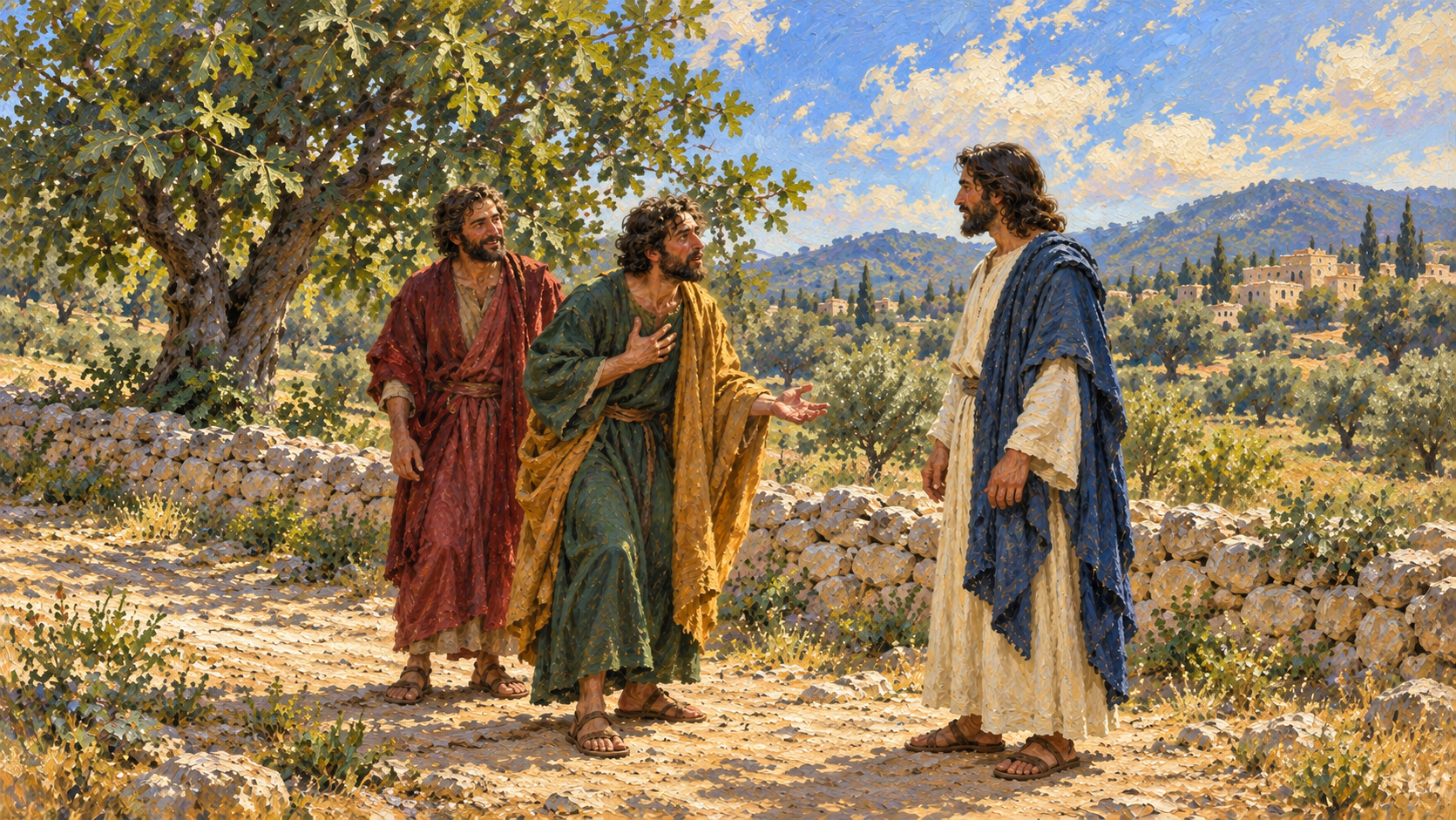
Bartholomew is named among the Twelve, but the Bible records very little about him under that name. Can we learn more by identifying him with Nathanael in John’s Gospel? I believe the evidence deserves a careful look, provided we distinguish what Scripture states from what we infer by comparing the passages.
What Scripture Actually Says About Bartholomew
Scripture does not record a sermon or a conversation with Bartholomew under that name. Nor does it describe something he did alone, whether a miracle or a failure. But it does name him among the twelve men Jesus chose as apostles, and that calling tells us something important about his life even with so few details recorded.
We need to begin with those apostolic lists because the Twelve were more than a loose circle of admirers. Jesus chose them personally and trained them before sending them to represent Him. They witnessed His ministry, and after His death the faithful apostles saw Him bodily alive again. They would carry His kingdom message to others as men who had been with Him.
Now the names of the twelve apostles are these: first, Simon, who is called Peter, and Andrew his brother; James the son of Zebedee, and John his brother; Philip and Bartholomew; Thomas and Matthew the tax collector; James the son of Alphaeus, and Lebbaeus, whose surname was Thaddaeus; Simon the Cananite, and Judas Iscariot, who also betrayed Him.
Simon, to whom He gave the name Peter; James the son of Zebedee and John the brother of James, to whom He gave the name Boanerges, that is, “Sons of Thunder”; Andrew, Philip, Bartholomew, Matthew, Thomas, James the son of Alphaeus, Thaddaeus, Simon the Cananite; and Judas Iscariot, who also betrayed Him.
Matthew places Bartholomew immediately after Philip, and Mark does the same. Luke includes him among the men Jesus named apostles. After the ascension, Acts still places him with the faithful apostles in Jerusalem. These lists don’t give us a full account of Bartholomew’s life, but they establish his calling and offer a clue about his connection with Philip.
And when it was day, He called His disciples to Himself; and from them He chose twelve whom He also named apostles.
And when they had entered, they went up into the upper room where they were staying: Peter, James, John, and Andrew; Philip and Thomas; Bartholomew and Matthew; James the son of Alphaeus and Simon the Zealot; and Judas the son of James.
As I read those names, I see men whose calling rested on Jesus’ grace rather than their human status. Fishermen and a tax collector were among them, along with a zealot. Some belonged to prominent pairs of brothers, while others receive almost no further attention in Scripture. Judas Iscariot was also there and later betrayed the Lord. Bartholomew’s place among them points us to Christ’s choice, not worldly importance, because Jesus called him to be one of the eyewitnesses on whose testimony the church was founded.
The word apostle refers to someone sent with authority. Bartholomew didn’t appoint himself to that work, and his place among the Twelve rested on Christ’s call rather than later fame. Jesus called these men out from the larger body of disciples to learn from Him at close range and announce His kingdom. After His resurrection, their testimony about what they had seen and heard became foundational for the church. Bartholomew shared that responsibility even though Scripture does not preserve one of his sermons.
Why Bartholomew Is Often Identified With Nathanael
The name Bartholomew is commonly understood as a patronymic, a name that identifies someone by his father. It likely means “son of Tolmai” or “son of Talmai.” That suggests Bartholomew may have been a family designation rather than his personal given name. It helps explain how the same man could appear elsewhere under another name, but the meaning alone does not prove that he was Nathanael.
The connection becomes more persuasive when we compare the Gospel accounts. Bartholomew regularly appears beside Philip in the lists in Matthew, Mark, and Luke. In John 1, it was Philip who found Nathanael and brought him to Jesus. John later names Nathanael of Cana among the disciples gathered after the resurrection. He never uses the name Bartholomew, while Matthew, Mark, and Luke do not name Nathanael among the Twelve.
Philip found Nathanael and said to him, “We have found Him of whom Moses in the law, and also the prophets, wrote–Jesus of Nazareth, the son of Joseph.”
Simon Peter, Thomas called the Twin, Nathanael of Cana in Galilee, the sons of Zebedee, and two others of His disciples were together.
I think these details make Bartholomew and Nathanael very likely to be the same man. Still, no verse says, “Bartholomew is Nathanael.” We can learn from John’s portrait while acknowledging that this long-standing identification comes from comparing the evidence rather than from an explicit statement of Scripture.
We should make that distinction whenever we read the Bible. I can be persuaded by a conclusion drawn from several passages and still describe it as likely when the text does not state it directly. That doesn’t weaken my confidence in Scripture; it helps me place that confidence in what God has actually revealed.
John 21 adds weight to the identification by placing Nathanael with several known apostles after the resurrection. His presence fits a man who continued with Jesus after the meeting in John 1, though the verse still calls him Nathanael rather than Bartholomew. Together with the repeated association with Philip and the complementary Gospel lists, that makes a persuasive case. Even with that evidence, we should remain humble about identifying the two names.
Nathanael Comes to See Jesus
If Bartholomew is Nathanael, John 1 gives us his clearest portrait. Philip came to him saying that the One promised by Moses and the prophets had come, and he identified Him as Jesus of Nazareth, the son of Joseph. That was an enormous claim, and Nathanael responded with the objection for which he is remembered.
And Nathanael said to him, “Can anything good come out of Nazareth?” Philip said to him, “Come and see.”
Nathanael’s question sounds dismissive, but I don’t read it as the response of a cynical man determined to reject the truth. Jesus’ own words describe him as a man without deceit. He was skeptical enough to voice a real objection, yet he accepted Philip’s invitation to investigate it.
Philip answered without pressuring Nathanael or pretending his objection didn’t exist. He simply brought him to Jesus. We don’t need to be frightened by honest questions. Some people resist truth because they love darkness, but others are trying to decide whether a claim can be trusted. We can patiently invite them to hear Christ’s own words, as Philip did.
Of course, not every objection is sincere, and Philip’s invitation doesn’t mean we should avoid giving reasons for faith. He had already explained why he believed Jesus was the promised One: Moses and the prophets had written about Him. Philip knew that an argument about Nazareth could not be the end of the conversation, because Nathanael needed to face Jesus Himself. In my own witness, I need to explain the biblical claim and keep directing the hearer toward Christ, without making my own cleverness the focus.
Jesus saw Nathanael coming toward Him, and said of him, “Behold, an Israelite indeed, in whom is no deceit!”
The Greek word translated “deceit” is dolos, which can mean deceit, guile, or trickery. Jesus was commending Nathanael’s sincerity rather than declaring him sinless, for only Jesus is without sin. Nathanael wasn’t hiding behind religious display or secret manipulation. He brought his objection into the open and was willing to follow the evidence.
We shouldn’t confuse that sincerity with using bluntness to excuse pride. Nathanael could have stayed away to protect his opinion of Nazareth, but he came to see and allowed the truth to correct him. His willingness to do that separates honest hesitation from hardened unbelief.
Nathanael’s change of mind catches my attention just as much as his first question. Once Jesus revealed the truth, he did not defend his earlier judgment or move the standard of proof. He bowed before what Christ showed him. An honest heart may begin with a mistaken assumption, but it cannot remain honest while refusing clear truth simply to save pride.
Jesus Saw Him Under the Fig Tree
Nathanael was startled when Jesus described his character, and he asked, “How do You know me?” Jesus answered that He had seen him under the fig tree before Philip called him. I’d like to know what Nathanael was doing there, but Scripture doesn’t tell us. Prayer or study may come to mind, as might meditation or a longing for the Messiah. Those are possibilities beyond what the text says. What we do know is that Jesus knew Nathanael before Nathanael knew Him.
Nathanael said to Him, “How do You know me?” Jesus answered and said to him, “Before Philip called you, when you were under the fig tree, I saw you.”
Jesus’ answer changed the conversation for Nathanael. The Lord wasn’t flattering him; He revealed personal, exact knowledge that went far beyond ordinary human observation. Nathanael had questioned whether anything good could come from Nazareth, but now he made a weighty confession about Jesus.
Nathanael answered and said to Him, “Rabbi, You are the Son of God! You are the King of Israel!”
Nathanael called Jesus Rabbi, or Teacher, and then confessed Him as the Son of God and King of Israel. In John’s Gospel, those titles go far beyond respect for a gifted teacher. I notice how early Nathanael recognized Jesus’ royal and divine identity. He had not yet seen the full course of His ministry, much less the cross and empty tomb that would precede His ascension. Yet Christ’s word had already opened his eyes.
Jesus answered by promising that Nathanael would see greater things. He spoke of heaven opened and God’s angels ascending and descending upon the Son of Man.
And He said to him, “Most assuredly, I say to you, hereafter you shall see heaven open, and the angels of God ascending and descending upon the Son of Man.”
That language takes us back to Jacob’s dream in Genesis 28. A ladder stood on the earth and reached heaven, with angels moving upon it. Here Jesus placed the ascending and descending angels upon the Son of Man Himself. I understand Him to be showing Nathanael that He Himself is the true meeting place between heaven and earth. The man Jesus had called an Israelite indeed was being shown that Israel’s hope centered in the Son of Man standing before him.
Faithful Without the Spotlight
In Acts 1, we return to the name Bartholomew. By then Judas had fallen, and Jesus had risen and ascended. The apostles gathered in Jerusalem to wait for the Father’s promise, with Bartholomew still among them. Scripture records his continued presence as one of Christ’s witnesses even though it gives him no dramatic speech.
Peter speaks often in Acts, while Bartholomew receives little notice beyond the lists. But I don’t want to miss what his presence tells us: he remained where Jesus told the apostles to remain. Before a public assignment ever begins, there is already an opportunity to be faithful by obeying what the Lord has said.
Before the public display of power in Acts 2, the apostles stayed together and prayed as they waited in obedience to Christ’s command. Bartholomew could not yet see how the next stage of the mission would unfold, but he was there. I need to remember that when obedience seems uneventful. Remaining where the Lord has placed us is still obedience even when we haven’t yet seen the result.
The church formed at Pentecost continued in the pattern of teaching and shared life established through those witnesses.
And they continued steadfastly in the apostles’ doctrine and fellowship, in the breaking of bread, and in prayers.
Having been built on the foundation of the apostles and prophets, Jesus Christ Himself being the chief cornerstone.
In Ephesians, Christ Himself is the chief cornerstone, so the apostles are not being placed above Him. Their witness was foundational to God’s establishment of the church. Bartholomew belonged to that company because Christ appointed him, regardless of how much public attention he received.
Later traditions describe Bartholomew’s missionary work and martyrdom, associating him with India, Armenia, Mesopotamia, and Persia. Scripture itself does not tell us where he traveled or how he died. Eusebius later wrote that Pantaenus traveled as far as India and found a copy of Matthew connected with earlier preaching by Bartholomew. I can take an interest in that early report while recognizing that Eusebius was passing on a tradition. Such accounts may preserve historical memory, but they do not carry the authority of Scripture.
We don’t need to make those traditions certain to appreciate Bartholomew’s place among the apostles. Jesus chose him and trained him with the Twelve, and Acts records that he remained with them after the ascension. If he was Nathanael, John also lets us hear his sincere confession. Even without a long biography, we can see the care of Christ, who knows His servants and sustains them in the work He assigns.
Bartholomew’s place among the Twelve makes me question any measure of a person’s value based on how well known he is. Many faithful believers will never write books or lead public movements, and crowds may never remember their names. But Christ knows them, just as He saw Nathanael under the fig tree before Nathanael came to Him. Being known by Him is better than receiving human applause.
The same lesson reaches into ordinary church life. Christ builds His body through people with different assignments, and many of them serve away from a platform. One believer may teach a child, while another quietly cares for a suffering neighbor. Others strengthen a congregation through prayer and unnoticed service. Public leadership is a real calling, but it is not the measure of every calling. The Lord evaluates the obedience He asked for, not the size of the audience that saw it.
I also need to consider how easily envy can distract a servant from his own work. We can waste years wishing for somebody else’s assignment. Yet Bartholomew did not need Peter’s prominence to be faithful, and Andrew did not need John’s writings to be useful. The Lord places each servant where He chooses. What He asks of us is faithfulness in that place, whether or not it brings human recognition.
Therefore, my beloved brethren, be steadfast, immovable, always abounding in the work of the Lord, knowing that your labor is not in vain in the Lord.
Related studies consider the disciple Andrew, the apostle Peter, the apostle Thomas, the life of the apostle Paul, and the body of Christ.
My Final Thoughts
Christ’s choice gave lasting importance to Bartholomew’s life even though so little is recorded of his words. I believe the evidence makes it likely that he was Nathanael, the sincere man who brought his question to Jesus and confessed Him as the Son of God and King of Israel. Scripture doesn’t give us the details of his later travels or death, and we should not pretend that tradition can fill every silence. What encourages me is that Christ knew this man whose place among the apostles was so quiet. He sees honest faith in His servants and gives each one a place to serve, and our faithful labor is never wasted in His sight.