
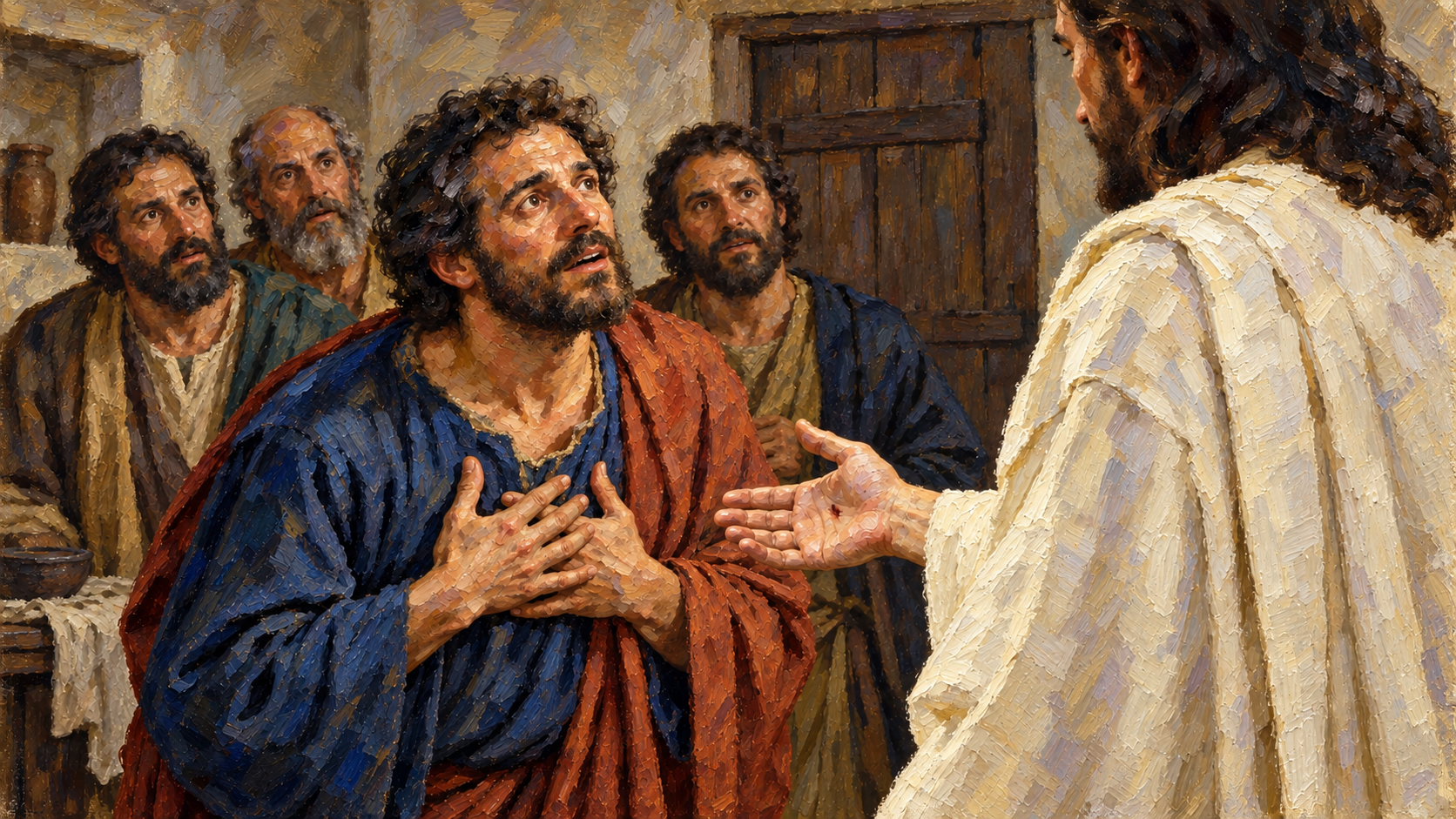
Thomas is usually remembered for refusing to believe that Jesus had risen, but John records more than that failure. Thomas was willing to follow Jesus into danger, asked a plain question when he did not understand, and eventually addressed the risen Christ as his Lord and God. His question and his refusal were different responses, and Jesus dealt with each according to what Thomas needed.
What Scripture Actually Tells Us About Thomas
John calls him “Thomas, who is called the Twin,” repeating the explanation in John 11:16, 20:24, and 21:2. Thomas comes from a Semitic word meaning twin; the Greek Didymus has the same meaning. The two names give Greek-speaking readers a name and its translation. Scripture never identifies the other twin, his parents, his birthplace, or his occupation before following Jesus. It does not even state that Thomas came from Galilee, although several other apostles did.
What Scripture does identify clearly is his place among the Twelve:
Now the names of the twelve apostles are these: first, Simon, who is called Peter, and Andrew his brother; James the son of Zebedee, and John his brother; Philip and Bartholomew; Thomas and Matthew the tax collector; James the son of Alphaeus, and Lebbaeus, whose surname was Thaddaeus; Simon the Cananite, and Judas Iscariot, who also betrayed Him.
Matthew, Mark, and Luke include Thomas in their lists, and Luke names him again in Acts after Christ’s ascension. Jesus selected the Twelve after prayer and gave them a distinct commission. They accompanied Him, heard His teaching, and were appointed to bear witness to Him. Thomas’s later refusal to believe was a serious failure within that calling. Christ corrected him and brought him to a clear confession before he went on as a believing witness.
John records enough of Thomas’s words to reveal courage, misunderstanding, and unbelief in their actual settings. Describing him as practical, melancholy, or skeptical can become a substitute for reading those passages. His response to danger does not explain away his later refusal, and that refusal should not erase everything else he said and did. John’s purpose is to direct us to Jesus so that we may believe He is the Christ, the Son of God, and have life in His name.
Loyalty and Questions Without Clear Sight
When Jesus announced that He would return to Judea, the disciples remembered that people there had recently tried to stone Him. Lazarus had died, but they initially misunderstood Jesus’ reference to his sleep. Jesus then spoke plainly about what had happened and why He would go:
Then Jesus said to them plainly, “Lazarus is dead. And I am glad for your sakes that I was not there, that you may believe. Nevertheless let us go to him.” Then Thomas, who is called the Twin, said to his fellow disciples, “Let us also go, that we may die with Him.”
Thomas urged the others to accompany Jesus despite the danger. He expected that going might mean dying with Him, yet he did not propose abandoning their Lord to protect themselves. I see real loyalty in his answer, even though he had not understood what Jesus was about to do.
Jesus was returning to call Lazarus out of the tomb. The journey Thomas associated with death would become the setting for a public demonstration of resurrection power, leading many who witnessed it to believe. No hostile crowd could take Christ’s life before His appointed hour; He would willingly lay it down. At Bethany, Thomas needed to follow Him and learn what the journey would accomplish.
I can sincerely want to remain faithful while still expecting the wrong outcome. Being ready to endure hardship does not mean I have understood God’s purpose, and courage by itself cannot supply that understanding. I need to attend to what Christ has said instead of assuming that the danger I foresee explains everything ahead of me.
Later, during the final evening before the crucifixion, Thomas admitted another misunderstanding. Judas had left to betray Jesus, and Peter had been told that he would deny Him. Jesus was preparing troubled disciples for His departure:
“Let not your heart be troubled; you believe in God, believe also in Me. In My Father’s house are many mansions; if it were not so, I would have told you. I go to prepare a place for you. And if I go and prepare a place for you, I will come again and receive you to Myself; that where I am, there you may be also. And where I go you know, and the way you know.” Thomas said to Him, “Lord, we do not know where You are going, and how can we know the way?” Jesus said to him, “I am the way, the truth, and the life. No one comes to the Father except through Me.”
The “many mansions” of the NKJV are dwelling places in the Father’s house, rather than a promise of separate luxury estates. Jesus assured the disciples that His departure would not end their fellowship with Him. He would prepare a place, come again, and receive them to Himself. First He would die, rise bodily, and ascend to the Father.
Thomas was trying to understand the destination and route as though Jesus were describing an ordinary journey. He admitted that he did not know where Jesus was going and asked how they could know the way. Jesus did not reprimand that admission. He answered by directing Thomas to Himself as the only One who could bring them to the Father.
Jesus is the way because sinners come to the Father through Him. He is the truth by which competing claims about God must be judged, and He is the life fallen people need. His answer cannot be reduced to advice about finding our own spiritual path. The eternal Son came from the Father, took real human flesh, lived without sin, and provided the salvation no other teacher or religious system can give.
I need to state His exclusive claim with the same clarity as His invitation. Every culture and every sinner is genuinely invited, and all come through the Son alone. Christians did not appoint Him to this place. We serve people by telling them who He is and what He said, including words that contradict the belief that every spiritual road leads to God.
Thomas Refused the Witness He Had Been Given
Jesus passed through the death He had foretold and rose bodily. On the evening of that first day of the week, He appeared to the gathered disciples:
Then, the same day at evening, being the first day of the week, when the doors were shut where the disciples were assembled, for fear of the Jews, Jesus came and stood in the midst, and said to them, “Peace be with you.” When He had said this, He showed them His hands and His side. Then the disciples were glad when they saw the Lord. So Jesus said to them again, “Peace to you! As the Father has sent Me, I also send you.” And when He had said this, He breathed on them, and said to them, “Receive the Holy Spirit. If you forgive the sins of any, they are forgiven them; if you retain the sins of any, they are retained.”
The disciples had shut the doors because they feared the Jewish authorities. Jesus stood among them, spoke peace, and showed them His hands and side. Those wounds identified the living man before them as the Lord who had been crucified. Their gladness came from recognizing Him alive, in the body that had been buried and was now raised and glorified.
Jesus commissioned them as witnesses and spoke of forgiving and retaining sins. I understand that authority as the proclamation of His gospel. They could declare forgiveness to those who repented and believed, and warn those who rejected Christ that their sins remained. He did not grant them independent power to erase guilt according to personal preference. Their authority depended on faithfully announcing His message.
Thomas had not shared this appearance:
Now Thomas, called the Twin, one of the twelve, was not with them when Jesus came. The other disciples therefore said to him, “We have seen the Lord.” So he said to them, “Unless I see in His hands the print of the nails, and put my finger into the print of the nails, and put my hand into His side, I will not believe.”
John gives no reason for his absence. We do not know whether circumstances kept him away or whether he chose to be elsewhere, so we cannot turn the verse into an accusation that he deliberately neglected the gathered church. We do know that he missed seeing Jesus that evening and that the others told him directly what they had witnessed.
These were men Thomas knew. He had traveled with them and heard Jesus predict His resurrection. Their united testimony was much more than an anonymous report, yet he insisted on examining the wounds himself before he would believe. His demand concerned the same bodily reality the others had seen: nail marks in Jesus’ hands and the wound in His side.
The others had been shown those wounds, and Luke records Jesus inviting the gathered disciples to handle Him. Thomas therefore wanted evidence of the same kind they had received. Even so, Jesus later called his response unbelief. Thomas was not merely asking the others to explain something he found confusing. He rejected their testimony unless his own condition was satisfied.
That demand presses me to examine the conditions I may attach to faith. If I insist that God perform a sign of my choosing before I accept the witness He has already given, I am placing my requirement over His testimony. Thomas’s words were frank enough to expose the problem: without the evidence he specified, he would not believe.
My Lord and My God
And after eight days His disciples were again inside, and Thomas with them. Jesus came, the doors being shut, and stood in the midst, and said, “Peace to you!” Then He said to Thomas, “Reach your finger here, and look at My hands; and reach your hand here, and put it into My side. Do not be unbelieving, but believing.” And Thomas answered and said to Him, “My Lord and my God!” Jesus said to him, “Thomas, because you have seen Me, you have believed. Blessed are those who have not seen and yet have believed.” And truly Jesus did many other signs in the presence of His disciples, which are not written in this book; but these are written that you may believe that Jesus is the Christ, the Son of God, and that believing you may have life in His name.
“After eight days” uses the inclusive counting customary in that setting, pointing to the next first day of the week. Thomas was now present. Jesus again stood among the disciples despite the shut doors. John tells us that He appeared; he does not describe how His body entered or give us a theory about passing through wood and walls.
Jesus knew the exact demand Thomas had made and invited the examination he had required. I see mercy in His willingness to answer this chosen witness, together with a firm command to turn from unbelief to belief. The invitation supplied decisive evidence. It did not commend Thomas for continuing to withhold his trust.
John does not say Thomas touched the wounds. Although paintings and sermons often supply that action, the passage moves from Christ’s invitation straight to Thomas’s confession. Seeing the risen Lord brought the answer recorded here.
The Greek words ho kyrios mou kai ho theos mou mean “My Lord and my God.” John says Thomas spoke them to Jesus. He was addressing the One before him, rather than making an unrelated exclamation toward heaven. His confession acknowledged both Christ’s authority and His deity, and Jesus accepted it as the response of a man who now believed.
A faithful creature would have corrected a blasphemous address. Jesus accepted Thomas’s confession and then spoke of the blessing given to later believers. John places these words near the conclusion of his selected signs and immediately explains his purpose for writing. The Gospel that began by declaring that the Word was with God and was God has brought us to an apostle confessing the incarnate, risen Son as his God.
This does not identify Jesus as the Father. Jesus had spoken of going to the Father and, after His resurrection, of ascending to Him. He is God the Son. The one God eternally exists as three distinct Persons: Father, Son, and Holy Spirit. Calling Jesus a mere teacher, a created spirit, or a lesser divine agent fails to account for the identity Thomas confessed. The risen man is the eternal Son, fully God and fully man in one Person.
His humanity was not discarded at the resurrection. Thomas saw the same Jesus who had been crucified, now alive in His glorified body. Full deity and full humanity remain together in Him without confusion or separation. A Complete Bible Study on the Deity of Jesus examines the wider biblical testimony to who He is.
Jesus also blessed those who would believe without seeing Him bodily as Thomas had. He was not praising irrational trust. Jesus fulfilled Scripture, rose from the dead, and repeatedly appeared to witnesses who would proclaim what they had seen. John preserved selected signs under the Holy Spirit’s inspiration so that readers could believe and receive life in His name. The record does not contain every sign Jesus performed, but it is sufficient for that saving purpose. In his first epistle, John describes the witness on which our faith rests:
That which was from the beginning, which we have heard, which we have seen with our eyes, which we have looked upon, and our hands have handled, concerning the Word of life– the life was manifested, and we have seen, and bear witness, and declare to you that eternal life which was with the Father and was manifested to us– that which we have seen and heard we declare to you, that you also may have fellowship with us; and truly our fellowship is with the Father and with His Son Jesus Christ.
John appeals to what the witnesses heard, saw, and handled. The eternal Son entered human history, and they encountered Him during His earthly ministry and after His bodily resurrection. Their testimony concerns a real Person whom they knew. Later generations receive that apostolic witness rather than requiring a fresh appearance before each person can believe.
When I confess Him as my Lord and God, my words do not make Him Lord or God. I receive the Son as Scripture reveals Him and entrust myself to Him, even though I have not seen Him bodily as Thomas did.
Faith does not require gullibility. We must reject fabricated visions, false christs, and a gospel that contradicts the apostles’ message. Questions about history, manuscripts, doctrine, or the resurrection deserve careful answers. Those answers should help us consider the evidence God has given, while any claim of new revelation remains subject to the written Word. A private experience cannot correct Scripture or overrule its testimony.
Thomas Remained Among the Apostolic Witnesses
John next names Thomas among the disciples who met Jesus beside the Sea of Tiberias, another name for the Sea of Galilee:
After these things Jesus showed Himself again to the disciples at the Sea of Tiberias, and in this way He showed Himself: Simon Peter, Thomas called the Twin, Nathanael of Cana in Galilee, the sons of Zebedee, and two others of His disciples were together.
Seven disciples had spent the night fishing without a catch. From the shore, Jesus directed them to cast the net again, and they gathered a miraculous catch. He then provided breakfast, giving them bread and fish. The Lord whom Thomas had confessed in the room was also present with them on the shore. John records no further words from Thomas here, but he remained among the disciples and shared another encounter with the bodily risen Christ.
After Jesus ascended, Thomas was with the apostles when they returned to Jerusalem:
Then they returned to Jerusalem from the mount called Olivet, which is near Jerusalem, a Sabbath day’s journey. And when they had entered, they went up into the upper room where they were staying: Peter, James, John, and Andrew; Philip and Thomas; Bartholomew and Matthew; James the son of Alphaeus and Simon the Zealot; and Judas the son of James. These all continued with one accord in prayer and supplication, with the women and Mary the mother of Jesus, and with His brothers.
The apostles obeyed Christ’s instruction to wait for the promised Holy Spirit. They continued together in prayer with the women who followed Jesus, Mary His mother, and His brothers. Thomas was no longer resisting the others’ testimony. He was praying among the witnesses who would proclaim the risen and ascended Lord. At Pentecost the Spirit would empower that mission, bringing the same message of the crucified and bodily raised Jesus to others.
This first company of witnesses had a foundational role in the church, as Paul explains:
Now, therefore, you are no longer strangers and foreigners, but fellow citizens with the saints and members of the household of God, having been built on the foundation of the apostles and prophets, Jesus Christ Himself being the chief cornerstone, in whom the whole building, being fitted together, grows into a holy temple in the Lord, in whom you also are being built together for a dwelling place of God in the Spirit.
Paul has explained how believing Jews and Gentiles are reconciled to God in one body through Christ. They belong to one household, and he develops that belonging through the image of a building. The apostles and prophets form its foundation, with Jesus Christ as the chief cornerstone who determines the building’s alignment. Thomas’s authority came from Christ’s choice and the witness entrusted to that first company.
That foundation does not need to be laid again in every generation. Missionaries, pastors, and church planters serve by carrying and teaching the message already delivered. They do not join the Twelve or gain authority to add doctrine alongside Scripture. The apostles sometimes misunderstood Jesus, but He corrected them, established their witness, and inspired the written testimony through the Holy Spirit. Trusting Scripture does not require pretending that Thomas had always understood or believed correctly.
Acts does not name Thomas again after the prayer gathering. His later travels, death, and burial are not recorded in Scripture. Later traditions may preserve historical information, but their age alone cannot give them the authority of an inspired apostolic account.
Writing in the early fourth century, Eusebius in Church History 3.1 says that, according to tradition, Thomas received Parthia as his field of labor. Parthia lay east of the Roman world, with territory and influence that at times extended toward the Indus. It is an early report of an eastern mission, recorded centuries after Thomas lived.
The apocryphal Acts of Thomas, generally dated to the third century and associated with Syriac Christianity, sends him to “India.” “Apocryphal” here identifies a writing outside the biblical canon. It names a ruler, Gundaphar, commonly compared with the historical Indo-Parthian king Gondophares. That recognizable setting is interesting evidence for studying the tradition. The work nevertheless contains legendary material and questionable doctrine, so it cannot be received as canonical eyewitness testimony.
Saint Thomas Christians preserve a longstanding tradition that he reached India’s Malabar Coast in AD 52. South Indian tradition also places his martyrdom near Mylapore, now part of Chennai, often describing death by spears. The ancient community deserves respectful study, and trade connections with the Near East made early contact possible. The Cambridge discussion of the South Indian tradition examines that body of evidence. These traditions do not independently establish the precise date of Thomas’s arrival, the location of his death, or the weapon used.
Thomas may have carried the gospel east and reached lands called India. I can appreciate those traditions while acknowledging the limits of the surviving evidence. Scripture leaves us with a firm account of his confession and his continued place among Christ’s witnesses.
Honest Questions Must Move Toward Faith
Thomas’s question in John 14 and his demand in John 20 help me distinguish confusion from refusal. He asked how he could know the way when he did not understand where Jesus was going. Jesus answered by revealing Himself as the way to the Father. Later, Thomas rejected credible testimony until his personal condition could be met, and Jesus commanded him to stop being unbelieving. We need to hear both responses when helping someone who struggles with faith.
A frightened believer may need patient reassurance, and a sincere learner may take time to understand. Treating every question as rebellion can push people into concealing what they need help with. Yet romanticizing doubt can make a clear confession of Christ seem naive. I want questions brought into the light and answered from Scripture, with the purpose of helping a person trust and obey the Lord.
Jesus supplied Thomas with decisive evidence as an apostolic witness. He has not promised to satisfy every condition later people devise. Questions become a means of evasion when every answer produces another demand and belief is postponed indefinitely. I need to consider whether I am seeking understanding or protecting a refusal to receive what God has already made clear. Emotional intensity does not earn eternal life; even a weak faith can rest on a strong Savior. A Complete Bible Study on Faith develops what it means to trust Him.
The Savior Thomas confessed is the eternal Son, fully God and fully man, born of a virgin and without sin. His nail wounds and pierced side were marks of the actual bodily suffering wicked men inflicted on Him. They physically tortured and punished Him before killing Him, and He willingly bore that real punishment for our sins in His innocent body. His saving work through His shed blood and death was complete before His bodily resurrection. He was buried and rose from the dead.
The Father did not punish, curse, abandon, strike, bruise, or pour wrath on Jesus. Christ died for the whole world, and God’s offer of salvation is genuine for every person, although people can resist His grace and reject Him. Everyone who repents and believes is forgiven and justified, meaning declared righteous before God. God gives that believer new birth, and the Holy Spirit indwells and seals every true believer. Those born again receive everlasting life and are eternally secure in Christ.
Works, religious merit, baptism, and church ancestry cannot secure this gift. Nor does eternal security excuse rebellion. The Lord who corrected Thomas commands His people and produces changed conduct in them through His Spirit. Obedience provides evidence of new life; it does not earn salvation. A superficial profession or the repetition of Christian words cannot establish that someone has genuinely been born again.
To believe in His name is to receive Jesus according to His revealed identity and authority. He is the only way to the Father, the truth, and the life. The study on Post Resurrection Jesus and His Ascension follows the further appearances and exaltation of this same Lord.
My Final Thoughts
“Doubting Thomas” is too small a description of the man John presents. His loyalty did not prevent misunderstanding, and his earlier courage did not make his later unbelief harmless. Jesus answered his question, confronted his refusal, and brought him to the confession that now directs us to the risen Son. I want to ask honest questions, receive the written witness God has given, and follow the One Thomas rightly addressed as his Lord and God.