
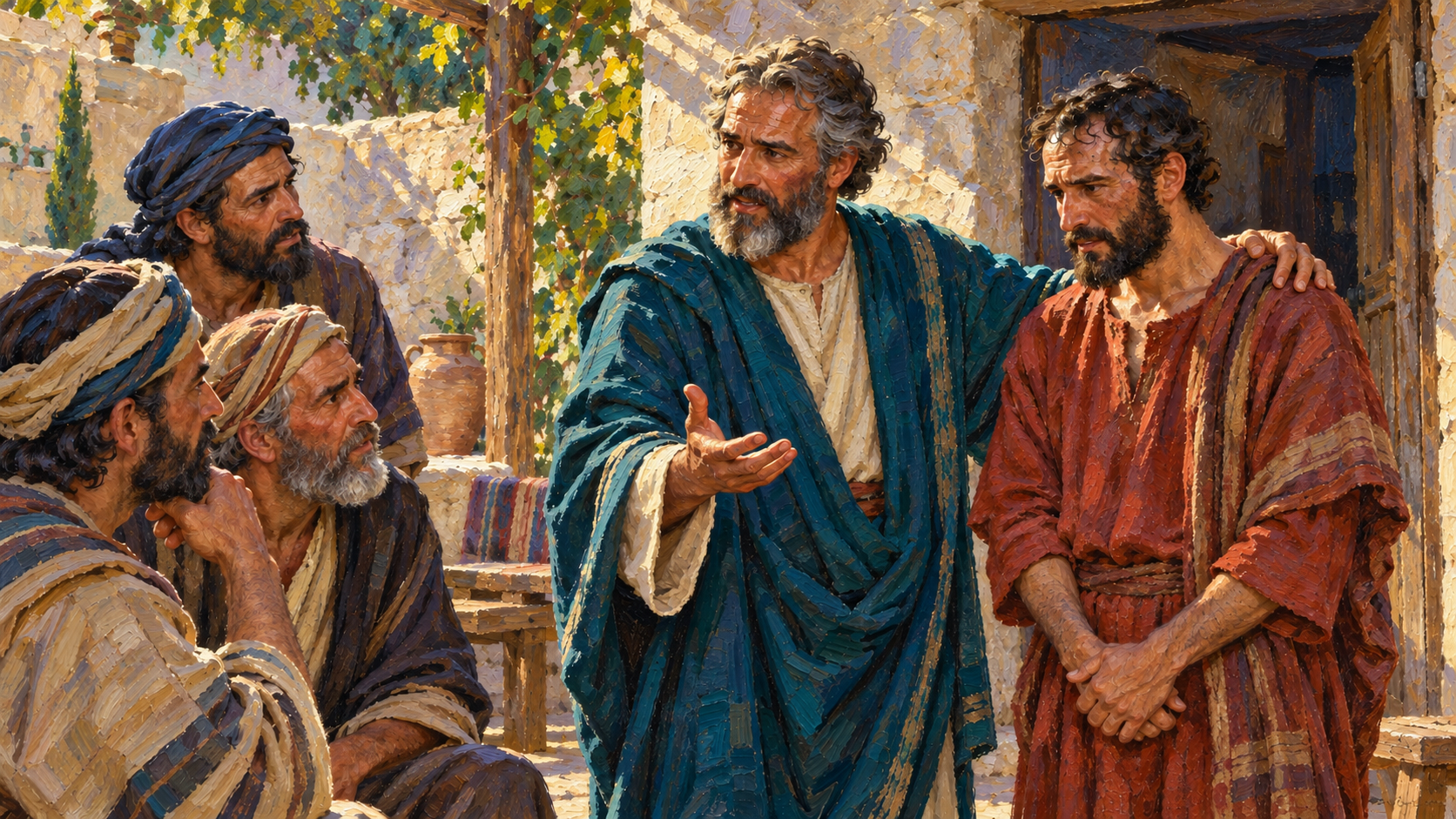
What kind of encouragement actually strengthens a church? Barnabas did more than make people feel welcome. He sold property to meet believers’ needs, spoke for a former persecutor whom the church feared, taught converts, and defended the gospel when false teachers unsettled them. Those responsibilities required judgment and courage as well as kindness. I also want to take his failures seriously. The man called the Son of Encouragement could be carried away by hypocrisy and become involved in a sharp disagreement with a fellow worker.
The Son of Encouragement in Jerusalem and Antioch
Luke introduces Barnabas through his generosity and the name the apostles gave him. His original name appears as Joses in the NKJV and Joseph in some other translations, forms referring to the same man. Acts does not give his age, physical appearance, or an account of his conversion. Its first record of him concerns a gift to meet needs:
And Joses, who was also named Barnabas by the apostles (which is translated Son of Encouragement), a Levite of the country of Cyprus, having land, sold it, and brought the money and laid it at the apostles' feet.
He was a Levite from Cyprus. The Levites had responsibilities connected with Israel’s worship, but not every Levite was a priest. The priesthood belonged to qualified male descendants of Aaron. Luke does not identify any particular Levitical service Barnabas or his family performed.
Cyprus, an island in the eastern Mediterranean, had a Jewish population within the wider Greek-speaking world. His connection to it would be relevant when he later served there, though Acts does not describe his upbringing, daily language, or family arrangements.
The apostles’ name for him, Son of Encouragement, fits the work Luke goes on to record. Barnabas urged believers to remain with the Lord and helped others enter useful service. The Greek noun paraklesis can express encouragement, exhortation, appeal, consolation, or strengthening. His ministry included those substantial forms of help, rather than merely praise or a pleasant manner.
His sale of land belonged to the generous care Luke had just described among Jerusalem’s believers:
Now the multitude of those who believed were of one heart and one soul; neither did anyone say that any of the things he possessed was his own, but they had all things in common. And with great power the apostles gave witness to the resurrection of the Lord Jesus. And great grace was upon them all. Nor was there anyone among them who lacked; for all who were possessors of lands or houses sold them, and brought the proceeds of the things that were sold, and laid them at the apostles' feet; and they distributed to each as anyone had need.
People saw needs among them and used their possessions to meet them. Some sold land or houses and entrusted the proceeds to the apostles, who distributed help according to need. This was voluntary giving, not government seizure or a command abolishing ownership. The next chapter makes that especially clear when Peter tells Ananias that his property, and afterward its proceeds, had remained under his control.
Ananias and Sapphira’s sin was lying to God while pretending to surrender everything. Barnabas’s gift stands before that fraud as an example of honest generosity. Selling land did not buy him salvation, authority, or the apostles’ approval. He gave resources that could relieve actual hardship. I need to consider both the cost and the honesty of my giving, without turning his particular transaction into a requirement that every believer sell everything.
We have different resources and responsibilities, but we can give freely and handle that care honestly under accountable church leadership. Encouraging a struggling believer may begin with meeting a practical need that costs us something.
His next appearance concerns a man the Jerusalem church had good reason to fear:
And when Saul had come to Jerusalem, he tried to join the disciples; but they were all afraid of him, and did not believe that he was a disciple. But Barnabas took him and brought him to the apostles. And he declared to them how he had seen the Lord on the road, and that He had spoken to him, and how he had preached boldly at Damascus in the name of Jesus. So he was with them at Jerusalem, coming in and going out. And he spoke boldly in the name of the Lord Jesus and disputed against the Hellenists, but they attempted to kill him. When the brethren found out, they brought him down to Caesarea and sent him out to Tarsus.
Saul had arrested believers and supported violent persecution. Although he had met Christ and preached in Damascus, the Jerusalem disciples did not yet believe he was one of them. Their fear was understandable. Forgiveness did not require forgetting his actions or immediately entrusting themselves to someone who had tried to destroy the church.
Barnabas brought Saul to the apostles and told them what had happened: Saul had seen the Lord, Christ had spoken to him, and he had preached boldly in Jesus’ name. He supplied testimony and evidence of a changed life for responsible leaders to consider. He did not simply insist that a claim of conversion entitled Saul to everyone’s immediate trust. The study on Saul’s Conversion on the Road to Damascus examines the change behind that testimony.
Saul was then received among the believers and spoke boldly in Jerusalem until another threat to his life required departure. Barnabas had helped them recognize God’s work without erasing Saul’s past. I appreciate that advocacy because it deals with what has changed rather than shaming people for being cautious. We can support a believer’s useful service while still requiring evidence and respecting legitimate concerns.
I would not conclude that Paul’s entire ministry would have failed without Barnabas. Christ had commissioned him and could accomplish His purpose. Barnabas willingly served at a difficult point in Saul’s reception, and Luke lets us see the good he did without asking us to invent what would otherwise have happened.
Jerusalem later entrusted Barnabas with another delicate responsibility when news arrived from Antioch:
Now those who were scattered after the persecution that arose over Stephen traveled as far as Phoenicia, Cyprus, and Antioch, preaching the word to no one but the Jews only. But some of them were men from Cyprus and Cyrene, who, when they had come to Antioch, spoke to the Hellenists, preaching the Lord Jesus. And the hand of the Lord was with them, and a great number believed and turned to the Lord. Then news of these things came to the ears of the church in Jerusalem, and they sent out Barnabas to go as far as Antioch. When he came and had seen the grace of God, he was glad, and encouraged them all that with purpose of heart they should continue with the Lord. For he was a good man, full of the Holy Spirit and of faith. And a great many people were added to the Lord. Then Barnabas departed for Tarsus to seek Saul. And when he had found him, he brought him to Antioch. So it was that for a whole year they assembled with the church and taught a great many people. And the disciples were first called Christians in Antioch.
The persecution following Stephen’s death had scattered believers into Phoenicia, Cyprus, and Antioch. Some spoke only to Jews, while men from Cyprus and Cyrene preached the Lord Jesus among Antioch’s Greek-speaking population. Many believed and turned to the Lord. This was Antioch in Syria, the church that would later send Barnabas and Saul out, rather than Pisidian Antioch on their missionary route.
Barnabas arrived, recognized God’s grace, and was glad. He did not treat an unfamiliar development as sufficient reason to condemn it. The converts had turned to Christ, and he urged them to continue with Him with purpose of heart. Luke calls Barnabas a good man, full of the Holy Spirit and faith, describing the character that equipped him for this work without claiming he was sinless.
As more people were added to the Lord, Barnabas went to Tarsus to find Saul and brought him to Antioch. For a whole year they assembled with the church and taught many people. Barnabas’s response to growing responsibility was to recruit another teacher, rather than keep every responsibility in his own hands. The disciples were first called Christians there, as Jewish and Gentile believers learned to follow Christ together.
The initial response to preaching did not complete their discipleship. They needed sustained teaching, fellowship, correction, and strength to endure. If I offer reassurance while avoiding the substantial truth a person needs, I am withholding part of the help Barnabas gave. He encouraged these believers by staying to teach and bringing someone who could share that work.
The church also entrusted him with practical care when Agabus warned of famine:
And in these days prophets came from Jerusalem to Antioch. Then one of them, named Agabus, stood up and showed by the Spirit that there was going to be a great famine throughout all the world, which also happened in the days of Claudius Caesar. Then the disciples, each according to his ability, determined to send relief to the brethren dwelling in Judea. This they also did, and sent it to the elders by the hands of Barnabas and Saul.
In response to the Spirit’s warning, the disciples determined to send relief to believers in Judea, each according to his ability. They prepared help instead of treating the prophecy as information to discuss. Different means produced different gifts; the passage does not demand an identical sum from every believer.
Barnabas and Saul carried the relief to Judea’s elders. The gift connected Gentile believers with Jewish brethren in another region, and its delivery through recognized leaders provided accountable care. These missionaries could be trusted with money and practical responsibility as well as teaching. Acts 12:25 records the completion of their service and their return with John Mark.
Sent by the Spirit to Preach Christ
Antioch’s leadership included several prophets and teachers. Their ministry to the Lord led to a specific call for Barnabas and Saul:
Now in the church that was at Antioch there were certain prophets and teachers: Barnabas, Simeon who was called Niger, Lucius of Cyrene, Manaen who had been brought up with Herod the tetrarch, and Saul. As they ministered to the Lord and fasted, the Holy Spirit said, "Now separate to Me Barnabas and Saul for the work to which I have called them." Then, having fasted and prayed, and laid hands on them, they sent them away. So, being sent out by the Holy Spirit, they went down to Seleucia, and from there they sailed to Cyprus. And when they arrived in Salamis, they preached the word of God in the synagogues of the Jews. They also had John as their assistant.
Barnabas served alongside Simeon called Niger, Lucius of Cyrene, Manaen, and Saul. This was shared leadership, not a private enterprise built around one man. The Holy Spirit spoke, called the two men to His work, and directed their separation for it. Those are the actions of a divine Person. The church responded with fasting, prayer, and the laying on of hands, recognizing His call rather than creating one He had never given.
They went through Seleucia to Cyprus and began preaching in the Jewish synagogues at Salamis, with John Mark assisting them. Cyprus was Barnabas’s home island, although Luke does not say they stayed with relatives or explain why it was their first destination. The Spirit sent them, the church recognized the call, and they would later return to report. Their zeal operated within fellowship and accountability. A Complete Bible Study on the Book of Acts follows that wider mission.
At Paphos, Sergius Paulus, the Roman provincial governor, wanted to hear God’s Word, but a false prophet tried to prevent him:
Now when they had gone through the island to Paphos, they found a certain sorcerer, a false prophet, a Jew whose name was Bar-Jesus, who was with the proconsul, Sergius Paulus, an intelligent man. This man called for Barnabas and Saul and sought to hear the word of God. But Elymas the sorcerer (for so his name is translated) withstood them, seeking to turn the proconsul away from the faith. Then Saul, who also is called Paul, filled with the Holy Spirit, looked intently at him and said, "O full of all deceit and all fraud, you son of the devil, you enemy of all righteousness, will you not cease perverting the straight ways of the Lord? And now, indeed, the hand of the Lord is upon you, and you shall be blind, not seeing the sun for a time." And immediately a dark mist fell on him, and he went around seeking someone to lead him by the hand. Then the proconsul believed, when he saw what had been done, being astonished at the teaching of the Lord.
Bar-Jesus, also called Elymas, was a Jewish sorcerer attached to Sergius Paulus. He opposed the missionaries because he wanted to turn the proconsul from the faith. Saul, also called Paul, confronted the deceit while filled with the Holy Spirit. Elymas became blind for a time, and Sergius Paulus believed, astonished at the Lord’s teaching. The sign confirmed that teaching; the missionaries had not come to entertain a ruler or settle a personal grievance.
From this point, Paul increasingly appears first in Luke’s naming of the missionaries and becomes the chief speaker. The order of names is not a fixed ranking in every sentence, but we can follow the change in public prominence. Barnabas continued sharing the work. I do not need to treat another servant’s growing usefulness as a threat to my own service or assume that the most visible speaker is the only person contributing.
At Perga, John Mark left them and returned to Jerusalem. Luke does not explain why. Paul later described him as withdrawing and failing to continue in the work. Compassion does not require inventing an excuse, and a serious view of responsibility does not authorize inventing a hidden sin. What Acts tells us is that Mark left and the missionaries continued.
At Pisidian Antioch, Paul traced Israel’s history and proclaimed Jesus as David’s promised Seed. He preached Christ’s death and resurrection, forgiveness, and justification through faith. To be justified is to be declared righteous before God. Many Gentiles received the Word, but opposition brought persecution and expulsion. The disciples there were filled with joy and the Holy Spirit. The work continued at Iconium, where Jews and Greeks believed during a sustained period of bold preaching. A violent plot eventually forced the men to flee into Lycaonia, where they continued preaching at Lystra and Derbe. Leaving Iconium allowed them to carry the gospel elsewhere.
At Lystra, a healing produced an entirely different danger:
And in Lystra a certain man without strength in his feet was sitting, a cripple from his mother's womb, who had never walked. This man heard Paul speaking. Paul, observing him intently and seeing that he had faith to be healed, said with a loud voice, "Stand up straight on your feet!" And he leaped and walked. Now when the people saw what Paul had done, they raised their voices, saying in the Lycaonian language, "The gods have come down to us in the likeness of men!" And Barnabas they called Zeus, and Paul, Hermes, because he was the chief speaker. Then the priest of Zeus, whose temple was in front of their city, brought oxen and garlands to the gates, intending to sacrifice with the multitudes. But when the apostles Barnabas and Paul heard this, they tore their clothes and ran in among the multitude, crying out and saying, "Men, why are you doing these things? We also are men with the same nature as you, and preach to you that you should turn from these useless things to the living God, who made the heaven, the earth, the sea, and all things that are in them, who in bygone generations allowed all nations to walk in their own ways. Nevertheless He did not leave Himself without witness, in that He did good, gave us rain from heaven and fruitful seasons, filling our hearts with food and gladness." And with these sayings they could scarcely restrain the multitudes from sacrificing to them.
The crowd called Barnabas Zeus and Paul Hermes, identifying Paul as the chief speaker. The priest brought animals and garlands for sacrifice. When the missionaries understood what was happening, they tore their clothes and rushed into the crowd to stop it. They insisted that they shared the same human nature as their hearers and called them to turn from idols to the living Creator, whose rain and fruitful seasons already testified to His goodness.
Opponents later stoned Paul and left him for dead. He and Barnabas went on to preach in Derbe and then returned through the cities where they had faced danger. They strengthened the disciples, urged them to continue in faith, and taught that entering God’s kingdom involves many tribulations. With prayer and fasting, they appointed qualified elders in every church. These new believers needed continuing care after the missionaries moved on.
Back in Syrian Antioch, Barnabas and Paul reported what God had done and how He had opened the door of faith to Gentiles. The church that sent them heard the result, and God received the credit. The ministry was not measured simply by how many towns they had reached; they had also returned to teach and establish the care of the churches. The wider course of Paul’s work is examined in A Complete Bible Study on the Apostle Paul.
Barnabas refused divine honors alongside Paul. Encouragement that creates devotion to a minister would contradict what they did at Lystra. I want to help people trust God and obey His Word, not make them dependent on admiration for the person helping them.
When Luke describes their refusal of worship at Lystra, he calls both men apostles:
But when the apostles Barnabas and Paul heard this, they tore their clothes and ran in among the multitude, crying out and saying, "Men, why are you doing these things? We also are men with the same nature as you, and preach to you that you should turn from these useless things to the living God, who made the heaven, the earth, the sea, and all things that are in them,
The Greek word apostolos means a sent representative or messenger. Barnabas had been called by the Holy Spirit and sent by the church, and Acts names him an apostle alongside Paul. That broader use should not be confused with every narrower use of the title. The Twelve were a defined group appointed during Jesus’ earthly ministry, while Paul received a direct commission from the risen Christ. Barnabas was not one of the Twelve, and no inspired biblical writing bears his name.
The anonymous early work called the Epistle of Barnabas does not establish its author merely by bearing that title. It is not inspired Scripture. Our account of Barnabas’s authority and ministry should rest on the biblical passages that name him, rather than later claims attached to his name.
First Corinthians 9:6 later names Barnabas alongside Paul as a worker entitled to material support who nevertheless labored rather than claiming it. His recognized service extended beyond this journey. Forgoing support for the gospel’s sake did not establish a rule forbidding churches to support ministers.
Defending Grace While Still Needing Correction
After the missionaries returned, teachers from Judea introduced a condition for salvation that Paul and Barnabas could not accept:
And certain men came down from Judea and taught the brethren, "Unless you are circumcised according to the custom of Moses, you cannot be saved." Therefore, when Paul and Barnabas had no small dissension and dispute with them, they determined that Paul and Barnabas and certain others of them should go up to Jerusalem, to the apostles and elders, about this question. So, being sent on their way by the church, they passed through Phoenicia and Samaria, describing the conversion of the Gentiles; and they caused great joy to all the brethren. And when they had come to Jerusalem, they were received by the church and the apostles and the elders; and they reported all things that God had done with them. But some of the sect of the Pharisees who believed rose up, saying, "It is necessary to circumcise them, and to command them to keep the law of Moses." Now the apostles and elders came together to consider this matter. And when there had been much dispute, Peter rose up and said to them: "Men and brethren, you know that a good while ago God chose among us, that by my mouth the Gentiles should hear the word of the gospel and believe. So God, who knows the heart, acknowledged them by giving them the Holy Spirit, just as He did to us, and made no distinction between us and them, purifying their hearts by faith. Now therefore, why do you test God by putting a yoke on the neck of the disciples which neither our fathers nor we were able to bear? But we believe that through the grace of the Lord Jesus Christ we shall be saved in the same manner as they." Then all the multitude kept silent and listened to Barnabas and Paul declaring how many miracles and wonders God had worked through them among the Gentiles.
These teachers insisted that Gentiles could not be saved without circumcision according to Moses. Paul and Barnabas disputed the claim because it altered the gospel itself. The church sent them to Jerusalem, and on the way they described Gentile conversions that brought joy to other believers. At Jerusalem, the apostles and elders openly examined the question.
Peter testified that God had given Gentiles the Holy Spirit and purified their hearts by faith without putting them under the Mosaic yoke. Jews and Gentiles alike are saved through the grace of the Lord Jesus Christ. Barnabas and Paul then reported the signs and wonders God had worked among Gentiles. The council’s letter called them beloved men who had risked their lives for Jesus’ name.
Barnabas’s reputation as an encourager did not make him unwilling to confront false teaching. A message requiring circumcision for salvation unsettled believers and denied the sufficiency of Christ’s work. If I remain agreeable while someone adds works to the conditions of salvation, I have failed to give the help those believers need. The doctrinal issue is examined further in A Complete Bible Study on Circumcision.
Paul’s letter to the Galatians also recounts Barnabas accompanying him when Titus, a Greek believer, was not compelled to be circumcised. They refused to surrender the truth of the gospel to false brethren. Yet that same letter records an occasion at Antioch when Barnabas’s conduct contradicted the truth he defended:
Now when Peter had come to Antioch, I withstood him to his face, because he was to be blamed; for before certain men came from James, he would eat with the Gentiles; but when they came, he withdrew and separated himself, fearing those who were of the circumcision. And the rest of the Jews also played the hypocrite with him, so that even Barnabas was carried away with their hypocrisy. But when I saw that they were not straightforward about the truth of the gospel, I said to Peter before them all, "If you, being a Jew, live in the manner of Gentiles and not as the Jews, why do you compel Gentiles to live as Jews?
Peter had eaten with Gentile believers until men associated with James arrived. Fearing those of the circumcision, he withdrew, and other Jewish believers followed him. Paul does not say James ordered this conduct. He identifies Peter’s fear and the resulting hypocrisy, which carried even Barnabas away.
Barnabas had recognized God’s grace at Antioch, taught its mixed congregation, and served among Gentiles. He knew why faith in Christ made these believers fit for fellowship. Yet he joined a withdrawal that treated them as though they needed the practices marking Jewish identity before they could share the table fully. His earlier courage did not make him immune to social pressure.
Paul opposed Peter publicly because the public conduct was no longer straightforward about gospel truth. The issue went beyond a private preference about meals. Other believers were being drawn into the same hypocrisy, and Gentiles were being pressured by the separation. Love for the church required correction rather than an appeal to preserve the leaders’ reputations.
Paul does not record Barnabas’s response, so I cannot supply a repentance speech or a conversation they later had. I can learn from the failure he does record. A teacher may need correction, and a man who strengthens others can still be led astray. Respect for a leader never puts his behavior above the truth he teaches.
Mark, Restoration, and Biblical Encouragement
Acts 15 records a different disagreement, this time over whether John Mark should accompany another journey:
Then after some days Paul said to Barnabas, "Let us now go back and visit our brethren in every city where we have preached the word of the Lord, and see how they are doing." Now Barnabas was determined to take with them John called Mark. But Paul insisted that they should not take with them the one who had departed from them in Pamphylia, and had not gone with them to the work. Then the contention became so sharp that they parted from one another. And so Barnabas took Mark and sailed to Cyprus; but Paul chose Silas and departed, being commended by the brethren to the grace of God. And he went through Syria and Cilicia, strengthening the churches.
Paul wanted to revisit the churches and see how the brethren were doing. Barnabas was determined to take Mark, identified in Colossians 4:10 as his cousin. Paul insisted that they should not take someone who had withdrawn in Pamphylia and failed to continue in the work. Barnabas was prepared to give Mark another opportunity; Paul regarded the earlier departure as a serious reason not to entrust him with this mission.
Luke uses paroxysmos, a Greek noun conveying intense provocation or disagreement. Their contention was sharp enough that they parted. We should not soften it into a cheerful agreement to divide their responsibilities, but neither does Luke pronounce one man wholly righteous and the other faithless. Both restoration and responsible care for a demanding mission required consideration.
A second opportunity is not automatically a return to every responsibility without evidence of reliability. Nor should an earlier failure condemn someone to permanent uselessness. Barnabas took Mark to Cyprus, while Paul chose Silas and traveled through Syria and Cilicia, commended by the brethren to God’s grace. God continued the work along both routes. A fruitful outcome does not make the sharpness of their conflict desirable or erase what their partnership lost.
Acts follows Paul from that point and tells us little more about Barnabas. That change of focus does not prove he stopped serving, founded a particular institution, or died in a particular way. His later ministry is largely unrecorded in Scripture. Mark’s later appearances, however, do show that the earlier departure did not end his usefulness.
In Colossians 4:10, Paul asks the church to welcome Mark if he comes. Philemon 24 includes him among Paul’s fellow laborers, and near the end of Paul’s life, 2 Timothy 4:11 describes Mark as useful to him for ministry. He had regained trust, and Paul openly acknowledged his value. We are not given every conversation that led there, so I would neither assign Barnabas all the credit nor conclude that Paul’s earlier concern had been sinful.
Peter calls Mark his son in 1 Peter 5:13, expressing a close spiritual relationship. Early church testimony identifies Mark as the writer of the second Gospel and connects him with Peter’s preaching. Eusebius preserves Papias’s testimony in Church History 3.39, describing Mark as Peter’s interpreter who recorded what he remembered. I regard this as early and meaningful historical evidence, while distinguishing it from an explicit identification of the author within the Gospel’s narrative.
I appreciate Barnabas’s willingness to invest in Mark again. It resembles his earlier advocacy for Saul in a limited way: he made room for someone whose usefulness others did not yet accept. Their situations were different, and neither removes the need for evidence, safety, or biblical qualifications. Barnabas gave practical help that could open the way to service rather than merely expressing confidence from a distance.
His ministry also shows why encouragement needs truth. He urged converts to remain with the Lord, stayed to teach, carried relief, endured opposition, and returned to strengthen churches. He did not help people by flattering them or treating every desire as a divine calling. Continuing with purpose of heart required a firm allegiance to Christ, including correction when conduct departed from the gospel.
That work respected the church’s order. Barnabas brought Saul to the apostles, Antioch sent its missionaries, the missionaries appointed elders, and the Jerusalem council examined the doctrinal dispute. Every believer can strengthen others within that order. Encouragement does not remove the biblical requirement for qualified men in the church’s teaching offices.
Men and women can both give this help through hospitality, generosity, prayer, discipleship, truthful counsel, and patient restoration. Speaking on a believer’s behalf may help him become useful again, but the aim is continued faithfulness to the Lord, rather than dependence on a gifted personality. I must also be willing to receive the same help. A kind reputation cannot protect me from fear of people, compromised fellowship, or sharp conflict.
The Gospel Behind His Encouragement
Barnabas could strengthen people because he had a true message to give them. At Pisidian Antioch, the missionaries proclaimed forgiveness and justification through Christ, which the law of Moses could not provide. His generosity and courage could not save anyone; they served the gospel of the Savior who could.
Jesus is the eternal Son, fully God and fully man, born of a virgin and completely sinless. He fulfilled the Scriptures and willingly offered Himself. Wicked men physically tortured, punished, and killed Him, yet He bore that real punishment for our sins in His innocent body and shed His blood. His saving work through His blood and death was complete before His burial and bodily resurrection. The Father did not punish, curse, abandon, strike, bruise, or pour wrath on Jesus.
Christ died for the whole world, and God’s offer is genuine for every person, though people can resist His grace and reject Him. Circumcision cannot justify a sinner, and neither can generosity, missionary labor, church membership, or a repaired reputation. We receive salvation by grace through repentance and faith in Jesus Christ. That righteous standing is His gift rather than a reward earned by religious effort.
The believer receives forgiveness, is born again as a new creation, and is indwelt and sealed by the Holy Spirit. He is eternally secure in Christ. That assurance gives no permission for lawlessness, and association with respected leaders does not prove genuine new birth. Our conduct should supply evidence of the life God has given; obedience neither earns nor keeps salvation.
Barnabas spoke for Saul because Christ had transformed him, rejoiced at Antioch because grace was producing faith, and opposed a circumcision requirement because Christ’s work was sufficient. His encouragement rested on what God had done. I want the same foundation when I help someone: enough truth to direct him to Christ, enough patience to keep serving him, and enough humility to accept correction myself.
My Final Thoughts
Barnabas gave costly, practical help that strengthened believers in the truth. He recognized changed lives, taught new converts, defended grace, and made room for another worker to become useful. His failures also warn me that encouraging others does not make me immune to hypocrisy or conflict. I want to support restoration without disregarding legitimate concerns, help people continue with the Lord, and keep their attention on Christ rather than myself. That requires receiving truthful correction as willingly as I hope others will receive mine.