
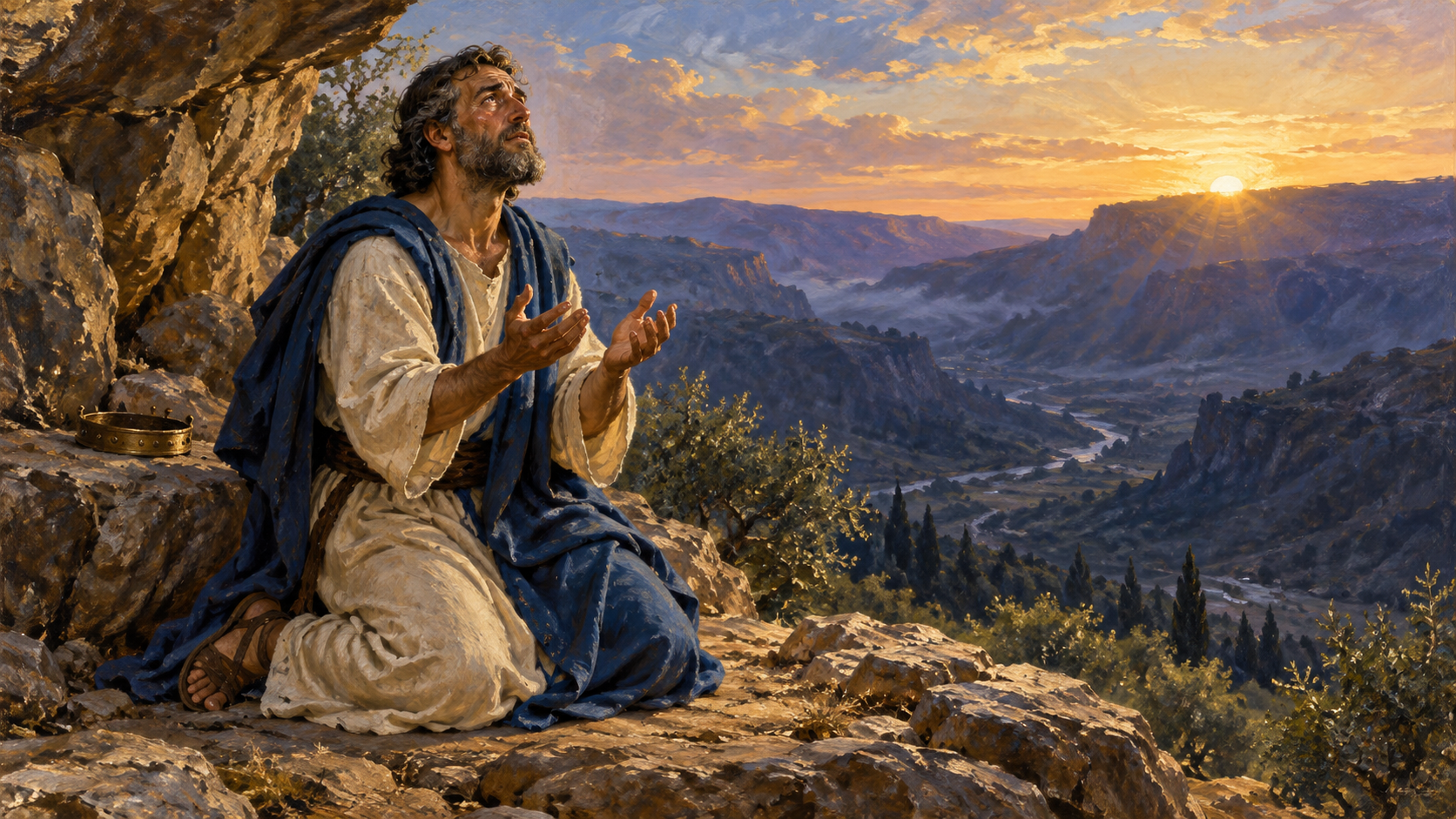
David begins Psalm 27 with one of his boldest statements of trust, yet later in the same psalm he cries urgently for help. By the end, he is telling his own heart to wait. I don’t want to miss that change in his voice. His confidence and his pleading help us understand how faith responds when the danger is real and God’s answer has not yet arrived.
The LORD Is My Light, Salvation, and Strength
Scripture does not name the event behind Psalm 27. At different times David faced Saul and the Philistines, and he also suffered family betrayal. Slander and war were familiar to him, but I cannot choose one of those troubles and claim that it explains this psalm. God has not tied these words to a single event. His people can pray them in many seasons when they face real enemies and need His help.
I need to read Psalm 27 as a whole, because his confidence, prayer, and waiting help explain one another. A favorite line can encourage us, but we can misunderstand it if we leave the rest of the poem behind. Other passages help us understand these themes more clearly when we use them to illuminate what David says rather than replace it.
David does not begin by measuring the army or counting the people against him. He begins with the LORD Himself.
The LORD is my light and my salvation; Whom shall I fear? The LORD is the strength of my life; Of whom shall I be afraid?
David begins with who the LORD is, and everything that follows rests on that confidence. Light makes a dark path visible and exposes what confusion would hide. Salvation means being rescued and brought safely through danger, while strength is the stability David needs when his heart could tremble. I notice that these words do not require fear to disappear before he can trust God. Fear may still speak, but it has no right to rule because the LORD is his light, salvation, and strength.
The Hebrew words help us understand what David is confessing. Or means light, while yeshuah speaks of salvation or deliverance. He is looking to the LORD to give him sight when he cannot see the way and to rescue him from danger. The One who does that also holds him steady. These are needs David brings to God, not abstract religious terms.
David made a similar confession in 2 Samuel 22:29: “The LORD is my lamp; The LORD shall enlighten my darkness.” Jesus brings this theme to its fullest revelation when He says, “I am the light of the world. He who follows Me shall not walk in darkness, but have the light of life” (John 8:12). I can recognize how perfectly the Son of David reveals God’s light without losing sight of David’s own confidence in the LORD.
David’s enemies were real. He describes wicked men who opposed him and speaks of an army and war. Trusting God did not require him to pretend those threats were small. He remembered that God had delivered him before, and that remembered help strengthened him to trust again. Psalm 27 invites us to do the same with our fear: bring it under the truth of who the LORD is rather than deny that we feel it.
One Desire: To Seek the LORD’s Presence
At the center of David’s confidence is not military success. One desire controls the others.
One thing I have desired of the LORD, That will I seek: That I may dwell in the house of the LORD All the days of my life, To behold the beauty of the LORD, And to inquire in His temple.
David wanted to remain near the LORD and behold His beauty, and he also wanted to inquire of Him. That desire helps me see that worship includes listening for the guidance God has given in His Word. Removing the threat would not satisfy everything David was asking for. He wanted to be near the God who is greater than the danger.
Solomon had not yet built the temple when David lived, so David was not describing the completed building of Solomon’s reign. Israel already had the tabernacle and ark, with priests offering sacrifices and the people gathering in holy assembly. Through that worship, God taught them to seek Him according to His Word. Psalm 23:6 expresses David’s same hope: “I will dwell in the house of the LORD Forever.” Surviving one conflict was not his deepest good; he belonged near the LORD.
I could win an earthly fight and still be spiritually empty, so I need to hear what David values above security. He seeks God’s presence above every lesser refuge. That desire explains why his next words about being hidden turn our attention to the LORD Himself.
Seeking the LORD first did not make David’s earthly responsibilities unimportant. He still had to live as a king and make the decisions danger required, but those responsibilities belonged beneath his desire for communion with God. Military advantage and personal safety could not become the gods directing his life when being near the LORD was his deepest good.
For in the time of trouble He shall hide me in His pavilion; In the secret place of His tabernacle He shall hide me; He shall set me high upon a rock.
The pavilion suggests a king’s protection, while the secret place of the tabernacle points to being near the holy God rather than simply having shelter. David also pictures a rock that provides stable ground above an enemy’s reach. He is using these images to describe the LORD as his refuge. Trouble is still present when he speaks of being protected.
Psalm 91:1 expresses the same confidence: “He who dwells in the secret place of the Most High Shall abide under the shadow of the Almighty.” We cannot treat that refuge as a charm promising an easy road. Danger may remain very real while He keeps His people. His presence gives security before the circumstances change.
That is why worship begins before David can see the battle’s end.
And now my head shall be lifted up above my enemies all around me; Therefore I will offer sacrifices of joy in His tabernacle; I will sing, yes, I will sing praises to the LORD.
David speaks of offering sacrifices of joy and singing praise as he looks ahead to deliverance. Faith turns his attention toward the LORD instead of letting fear control it. That helps me understand how worship belongs in the middle of trouble. Praising God does not mean I feel nothing; it means He remains worthy while I endure what is happening. Christians can say, “Thanks be to God, who gives us the victory through our Lord Jesus Christ” (1 Corinthians 15:57), because His resurrection has secured the final victory even while today’s struggle continues.
Confidence That Still Cries Out in Prayer
The tone changes in the next part of the psalm. David has spoken confidently, but now he cries aloud for mercy and asks God to answer him.
Hear, O LORD, when I cry with my voice! Have mercy also upon me, and answer me. When You said, “Seek My face,” My heart said to You, “Your face, LORD, I will seek.”
David’s cry for mercy helps me understand why trusting God does not make prayer unnecessary. His confidence leads him to speak more honestly about his need instead of pretending his pain is small. Knowing sound doctrine does not remove his need for help either. In the same psalm, he confesses who God is and pleads for mercy, and those expressions of faith belong together.
The Hebrew word panim, often translated “face,” can also speak of presence or personal attention. That helps us understand what David seeks as he turns his heart toward God’s invitation. He wants the LORD’s favorable presence and fellowship. The language describes that relationship rather than suggesting that God has a physical face in the creaturely way we do.
David wanted deliverance, but his prayer reached beyond a change in circumstances to God Himself. That makes me consider what I am seeking when I pray. I can bring practical needs to the Father while also seeking fellowship with Him, without making that relationship depend on getting the results I want.
Do not hide Your face from me; Do not turn Your servant away in anger; You have been my help; Do not leave me nor forsake me, O God of my salvation. When my father and my mother forsake me, Then the LORD will take care of me.
David asked the LORD not to hide His face or turn him away. He could speak honestly about the fear of abandonment without deciding that God had broken His word, because he remembered how God had helped him: “You have been my help.” He was calling again on the One who had already shown Himself faithful.
David’s words in verse 10 reach into the fear of being forsaken by a father or mother. Even if that closest earthly bond failed, the LORD would take care of him. I do not hear David minimizing the grief of family rejection. He is saying that God’s care is stronger than that bond. Isaiah 49:15 makes a similar comparison: even if a nursing mother could forget, the LORD will not forget His people.
Courage does not keep David from pleading with the LORD. Knowing Him is the very reason David brings his need into His presence. That encourages me to bring what I need as well. Understanding what is true does not mean a believer no longer needs strength for the next hour.
Teach Me Your Way While I Wait
With enemies around him, David asked for more than a clever way to escape. He wanted the LORD to teach him, so his confidence did not make him careless about how he should respond.
Teach me Your way, O LORD, And lead me in a smooth path, because of my enemies. Do not deliver me to the will of my adversaries; For false witnesses have risen against me, And such as breathe out violence.
David’s request for a “smooth path” describes a level or straight way where accusations and violence will not trap his steps. He asks God to lead him rightly through hardship, not to remove every hardship from his life. That speaks to how I respond under pressure. A quick reaction may come from fear or anger, but following the LORD’s way is more important than acting on that impulse.
False witnesses attack a person’s name with lies, and in this psalm violence stands behind their words. David knew the danger of slander and betrayal, including danger in political life. Jesus, the Son of David, also faced false witnesses. Matthew 26:59-60 records how the chief priests and council sought false testimony against Him. I want to keep hearing David’s own prayer in Psalm 27 while recognizing how the suffering of the righteous reaches its deepest point in Christ.
The last two verses bring David back to confidence in the LORD.
I would have lost heart, unless I had believed That I would see the goodness of the LORD In the land of the living. Wait on the LORD; Be of good courage, And He shall strengthen your heart; Wait, I say, on the LORD!
David admitted that he would have lost heart without confidence in the LORD’s goodness. I find encouragement in that honesty rather than a rebuke for believers who feel faint. “The land of the living” points our hope toward God’s goodness in real life and history, rather than leaving it as a distant idea.
David’s hope does not promise that every outcome we want will arrive quickly. The LORD’s goodness is certain, but He governs the timing and form of deliverance. The Hebrew word qavah can mean to wait, hope, or look eagerly. Those meanings help us understand waiting here as expectant trust in the LORD, not simply letting time pass.
Waiting on God does not mean giving up or trying to force Him to act when we want. We continue to pray and obey what He has already revealed. That means refusing revenge and resisting panic rather than assuming He must follow our plan. Isaiah 40:31 says that those who wait on the LORD shall renew their strength. Sometimes that strength enables endurance in ordinary obedience rather than a dramatic escape. I should not think that continuing to walk with God is less faithful than soaring.
Reading Psalm 27 With Our Eyes on Christ
David is the inspired psalmist, and I need to listen to him when I read Psalm 27 as a Christian. His confidence makes sense alongside his fear, and his prayers lead us into waiting with him. Those are part of the song’s meaning. He is also the anointed king whose line leads to the Messiah, so the Son of David fulfills the deepest hope of the Psalms without erasing David’s own voice.
Jesus reveals the LORD’s light perfectly. His words, “I am the light of the world,” describe the divine light that gives life, not a decorative use of the psalm’s language. He also opens the way for us to draw near to God. Hebrews 10:19-22 says that His blood gives us boldness to enter the Holiest by a new and living way. David sought the LORD’s presence through the worship God had given Israel; we now draw near through Jesus Christ.
David’s prayer against violent adversaries also helps us consider what Christ faced. Jesus stood before men who sought false testimony and then delivered Him to be crucified. Wicked men physically tortured and punished Him before killing Him, and He willingly bore that real punishment for our sins in His innocent body. He shed His blood and died. After His burial, He rose bodily.
The Father did not abandon or curse the Son. He did not punish, strike, or bruise Him, nor did He pour wrath on Him. The triune God remained united in the purpose of saving us. Our access to God therefore rests securely on the risen Christ, and neither death nor our enemies will have the last word.
Psalm 27 asks me to begin with who the LORD is before I name what I fear. Seeking His presence above lesser securities gives me reason to pray honestly about pain. I still need Him to teach me the right way, because pressure does not make obedience less important. And while I wait, I can trust His goodness with courage without trying to control His timing.
For further study, see Waiting on the Lord, Prayer, and Psalm 23. The studies on Psalm 34:8: Taste and See, Psalm 22, and The Life of King David develop these connected themes further.
My Final Thoughts
After walking through Psalm 27, I do not hear David denying fear or pretending that prayer is unnecessary. He begins with who the LORD is and seeks God’s presence as his greatest good. From that confidence he can cry honestly for mercy and ask to be led in the right way. Then he waits because he believes he will see the LORD’s goodness. When fear presses us, we can bring it into God’s presence through Christ and keep obeying while we wait. The LORD is still our light and salvation, the strength of every heart that hopes in Him.