
It is easy to describe Joseph’s life as a rise from a pit to a palace and overlook the years of slavery, false accusation, and imprisonment between them. Genesis gives those years their place. Joseph had to live through them while his brothers continued hiding what they had done. I want to follow the whole account, including how God preserved the family and how those brothers eventually faced their guilt.
A Favored Son in a Divided Family
Now Israel loved Joseph more than all his children, because he was the son of his old age. Also he made him a tunic of many colors. But when his brothers saw that their father loved him more than all his brothers, they hated him and could not speak peaceably to him.
Joseph was seventeen when Genesis 37 introduces him. He was Rachel’s firstborn, received in Jacob’s old age, and Jacob made his preference conspicuous through a distinctive garment. His brothers saw the favoritism and could not speak peaceably to him. Their father’s conduct aggravated a rivalry already present in the household.
The NKJV’s “tunic of many colors” translates ketonet passim, a Hebrew expression whose precise description is disputed. A richly decorated garment and a long-sleeved robe are among the proposed meanings. Genesis does not provide enough detail to settle its design, but it does explain its significance: Jacob’s gift visibly distinguished Joseph as his favored son.
Jacob had twelve sons through Leah, Rachel, Bilhah, and Zilpah. His preference for Rachel had wounded the family long before Joseph received the garment. Joseph was her first son; Benjamin was her second and Jacob’s youngest. The study on The Life of Jacob follows the relationships and choices behind this divided home.
This was also the family through whom God was carrying His covenant promise. He had promised Abraham, Isaac, and Jacob descendants who would become a nation and bring blessing through their line. The brothers’ hostility therefore threatened more than their relationship with Joseph. God would preserve the household through the very son they wanted to remove.
Joseph then described two dreams. His brothers’ sheaves bowed to his sheaf, and the sun, moon, and eleven stars bowed to him. The family understood the implication. His brothers hated him more, and Jacob rebuked him while keeping the matter in mind.
Genesis does not identify Joseph’s telling of the dreams as a sin or say he fabricated them to exalt himself. Some readers see youthful indiscretion in how he spoke, but the passage does not settle that judgment. The dreams disclosed a future that would be fulfilled when his brothers bowed before him in Egypt. Their response was to devise a way to prevent it.
Now when they saw him afar off, even before he came near them, they conspired against him to kill him. Then they said to one another, “Look, this dreamer is coming! Come therefore, let us now kill him and cast him into some pit; and we shall say, ‘Some wild beast has devoured him.’ We shall see what will become of his dreams!”
Jacob had sent Joseph to check on his brothers and the flock. When they saw him approaching near Dothan, they planned to kill him and explain his disappearance by blaming a wild animal. Reuben persuaded them to put him in a pit, intending to rescue him later. Judah then proposed selling him rather than shedding his blood directly.
The account calls the traders Ishmaelites and Midianites. Related desert peoples could travel in the same trading company, so those descriptions need not mean two incompatible accounts of the journey. The exact relationship between the names is less clear than the brothers’ responsibility. Joseph would later address them as the men who sold him into Egypt.
They profited by twenty shekels of silver, stained his garment with a goat’s blood, and let Jacob conclude that a beast had killed him. They had harmed Joseph and plunged their father into grief. The family then lived with that deception for more than twenty years before Joseph revealed himself.
Favoritism helps explain the brothers’ resentment without excusing their response. They were responsible for nursing hatred, planning murder, and selling their brother. Their father’s failure did not require them to become cruel. We need to recognize the wrong done within a family without using it to justify the wrong someone chooses afterward.
I do not want to call the sale into slavery a blessing in a way that makes the betrayal itself sound good. Joseph lost his home and freedom because his brothers chose evil. God would overrule their actions and preserve life through Joseph, without approving their cruelty or causing their sin. Their effort to destroy the dreams could not stop His promise.
Faithful Through Slavery, Accusation, and Waiting
In Egypt, Potiphar bought Joseph and eventually entrusted his household to him. He recognized that the LORD was with Joseph and prospered his work. Joseph was still enslaved in circumstances he had not chosen, but he served with integrity. God’s presence did not begin only when he became free.
And it came to pass after these things that his master’s wife cast longing eyes on Joseph, and she said, “Lie with me.” But he refused and said to his master’s wife, “Look, my master does not know what is with me in the house, and he has committed all that he has to my hand. There is no one greater in this house than I, nor has he kept back anything from me but you, because you are his wife. How then can I do this great wickedness, and sin against God?”
Potiphar’s wife repeatedly pressured Joseph to have sex with her. He explained the trust her husband had placed in him: the household was under his care, but that responsibility gave him no right to his master’s wife. Adultery would betray Potiphar and violate their marriage. Joseph also named the deepest offense. Giving in would be great wickedness and sin against God.
We should remember who held power in that house. Joseph was an enslaved servant, and Potiphar’s wife could put him at risk through an accusation. Her demands were coercive. Genesis records his repeated refusal and her pursuit of him; it gives us no reason to make him responsible for her abuse of power.
When she grabbed his garment, he fled and left it in her hands. She used it as false evidence, claiming that he had approached her sexually and fled when she cried out. Joseph had done right, yet he was imprisoned. Protecting his obedience to God had cost him more than the garment.
I need to take that outcome seriously when I think about the rewards of obedience. Doing right can cost someone freedom, employment, reputation, or comfort. Joseph could not require immediate vindication as the condition on which he would refuse adultery. God was worthy of obedience while the accusation stood.
He sent a man before them– Joseph–who was sold as a slave. They hurt his feet with fetters, He was laid in irons. Until the time that his word came to pass, The word of the LORD tested him.
Genesis again says the LORD was with Joseph, showing him mercy and giving him favor with the keeper of the prison. Psalm 105 also describes the fetters that hurt him. God’s care and Joseph’s confinement were both real. If I measure God’s presence only by comfort, I will misunderstand what these passages say about a man He had not deserted.
In prison, Joseph noticed the sadness of Pharaoh’s cupbearer and baker and asked what troubled them. Each had dreamed, and Joseph explained that interpretations belong to God. The interpretations he gave were fulfilled: the cupbearer returned to office, and the baker was executed.
Joseph asked the cupbearer to remember him and explain his unjust confinement to Pharaoh. Trusting God did not prevent him from making a truthful appeal for help. The restored official nevertheless forgot him, and two full years passed. Psalm 105 calls the waiting a test under the LORD’s word. Scripture does not record his daily thoughts, so our confidence in God’s care does not depend on imagining Joseph untroubled.
When Pharaoh dreamed and his advisers could not explain the dreams, the cupbearer finally remembered Joseph. Joseph was brought from prison to stand before the king:
And Pharaoh said to Joseph, “I have had a dream, and there is no one who can interpret it. But I have heard it said of you that you can understand a dream, to interpret it.” So Joseph answered Pharaoh, saying, “It is not in me; God will give Pharaoh an answer of peace.”
The dreams of cows and grain announced the same sequence: seven abundant years followed by seven years of severe famine. Their repetition confirmed that God had fixed what was coming and would bring it to pass. Joseph’s answer, “It is not in me”, denied that he possessed an independent ability to interpret. God supplied the explanation Pharaoh needed.
Joseph then advised Pharaoh to appoint a wise administrator, collect one-fifth of the produce during the abundant years, and store it against the famine. Preparing for the shortage was an appropriate response to God’s warning. Pharaoh recognized Joseph’s God-given wisdom and placed him over Egypt, with only the throne above him.
During the years before the famine, Joseph married Asenath and became the father of Manasseh and Ephraim. He associated Manasseh’s name with relief from toil and Ephraim’s with fruitfulness in affliction. Their names acknowledged God’s care without denying that Egypt had been a land of suffering for him.
Joseph was thirty when he entered Pharaoh’s service. Thirteen years had passed since he was seventeen, spent in slavery and confinement. The seven abundant years would pass before the famine brought his brothers to Egypt. By the time he revealed himself, two famine years had elapsed, making him about thirty-nine. The promise unfolded across decades.
Joseph’s appointment served God’s purpose of preserving nations and the covenant family. It does not promise every faithful believer a powerful position after enough suffering. Many believers die without earthly advancement. Joseph’s life assures us of God’s faithfulness without making his public success the standard by which we judge everyone else’s faith.
The Brothers Return and Their Repentance Is Tested
Joseph stored immense quantities of grain during the abundant years. When the famine came, Egypt opened its storehouses, and people from surrounding lands arrived to buy food. Among them were ten of Joseph’s brothers. They bowed before him without recognizing the brother they had sold, and Joseph remembered the dreams.
He kept his identity hidden, spoke through an interpreter, and accused them of being spies. Their answers gave him information about his father and Benjamin, whom Jacob had kept at home. Joseph demanded that they bring their youngest brother as evidence that their account was true.
I understand these tests as more than an attempt to frighten the men who had wronged him. Joseph needed to learn what had become of the family and whether they would protect Rachel’s other son. Their later choices would show whether they were still willing to abandon a favored brother to save themselves. Joseph’s repeated withdrawal to weep also gives us reason not to mistake his stern manner for enjoyment of their distress.
The brothers began speaking about their guilt. They remembered Joseph pleading in anguish and their refusal to listen, while Reuben recalled his earlier warning. Their present trouble brought the old wrongdoing into their conversation. They did not know Joseph understood them.
Joseph kept Simeon bound and sent the others home with food, having their money returned in their sacks. Jacob resisted sending Benjamin until the family again faced hunger. Judah then became surety for Benjamin: he personally guaranteed the younger man’s safe return and accepted lasting blame if he failed. The brother who had proposed Joseph’s sale was now taking responsibility for Rachel’s remaining son.
After they returned with Benjamin, Joseph arranged for his silver cup to be placed in Benjamin’s sack. When the cup was discovered, the others could have gone free by leaving him enslaved. Instead, they tore their clothes and returned together. Joseph could stop the test he had arranged; his conduct afterward shows that he did not intend to keep Benjamin permanently.
Judah explained how closely Jacob’s life was bound to Benjamin and how another loss would grieve their father. He then made this appeal:
For your servant became surety for the lad to my father, saying, ‘If I do not bring him back to you, then I shall bear the blame before my father forever.’ Now therefore, please let your servant remain instead of the lad as a slave to my lord, and let the lad go up with his brothers. For how shall I go up to my father if the lad is not with me, lest perhaps I see the evil that would come upon my father?”
Judah offered to remain a slave so Benjamin could return home. He could not undo what he had done to Joseph, but this new choice revealed a changed allegiance. He would accept the personal loss he had once imposed on his brother in order to protect Benjamin and spare their father further grief. Repentance was becoming visible in his conduct, beyond regret over the trouble his sin had brought.
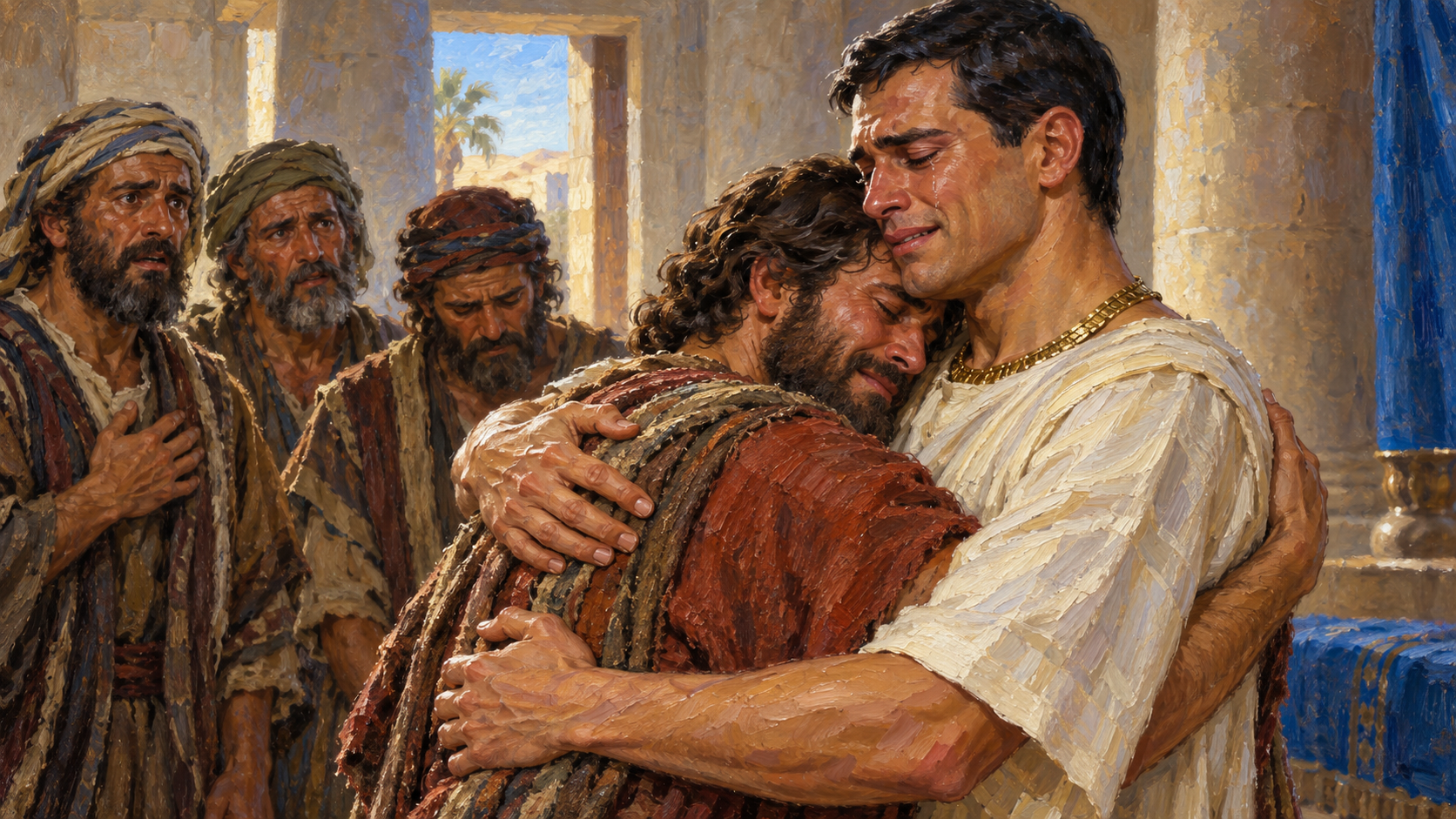
Joseph could no longer restrain himself. He sent the Egyptians out and wept loudly enough for others to hear. When he identified himself and asked whether his father was still alive, his brothers were too terrified to answer. He called them closer:
And Joseph said to his brothers, “Please come near to me.” So they came near. Then he said: “I am Joseph your brother, whom you sold into Egypt. But now, do not therefore be grieved or angry with yourselves because you sold me here; for God sent me before you to preserve life.
Joseph put two facts before them: “whom you sold” and “God sent me before you.” He offered mercy without denying the sale or telling the brothers they had obeyed God by committing it. He recognized a purpose beyond their intention, through which their family would survive.
Only two years of famine had passed, with five severe years still ahead. Joseph explained that God had sent him to preserve a remnant and sustain many lives. He embraced Benjamin and his brothers, and they were able to speak together. With Pharaoh’s support, Joseph sent provisions and transport to bring Jacob’s household to Egypt. The divided family would be sustained in Goshen through the authority God had given the son they rejected.
Genesis 47 also describes the effects of Joseph’s food policy on Egypt. The people spent their money, then exchanged livestock for food. As the famine continued, they surrendered their land and entered Pharaoh’s service. Joseph established a continuing one-fifth share of the produce for Pharaoh, with the priests’ land exempt. The people thanked him for preserving their lives.
His administration preserved life and concentrated wealth and power in Pharaoh’s hands. Both results need to be acknowledged. Genesis does not endorse every modern economic policy by recording what Joseph did during this emergency. Exodus later describes a king who did not know Joseph using Egypt’s power to oppress Israel. A government that once provided security could become a source of bondage under another ruler.
Providence, Forgiveness, and Rebuilt Trust
Many years later, after Jacob died, the brothers feared Joseph had delayed his revenge until their father was gone. They asked forgiveness and fell before him. Joseph wept and answered:
Joseph said to them, “Do not be afraid, for am I in the place of God? But as for you, you meant evil against me; but God meant it for good, in order to bring it about as it is this day, to save many people alive. Now therefore, do not be afraid; I will provide for you and your little ones.” And he comforted them and spoke kindly to them.
Genesis uses the same Hebrew verb, translated “meant,” for the brothers’ intention and God’s intention. They intended evil against Joseph. God intended the preservation of life through the events He overruled. The passage neither excuses their purpose nor attributes their sin to God. The study on Providence and Provision develops this care by which God governs events while holding people responsible for their choices.
This is providence: God’s faithful government of events, including His ability to restrain and redirect what wicked people intend. His promise did not become dependent on the brothers’ goodwill. Neither did His use of their actions make the betrayal good. Joseph could acknowledge their guilt and God’s faithfulness in the same explanation.
I reject fatalism and Calvinistic determinism as explanations of this passage. Calvinistic confessions also deny that God is the author of sin; the Westminster Confession, chapter 3, places that denial beside its teaching that God unchangeably ordains everything that occurs. I do not believe Joseph’s words require that determination of the brothers’ wicked choices. God did not create their hatred or force their betrayal and then condemn them for what He compelled. They chose evil, and He was wise and powerful enough to overrule it without morally causing it.
Joseph also refused to take God’s place in vengeance. He now had the power to retaliate, yet he promised to provide for his brothers and their children. He comforted them and spoke kindly. His forgiveness could be seen in the practical care he gave the family.
That forgiveness had not required him to deny the danger his brothers once presented. Earlier, he had gathered information about Jacob and Benjamin and watched their conduct. Their admissions of guilt and Judah’s willingness to suffer for Benjamin gave him a basis for renewed trust. Reconciliation followed evidence of change, rather than a demand that Joseph pretend nothing had happened.
I need that combination of mercy and discernment when I consider forgiveness. Refusing revenge does not make wisdom unnecessary, and rebuilding trust involves learning whether the wrongdoer is telling the truth and acting differently. Joseph’s kindness did not make slavery, deceit, or decades of grief harmless. He could name the evil honestly while refusing to become cruel in return.
Covenant Hope and the Greater Son
Before Jacob died, he adopted Joseph’s Egyptian-born sons, Ephraim and Manasseh, as his own for tribal inheritance, placing them beside Reuben and Simeon. Joseph thus received a double portion through two tribal lines. Joseph positioned Manasseh, the older son, beneath Jacob’s right hand, but Jacob crossed his hands and gave Ephraim priority. He maintained that blessing despite Joseph’s objection.
The younger son’s greater role continues a pattern in Genesis in which God fulfills His promise beyond ordinary expectations about rank. It does not establish that younger children are automatically more faithful or entitled. Manasseh would also become a people. The blessing concerned God’s purposes for these tribes, and Joseph’s Egyptian-born sons were included within Israel’s covenant identity.
The covenant family’s future also included the royal line that would come through Judah’s tribe. Genesis has not concealed his guilt, and his later place in God’s purpose cannot be explained by imagining him naturally blameless. God was changing a guilty man and carrying His promise forward by grace. The Tribe of Judah follows that line further.
By faith Joseph, when he was dying, made mention of the departure of the children of Israel, and gave instructions concerning his bones.
Joseph lived to 110 and saw later generations of his family, but he did not treat Egypt as the final destination of God’s covenant. He made his people promise to carry his bones away when God visited them and brought them to the land promised to their fathers. Paul, the author of Hebrews, identifies that instruction as an act of faith.
Joseph trusted God for a departure he would not see during his mortal life. His high office and Egypt’s present security would pass, but the promise did not depend on those things enduring. Exodus 13 records Moses taking Joseph’s bones when Israel left Egypt, and Joshua 24 records their burial at Shechem. His dying instruction joins Genesis to the exodus and the possession of the land.
Joseph’s life also presents patterns that direct our attention to Jesus Christ. A beloved son was sent by his father, rejected by his brothers, and sold for silver. After being brought low, he was raised to authority and preserved people who later bowed before him. He forgave those who had harmed him and fed them during a deadly famine.
These correspondences should be explained as comparisons, rather than making every detail a direct prophecy. Joseph was a sinful man who needed grace. He did not die for his brothers’ sins or rise bodily from the dead. Jesus is the eternal, completely sinless Son, fully God and fully man, whose saving work is unique.
Wicked men physically tortured and punished Jesus before putting Him to death. He willingly bore that real punishment for our sins in His innocent body. Through His shed blood and death, He completed His saving sacrifice before His burial and bodily resurrection. The Father did not punish, curse, abandon, strike, bruise, or pour wrath on His Son.
Christ died for the whole world, so God’s offer of salvation is genuine for every person, though people can resist His grace and reject Him. Everyone who repents and believes is forgiven, justified, and born again. The Holy Spirit indwells and seals each genuine believer, who is eternally secure in Christ. That security gives no permission for lawlessness, and a shallow profession does not prove new birth. A changed life is evidence of salvation, not the price of receiving it.
Joseph supplied grain that sustained mortal life during famine. Jesus, who reigns now as Lord, gives eternal life to those who believe and will raise the dead. The comparison should bring us to trust Him, rather than make Joseph’s experiences a hidden code or a promise that our own suffering will end with political influence and wealth.
My Final Thoughts
Joseph’s life teaches me to trust God’s providence without calling evil good. The brothers were guilty of betrayal, yet God preserved them through the brother they had sold. Judah’s offer to take Benjamin’s place showed repentance through a costly change in conduct, and Joseph’s provision for the family made his forgiveness visible. Even his instructions about his bones rested on a promise beyond Egypt’s security. I need that hope while obeying God in circumstances I cannot quickly change, and I need the mercy found in Jesus Christ, who shed His innocent blood and died for sinners before rising bodily to give life to those who believe.