
God had spoken about Jacob’s future before he was born, yet Jacob repeatedly tried to secure that future through his own schemes. I want to understand how God kept His promise while dealing with Jacob’s sin. Genesis shows us His patience as He disciplined and changed a man who could never have become Israel through cleverness.
God’s Choice and Human Responsibility
Before Jacob had made any choices, God spoke about him to Rebekah. Her difficult pregnancy led her to inquire of the LORD, who explained the struggle within her womb. Two nations and peoples would come from her sons, and the older would serve the younger.
And the LORD said to her: “Two nations are in your womb, Two peoples shall be separated from your body; One people shall be stronger than the other, And the older shall serve the younger.”
I start with this prophecy because God spoke before either son could act. Ordinarily, the firstborn received the primary inheritance rights and leadership in the family. God chose to carry His covenant through Jacob instead of Esau, overturning that expectation. We see a similar pattern when He received Abel rather than Cain and continued the promise through Isaac rather than Ishmael. Later, Ephraim would receive the greater blessing instead of Manasseh.
Paul drew on this history in Romans 9 to explain God’s freedom in Israel’s covenant history. Genesis speaks of two nations and peoples. The later words “Jacob I have loved, but Esau I have hated” came from Malachi’s message about Israel and Edom centuries after the twins lived. I need to keep that setting in view when reading Paul’s argument. It establishes God’s right to choose the family line and role through which His promise would advance. It does not teach that Esau was created for unavoidable personal damnation or that individual sinners cannot respond to God’s genuine offer.
God’s word made the outcome certain without removing anyone’s responsibility for how they acted. Jacob’s deception was still sin even though God had already spoken about his future. The Lord kept His promise through Jacob and disciplined him for his crookedness.
The Birthright and the Blessing
Esau was a skillful hunter and a man of the field, while Jacob was a mild man who dwelt in tents. Their parents’ affections were divided too. Isaac loved Esau because he enjoyed his game, and Rebekah loved Jacob. That favoritism gave sin room to grow within the household.
When Esau came home weary, Jacob had stew ready and demanded the birthright in exchange for a meal. Esau wanted immediate relief more than he valued that inheritance.
And Esau said, “Look, I am about to die; so what is this birthright to me?” Then Jacob said, “Swear to me as of this day.” So he swore to him, and sold his birthright to Jacob.
Hebrews calls Esau profane because he treated something holy as though it were common. Satisfying his appetite mattered more to him than his spiritual inheritance. I need to consider that warning whenever temporary relief or pleasure makes eternal things seem less valuable. The pressure might be another person’s disapproval, or anger that makes a bad bargain seem justified. A desire for money or control can lead to the same choice, valuing an immediate gain above what God calls holy.
lest there be any fornicator or profane person like Esau, who for one morsel of food sold his birthright.
Esau’s contempt for the birthright does not make Jacob innocent. Jacob saw his brother’s weakness and exploited it to obtain what God had already said would be tied to him. I can condemn Esau’s choice without admiring Jacob’s tactics. Neither man acted rightly.
Jacob’s name is connected with the heel-grasping scene at his birth and with the idea of supplanting, or taking another person’s place. Genesis lets that connection stay in view as his early character unfolds.
The conflict over the blessing exposed the sin throughout the family. Isaac intended to bless Esau, but Rebekah secretly planned to secure the blessing for Jacob. Jacob carried out her scheme by lying to his father, and Esau later responded with hatred and a desire to kill. We cannot account for this by blaming only one person. Favoritism had divided the household, allowing fear and scheming to grow alongside unchecked appetite.
Rebekah prepared the food and covered Jacob’s smooth hands and neck with goatskins so that the nearly blind Isaac would mistake him for Esau. Jacob actively deceived his father. He said, “I am Esau your firstborn,” and invoked the LORD when Isaac asked how he had found the game so quickly. I cannot call this clever faith when the promised heir was using God’s name to support a lie.
The birthright concerned firstborn status and inheritance rights, while the blessing was the patriarch’s formal pronouncement about the family’s future and covenant leadership. They were related, but they were not the same thing. Jacob wanted that blessing and used deception to obtain it.
So Jacob went near to Isaac his father, and he felt him and said, “The voice is Jacob’s voice, but the hands are the hands of Esau.” And he did not recognize him, because his hands were hairy like his brother Esau’s hands; so he blessed him.
Jacob received the blessing but had to flee from Esau’s rage. Getting what he wanted through sin had brought misery rather than peace. God had already said the older would serve the younger, so Jacob had never needed to deceive his father in order for God to keep His word.
Rebekah sent Jacob away to protect him, and Scripture never records her seeing him again. Her plan had cost her dearly. Sin can promise us control over the future and then take away the very thing we hoped to protect.
Bethel, Haran, and God’s Patient Discipline
Jacob left home with fear and guilt and very little else. He slept outdoors with a stone near his head while fleeing consequences he had helped bring about. God met Jacob in that humbled condition.
Then he dreamed, and behold, a ladder was set up on the earth, and its top reached to heaven; and there the angels of God were ascending and descending on it.
The word often translated ladder likely refers to something like a stairway or ramp. Its exact shape is less important than what Jacob sees: a real connection between heaven and earth that he did not build and could not control.
The Lord identified Himself as the God of Abraham and Isaac, then promised Jacob the land and descendants who would spread abroad. Through his family, blessing would reach all the families of the earth. God also promised to keep him as he traveled and bring him home. He would remain with Jacob until He had fulfilled everything He had said.
Behold, I am with you and will keep you wherever you go, and will bring you back to this land; for I will not leave you until I have done what I have spoken to you.
Jacob had done nothing to earn this meeting, and God’s promise did not make his deception good. I see grace here because God committed Himself to keeping His covenant with a man who still had much to learn. Its fulfillment rested on the Lord’s faithfulness, not Jacob’s maturity.
Jacob responded with awe and named the place Bethel, meaning “house of God,” and set up the stone as a pillar. Yet his vow still sounded conditional. If God kept him and supplied food and clothing, then brought him home, the LORD would be his God and he would give a tenth. This may express emerging faith, but it also reveals how much he still needed to grow. God had given an unconditional covenant promise, and Jacob answered cautiously as a man learning to trust Him.
Jesus later used the imagery of Bethel when He told Nathanael he would see heaven opened and the angels of God ascending and descending upon the Son of Man. That helps me understand where the connection between heaven and earth is found. It is Christ Himself, not a ladder Jacob could climb. He is fully God and fully man, the only Mediator between God and humanity.
And He said to him, “Most assuredly, I say to you, hereafter you shall see heaven open, and the angels of God ascending and descending upon the Son of Man.”
Jacob arrived in Haran and met Rachel, but there he experienced the kind of deception he had practiced at home. He agreed to work seven years for her, only for Laban to give him Leah instead. Now Jacob was the one asking why he had been deceived.
So it came to pass in the morning, that behold, it was Leah. And he said to Laban, “What is this you have done to me? Was it not for Rachel that I served you? Why then have you deceived me?”
Jacob had deceived his father in his tent. He then spent years working under a man who repeatedly deceived him. Genesis shows God’s discipline through those circumstances, not a reversal for our entertainment. The consequences were not random, because the Lord was working on Jacob’s character.
The growing family in Haran suffered too. Leah was unloved, while Rachel was loved but remained barren for a time. Their rivalry shaped the household into which their children were born. Genesis records the fruitfulness of this polygamous family alongside its sorrow, giving us no reason to romanticize it.
God built the family that would become Israel through these painful circumstances. His faithfulness did not approve the sin within the home. He carried His promise forward while exposing what was wrong.
Laban also exploited Jacob’s work by changing his wages and trying to control the outcome. Yet God protected Jacob and provided for him, and Jacob eventually acknowledged that his increase had come from the Lord.
So God has taken away the livestock of your father and given them to me.
Jacob had arrived in Haran running from his past. By the time he left, he had the responsibilities of a large family and had endured many difficult years. Those years had slowed him down and helped him see that God could provide without his scheming to control every outcome.
Returning to the Land
After years in Haran, Jacob returned toward the land of his fathers because the Lord commanded him to go and promised to be with him. His obedience did not mean he had become fearless.
Then the LORD said to Jacob, “Return to the land of your fathers and to your family, and I will be with you.”
As Jacob approached Esau, he learned his brother was coming with four hundred men. His old fear returned, and he divided the camp and sent gifts. Some of those precautions were prudent, but none could cleanse his guilt. I notice that he was obeying God’s command while still afraid. Obedience does not always begin with fear already resolved.
Jacob’s prayer in Genesis 32 shows how he was growing. He appealed to God’s command and promise while confessing that he was unworthy of even the least of the Lord’s mercies.
I am not worthy of the least of all the mercies and of all the truth which You have shown Your servant; for I crossed over this Jordan with my staff, and now I have become two companies.
Jacob was still afraid and making plans, but he now spoke to God with an awareness of his own unworthiness and a reliance on His promise. That growing trust is part of sanctification, the process of becoming holy. I need to recognize the growth without expecting every old response to disappear at once. God often uses pressure to show us where we trust our own instincts more than His word, and the change can be slower than we want.
The God Who Changes Jacob
Jacob was left alone at the Jabbok, where a Man wrestled with him until daybreak. There is mystery in the encounter, but Genesis identifies it as divine. Jacob named the place Peniel because he had seen God face to face, and Hosea later described him as struggling with God and with the Angel.
Then Jacob was left alone; and a Man wrestled with him until the breaking of day. Now when He saw that He did not prevail against him, He touched the socket of his hip; and the socket of Jacob’s hip was out of joint as He wrestled with him.
A single touch from the Man put Jacob’s hip out of joint. That tells me Jacob had not overpowered God; the wrestling continued because God allowed it. Jacob was being humbled until he stopped striving against God and clung to Him instead.
And He said, “Let Me go, for the day breaks.” But he said, “I will not let You go unless You bless me!” So He said to him, “What is your name?” He said, “Jacob.” And He said, “Your name shall no longer be called Jacob, but Israel; for you have struggled with God and with men, and have prevailed.”
The question “What is your name?” brought Jacob to acknowledge who he had been. His name identified him as the heel-grabber and supplanter who had spent his life getting around others. God gave him the new name Israel. His struggle with God and men would leave its mark on him as God changed his life.
He took his brother by the heel in the womb, And in his strength he struggled with God. Yes, he struggled with the Angel and prevailed; He wept, and sought favor from Him.
Hosea’s account helps me understand the encounter described in Genesis 32. Alongside Jacob’s “face to face” testimony, it shows that this was no ordinary human contest. The LORD was making Himself known, as He did elsewhere in the Old Testament. That does not give us reason to identify every angel reference with Christ.
The Man who wrestled with Jacob was the eternal Son appearing before He became man, a Christophany. Hosea called Him the Angel while also saying Jacob struggled with God and sought favor from the LORD God of hosts. This distinctive divine Messenger was not a created angel. The Son did not begin to exist in this appearance or at Bethlehem.
Israel is a name tied to striving with God. It identifies Jacob as a man whom God humbled and reshaped through that encounter, rather than rewarding him for self-reliance.
Jacob left with a limp, a merciful reminder that his future did not depend on his natural strength. He could not secure God’s blessing through cleverness or a quick scheme. The weakness he now carried reminded him where that blessing came from.
Genesis continues to call him Jacob after this encounter, even though “Israel” expresses the identity God gave him and became the nation’s name. Keeping both names in view helps me see the change without assuming every old weakness vanished that night. The new name marked God’s transforming claim on his life.
Jacob’s Legacy and Israel’s Future
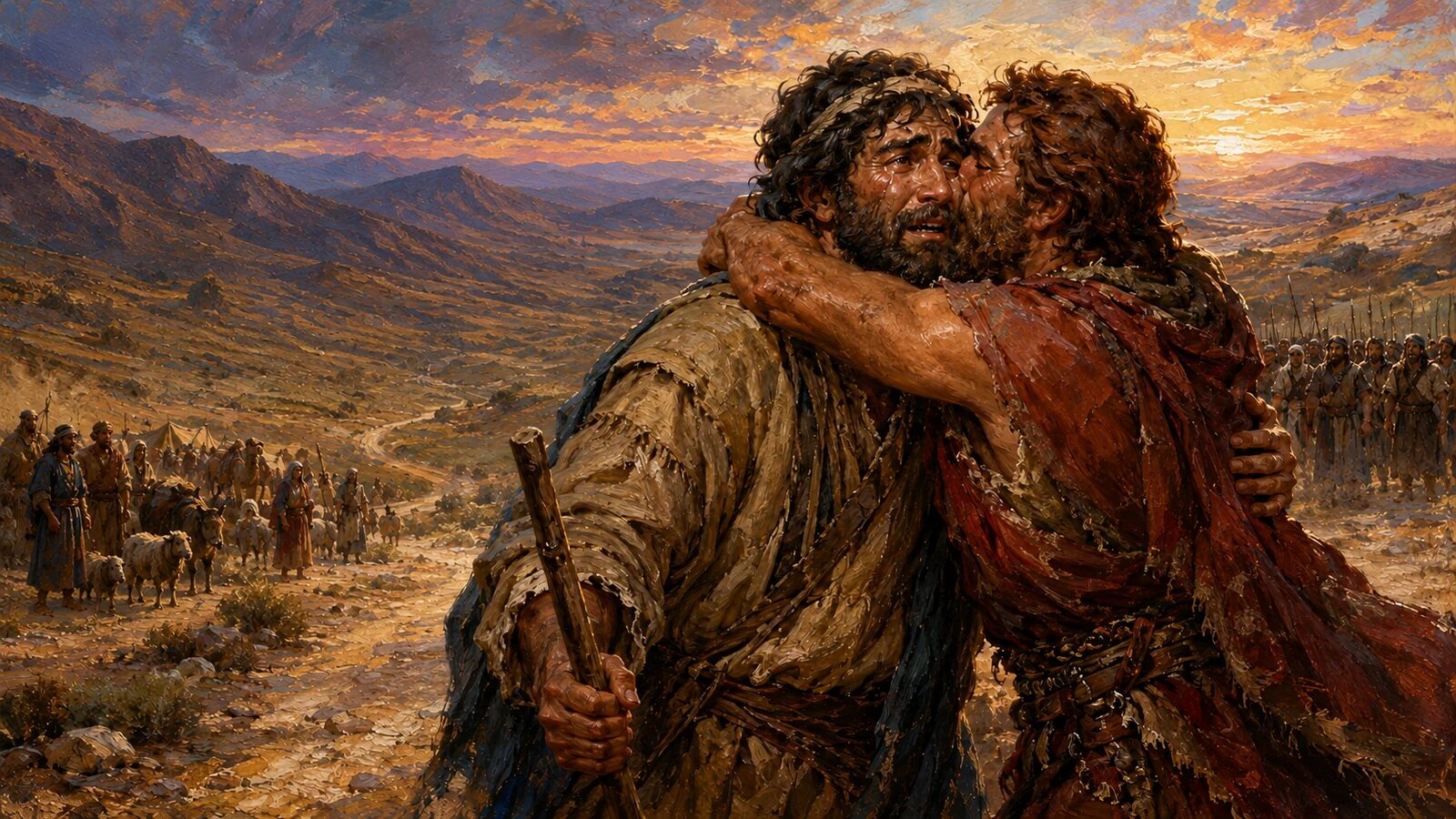
When Jacob met Esau after Jabbok, the brother he had feared embraced him. Their past had not disappeared, and Scripture does not promise that every broken relationship will be restored this way. It does show that the Lord can go ahead of His people and soften what they cannot control.
But Esau ran to meet him, and embraced him, and fell on his neck and kissed him, and they wept.
Jacob later grieved Rachel’s death and spent many years believing Joseph was dead after his son had been sold. Genesis does not make him emotionally numb because he was a man of faith. His grief was real, and God’s promise continued even while Jacob could not see all that was happening.
Between the reunion with Esau and the loss of Joseph, serious sin brought further trouble into the family. Dinah was violated at Shechem. Simeon and Levi responded with deceit and slaughtered the city’s males. Jacob condemned what they had done, though his first response gave much attention to the danger they had brought on his household. God then told him to return to Bethel. Before building an altar where God had first met him in flight, Jacob told his household to put away their foreign gods. They were to purify themselves and change their garments. Returning to Bethel meant returning to worship and separating the household from idolatry.
Years later, famine brought Jacob’s family to Egypt after Joseph was revealed to be alive and serving under Pharaoh. God told Jacob not to fear going there. He would make Israel a great nation in Egypt and bring the family up again. Jacob arrived as a dependent immigrant, yet he blessed Pharaoh and spoke of the difficulty of his years. Before his death, he adopted Joseph’s sons Ephraim and Manasseh and deliberately gave the greater blessing to the younger Ephraim. The pattern from Jacob’s own life appeared again, but this time the blessing came through his conscious prophetic act rather than deception.
Near the end of his life, Jacob pronounced blessings over his sons that set the direction for their tribes. These were more than a father’s wishes for his children. Judah received a kingly promise that reached beyond his immediate descendants to the Messiah.
The scepter shall not depart from Judah, Nor a lawgiver from between his feet, Until Shiloh comes; And to Him shall be the obedience of the people.
The covenant had continued from Abraham through Isaac and Jacob. It now pointed toward Judah and ultimately Christ. Jacob had become a prophetic patriarch whose words concerned far more than his own household, a very different man from the schemer we met earlier.
Jeremiah uses Jacob’s name for the nation descended from him when describing a future period of severe distress. The time of Jacob’s trouble will be followed by deliverance. I understand this as actual distress for Israel with God’s promise to deliver the nation, not a general metaphor for hardship.
Alas! For that day is great, So that none is like it; And it is the time of Jacob’s trouble, But he shall be saved out of it.
Jacob’s life helps us understand the nation that came from him. Both were chosen according to God’s word and face His discipline for sin. Yet He preserves them because He does not abandon His promises. Jacob’s life belongs within Israel’s history and the coming of the Messiah. Through both the man and the nation, we see God’s faithfulness.
That future distress will take place during the literal Tribulation before Christ returns bodily and reigns in His kingdom. Jeremiah does not say Israel will be erased or replaced. God will bring the nation descended from Jacob through judgment and deliver it in faithfulness to His covenant.
God chose Jacob before his birth, but that choice never made his deception right. His life should lead us to obey what God has said rather than manipulate events to make His promise come true.
Esau’s choice should make me question what I value when an immediate desire feels urgent. Holy things do not become less valuable because I want relief. Jacob’s years in Haran teach me to take God’s discipline seriously too. It was painful, but it exposed his grasping heart and taught him that God could provide without his constant control.
By the time Jacob prayed before meeting Esau, he was relying on God’s promise instead of speaking as though he could manage his future. At Jabbok, that dependence became unmistakable as he clung to God. Grace was changing him as he learned to trust, even though his weaknesses did not all disappear at once.
My Final Thoughts
Jacob’s life gives me hope because God did not abandon him to the consequences of his schemes. That does not excuse the deception. God had spoken before the twins were born and needed none of Jacob’s lies to preserve His covenant. He met Jacob at Bethel and disciplined him through difficult years before bringing him home and giving him the name Israel. His grace can change a crooked heart and teach us to trust His word instead of trying to force our own future.