
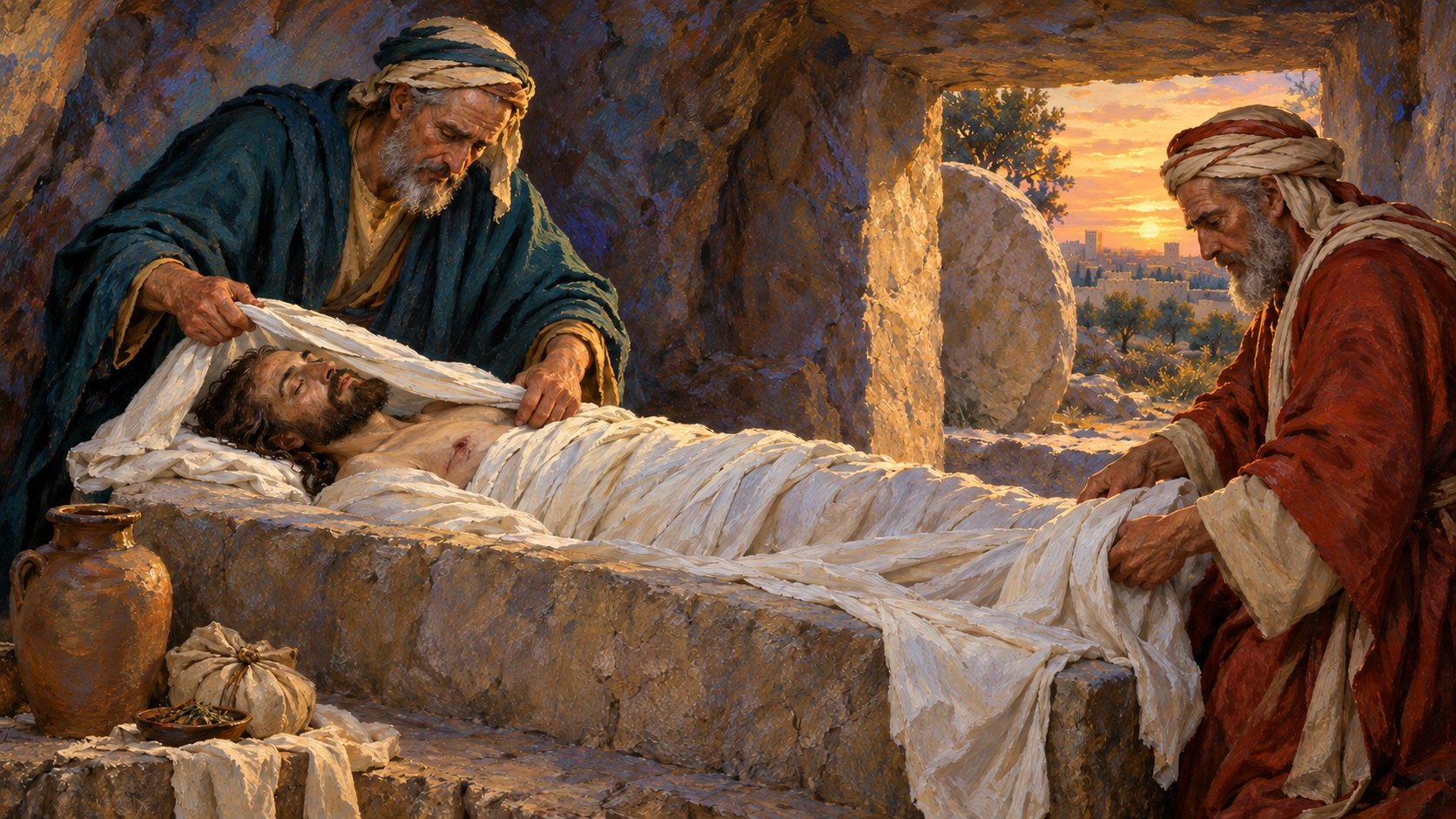
Joseph of Arimathea appears only near the end of the crucifixion day, so it is easy to read past him. Yet all four Gospels name him, and each adds something to our understanding of the man. Together, they show us a real disciple whose fear had kept him quiet until he stepped forward to honor Jesus at a cost to himself.
What the Four Gospels Tell Us About Joseph
The Gospels leave much of Joseph’s life untold. We learn nothing about his childhood or family, and they do not give the details of his later ministry or death. What they do tell us is carefully chosen. Matthew identifies him as a rich man from Arimathea who had become Jesus’ disciple. Mark describes a prominent council member waiting for God’s kingdom. Luke calls him good and just, while John explains why he had followed Jesus secretly: he feared the hostile Jewish authorities.
When I bring those details together, I see more than a man who happened to have an available tomb. Joseph’s rank carried serious responsibility, and his wealth gave him resources he could use for Jesus. He hoped for God’s kingdom and had real faith, even though fear had kept that faith quiet. His costly act of honor after Jesus died brought his hidden discipleship into the open.
Matthew begins with Joseph’s wealth and discipleship:
Now when evening had come, there came a rich man from Arimathea, named Joseph, who himself had also become a disciple of Jesus.
Mark adds Joseph’s public standing and his expectation of God’s kingdom:
Joseph of Arimathea, a prominent council member, who was himself waiting for the kingdom of God, coming and taking courage, went in to Pilate and asked for the body of Jesus.
Joseph belonged to the Jewish leadership in Jerusalem. He had a place within the religious establishment, rather than watching it as an unknown outsider. That position gave him access another person might not have had and helps explain how he could approach Pilate for Jesus’ body. It also made his request dangerous. A man in his position was openly showing where his loyalty lay.
Luke calls Joseph “a good and just man” in Luke 23:50. His wealth alone would not explain that description, since a rich man can be proud or spiritually blind. Joseph’s resources became useful because his heart was turned toward the Lord. He had a new tomb and could buy linen, and his standing opened Pilate’s door. The question was whether he would use what he had to honor the crucified Messiah.
Mark says Joseph was waiting for the kingdom, which helps me understand his hope. His hope reached beyond religion as a public institution to God’s rule and promise. Simeon had waited for Israel’s Consolation, and Anna spoke to others who were looking for redemption in Jerusalem. Joseph shared that patient, expectant kind of faith.
I appreciate that Scripture lets us see both Joseph’s fear and his courage. His later action does not erase his earlier weakness, and his fear does not prove that his discipleship was false. The Gospels record the weakness honestly, then show God’s grace bringing his loyalty into the light when it carried real cost.
The Secret Disciple Took Courage
John gives the most searching description of Joseph’s earlier condition. He was a disciple, but he had kept that discipleship secret because he feared the Jewish authorities who opposed Jesus.
After this, Joseph of Arimathea, being a disciple of Jesus, but secretly, for fear of the Jews, asked Pilate that he might take away the body of Jesus; and Pilate gave him permission. So he came and took the body of Jesus.
John is not condemning the Jewish people as a whole. Jesus and His apostles were Jewish, as were Joseph, Nicodemus, and the first believers. In this context, Joseph feared the leadership structures that had opposed the Lord and the social consequences that could follow open allegiance to Him.
I should be humbled by the fear we see around Jesus’ death. Peter denied Him and the disciples scattered. Joseph had kept his faith hidden. Human courage can fail when safety or belonging is threatened. If preserving my position or reputation becomes more important than confessing Christ, the very things I want to protect can hold me back from honoring Him.
Luke also tells us that Joseph had not agreed with the council’s decision and deed. I would not take that to mean he publicly defended Jesus in the council or could have stopped the condemnation. Scripture does not say either of those things. It does tell us that this secret disciple had not consented to the council’s evil action.
This man had not consented to their decision and deed. He was from Arimathea, a city of the Jews, who himself was also waiting for the kingdom of God.
Fear can silence a believer when speech is needed and delay an open identification with Christ. I do not want to excuse that, but neither should I judge Joseph more harshly than Scripture does. The Holy Spirit calls him a disciple and describes him as good and just. He waited for the kingdom and refused to agree with the council’s deed. His example encourages a fearful disciple to take courage, rather than settle into fear as a way of life.
Joseph stepped into the open after Jesus died. Rome had crucified Him, and the rulers had rejected Him. The Sabbath was approaching, and the other disciples were shaken. It was then that Joseph went to Pilate.
Now when evening had come, because it was the Preparation Day, that is, the day before the Sabbath, Joseph of Arimathea, a prominent council member, who was himself waiting for the kingdom of God, coming and taking courage, went in to Pilate and asked for the body of Jesus.
Evening was drawing near, so Joseph had little time before the Sabbath began. Leaving Jesus’ body exposed after crucifixion would have added to the public shame. Joseph could have left the responsibility to someone else. Instead, he went to the Roman governor and openly associated himself with the man who had just been executed under the title “King of the Jews.”
Mark says Joseph was “taking courage.” The Greek participle τολμήσας (tolmēsas) comes from the verb tolmaō, meaning to dare, venture, or act boldly. That helps us understand the action Mark describes. Joseph did not wait for the danger to pass before offering a private kindness. He dared to face Pilate and ask for Jesus’ body while the cross was still fresh in everyone’s mind.
Mark’s wording suggests that Joseph understood the risk and acted anyway. Courage did not require him to become unaware of the danger. His standing on the council could suffer, and identifying publicly with a crucified man could cost him his peers’ respect. Handling the body also meant choosing devotion to Jesus over concern about ceremonial complications. He had once protected his identity as a disciple. Now he placed his name and reputation beside the condemned Lord.
Pilate was surprised that Jesus had died so soon. He called the centurion and did not release the body until the death had been confirmed.
Pilate marveled that He was already dead; and summoning the centurion, he asked him if He had been dead for some time. So when he found out from the centurion, he granted the body to Joseph.
Before I follow Joseph to the tomb, I want to be clear about what Pilate had confirmed. He did not release the body without verification, and Joseph did not bury a living man. The Roman centurion had confirmed that Jesus was dead. The burial and resurrection accounts proceed from that established fact.
Jesus’ death was not left uncertain in the Gospel accounts. The officer responsible for the Roman execution confirmed Jesus’ death before Pilate released the body. Joseph then received that same body and laid it in a known tomb. The resurrection announcement rests on a death and burial already established as physical events in public history.
An Honorable Burial in the Rich Man’s Tomb
Joseph bought linen and took Jesus down from the cross. He wrapped His body and laid it in a new tomb cut out of rock, then rolled a large stone across the entrance. These plain physical details establish the reality of the burial. They also let us see the reverence with which Joseph treated Christ’s body.
When Joseph had taken the body, he wrapped it in a clean linen cloth, and laid it in his new tomb which he had hewn out of the rock; and he rolled a large stone against the door of the tomb, and departed.
Then he bought fine linen, took Him down, and wrapped Him in the linen. And he laid Him in a tomb which had been hewn out of the rock, and rolled a stone against the door of the tomb.
Jesus had endured torture and crucifixion. He had shed His blood and physically borne the punishment for our sins in His innocent body. Joseph’s service did not add anything to Christ’s atoning work. The sacrifice had been made. Joseph’s act honored the body of the sinless Lamb after His death.
Joseph gave Jesus his own new tomb, where no one had ever lain, and provided linen for His body. I see reverence in that gift, but also in the work Joseph took on himself. His position opened a door to Pilate; it could not replace the time and labor the burial required of him. Men had mocked and stripped Jesus before nailing Him to the cross. Joseph could not undo their evil, but he refused to share in its dishonor and treated Jesus’ body with care.
The Gospels record no sermon from Joseph. His faith became visible in practical service through the difficult work he accepted and the cost he bore. Devotion sometimes needs to be spoken. Here, Joseph expressed it by providing the tomb and linen and being willing to be seen doing so.
Joseph’s tomb also fulfilled Isaiah 53:9. Isaiah said that the suffering Servant would be connected with the wicked in His death and with the rich at His death. Jesus was crucified between criminals, yet a rich disciple buried Him in a new tomb. The prophecy also says the Servant had done no violence and that no deceit was in His mouth, as Isaiah 53:9 records. Jesus was not a sinner suffering for His own guilt. He was completely innocent and willingly gave Himself for sinners.
Matthew’s mention of Joseph’s wealth connects the burial to Isaiah’s prophecy. God had spoken beforehand, and the burial unfolded under His faithful rule. Neither the rulers nor Pilate controlled the outcome, and Joseph was not directing prophecy himself. God fulfilled His Word through the real choices these people made.
What I notice is that no one in the scene appears to be staging that fulfillment. The hostile leaders wanted Jesus dead and disgraced, while Pilate was concerned with whether the execution was complete. Joseph wanted to give the Lord an honorable burial before the Sabbath. Through those different choices, Isaiah’s words came to pass. The innocent Servant was treated with the wicked in His death and was with the rich when He was buried.
Joseph, Nicodemus, and the Gospel Witness
John tells us that Nicodemus joined Joseph, bringing a large quantity of myrrh and aloes. This was the ruler who had first come to Jesus by night. Jesus had taught him that a person must be born again. Later, he urged the rulers to hear Jesus before judging Him. Now he took part with Joseph in an open and costly act of honor.
And Nicodemus, who at first came to Jesus by night, also came, bringing a mixture of myrrh and aloes, about a hundred pounds.
Then they took the body of Jesus, and bound it in strips of linen with the spices, as the custom of the Jews is to bury.
The connection between these two men moves me. Both had standing, and both had reasons to fear public identification with Jesus. Each was connected with the leaders who opposed Him. At the burial, they stepped forward together.
John describes Joseph and Nicodemus wrapping Jesus’ body in linen with spices according to Jewish burial custom. They laid Him in a nearby tomb because the Preparation Day was nearly over. These were physical acts performed on His body before it was placed in a known tomb. The Word who became flesh had truly died in the flesh.
Joseph and Nicodemus were not honoring a teacher who had merely died as an example of courage. They were caring for the Lamb of God who had shed His blood for the sins of the world. Jesus is the eternal Son made flesh and the sinless Savior. His resurrection would soon overturn the grief of that evening, but the burial first testified that His death was real.
Paul therefore includes the burial in his summary of the gospel. Christ died for our sins according to the Scriptures. He was buried, and He rose again on the third day according to the Scriptures.
For I delivered to you first of all that which I also received: that Christ died for our sins according to the Scriptures, and that He was buried, and that He rose again the third day according to the Scriptures.
The church does not confess a vague spiritual survival after death. Jesus physically died for our sins, was buried, and then rose bodily. Joseph’s work belongs to that public testimony: Pilate released the body only after the centurion confirmed death, and the tomb where Joseph laid Him was known. The women saw the place, and a stone closed its entrance.
Paul makes the same movement when he preaches in Antioch. After describing the rejection and crucifixion of Jesus, he says that “they took Him down from the tree and laid Him in a tomb” in Acts 13:29. The next sentence announces the reversal: “But God raised Him from the dead” (Acts 13:30).
I would not assume Joseph understood everything that was about to happen. The Gospels never tell us he expected Jesus to rise on the third day. Yet God used his obedience to place Jesus’ body where the resurrection testimony would unfold. His service helps me see that faithful work can mean far more than the servant understands at the time.
What Joseph’s Testimony Teaches Us
Later traditions connected Joseph with Britain, relics, and other claims far removed from the Gospel record. I would not build doctrine or history on them. We do not have to mock every tradition to distinguish it from the authority of Scripture, which already tells us enough to understand Joseph’s place in the Gospel account.
We know that Joseph came from Arimathea and possessed wealth and standing. He was a council member who was good and just. He had become a disciple of Jesus and waited for God’s kingdom, though fear had kept his faith secret. He did not consent to the council’s deed. After the crucifixion, he asked Pilate for Jesus’ body and buried Him in his own new tomb. Those truths belong to the inspired record. Anything beyond them is secondary and uncertain.
Joseph’s biblical testimony is already weighty enough. We do not need to embellish the biblical account of his life with legends. The Spirit chose to show this man at the burial of Christ, where his faith finally became visible.
Joseph’s example teaches us that quiet faith should move toward open loyalty. A believer may go through a fearful season while learning and growing under pressure, and Joseph shows us the Lord’s patience with that weakness. But discipleship cannot stay permanently hidden, as though Jesus were safe to admire in private and too costly to confess in public. Joseph’s courage came late in the day, but it came.
That does not give me a reason to put off obedience. The encouragement is that grace brought Joseph forward, not that his fear did no harm. When loyalty to Christ carries a cost, a believer may feel the pull to remain unknown or let someone else act. Joseph’s example encourages us to bring that fear to the Lord and take the next faithful step while the opportunity remains.
God used Joseph’s resources without making wealth a measure of spirituality. His tomb and linen were available to Christ, and his influence gave him access to Pilate. He still took up the burial work with his own hands. I should not conclude that a wealthy disciple is better than another believer. The question for each of us is whether what God has entrusted to us is available for His use. That includes property, but it also includes our time and skill. Even our reputation may need to be placed beneath loyalty to Jesus.
Joseph’s work also keeps the physical truth of the gospel in front of us. The Son of God truly took flesh. He suffered in that body and shed His blood before He died and was buried. Christian faith is not merely a collection of moral ideas. It rests upon the incarnate Savior who gave Himself for sinners and rose bodily from the tomb.
Joseph’s quiet service was a holy act of love when others were absent or afraid. He did necessary work without taking center stage or giving a recorded speech. Honoring Christ sometimes requires clear words. At other times, it calls for the courage to do the difficult work in front of us with reverence.
The burial’s place in the gospel can be explored further in the studies on the moment Jesus died and the resurrection grave clothes. The studies on post-resurrection Jesus and His ascension and Isaiah’s prophecies of a Messiah follow the larger resurrection and prophetic setting.
My Final Thoughts
When I put the four Gospel accounts together, I see a real disciple whose weakness Scripture does not hide. Joseph had stayed in the background, yet at the cross he took courage and openly honored Jesus when doing so carried a price. God used his standing and practical service to fulfill Scripture and place Christ’s burial inside the public gospel witness. Joseph did not earn salvation through this act; salvation is by grace through faith in the Savior whose blood was shed for us and who rose bodily from that tomb. His example calls fearful believers like us toward visible loyalty, while reminding us that even quiet work can honor the crucified and risen King.