
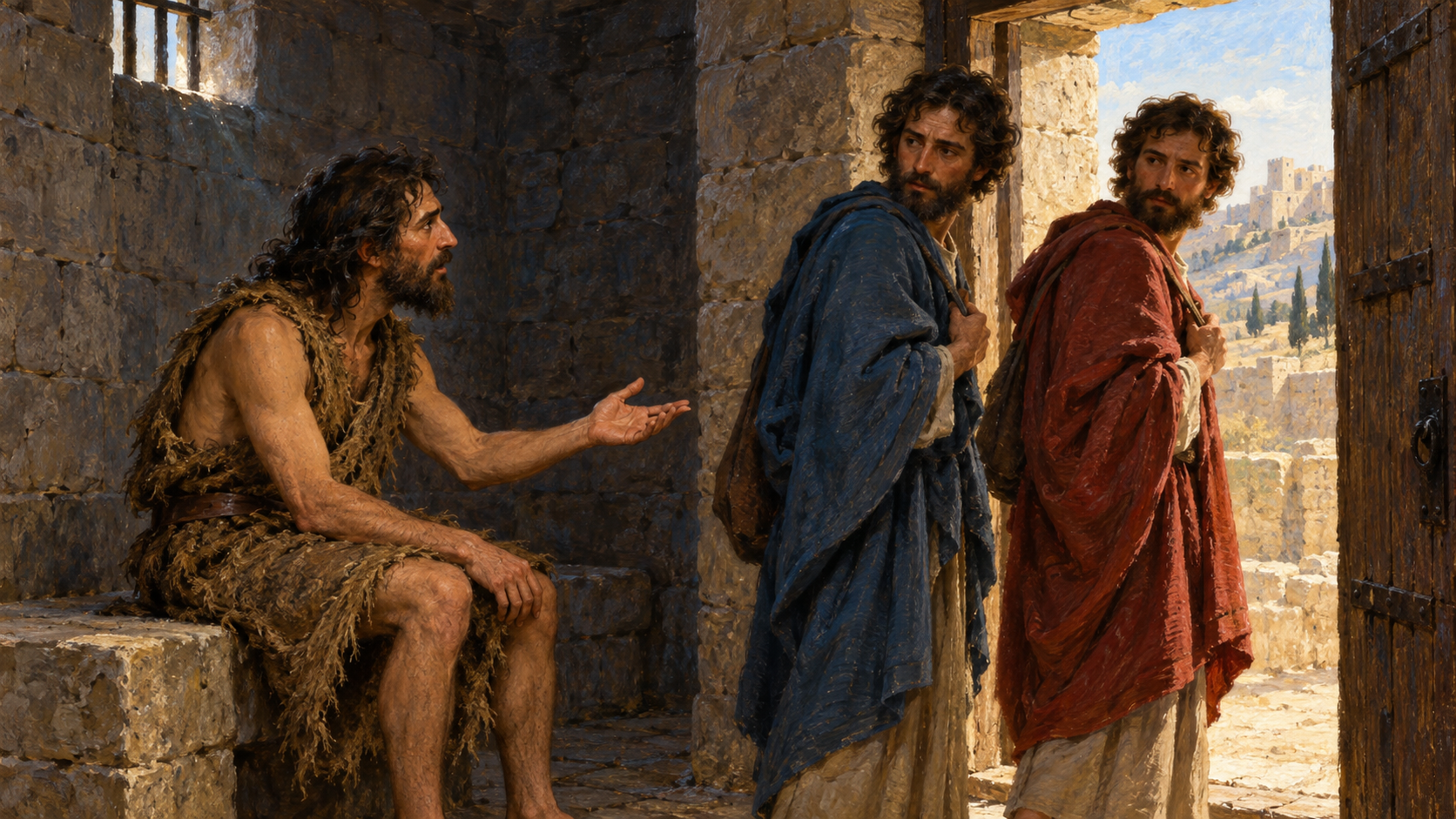
John the Baptist was imprisoned for rebuking a ruler’s sin and eventually killed at that ruler’s command. Before his death, he sent disciples to ask Jesus whether He was the Coming One. Jesus answered him with evidence from His works and continued to honor him as a faithful prophet.
John’s Final Witness and Arrest
John called Israel to repentance, baptized those who confessed their sins, and directed people beyond himself to Jesus. He identified Him as “the Lamb of God who takes away the sin of the world” (John 1:29). When Jesus’ public ministry increased, John said, “He must increase, but I must decrease” (John 3:30). The study on John the Baptist’s broader life and ministry follows that calling from its beginning.
John’s decrease did not mean he had stopped speaking faithfully. Herod Antipas had taken Herodias, his brother Philip’s wife, and John rebuked the relationship:
Because John had said to Herod, “It is not lawful for you to have your brother’s wife.”
But Herod the tetrarch, being rebuked by him concerning Herodias, his brother Philip’s wife, and for all the evils which Herod had done, also added this, above all, that he shut John up in prison.
Luke says John rebuked Herod “for all the evils” he had done. John’s rebuke was not confined to one feature of the ruler’s private life. He had called the crowds to bear fruits worthy of repentance and addressed the particular sins of tax collectors and soldiers. Herod likewise had to answer to God. His rank did not excuse conduct that God’s law condemned.
John could not faithfully call Israel to repentance while exempting Herod’s household from God’s law. His example does not excuse needless rudeness. The conflict described here concerned an unlawful relationship and other evils, rather than a personal insult invented to provoke outrage. John told a powerful man the truth when that man could punish him for saying it.
Herod Heard John but Would Not Repent
Herodias responded to the rebuke with a desire to kill John. Herod’s response was more divided:
Therefore Herodias held it against him and wanted to kill him, but she could not; for Herod feared John, knowing that he was a just and holy man, and he protected him. And when he heard him, he did many things, and heard him gladly.
Mark tells us why Herod protected John: he feared him and knew him to be just and holy. He also heard him gladly. Yet he kept John in prison after the prophet had rebuked his unlawful relationship. Herod’s willingness to listen had not become the repentance John’s preaching required. For a time, he kept Herodias from carrying out her plan, but John remained in the custody of a ruler who would not repent.
John’s Question and Jesus’ Answer
While imprisoned, John heard reports of Christ’s works and sent two disciples with a direct question:
And when John had heard in prison about the works of Christ, he sent two of his disciples and said to Him, “Are You the Coming One, or do we look for another?”
John had already identified Jesus as the Lamb of God and witnessed heaven’s testimony at His baptism. We need to remember that testimony before dismissing his whole ministry as a failure. He had preached openly to crowds; now he was confined while the ruler he had rebuked remained in power. His question came from a faithful prophet under pressure, not from someone casually examining a stranger’s claims.
Some interpreters think John sent the disciples for their own benefit, so they would hear Jesus’ answer directly. Others understand John himself to have needed reassurance. Matthew records the question and the answer without explaining every part of John’s intention. I understand it as an honest question from a faithful man under severe pressure. His earlier testimony did not mean he could never need reassurance while suffering for Christ.
John’s preaching may help explain his question. He had warned about the axe at the root of the trees and about the Messiah gathering wheat and burning chaff with unquenchable fire. Judgment belonged to his announcement of the Messiah. Now he heard reports of Jesus healing and showing mercy, while Herod had not been removed. That difference may have troubled John, although Matthew does not expressly identify it as his reason for sending the messengers.
Jesus directed the messengers to report what they could hear and see:
Jesus answered and said to them, “Go and tell John the things which you hear and see: The blind see and the lame walk; the lepers are cleansed and the deaf hear; the dead are raised up and the poor have the gospel preached to them.”
“And blessed is he who is not offended because of Me.”
Those works matched the prophetic promises. Isaiah 35:5–6 describes blind eyes opened, deaf ears unstopped, the lame leaping, and the mute singing. Isaiah 61:1 speaks of good news for the poor. Jesus gave John evidence that His ministry fulfilled Scripture. The messengers could carry back an answer grounded in Christ’s actual works. John was being given reason to trust the promises he had preached.
The word “offended” carries the idea of stumbling. Jesus calls for trust even when His work does not follow the course someone expected. At His first coming, He would preach the gospel and give His life to save sinners. He would return later as Judge and King. He was doing the Messiah’s promised work even though final judgment remained future.
Jesus’ answer contained no promise that John would be released. He confirmed that He was the One John had announced and called him not to stumble over Him. John received truth he could trust while still in prison. He did not have to know every part of his future to trust what Christ had shown him.
Jesus Honored His Forerunner
As the messengers departed, Jesus spoke to the crowd about John. He asked whether they had gone into the wilderness to see a reed shaken by the wind or a man in the soft clothing of a royal household. His questions rejected the idea that John was merely unstable or accustomed to palace comfort. He then identified John’s office:
“But what did you go out to see? A prophet? Yes, I say to you, and more than a prophet. For this is he of whom it is written: ‘Behold, I send My messenger before Your face, Who will prepare Your way before You.'”
“Assuredly, I say to you, among those born of women there has not risen one greater than John the Baptist; but he who is least in the kingdom of heaven is greater than he.”
John was more than a prophet because he was the promised messenger preparing the way for the Messiah. Earlier prophets had announced Christ’s coming from a distance; John could point to Jesus and say, “Behold the Lamb.” His question from prison did not erase that calling. Jesus’ public words gave the crowd no basis for treating him as a false prophet.
When Jesus calls the least in the kingdom greater than John, I understand Him to be speaking about privilege within God’s unfolding work of redemption. John announced the Lamb but died before the cross and bodily resurrection. Those who look back on Christ’s finished work can understand the fulfillment John did not live to witness. Jesus is not praising John’s faithfulness and then dismissing him as worthless. Greater light gives us reason for gratitude and responsibility, not contempt for the prophet who prepared the way.
Jesus also connected John with Elijah:
“For all the prophets and the law prophesied until John. And if you are willing to receive it, he is Elijah who is to come.”
Gabriel’s earlier announcement to Zechariah explains the nature of that connection:
“He will also go before Him in the spirit and power of Elijah, ‘to turn the hearts of the fathers to the children,’ and the disobedient to the wisdom of the just, to make ready a people prepared for the Lord.”
John was not Elijah reincarnated. He went before the Lord in Elijah’s spirit and power, calling disobedient people to repentance and preparing them for the Messiah. I understand this as John’s fulfillment of the forerunner role associated with Malachi 4:5–6. The study on Elijah examines that earlier prophet’s life and witness.
John’s Death and the Cost of Truth
Herodias found her opportunity at Herod’s birthday feast, when her daughter danced before him and his guests. Pleased by the performance, he made a reckless oath, promising to give her whatever she might ask, up to half his kingdom. She consulted her mother and returned with the demand:
She came in immediately with haste to the king and asked, saying, “I want you to give me at once the head of John the Baptist on a platter.”
And the king was exceedingly sorry; yet, because of the oaths and because of those who sat with him, he did not want to refuse her.
Immediately the king sent an executioner and commanded his head to be brought. And he went and beheaded him in prison, brought his head on a platter, and gave it to the girl; and the girl gave it to her mother.
John’s disciples recovered his body:
When his disciples heard of it, they came and took away his corpse and laid it in a tomb.
Matthew 14:12–13 adds that they went and told Jesus. When He heard, He withdrew by boat to a deserted place by Himself.
Herod had known John was just and holy, had protected him, and had listened gladly. At the feast he was deeply sorry, yet he still ordered an innocent man’s execution. Mark identifies the oaths and the guests as his reasons for granting the demand. He should have admitted that his reckless promise could not justify murder. Instead, he honored it before his guests at the cost of John’s life.
This is why I cannot equate interest, conviction, or sorrow with repentance. A person may enjoy hearing the truth, admire a faithful witness, and feel distressed by the consequences of sin while still choosing to continue in it. Herod’s regret did not protect John because the ruler would not refuse the evil demand. Repentance would have required him to refuse it, regardless of his oath or his guests.
John’s martyrdom continued the long rejection of God’s prophets. Jesus later rebuked leaders who honored the prophets’ tombs while sharing the conduct of those who had killed them. Remembering a dead prophet respectfully is easier than receiving a living rebuke that exposes one’s own sin. Herod’s treatment of John makes that danger concrete.
John’s death also foreshadowed the rejection Jesus would face, but their deaths did not accomplish the same thing. John was a faithful martyr, a witness killed for his testimony. His blood could not atone for sin. Jesus is the eternal Son, fully God and fully man, the sinless Lamb who willingly gave Himself as the perfect sacrifice for the sins of the world. Wicked men inflicted His bodily suffering and crucified Him. His saving sacrifice was complete through His shed blood and death. He was then buried and rose bodily from the grave. We receive His salvation through repentance and faith. The study on the gospel develops that saving work and our response.
John directed people to that Savior throughout his ministry. His murder did not mean God had rejected a faithful servant. Jesus and Paul both warned believers that obedience would meet opposition:
“And you will be hated by all for My name’s sake.”
Yes, and all who desire to live godly in Christ Jesus will suffer persecution.
Not every faithful believer will be martyred, but we cannot measure God’s approval by whether the world applauds us or whether we escape persecution. John was imprisoned for a righteous rebuke, and he died at the order of the man who had heard it. His death gives us no right to blame him for insufficient faith.
John brought his question to Christ, and Christ answered with evidence from Scripture and His works. I can bring honest need to the Lord without assuming that continued suffering means He is untrustworthy. Jesus did not humiliate John for asking, and we should show the same care when a fellow believer needs reassurance. Our answer should give them truth they can trust.
Herod’s command ended John’s earthly ministry, but it could not take away his hope of resurrection. His body was buried, and he will rise in the resurrection of the righteous. The Christ he announced has conquered death and will return as King. Following Him remains worthwhile even when obedience brings suffering that is not relieved in this life.
My Final Thoughts
I do not understand John’s question as faithless rebellion. He brought it to the Christ he had announced, and Jesus answered with evidence while continuing to honor his calling. John died because sinful people would not receive the rebuke he gave, not because he had failed to believe strongly enough. His witness calls me to speak truth without cruelty, take repentance more seriously than admiration or regret, and bring honest questions to Christ without making obedience depend on immediate rescue.