
Jephthah trusted the LORD to deliver Israel, yet his vow brought grief into his own household and his later conflict with Ephraim ended in terrible bloodshed. Paul still names him among the people of faith in Hebrews 11. I do not think we can understand him by choosing which part of that record we prefer.
The World of Judges and a Rejected Deliverer
Judges 10 describes Israel turning from the LORD to the Baals, Ashtoreths, and the gods of neighboring peoples. God had delivered Israel from Egypt and bound the nation to Himself by covenant. He had established that relationship with its promises and obligations, and serving other gods betrayed it. The oppression that followed was a consequence of Israel’s rebellion, rather than evidence that its idols were stronger than the LORD.
God gave Israel into the hands of the Philistines and Ammonites. Ammon’s oppression bore heavily on Gilead, east of the Jordan, and also reached across the river. When the people cried out, the LORD reminded them of previous deliverances and told them to seek help from the gods they had chosen. They had repeatedly abandoned Him after receiving mercy. Their distress did not entitle them to another rescue while they continued serving His rivals.
The people confessed their sin, put away their foreign gods, and served the LORD. Judges 10:16 says that “His soul could no longer endure the misery of Israel.” He knew their repeated unfaithfulness and still had compassion on them. Jephthah entered this situation because Gilead needed a commander, but the deliverance began with God’s mercy toward His suffering people.
Now Jephthah the Gileadite was a mighty man of valor, but he was the son of a harlot; and Gilead begot Jephthah. Gilead’s wife bore sons; and when his wife’s sons grew up, they drove Jephthah out, and said to him, “You shall have no inheritance in our father’s house, for you are the son of another woman.”
Jephthah’s Hebrew name, Yiphtach, is commonly rendered “he opens” or “he will open.” He was a capable warrior, but his ability did not protect him from rejection within his own family. His brothers used his mother’s identity to drive him out and deny him a share in their father’s inheritance. He had not chosen the circumstances of his birth, yet he bore the shame and exclusion attached to them.
He fled to Tob, where men described as worthless gathered around him and accompanied him on raids. The account gives us no reason to admire their rough life simply because their leader had suffered injustice. Jephthah was already leading men outside the household that had rejected him when Gilead’s elders sought his help.
There is a limited resemblance to David’s later experience in 1 Samuel 22, when distressed, indebted, and discontented men gathered around him while he fled Saul. Both men led others during a period of rejection before receiving wider recognition. Their lives and responsibilities were different, however, and the resemblance does not make Jephthah another David or establish that all his decisions were wise.
Jephthah Returns and Answers Ammon
And it was so, when the people of Ammon made war against Israel, that the elders of Gilead went to get Jephthah from the land of Tob. Then they said to Jephthah, “Come and be our commander, that we may fight against the people of Ammon.”
Jephthah asked why the people who had hated him and driven him from his father’s house were coming now that they were in trouble. His accusation included the elders, not merely his brothers. I think he was right to confront the inconsistency. Their urgent need for his help against Ammon did not undo the rejection that had sent him away. A community’s need for someone’s abilities does not erase its responsibility for how it treated him.
The elders offered him leadership if he returned to fight. Jephthah pressed them to confirm that he would become their head if the LORD delivered Ammon into his hand. The elders called on the LORD as witness to their agreement, and the people made him head and commander. At Mizpah, he spoke his words before the LORD. His return rested on a definite public commitment, rather than a vague invitation to help until the danger passed.
I can see prudence, as well as concern for his own standing in Gilead, in Jephthah’s insistence on a clear agreement. He was dealing with people who had already failed him. Still, being useful in a crisis did not mean he was prepared to handle every responsibility well. The rest of his leadership would expose serious weaknesses.
Before fighting, Jephthah sent messengers to ask the king of Ammon why he had invaded Israel’s land. The king claimed Israel had taken his territory during the journey from Egypt, between the Arnon, the Jabbok, and the Jordan. Jephthah answered with a detailed account of Israel’s route and the war in which Israel had acquired the disputed land.
Israel had gone around Edom and Moab when permission to pass through was refused. It had not taken Moabite or Ammonite territory. Sihon, king of the Amorites, also refused Israel passage, but he gathered his people to fight. The LORD delivered him into Israel’s hand, and Israel took his territory, as Numbers 21:21–31 records. Ammon’s king was demanding land Israel had received after an Amorite king attacked, rather than land Israel had seized from Ammon.
“So now the LORD God of Israel has dispossessed the Amorites from before His people Israel; should you then possess it? Will you not possess whatever Chemosh your god gives you to possess? So whatever the LORD our God takes possession of before us, we will possess.”
I understand Jephthah to be answering the king on the basis of the king’s own religious claims. If the king claimed land supposedly granted by his god, why deny Israel what the LORD had given after defeating Sihon? Jephthah’s argument does not require us to believe Chemosh was a real deity capable of granting territory. It challenges the inconsistency of the demand.
There is a difficulty in the reference to Chemosh: other passages identify him with Moab, while Milcom is associated with Ammon (1 Kings 11:5–7). The disputed region had belonged to Moab before Sihon took it, which may explain the appeal to Chemosh. The NET translators’ note on Judges 11:24 discusses that connection. Judges does not spell out why Jephthah used the name, so I would keep this explanation qualified.
Jephthah also pointed to Israel’s three hundred years in the territory and asked why Ammon had not recovered it during that time. He appealed to the LORD as Judge between the two peoples. The king refused to listen. Jephthah’s knowledge of Israel’s past equipped him to challenge a false claim about its inheritance before the dispute became a battle.
The Spirit of the LORD and a Rash Vow
Then the Spirit of the LORD came upon Jephthah, and he passed through Gilead and Manasseh, and passed through Mizpah of Gilead; and from Mizpah of Gilead he advanced toward the people of Ammon.
The Spirit of the LORD empowered Jephthah for the work of deliverance. Judges repeatedly describes God enabling people to confront enemies who oppressed Israel. That empowerment did not make the person sinless, all-knowing, or incapable of foolish decisions. I should not defend everything a leader does merely because God has accomplished something real through his service.
The Spirit came upon Jephthah before he made his vow. God had already supplied the power for the task, and the passage does not say He instructed Jephthah to add a promise. Yet Jephthah attached this condition to his request for victory:
And Jephthah made a vow to the LORD, and said, “If You will indeed deliver the people of Ammon into my hands, then it will be that whatever comes out of the doors of my house to meet me, when I return in peace from the people of Ammon, shall surely be the LORD’s, and I will offer it up as a burnt offering.”
A vow was a solemn promise made before God; the Hebrew word is neder. God’s law regulated vows, so the mere act of making one was not necessarily sinful. The danger lay in what Jephthah promised. He declared that “whatever” came out of his house to meet him would belong to the LORD, and he spoke of offering it as a burnt offering. He had not specified who or what might come out. A promise involving someone else did not become righteous simply because he made it to God.
The term for burnt offering, olah, describes an offering that ascends in smoke. Jephthah was speaking of sacrifice, far more than giving God a share of the spoils. He trusted the LORD enough to lead Israel into battle, but that trust did not make his additional bargain wise. God’s power did not need to be purchased by a sacrifice Jephthah had devised.
Jephthah went against Ammon, and the LORD delivered the enemy into his hand. Judges 11:32–33 describes a great defeat of Ammon across twenty cities. Israel received the rescue it needed. The next scene follows the commander home, where the terms of his vow would bring grief into the celebration.
What Happened to Jephthah’s Daughter?
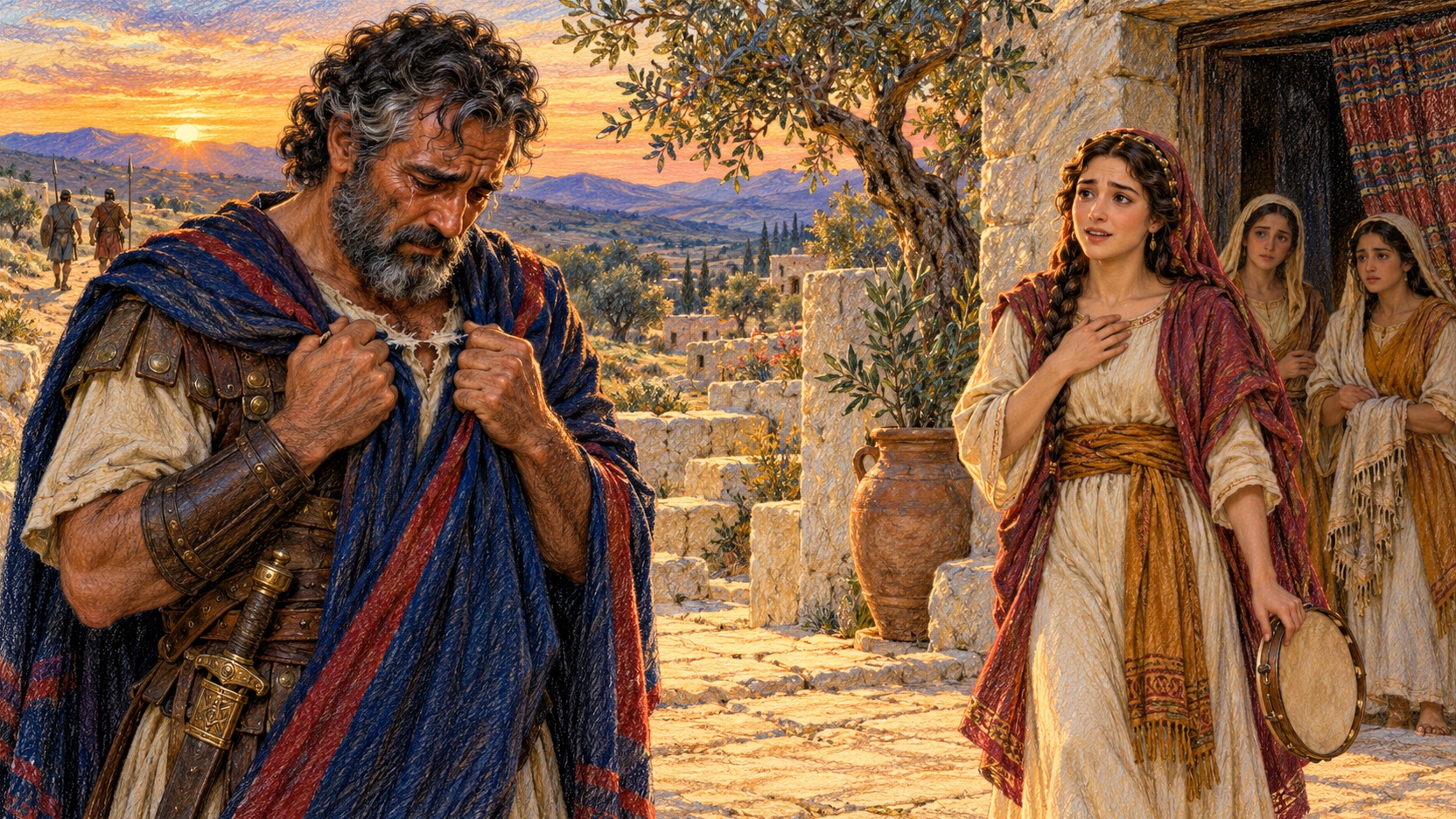
When Jephthah came to his house at Mizpah, there was his daughter, coming out to meet him with timbrels and dancing; and she was his only child. Besides her he had neither son nor daughter.
His daughter came out with timbrels and dancing, apparently celebrating the victory. The passage twice emphasizes that she was his only child. Jephthah tore his clothes and spoke as though she had brought this calamity on him, but she had done nothing wrong by welcoming her father. He had made the vow. Whatever conclusion we reach about her fate, the responsibility for his words belonged to him.
She accepted that he had made a commitment before the LORD and asked for time with her friends before he carried it out.
So she said to her father, “Let this thing be done for me: let me alone for two months, that I may go and wander on the mountains and bewail my virginity, my friends and I.”
After two months she returned, and Judges 11:39 says Jephthah did with her according to his vow. It adds that she knew no man. The following verse describes an annual custom in which Israel’s daughters remembered Jephthah’s daughter for four days. These details have led Christians to two main interpretations, and each deserves to be explained fairly.
The first is that Jephthah killed his daughter as a literal burnt offering. His promise uses the ordinary sacrificial term, and the narrator says he carried out the vow. On this reading, her mourning over virginity concerns dying unmarried and without children. The yearly observance mourned her death. The repeated emphasis on her being an only child also makes clear that her death ended the future of his family line.
This interpretation does not mean God approved the sacrifice. Judges records many appalling acts without endorsing them. A man could know Israel’s national history and trust the LORD in battle while still making a decision shaped by the corrupt religious practices around him. If Jephthah killed her, it was a further horror within the moral disorder the book describes.
The second interpretation is that his daughter was devoted to the LORD in lifelong virginity and never married. Those who take this view point to the repeated emphasis on virginity: she mourned it, and the narrator specifically says she knew no man. They understand the yearly custom as commemorating a woman whose life had been set apart. Jephthah would have lost the prospect of descendants through his only child, while she would have lost the opportunity to marry and have children.
Readers who favor dedication also emphasize God’s prohibition of human sacrifice. That prohibition establishes what Jephthah ought to have done, although by itself it cannot prove what he actually did. Judges frequently records disobedience. The dedication interpretation must still account for the burnt-offering language, just as the literal-sacrifice interpretation must explain the emphasis on virginity. I do not think we can settle the question honestly by making either set of details disappear.
We can be definite about God’s instruction even where the precise outcome remains disputed:
You shall not worship the LORD your God in that way; for every abomination to the LORD which He hates they have done to their gods; for they burn even their sons and daughters in the fire to their gods.
If Jephthah killed his daughter, he committed a horrible sin God had already forbidden. A vow could not turn that prohibition into permission, and victory from the LORD could not make the killing obedience. He needed to acknowledge the wrong in his promise instead of treating it as a command God had imposed. If he dedicated her to lifelong virginity, his rash words still deprived his only child of marriage and children. Neither reading makes his zeal an excuse for the harm his promise brought.
God’s law already governed what Jephthah could offer. Ecclesiastes later gives the warning he needed to heed before making such a promise:
Do not be rash with your mouth, and let not your heart utter anything hastily before God. For God is in heaven, and you on earth; therefore let your words be few.
Ecclesiastes 5 warns against both hasty promises and the attempt to dismiss them once we discover the cost. James 5:12 likewise calls us to truthful speech without multiplying oaths. Reverence should make me consider what I am promising, who will be affected, and whether I have any right to promise it. A dramatic vow can sound devoted while concealing a reckless disregard for responsibilities God has already given.
Victory Against Ammon, Bloodshed Within Israel
Judges 12 turns from the household tragedy to conflict among the tribes. The men of Ephraim crossed toward Zaphon and accused Jephthah of going to battle without calling them. They threatened to burn his house over him. Whatever grievance they believed they had, threatening to kill a fellow Israelite in his own home was a wicked response.
Jephthah answered that he had called them during the struggle and they had not come to deliver him. He had risked his life against Ammon, and the LORD had given victory. The Ephraimites also insulted the men of Gilead, and the confrontation became a battle. Jephthah gathered the Gileadites, who defeated Ephraim and seized the crossings of the Jordan.
Men attempting to escape were required to say “Shibboleth” when they reached the crossing. The Ephraimites could not pronounce it in the required way and were identified by their speech. The Gileadites then killed them. Judges reports that forty-two thousand Ephraimites fell at that time. The men being identified and killed were fellow Israelites, members of the nation God had just delivered from foreign oppression.
A word as ordinary as “Shibboleth” became the means of deciding who would live at the river. The passage does not invite admiration for a clever security test. It records how far the conflict had gone. A victory against Ammon had not cured the pride and contempt within Israel itself.
The contrast with Gideon is sobering. Ephraim had angrily challenged him after his victory too, but he answered gently and turned away their anger (Judges 8:1–3). Their threat against Jephthah was more severe, so the situations were not identical. Still, the accounts show very different outcomes when leaders faced tribal resentment. The study A Complete Bible Study on Gideon follows that earlier exchange.
I can be right about a wrong done to me and still respond destructively. Jephthah’s brothers had genuinely mistreated him, and Ephraim’s threat was inexcusable. Those wrongs did not excuse him from examining his own reactions. Someone who has suffered rejection still needs wisdom to handle authority, grievances, and anger. Hardship may develop a person’s ability to lead without teaching him everything he needs to lead well.
Jephthah judged Israel for six years and then died. He had delivered the people from Ammon, but his brief rule did not resolve their divisions. Israel continued to need more than an effective commander who could defeat a foreign army.
Why Hebrews 11 Names Jephthah
And what more shall I say? For the time would fail me to tell of Gideon and Barak and Samson and Jephthah, also of David and Samuel and the prophets: who through faith subdued kingdoms, worked righteousness, obtained promises, stopped the mouths of lions…
Paul’s inclusion of Jephthah recognizes genuine faith. He stood against Ammon, defended Israel’s inheritance, and acknowledged that the LORD must give the victory. Hebrews does not present him as a man who accomplished deliverance independently and then claimed religious credit for it. His confidence rested in God.
Neither does the passage approve every part of his life. The other people named here also had failures, some grievous. Recognizing their faith does not require us to defend the sins and follies Scripture records. I can acknowledge Jephthah’s trust in the LORD without recommending his vow or his conduct in the conflict with Ephraim. The account of Samson likewise requires us to distinguish God’s work of deliverance from the deliverer’s disobedience.
Faith does not earn God’s favor or make correction unnecessary. Trusting Him should make us willing to receive His instruction about our conduct. Jephthah’s example gives me no reason to excuse reckless speech because a person has also shown courage in trusting God. The related study on faith develops that responsibility further.
Jephthah’s rejection and later return resemble a pattern found elsewhere in Scripture: people eventually needed the deliverer they had refused. That pattern ultimately directs our attention to Christ, but we must keep the limits of the comparison clear. Jephthah’s rash words brought grief into his family. Jesus is the eternal Son, fully God and fully man, whose speech and obedience were sinless. His willingness to save was never an impulsive bargain to gain the Father’s help.
No judge of Israel could accomplish what Christ did for sinners. Wicked people inflicted real bodily punishment on Him, but He willingly endured it and gave Himself to be slain as the perfect sacrifice for our sins. He shed His innocent blood and died; the Father did not punish Him. His saving work through His blood and death was complete when He died. Afterward He was buried and rose bodily from the grave. His once-for-all offering was holy and willing, and we must not confuse it with the human sacrifice God condemns.
I am grateful that God used Jephthah to deliver people who needed mercy, but his troubled life also exposes how much Israel still lacked in its leaders. Jesus is the Redeemer who can save sinners completely. We can bring our guilt to Him in repentance and faith instead of expecting another fallible human leader to provide the salvation only He can give.
My Final Thoughts
Jephthah’s faith deserves recognition, and his failures deserve honest examination. His usefulness did not release him from obedience, and the injustice he suffered did not make every later response right. Before I make a promise or defend a leader, I need to ask whether the commitment or conduct agrees with what God has said. Jephthah also leaves me looking beyond military rescue and human ability to Jesus Christ, whose words are trustworthy and whose saving work is complete.