
I cannot admire Samson’s strength without being troubled by what he did with the life God entrusted to him. He was set apart before birth to begin Israel’s deliverance, yet repeatedly pursued what he wanted despite the cost to that calling. God worked through him, but neither his victories nor his place among the faithful in Hebrews gives us permission to dismiss the sin recorded in Judges.
The Days of the Judges
Samson lived during a period when Israel repeatedly turned from the Lord to worship other gods. Oppression followed, and God raised up deliverers, but being rescued did not settle the nation’s unwillingness to obey Him.
Nevertheless, the LORD raised up judges who delivered them out of the hand of those who plundered them. Yet they would not listen to their judges, but they played the harlot with other gods, and bowed down to them.
The judges in this book were chiefly deliverers God raised up, rather than officials whose work was confined to a courtroom. Some gathered armies, but Samson’s conflicts with the Philistines often developed out of personal disputes. His conduct fits the wider condition of a people who kept doing what was right in their own eyes.
The Lord began this deliverance by promising a son to Manoah’s wife, who had been unable to have children. The Angel of the Lord appeared to her with the announcement:
And the Angel of the LORD appeared to the woman and said to her, “Indeed now, you are barren and have borne no children, but you shall conceive and bear a son.”
Before Samson could earn anyone’s approval or make a decision about his future, God had announced a purpose for his life. Israel’s deliverance began with the Lord’s initiative. Samson would be responsible for how he answered that calling, but he had done nothing to obtain it.
Set Apart From the Womb
The announcement included instructions that would mark Samson as belonging to God. His mother was told to avoid wine and unclean food, and the child was to be set apart from the beginning of his life.
For behold, you shall conceive and bear a son. And no razor shall come upon his head, for the child shall be a Nazirite to God from the womb; and he shall begin to deliver Israel out of the hand of the Philistines.
A Nazirite was someone separated or consecrated to the Lord. Numbers 6 describes a vow that could be taken for a stated period. During that time the person abstained from grape products, stayed away from human corpses, and left the hair uncut. The restrictions identified a life dedicated to God; their purpose was more than avoiding certain things.
Samson’s circumstances were unusual because he was set apart before birth for his whole life. His uncut hair was the visible sign of that consecration. It did not contain magical power, and his later loss of strength cannot be explained as a man losing a charm. He would be disregarding the God to whom he belonged.
When Manoah heard what his wife had been told, he asked God for instruction about their responsibility to the child.
Then Manoah prayed to the LORD, and said, “O my Lord, please let the Man of God whom You sent come to us again and teach us what we shall do for the child who will be born.”
God heard him, and the Messenger returned, repeating the instructions already given to Samson’s mother. During that encounter, Manoah asked His name and was told that it was wonderful. When the burnt offering was made, the Angel of the Lord ascended in its flame. Manoah then said, “We shall surely die, because we have seen God.”
Those details are why I understand this Messenger as the eternal Son appearing before He became man, an appearance called a Christophany. The description goes beyond a messenger who simply delivers information. Manoah recognized an encounter with God, and his wife reasoned that the Lord would not have accepted their offering and promised them a child if He intended to kill them. Judges 13 presents the child’s calling as God’s work from the outset.
I appreciate Manoah’s request to be taught because a remarkable promise did not make raising the child automatic. These parents still had to listen to God and obey what He had told them. Parents cannot manufacture a child’s calling, but they can pray for wisdom and teach the Scriptures faithfully. Teaching a child to honor God requires instruction and correction; good intentions will not do that work for them.
The promised child was born, and the Lord blessed him as he grew. The chapter then identifies who was at work in him:
And the Spirit of the LORD began to move upon him at Mahaneh Dan between Zorah and Eshtaol.
Samson’s strength was more than natural physical ability. The Spirit of the Lord empowered him for acts of deliverance. That did not mean every desire he entertained was right or that his character was mature. We can see a person exercise an impressive ability and wrongly assume that the rest of his life must be equally sound.
If a teacher explains Scripture well but treats people dishonestly, his ability does not excuse that dishonesty. The same caution applies to influence or apparent success in ministry. God’s use of someone in a particular task is no reason to overlook conduct His Word condemns.
The Spirit’s empowerment of Samson for acts of deliverance is not the same subject as His indwelling of every born-again believer. The New Testament teaches that the Holy Spirit indwells and seals those who belong to Christ. We should not use Samson’s later loss of strength to teach that the Spirit repeatedly abandons the Christian.
Compromise and Calling
In Judges 14, Samson saw a Philistine woman in Timnah and insisted that his parents obtain her for him as a wife. They questioned why he would seek a wife among the uncircumcised Philistines rather than his own people. His answer appealed to how much she pleased him. The people oppressing Israel were also the people among whom he was determined to find a wife.
Samson’s parents objected without knowing how God would use the conflict that followed:
But his father and mother did not know that it was of the LORD, that He was seeking an occasion to move against the Philistines.
At the wedding feast, Samson wagered clothing on a riddle. The men threatened his bride until she obtained the answer from him. Samson then killed thirty men in Ashkelon and used their clothing to pay the wager. The Spirit empowered him against the Philistines, yet the chapter also records his anger. His bride was then given to another man.
The Lord was seeking an occasion against the Philistines, who ruled over Israel. Samson was choosing the woman who pleased him, and God used the resulting conflict to strike the oppressors. Samson’s desires did not become pure because the Lord could accomplish His purpose through a man whose behavior still required correction.
I would be reckless to judge a decision only by some good God eventually brings from it. If He brings help to someone despite my disobedience, I have reason to thank Him for His mercy, not permission to repeat the disobedience. Samson’s calling gave him a responsibility to obey; it did not make whatever he wanted acceptable.
His insistence on the woman who pleased him also exposes a problem that reaches well beyond his life. We can want something badly enough that we start searching for reasons to justify it instead of asking whether pursuing it is right. James describes what happens when we welcome that desire:
But each one is tempted when he is drawn away by his own desires and enticed. Then, when desire has conceived, it gives birth to sin; and sin, when it is full-grown, brings forth death.
Temptation draws on what we want. The danger grows when we begin defending the desire and making room to satisfy it, even while knowing where it conflicts with God’s Word. Samson escaped earlier dangers, but being spared did not make another reckless encounter safe.
Presumption is treating God’s past mercy as though He owes us another escape. I cannot keep placing myself near a temptation and call that confidence in Him. Paul gives a warning to someone who thinks he is beyond falling:
Therefore let him who thinks he stands take heed lest he fall.
Sometimes obedience requires leaving a situation instead of demonstrating that I can handle it. If I already know that staying is drawing me toward sin, proving my strength is a poor excuse for remaining there.
Delilah and Betrayal
By Judges 16, Samson was again involved with a woman his enemies could use against him. He loved Delilah, and the Philistine rulers offered her money to discover how he could be overpowered. She repeatedly asked him how he might be bound.
Samson gave false answers, but Delilah acted on them. She bound him first with bowstrings and then with new ropes, and he broke free each time. I think it was reckless to stay with someone who was using his own words to try to subdue him. His affection did not change what her actions had revealed.
Eventually, after she pressed him day after day, Samson told her about his lifelong consecration and uncut hair. Delilah summoned the Philistine rulers and had a man shave his head while he slept on her lap. What God had commanded him to preserve had been surrendered to someone working with his enemies.
When Delilah announced that the Philistines were upon him, Samson expected to free himself as he had before.
So he awoke from his sleep, and said, “I will go out as before, at other times, and shake myself free!” But he did not know that the LORD had departed from him.
Samson had come to expect the strength God supplied while disregarding the consecration it was meant to serve. He expected another effortless escape, even though he had surrendered to Delilah the knowledge she needed to destroy the sign of his consecration.
This time the Philistines seized him, put out his eyes, bound him with bronze fetters, and forced him to grind in prison. I find his blindness especially sobering after reading how often he had insisted on what pleased his eyes. That connection does not excuse the Philistines’ cruelty, but it makes the consequences of his recklessness painfully clear.
Mercy After Collapse
Judges does not leave Samson’s condition there. While he was still a prisoner, it records a brief development:
However, the hair of his head began to grow again after it had been shaven.
I read the returning hair as a reminder of his consecration and an anticipation of the Lord’s further work through him. It did not restore his sight or release him from captivity. The damage he had suffered remained, and his hair could no more supply power by itself now than it could before.
The Philistine rulers later gathered to sacrifice to Dagon and celebrate Samson’s capture. They credited their god with delivering their enemy into their hands and brought Samson from prison to entertain them. In that humiliating setting, he called on the Lord for strength.
Then Samson called to the LORD, saying, “O Lord GOD, remember me, I pray! Strengthen me, I pray, just this once, O God.”
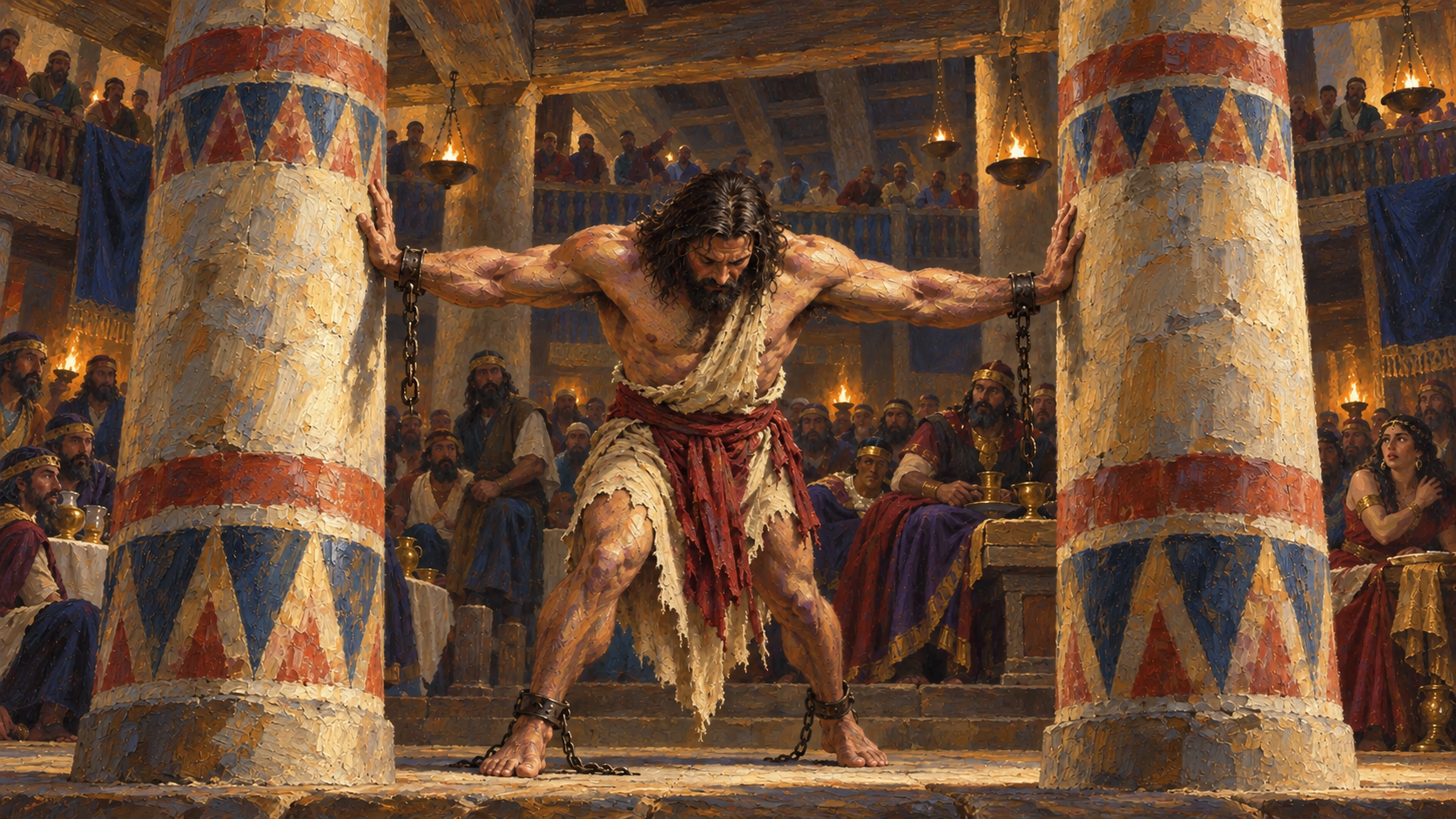
The full prayer continues with his request for vengeance for his eyes. I do not want to present it as though every motive had suddenly become pure. Yet he was now asking God to remember and strengthen him, instead of assuming that he could shake himself free. The Lord answered, and Samson brought down the building on the assembled rulers and people. He died with them, having killed more at his death than during his life.
His final act belonged to his calling as a deliverer confronting Israel’s oppressors in an idolatrous gathering. It gives us no permission for suicide or self-harm, and it should not be offered as a model to someone overwhelmed by despair. God empowered Samson to strike the oppressors; the victory did not make his captivity and death any less tragic.
He had been promised a part in beginning Israel’s deliverance, and that work did advance. The Philistine threat continued into the days of Samuel, Saul, and David, so Samson had not finished it.
God’s mercy does not always remove the repercussions of a person’s sin. Someone who repents of dishonesty may still have to repay what he took or work to regain the trust he damaged. Those consequences do not make repentance pointless. If I have sinned, continuing to hide from God will not repair the harm; I need to confess it and turn to Him.
Samson’s relationship with Delilah should also make us take unequal yoking seriously. Christians are to love unbelieving neighbors and speak to them as witnesses; Jesus Himself received sinners. Binding our lives to someone who persistently draws us away from obedience is a different matter. Affection cannot make that influence harmless or relieve us of responsibility for the choices we make.
These warnings do not mean Samson was beyond God’s mercy. The failures recorded in Judges are not the only testimony Scripture gives about him. Hebrews names him among those remembered for faith:
And what more shall I say? For the time would fail me to tell of Gideon and Barak and Samson and Jephthah.
Hebrews remembers his faith rather than presenting every decision he made as faithful. Judges has already shown why we should not excuse those decisions, but Samson’s appeal to the Lord also keeps me from treating a serious failure as a reason to stop seeking His mercy.
The Better Deliverer
Samson’s failures help us appreciate the faithfulness of Christ. Jesus was holy from conception and obeyed His Father without sin. He never treated His calling as permission to satisfy a corrupt desire. Where Samson’s conflict was mixed with personal vengeance, Christ willingly gave Himself to save the very people who were His enemies.
The eternal Son became fully man without ceasing to be God. Wicked men inflicted physical punishment on His innocent body, and He willingly bore it for our sins. His shed blood and death completed His saving work before He rose bodily from the grave. Samson’s death could not settle Israel’s struggle with the Philistines, but Christ’s death accomplished the redemption for which He gave Himself.
Our hope is in this faithful Deliverer, whether we are impressed with our abilities or ashamed of a serious failure. A gift gives us no exemption from obedience, and the damage caused by sin gives us no reason to refuse repentance. We need to confess honestly without minimizing the harm, trust Christ, and obey what He has made known in His Word.
My Final Thoughts
Samson’s strength came from God, but being useful did not make his reckless decisions safe. I need to remember that when something I do succeeds despite conduct I know is wrong. His final prayer also gives me reason to call on the Lord after failure, without pretending that mercy makes the consequences disappear. I want to take God’s claim on my life seriously and place my confidence in the Savior whose faithfulness never failed.