
Gideon obeyed God while he was afraid, and the LORD delivered Israel through him in a way that left no room for boasting. But his life did not end with that victory. The man who tore down Baal’s altar later made an object that drew Israel into false worship. I want to follow both parts of his life, because Judges gives us good reason to learn from his faith without excusing what he did afterward.
God Diagnosed Israel’s Sin Before Calling Gideon
Then the children of Israel did evil in the sight of the LORD. So the LORD delivered them into the hand of Midian for seven years, and the hand of Midian prevailed against Israel. Because of the Midianites, the children of Israel made for themselves the dens, the caves, and the strongholds which are in the mountains. So it was, whenever Israel had sown, Midianites would come up; also Amalekites and the people of the East would come up against them. Then they would encamp against them and destroy the produce of the earth as far as Gaza, and leave no sustenance for Israel, neither sheep nor ox nor donkey. For they would come up with their livestock and their tents, coming in as numerous as locusts; both they and their camels were without number; and they would enter the land to destroy it. So Israel was greatly impoverished because of the Midianites, and the children of Israel cried out to the LORD. And it came to pass, when the children of Israel cried out to the LORD because of the Midianites, that the LORD sent a prophet to the children of Israel, who said to them, “Thus says the LORD God of Israel: ‘I brought you up from Egypt and brought you out of the house of bondage; and I delivered you out of the hand of the Egyptians and out of the hand of all who oppressed you, and drove them out before you and gave you their land. Also I said to you, “I am the LORD your God; do not fear the gods of the Amorites, in whose land you dwell.” But you have not obeyed My voice.'”
Gideon lived after Joshua and before Israel had a king. During this period, the tribes repeatedly abandoned the LORD, suffered under oppressors, and cried out to Him for help. God raised up judges to deliver and govern them. These were more than courtroom officials; their work included rescuing Israel from enemies the people could not overcome on their own.
This time the oppression lasted seven years. Whenever Israel planted crops, Midianites arrived with Amalekites and other eastern peoples, bringing tents, livestock, and so many camels that the passage compares their numbers to locusts. They ravaged the land as far as Gaza, destroying the food Israel needed and leaving no livestock to sustain the people. Families took refuge in caves and mountain strongholds. This was a national disaster that reached into ordinary households and threatened their ability to eat.
When Israel cried out, the LORD first sent a prophet to explain why they were suffering. He reminded them that God had brought them out of Egypt, rescued them from oppressors, and given them their land. Their response should have been obedience to the One who had delivered them. Instead, as the prophet told them, “You have not obeyed My voice.” Before giving relief, God confronted the rebellion that had brought this discipline.
I need to keep that rebuke in view when I read what follows. Israel did not merely need a more confident leader or a better army. The people were worshiping other gods in the land the LORD had given them, and military success alone could not put that right.
Even so, God had not exhausted His compassion toward His covenant people. He heard their cry and called a deliverer while they had nothing to boast about. His mercy did not mean their sin was harmless; He was willing to rescue the very people He had just reprimanded.
Now the Angel of the LORD came and sat under the terebinth tree which was in Ophrah, which belonged to Joash the Abiezrite, while his son Gideon threshed wheat in the winepress, in order to hide it from the Midianites. And the Angel of the LORD appeared to him, and said to him, “The LORD is with you, you mighty man of valor!” Gideon said to Him, “O my lord, if the LORD is with us, why then has all this happened to us? And where are all His miracles which our fathers told us about, saying, ‘Did not the LORD bring us up from Egypt?’ But now the LORD has forsaken us and delivered us into the hands of the Midianites.” Then the LORD turned to him and said, “Go in this might of yours, and you shall save Israel from the hand of the Midianites. Have I not sent you?” So he said to Him, “O my Lord, how can I save Israel? Indeed my clan is the weakest in Manasseh, and I am the least in my father’s house.” And the LORD said to him, “Surely I will be with you, and you shall defeat the Midianites as one man.” Then he said to Him, “If now I have found favor in Your sight, then show me a sign that it is You who talk with me. Do not depart from here, I pray, until I come to You and bring out my offering and set it before You.” And He said, “I will wait until you come back.” So Gideon went in and prepared a young goat, and unleavened bread from an ephah of flour. The meat he put in a basket, and he put the broth in a pot; and he brought them out to Him under the terebinth tree and presented them. The Angel of God said to him, “Take the meat and the unleavened bread and lay them on this rock, and pour out the broth.” And he did so. Then the Angel of the LORD put out the end of the staff that was in His hand, and touched the meat and the unleavened bread; and fire rose out of the rock and consumed the meat and the unleavened bread. And the Angel of the LORD departed out of his sight. Now Gideon perceived that He was the Angel of the LORD. So Gideon said, “Alas, O Lord GOD! For I have seen the Angel of the LORD face to face.” Then the LORD said to him, “Peace be with you; do not fear, you shall not die.” So Gideon built an altar there to the LORD, and called it The-LORD-Is-Peace. To this day it is still in Ophrah of the Abiezrites.
Gideon was beating wheat in a winepress to keep Midian from finding it. Threshing loosens the grain, and the chaff is then separated by winnowing, usually where a breeze can carry it away. A winepress was an awkward place for that work, but concealment protected the food from raiders. I would not call the hiding itself proof of cowardice. Gideon shows fear plainly enough later, while here he is trying to preserve a harvest from people who would destroy it.
The LORD called him in the middle of that work. Judges introduces him protecting grain, rather than assembling followers or presenting himself as Israel’s next leader. He had to hear both who was sending him and how he could possibly carry out the task.
The One who appeared was the Angel of the LORD, and the passage moves directly from the Angel speaking to “the LORD” turning toward Gideon. Later, the offering is consumed by supernatural fire, and Gideon fears that seeing this Person will cost him his life. I understand this as a Christophany, an appearance of the eternal Son before He became man. The divine names and authority here lead me to identify Him as Christ, rather than a created angel.
Angel means messenger, so the title alone does not identify every messenger in Scripture as Christ. Created angels are servants of God and refuse worship. Here the LORD speaks in His own authority, receives Gideon’s offering, and reassures him after the encounter. The Son did not begin to exist at Bethlehem; He has always shared the one divine nature with the Father and the Holy Spirit. His later incarnation means that this eternal Son took a real human nature.
The greeting “mighty man of valor” comes with the promise, “The LORD is with you.” Gideon’s answer turns to Israel’s suffering: if God is with them, why are they oppressed, and where are the miracles their fathers described? His description of their misery is true, but it leaves out the disobedience the prophet has just exposed. The LORD had delivered Israel into Midian’s hand because of its sin. The people had not been innocently abandoned.
When the LORD commissioned him, Gideon pointed to his clan’s weakness in Manasseh and his own low standing in his father’s house. God did not answer by praising abilities Gideon had failed to discover. He promised, “Surely I will be with you.” The outcome depended on the One sending him, who pledged that Gideon would defeat Midian as though its vast force were one man.
Gideon asked for a sign to confirm who was speaking and brought out an offering of meat, unleavened bread, and broth. When fire rose from the rock and consumed it, the Angel vanished. Gideon then realized whom he had seen and feared he would die. The LORD reassured him, “Peace be with you; do not fear, you shall not die.” He built an altar and called it Yahweh-Shalom, “The-LORD-Is-Peace.” The God who commissioned him had also given him reason to trust that he could survive this encounter.
Gideon Obeyed While He Was Still Afraid
Now it came to pass the same night that the LORD said to him, “Take your father’s young bull, the second bull of seven years old, and tear down the altar of Baal that your father has, and cut down the wooden image that is beside it; and build an altar to the LORD your God on top of this rock in the proper arrangement, and take the second bull and offer a burnt sacrifice with the wood of the image which you shall cut down.” So Gideon took ten men from among his servants and did as the LORD had said to him. But because he feared his father’s household and the men of the city too much to do it by day, he did it by night. And when the men of the city arose early in the morning, there was the altar of Baal, torn down; and the wooden image that was beside it was cut down, and the second bull was being offered on the altar which had been built. So they said to one another, “Who has done this thing?” And when they had inquired and asked, they said, “Gideon the son of Joash has done this thing.” Then the men of the city said to Joash, “Bring out your son, that he may die, because he has torn down the altar of Baal, and because he has cut down the wooden image that was beside it.” But Joash said to all who stood against him, “Would you plead for Baal? Would you save him? Let the one who would plead for him be put to death by morning! If he is a god, let him plead for himself, because his altar has been torn down!” Therefore on that day he called him Jerubbaal, saying, “Let Baal plead against him, because he has torn down his altar.”
That same night, God commanded Gideon to confront the false worship in his own household. His father Joash had an altar to Baal with an Asherah beside it. Gideon was to tear down the altar, cut down the wooden image, and use its wood to offer his father’s second bull on an altar built to the LORD.
Baal was worshiped as a Canaanite storm and fertility god, while the Asherah was a wooden object associated with false worship. These were not merely foreign practices Gideon had heard about. His own family maintained them, and the town would defend them. The bull was seven years old, the same length of time Israel had suffered under Midian. I notice that correspondence, though the passage does not explain whether the bull’s age was intended to symbolize those years.
Gideon took ten servants and did what God commanded at night because he feared his household and the men of the city. He did not wait until obedience felt safe. By morning the altar was down, and the townsmen demanded that Joash hand over his son to be killed. Joash challenged their demand: if Baal really was a god, why did he need them to defend his altar? Gideon received the name Jerubbaal, meaning “Let Baal plead.”
God had addressed the cause of Israel’s bondage before commissioning its deliverer, and now He required that deliverer to remove the idolatry at home. Gideon could not faithfully lead Israel against Midian while preserving his father’s altar to Baal. His first assignment put him at odds with people close to him, before he faced the invading army.
Then all the Midianites and Amalekites, the people of the East, gathered together; and they crossed over and encamped in the Valley of Jezreel. But the Spirit of the LORD came upon Gideon; then he blew the trumpet, and the Abiezrites gathered behind him. And he sent messengers throughout all Manasseh, who also gathered behind him. He also sent messengers to Asher, Zebulun, and Naphtali; and they came up to meet them. So Gideon said to God, “If You will save Israel by my hand as You have said– look, I shall put a fleece of wool on the threshing floor; if there is dew on the fleece only, and it is dry on all the ground, then I shall know that You will save Israel by my hand, as You have said.” And it was so. When he rose early the next morning and squeezed the fleece together, he wrung the dew out of the fleece, a bowlful of water. Then Gideon said to God, “Do not be angry with me, but let me speak just once more: Let me test, I pray, just once more with the fleece; let it now be dry only on the fleece, but on all the ground let there be dew.” And God did so that night. It was dry on the fleece only, but there was dew on all the ground.
As the enemy coalition gathered in the Valley of Jezreel, the Spirit of the LORD came upon Gideon. The Hebrew verb labash, meaning to put on or clothe, pictures the Spirit clothing Himself with Gideon for this work. Gideon sounded a trumpet, his Abiezrite clan gathered, and messengers summoned Manasseh, Asher, Zebulun, and Naphtali. The man who had been concealing wheat was now calling tribes to war because God had sent and empowered him.
The Spirit who empowered Gideon is the same divine Person who lives in believers today, though we should respect the different covenant setting. This passage describes His enabling a man for a particular task. The New Testament also promises His permanent indwelling and sealing of every genuine believer; we should not assume Judges 6 is describing every aspect of that later promise.
Even after that summons, Gideon asked for further assurance. He placed a fleece, a piece of wool, on the threshing floor and asked for dew on it while the ground remained dry. God answered, and the next night He answered the reverse request: the fleece stayed dry while dew covered the ground. Gideon knew he was asking boldly, since he asked God not to be angry. The LORD dealt patiently with him. Judges does not expressly condemn the request as the rebellious testing forbidden in Deuteronomy 6.
I would be careful about making “putting out a fleece” a regular method of guidance. If I decide that an unusual event will mean God wants me to make a certain choice, I may end up treating my own arrangement as His instruction. Scripture gives us truth to obey, and we can ask for wisdom, seek sound counsel, and consider our circumstances without demanding a private sign.
Gideon already knew what God had commanded. He twice referred to what God had said about saving Israel by his hand, so the fleece was a request to confirm an existing promise. It was not a way of discovering an otherwise unknown assignment. God’s patience with Gideon’s weakness does not give me permission to postpone obedience until He supplies whatever reassurance I prefer.
God Made Israel’s Weakness Impossible to Hide
Then Jerubbaal (that is, Gideon) and all the people who were with him rose early and encamped beside the well of Harod, so that the camp of the Midianites was on the north side of them by the hill of Moreh in the valley. And the LORD said to Gideon, “The people who are with you are too many for Me to give the Midianites into their hands, lest Israel claim glory for itself against Me, saying, ‘My own hand has saved me.’ Now therefore, proclaim in the hearing of the people, saying, ‘Whoever is fearful and afraid, let him turn and depart at once from Mount Gilead.'” And twenty-two thousand of the people returned, and ten thousand remained. But the LORD said to Gideon, “The people are still too many; bring them down to the water, and I will test them for you there. Then it will be, that of whom I say to you, ‘This one shall go with you,’ the same shall go with you; and of whomever I say to you, ‘This one shall not go with you,’ the same shall not go.” So he brought the people down to the water. And the LORD said to Gideon, “Everyone who laps from the water with his tongue, as a dog laps, you shall set apart by himself; likewise everyone who gets down on his knees to drink.” And the number of those who lapped, putting their hand to their mouth, was three hundred men; but all the rest of the people got down on their knees to drink water. Then the LORD said to Gideon, “By the three hundred men who lapped I will save you, and deliver the Midianites into your hand. Let all the other people go, every man to his place.” So the people took provisions and their trumpets in their hands. And he sent away all the rest of Israel, every man to his tent, and retained those three hundred men. Now the camp of Midian was below him in the valley.
The force assembled under Gideon numbered 32,000, but the LORD said there were too many. He knew Israel could win and then claim, “My own hand has saved me.” When Gideon announced that the fearful could leave, 22,000 went home. Ten thousand remained, and God said even that reduced force was too large.
At the water, the LORD separated the men according to how they drank, retaining only the 300 who brought water to their mouths with their hands. Some explanations turn their drinking posture into evidence that they were more watchful or experienced soldiers. Judges does not say that. God had stated His purpose before the selection: Israel must not boast that its own strength had saved it. The method selected the men, while their small number made the army’s inadequacy unmistakable.
I would not take this to mean that planning, training, or adequate resources are wrong. God reduced this particular army for a stated reason, and He promised to save Israel through the men who remained. We have no authority to make reckless decisions and then claim Gideon’s promise as a guarantee that they will succeed.
It happened on the same night that the LORD said to him, “Arise, go down against the camp, for I have delivered it into your hand. But if you are afraid to go down, go down to the camp with Purah your servant, and you shall hear what they say; and afterward your hands shall be strengthened to go down against the camp.” Then he went down with Purah his servant to the outpost of the armed men who were in the camp. Now the Midianites and Amalekites, all the people of the East, were lying in the valley as numerous as locusts; and their camels were without number, as the sand by the seashore in multitude. And when Gideon had come, there was a man telling a dream to his companion. He said, “I have had a dream: To my surprise, a loaf of barley bread tumbled into the camp of Midian; it came to a tent and struck it so that it fell and overturned, and the tent collapsed.” Then his companion answered and said, “This is nothing else but the sword of Gideon the son of Joash, a man of Israel! Into his hand God has delivered Midian and the whole camp.” And so it was, when Gideon heard the telling of the dream and its interpretation, that he worshiped. He returned to the camp of Israel, and said, “Arise, for the LORD has delivered the camp of Midian into your hand.” Then he divided the three hundred men into three companies, and he put a trumpet into every man’s hand, with empty pitchers, and torches inside the pitchers. And he said to them, “Look at me and do likewise; watch, and when I come to the edge of the camp you shall do as I do: When I blow the trumpet, I and all who are with me, then you also blow the trumpets on every side of the whole camp, and say, ‘The sword of the LORD and of Gideon!'” So Gideon and the hundred men who were with him came to the outpost of the camp at the beginning of the middle watch, just as they had posted the watch; and they blew the trumpets and broke the pitchers that were in their hands. Then the three companies blew the trumpets and broke the pitchers–they held the torches in their left hands and the trumpets in their right hands for blowing–and they cried, “The sword of the LORD and of Gideon!” And every man stood in his place all around the camp; and the whole army ran and cried out and fled. When the three hundred blew the trumpets, the LORD set every man’s sword against his companion throughout the whole camp; and the army fled to Beth Acacia, toward Zererah, as far as the border of Abel Meholah, by Tabbath. And the men of Israel gathered together from Naphtali, Asher, and all Manasseh, and pursued the Midianites. Then Gideon sent messengers throughout all the mountains of Ephraim, saying, “Come down against the Midianites, and seize from them the watering places as far as Beth Barah and the Jordan.” Then all the men of Ephraim gathered together and seized the watering places as far as Beth Barah and the Jordan. And they captured two princes of the Midianites, Oreb and Zeeb. They killed Oreb at the rock of Oreb, and Zeeb they killed at the winepress of Zeeb. They pursued Midian and brought the heads of Oreb and Zeeb to Gideon on the other side of the Jordan.
Before the attack, the LORD offered Gideon another reassurance. If he was afraid, he could take his servant Purah down to the enemy camp and listen. There he heard a man describe a dream in which a loaf of barley bread tumbled into the camp and overturned a tent. The man’s companion identified it with Gideon’s sword and said God had handed Midian and the whole camp over to him.
An ordinary barley loaf was hardly an impressive weapon, which makes its overthrow of the tent a fitting image of this unlikely victory. More strikingly, Gideon heard God’s promise confirmed in the enemies’ own conversation. He worshiped there, then returned to tell Israel to rise because the LORD had delivered Midian into their hands.
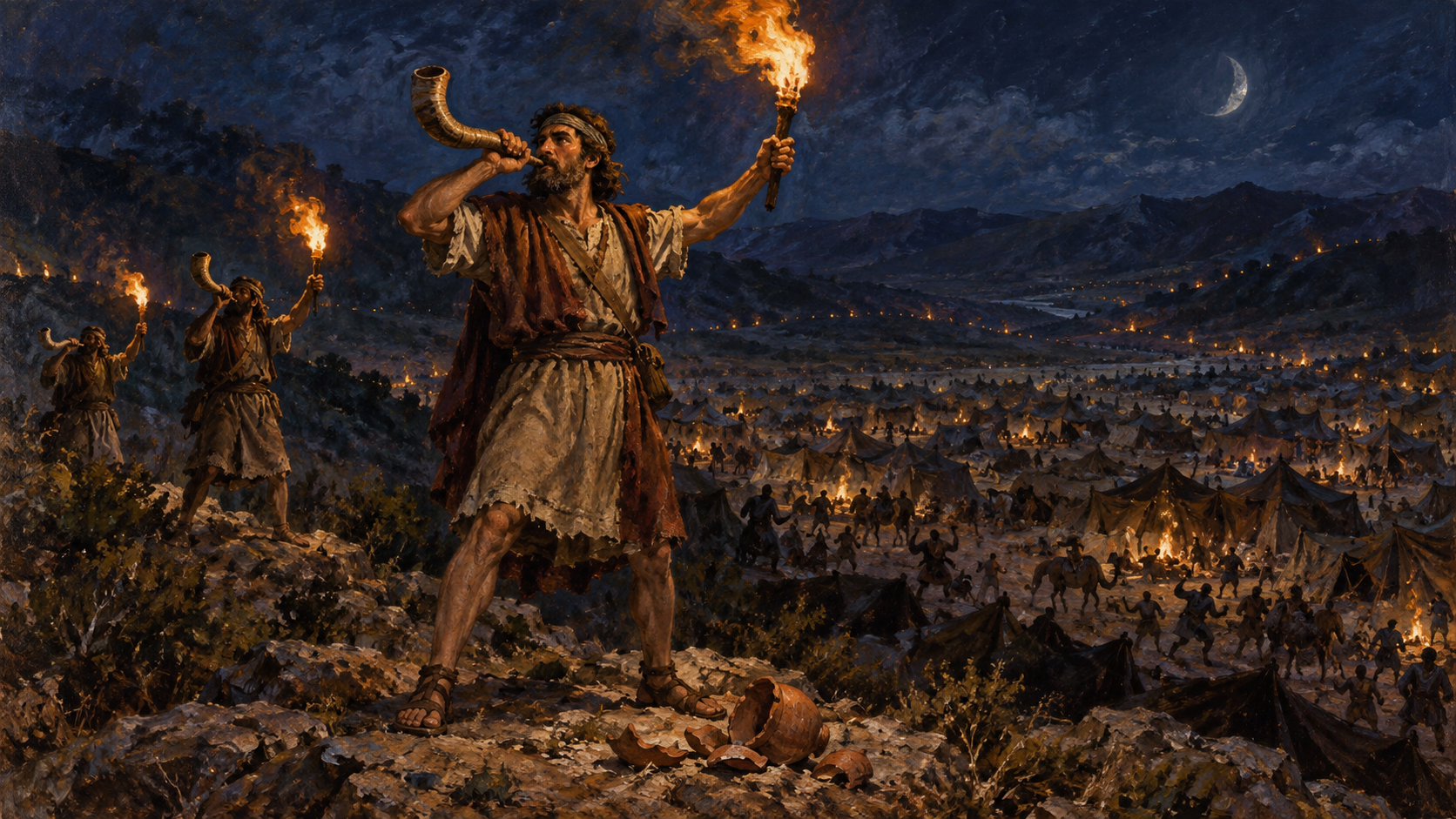
Gideon divided the 300 into three companies, giving each man a trumpet and a jar with a torch concealed inside. They approached at the beginning of the middle watch, just after the guards had changed. At his signal they blew the trumpets, shattered the jars, exposed the torches, and cried, “The sword of the LORD and of Gideon!” Each man stood in his place while panic spread through the enemy camp. The LORD set the soldiers’ swords against one another, and the army fled.
The rout began through the LORD turning the invaders against one another, but the campaign did not end without further fighting. Men from Naphtali, Asher, and Manasseh joined the pursuit. Gideon also called Ephraim to seize the watering places and Jordan crossings, cutting off the fleeing army. Ephraim captured and killed the princes Oreb and Zeeb, while Gideon continued after Midian’s kings.
God also allowed Gideon to receive help from other people. Purah accompanied him on that dangerous visit, the 300 carried out his instructions, and other Israelites joined the pursuit. Dependence on God did not require him to work alone. When a fellow believer is afraid, standing beside him and helping him do what is right may be more useful than reprimanding him for feeling afraid.
Victory Exposed New Dangers in Gideon’s Heart
Now the men of Ephraim said to him, “Why have you done this to us by not calling us when you went to fight with the Midianites?” And they reprimanded him sharply. So he said to them, “What have I done now in comparison with you? Is not the gleaning of the grapes of Ephraim better than the vintage of Abiezer? God has delivered into your hands the princes of Midian, Oreb and Zeeb. And what was I able to do in comparison with you?” Then their anger toward him subsided when he said that. When Gideon came to the Jordan, he and the three hundred men who were with him crossed over, exhausted but still in pursuit. Then he said to the men of Succoth, “Please give loaves of bread to the people who follow me, for they are exhausted, and I am pursuing Zebah and Zalmunna, kings of Midian.” And the leaders of Succoth said, “Are the hands of Zebah and Zalmunna now in your hand, that we should give bread to your army?” So Gideon said, “For this cause, when the LORD has delivered Zebah and Zalmunna into my hand, then I will tear your flesh with the thorns of the wilderness and with briers!” Then he went up from there to Penuel and spoke to them in the same way. And the men of Penuel answered him as the men of Succoth had answered. So he also spoke to the men of Penuel, saying, “When I come back in peace, I will tear down this tower!” Now Zebah and Zalmunna were at Karkor, and their armies with them, about fifteen thousand, all who were left of all the army of the people of the East; for one hundred and twenty thousand men who drew the sword had fallen. Then Gideon went up by the road of those who dwell in tents on the east of Nobah and Jogbehah; and he attacked the army while the camp felt secure. When Zebah and Zalmunna fled, he pursued them; and he took the two kings of Midian, Zebah and Zalmunna, and routed the whole army. Then Gideon the son of Joash returned from battle, from the Ascent of Heres. And he caught a young man of the men of Succoth and interrogated him; and he wrote down for him the leaders of Succoth and its elders, seventy-seven men. Then he came to the men of Succoth and said, “Here are Zebah and Zalmunna, about whom you ridiculed me, saying, ‘Are the hands of Zebah and Zalmunna now in your hand, that we should give bread to your weary men?'” And he took the elders of the city, and thorns of the wilderness and briers, and with them he taught the men of Succoth. Then he tore down the tower of Penuel and killed the men of the city. And he said to Zebah and Zalmunna, “What kind of men were they whom you killed at Tabor?” So they answered, “As you are, so were they; each one resembled the son of a king.” Then he said, “They were my brothers, the sons of my mother. As the LORD lives, if you had let them live, I would not kill you.” And he said to Jether his firstborn, “Rise, kill them!” But the youth would not draw his sword; for he was afraid, because he was still a youth. So Zebah and Zalmunna said, “Rise yourself, and kill us; for as a man is, so is his strength.” So Gideon arose and killed Zebah and Zalmunna, and took the crescent ornaments that were on their camels’ necks.
Ephraim then sharply reprimanded Gideon for leaving them out of the earlier summons. He answered by praising what they had accomplished: their capture of Oreb and Zeeb surpassed his own clan’s contribution, as gleanings from a fine vineyard might surpass another’s whole vintage. He also credited God with delivering the princes into their hands. Ephraim’s anger subsided, and a quarrel that could have divided the tribes was settled without Gideon demanding recognition for himself.
His treatment of Succoth and Penuel was much harsher. He and the 300 crossed the Jordan exhausted and asked Succoth for bread, but its officials demanded to know whether Zebah and Zalmunna were already in his hands. Penuel gave the same answer. Fear of Midianite retaliation may explain their reluctance to help before the kings were captured, although Judges does not state that motive. They shamefully withheld help from Israel’s weary deliverers while the pursuit was still underway.
Gideon threatened Succoth with thorns and briers and Penuel with the destruction of its tower. He then attacked the remaining enemy force, which felt secure at Karkor. Of the 135,000 swordsmen in the eastern army, 120,000 had fallen and about 15,000 remained. He routed them and captured both kings. Returning with his captives, he punished Succoth’s elders with thorns, tore down Penuel’s tower, and killed the men of that city. Those were severe reprisals against fellow Israelites, and Judges does not tell us that God commanded each of them.
Gideon’s words to the captured kings revealed a personal reason for vengeance. The men they had killed at Tabor were his own brothers, and he said he would have spared the kings if they had let his brothers live. He ordered his firstborn, Jether, to kill them. The boy was afraid to draw his sword, so Gideon killed them himself and took the crescent ornaments from their camels.
Having his son carry out the execution may have been intended to vindicate the family or humiliate the kings. The passage does not tell us why Gideon chose Jether. It does tell us why Gideon said the kings must die: they had killed his brothers. The national deliverance and his personal grievance were now intertwined, which prevents me from treating everything in the pursuit as though it had the same clear command behind it as the first attack.
I find Gideon’s conduct after the victory troubling. He had answered Ephraim with restraint, yet he inflicted brutal reprisals on towns that refused him bread. Their failure to help was wrong, but the earlier miracle does not settle whether his response was right. A leader who has been used by God still needs to answer for how he treats people who resist him.
Gideon’s Royal Habits and Ephod Became a Snare
Then the men of Israel said to Gideon, “Rule over us, both you and your son, and your grandson also; for you have delivered us from the hand of Midian.” But Gideon said to them, “I will not rule over you, nor shall my son rule over you; the LORD shall rule over you.” Then Gideon said to them, “I would like to make a request of you, that each of you would give me the earrings from his plunder.” For they had golden earrings, because they were Ishmaelites. So they answered, “We will gladly give them.” And they spread out a garment, and each man threw into it the earrings from his plunder. Now the weight of the gold earrings that he requested was one thousand seven hundred shekels of gold, besides the crescent ornaments, pendants, and purple robes which were on the kings of Midian, and besides the chains that were around their camels’ necks. Then Gideon made it into an ephod and set it up in his city, Ophrah. And all Israel played the harlot with it there. It became a snare to Gideon and to his house. Thus Midian was subdued before the children of Israel, so that they lifted their heads no more. And the country was quiet for forty years in the days of Gideon. Then Jerubbaal the son of Joash went and dwelt in his own house. Gideon had seventy sons who were his own offspring, for he had many wives. And his concubine who was in Shechem also bore him a son, whose name he called Abimelech. Now Gideon the son of Joash died at a good old age, and was buried in the tomb of Joash his father, in Ophrah of the Abiezrites. So it was, as soon as Gideon was dead, that the children of Israel again played the harlot with the Baals, and made Baal-Berith their god. Thus the children of Israel did not remember the LORD their God, who had delivered them from the hands of all their enemies on every side; nor did they show kindness to the house of Jerubbaal (Gideon) in accordance with the good he had done for Israel.
Afterward, the men of Israel asked Gideon to establish a dynasty: they wanted him, his son, and his grandson to rule over them. Their reason was that he had delivered them from Midian. Gideon rightly refused, saying that neither he nor his son would rule, because the LORD would rule over Israel.
Israel’s request shows how quickly the people had missed the purpose of the victory. God had reduced the army so Israel could not claim the credit, yet now the people wanted to reward the human deliverer with hereditary rule. Gideon’s answer honored God’s authority. His later decisions, however, failed to match that answer.
He asked each man for a gold earring from the plunder and received 1,700 shekels of gold. The passage lists that weight separately from the royal ornaments, purple robes, and camel chains. Gideon used the gold to make an ephod and set it up in Ophrah. An ephod was associated with priestly clothing and inquiry of God, although the exact form of Gideon’s object is debated. Judges does not describe its construction or say whether he intended a memorial, a priestly object, or another means of seeking guidance. It does state the result: Israel turned to it in unfaithful worship, and it ensnared Gideon and his household.
The man who had torn down Baal’s altar had now made an object that drew Israel into another form of religious unfaithfulness. His past obedience did not authorize him to devise a new center of worship. I need to be careful about excusing an innovation merely because a respected leader introduced it. What it leads people to believe and do must still be judged by God’s Word.
Midian was subdued, and the land remained quiet for forty years during Gideon’s lifetime. That peace was a real mercy, even while the ephod was corrupting Israel’s worship. Outward security did not mean all was well with the people spiritually.
Alongside the corruption in worship, Gideon’s household began to resemble a royal establishment. He had many wives and seventy sons, along with a concubine in Shechem who bore Abimelech. A concubine was a recognized secondary partner in a household, with lower standing than a wife. Abimelech’s name is commonly understood as “my father is king.” Those choices sit uneasily beside Gideon’s refusal of a dynasty. He had declined the title, but his wealth, marriages, and large household gave him many of the advantages associated with royalty.
Scripture records Gideon’s many marriages without making polygamy an improvement on God’s creation design for one man and one woman in covenant marriage. A large household could display a ruler’s status, but it also created competing family interests, as the next chapter makes painfully clear. Gideon died at a good old age and was buried in his father’s tomb, leaving behind both the ephod and a household vulnerable to rivalry. After his death, Israel returned to the Baals, made Baal-Berith its god, forgot the LORD’s deliverance, and failed to show kindness to Gideon’s family for the good he had done.
Then Abimelech the son of Jerubbaal went to Shechem, to his mother’s brothers, and spoke with them and with all the family of the house of his mother’s father, saying, “Please speak in the hearing of all the men of Shechem: ‘Which is better for you, that all seventy of the sons of Jerubbaal reign over you, or that one reign over you?’ Remember that I am your own flesh and bone.” And his mother’s brothers spoke all these words concerning him in the hearing of all the men of Shechem; and their heart was inclined to follow Abimelech, for they said, “He is our brother.” So they gave him seventy shekels of silver from the temple of Baal-Berith, with which Abimelech hired worthless and reckless men; and they followed him. Then he went to his father’s house at Ophrah and killed his brothers, the seventy sons of Jerubbaal, on one stone. But Jotham the youngest son of Jerubbaal was left, because he hid himself. And all the men of Shechem gathered together, all of Beth Millo, and they went and made Abimelech king beside the terebinth tree at the pillar that was in Shechem.
Abimelech approached his mother’s relatives in Shechem and asked whether they would rather have Gideon’s seventy sons rule or one man from their own family. That appeal won their support. With seventy shekels of silver from Baal-Berith’s temple, he hired worthless and reckless men and went to Ophrah to murder his brothers on one stone. Jotham, the youngest, escaped by hiding. Shechem then made Abimelech king, obtaining a ruler who had slaughtered his own family to remove potential rivals.
Gideon had not ordered these murders; he was already dead, and Abimelech and his accomplices were responsible for what they chose to do. Yet the family connections, royal expectations, and competing sons did not arise from nowhere. Gideon’s household provided the setting Abimelech exploited. A parent’s compromises do not force children to sin, but they can leave children with opportunities and conflicts that make the consequences reach well beyond the parent’s lifetime.
Jotham later used a parable of trees to condemn what Shechem had done. Useful trees refused the invitation to rule, while a bramble accepted and threatened destruction by fire. He warned that Abimelech and the people who made him king would destroy one another if they had acted treacherously. Their alliance collapsed, Abimelech destroyed Shechem, and his own campaign ended at Thebez. A woman dropped an upper millstone that crushed his skull, after which his armor-bearer killed him at his request. Judges 9:50-57 identifies the outcome as God’s repayment of the wickedness committed by Abimelech and Shechem.
When I read the end of that family, I cannot assume that useful service will protect me from the consequences of later compromise. God forgives the repentant sinner, but forgiveness does not promise to undo every damaged relationship or remove every earthly consequence. That should lead us to deal with sin now, rather than rely on what we once did faithfully.
Gideon’s Faith and Weakness Point Beyond Gideon
And what more shall I say? For the time would fail me to tell of Gideon and Barak and Samson and Jephthah, also of David and Samuel and the prophets: who through faith subdued kingdoms, worked righteousness, obtained promises, stopped the mouths of lions, quenched the violence of fire, escaped the edge of the sword, out of weakness were made strong, became valiant in battle, turned to flight the armies of the aliens. Women received their dead raised to life again. Others were tortured, not accepting deliverance, that they might obtain a better resurrection. Still others had trial of mockings and scourgings, yes, and of chains and imprisonment. They were stoned, they were sawn in two, were tempted, were slain with the sword. They wandered about in sheepskins and goatskins, being destitute, afflicted, tormented– of whom the world was not worthy. They wandered in deserts and mountains, in dens and caves of the earth. And all these, having obtained a good testimony through faith, did not receive the promise, God having provided something better for us, that they should not be made perfect apart from us.
Paul nevertheless names Gideon among the people who acted through faith. Hebrews honors that faith without declaring every later choice righteous. The same chapter includes Samson, Jephthah, and David, whose failures Scripture also records. We do not need to defend Gideon’s ephod to acknowledge that he trusted God and obeyed Him in the battle.
The chapter also prevents us from treating Gideon’s victory as a guarantee that faithful people will always escape suffering. Some were made strong in battle; others endured torture, imprisonment, destitution, and death. I think it is reckless to tell a suffering believer that he must lack faith. Paul commends people who suffered terribly, and their trust in God was not discredited because they were killed.
Gideon and the others depended on God’s promise rather than on the strength of their own confidence. Hebrews ends by looking beyond their individual deliverances to the completed blessing God has provided in Christ. They belong with us in His purpose, rather than receiving its final fulfillment in isolation. Paul’s explanation to the Corinthians likewise leaves no room for boasting in the people God uses.
For the message of the cross is foolishness to those who are perishing, but to us who are being saved it is the power of God. For it is written: “I will destroy the wisdom of the wise, And bring to nothing the understanding of the prudent.” Where is the wise? Where is the scribe? Where is the disputer of this age? Has not God made foolish the wisdom of this world? For since, in the wisdom of God, the world through wisdom did not know God, it pleased God through the foolishness of the message preached to save those who believe. For Jews request a sign, and Greeks seek after wisdom; but we preach Christ crucified, to the Jews a stumbling block and to the Greeks foolishness, but to those who are called, both Jews and Greeks, Christ the power of God and the wisdom of God. Because the foolishness of God is wiser than men, and the weakness of God is stronger than men. For you see your calling, brethren, that not many wise according to the flesh, not many mighty, not many noble, are called. But God has chosen the foolish things of the world to put to shame the wise, and God has chosen the weak things of the world to put to shame the things which are mighty; and the base things of the world and the things which are despised God has chosen, and the things which are not, to bring to nothing the things that are, that no flesh should glory in His presence. But of Him you are in Christ Jesus, who became for us wisdom from God–and righteousness and sanctification and redemption– that, as it is written, “He who glories, let him glory in the LORD.”
Paul centers this passage on Christ crucified. Many people regarded that message as foolishness or a stumbling block, yet God saves those who believe it. He also calls people the world considers unimportant, weak, or despised, so no one can claim to have earned a place with Him through wisdom, influence, or social standing. Gideon’s reduced army illustrates a similar refusal to let human strength take the credit for God’s deliverance.
This gives me no reason to cultivate incompetence or neglect abilities I could put to good use. God can use training and skill, and we remain responsible to work carefully. What we cannot do is treat those abilities as though they made us independent of Him. Israel’s rescue depended on His promise and power, not on Gideon discovering that he was sufficient after all.
Success did not remove that dependence. The same Gideon who needed God before the battle still needed to obey Him when people offered him power and gold. If I have served faithfully in the past, that does not make my present judgment infallible or put my conduct beyond correction.
Paul learned continuing dependence in his own ministry. In 2 Corinthians 12, after describing extraordinary revelations, he tells of an affliction that kept him from becoming conceited. He asked three times for it to be removed. Christ answered that His grace was sufficient and His strength was made perfect in weakness, so Paul learned to rely on that power even while the affliction remained. He was not praising pain for its own sake or promising that faithful prayer always ends it.
Our lasting hope rests in Christ Himself. The One I understand to have called Gideon as the Angel of the LORD later came as man to save sinners. The eternal Son took a real human nature without ceasing to be fully God. Born of a virgin, He lived without sin and willingly gave Himself for us.
Wicked men physically tortured Jesus and put Him to death. He willingly bore that real punishment for our sins in His innocent body. Through His shed blood and death, He completed His saving sacrifice before He was buried and rose bodily. The Father did not punish or curse His Son. He never abandoned Jesus, struck or bruised Him, or poured wrath upon Him.
Gideon’s deliverance gave Israel relief for a time, but his own conduct later harmed the people he had served. Christ’s sinless faithfulness gives us a confidence no human judge could provide. He lives forever and will never corrupt the people He redeemed or lead them into false worship.
Christ died for the whole world, and His offer of salvation is genuine, though people may resist it. Everyone who repents and believes is forgiven and justified, meaning declared righteous before God. God also gives that person new birth, and the Holy Spirit comes to dwell within him and seal him. The believer is eternally secure in Christ, but that assurance gives no permission to continue in lawlessness. A Christian label alone is no proof of regeneration; new birth should produce evidence of new life in how we live. Salvation is open even to someone who feels terribly inadequate, because it depends on the Savior rather than the sinner’s strength.
My Final Thoughts
I want to learn from Gideon’s obedience while he was afraid and take his later failures just as seriously. God rescued Israel through an army too small to claim the credit, yet the victory did not keep its leader from harsh reprisals, royal habits, and corrupt worship. His need to obey God continued after the crisis had passed, and ours does too. We can trust Christ’s sufficient grace while allowing His Word to correct us, however faithfully we may have served before.