
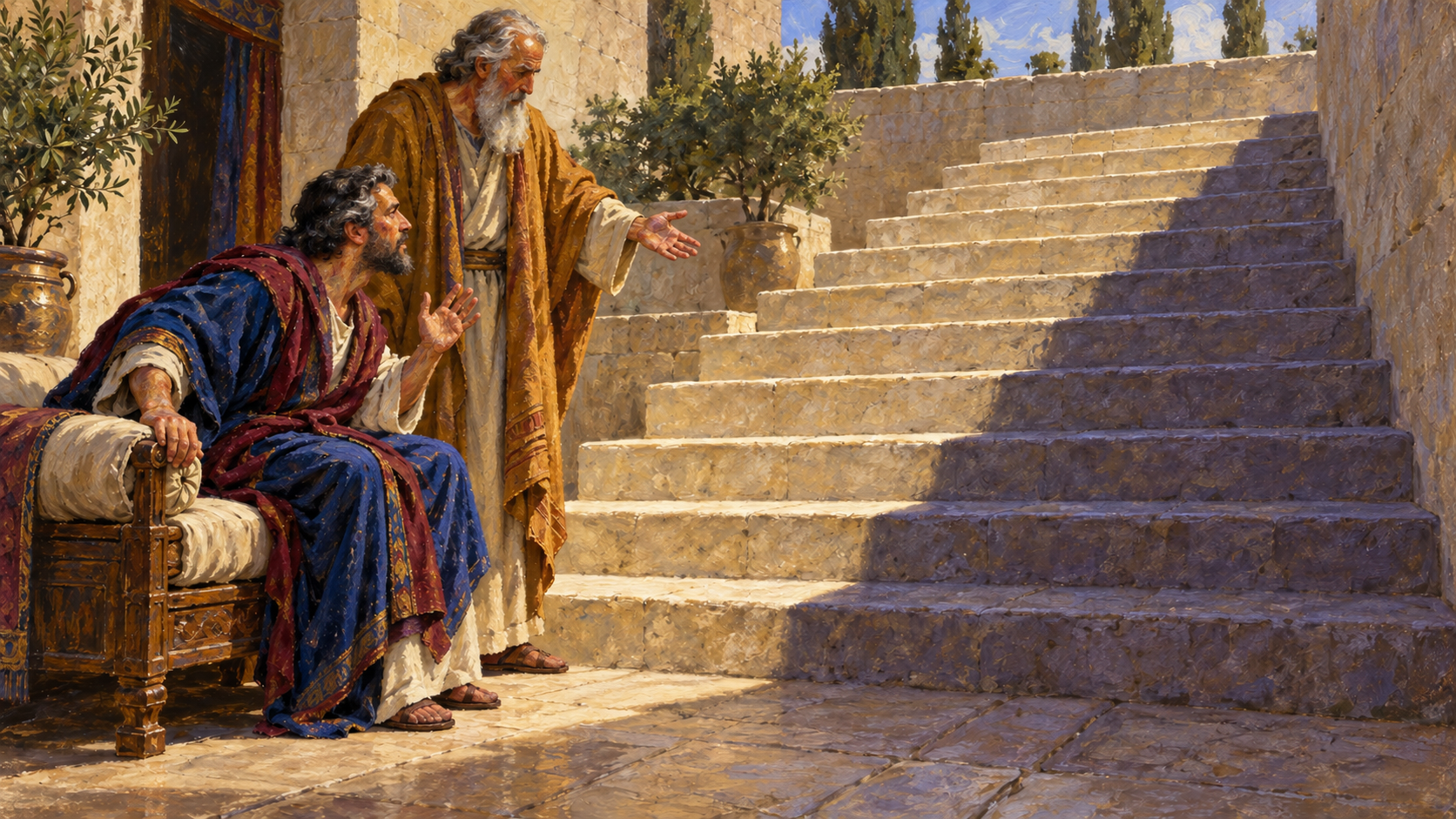
When God promised Hezekiah fifteen more years of life, He confirmed that promise by making a shadow move backward. I believe Scripture describes a real miracle, even though it does not explain how God performed it. But the king’s recovery was not the end of the account. He still needed to receive mercy humbly, and even the added years could not give him the final victory over death that we receive through Christ.
Hezekiah Faced Death While Assyria Threatened Jerusalem
Second Kings 20 and Isaiah 38 describe Hezekiah’s illness, prayer, and the backward-moving shadow. Second Chronicles 32 adds a brief account of his sickness alongside his prosperity, pride, and dealings with Babylonian envoys. Reading them together keeps the sign connected with the king who received it and the responsibilities that followed. The study on Isaiah examines the prophet’s wider ministry.
The illness belongs to the period of Assyrian danger. Assyria had conquered the northern kingdom of Israel and was taking Judah’s fortified cities. Second Kings 18:13 dates Sennacherib’s invasion to Hezekiah’s fourteenth year, while Kings gives him twenty-nine years in all. The promise of fifteen additional years therefore belongs well before the end of his reign.
The chapters recounting Jerusalem’s rescue come before the illness account, yet God still promises deliverance from Assyria in 2 Kings 20:6. We should not assume that the chapter order supplies a day-by-day sequence. The exact relationship between the illness, Assyria’s campaign, and Jerusalem’s deliverance remains uncertain. What the text makes clear is that Hezekiah’s life and his city’s safety both depended on the Lord.
This was a king whose faithfulness Scripture commends, although it also records serious failures. His response to sickness needs to be read in light of that actual life.
Now it came to pass in the third year of Hoshea the son of Elah, king of Israel, that Hezekiah the son of Ahaz, king of Judah, began to reign. He was twenty-five years old when he became king, and he reigned twenty-nine years in Jerusalem. His mother’s name was Abi the daughter of Zechariah. And he did what was right in the sight of the LORD, according to all that his father David had done. He removed the high places and broke the sacred pillars, cut down the wooden image and broke in pieces the bronze serpent that Moses had made; for until those days the children of Israel burned incense to it, and called it Nehushtan. He trusted in the LORD God of Israel, so that after him was none like him among all the kings of Judah, nor who were before him. For he held fast to the LORD; he did not depart from following Him, but kept His commandments, which the LORD had commanded Moses. The LORD was with him; he prospered wherever he went. And he rebelled against the king of Assyria and did not serve him. He subdued the Philistines, as far as Gaza and its territory, from watchtower to fortified city.
Hezekiah inherited the damage left by Ahaz’s idolatry and chose a different course. He removed places of false worship, destroyed their objects, and even broke the bronze serpent Moses had made. God had once appointed that serpent for a particular purpose, but people were now burning incense to it. Its honored past did not justify worshiping it. Hezekiah was right to destroy an object that had become a rival to the God who gave it.
Kings says he trusted the Lord and held fast to Him by keeping His commands. His later prayer about walking with a loyal heart did not invent a record of obedience. Yet genuine faith did not make him sinless or entitle him to more years. The same king who prayed sincerely in weakness would need correction for the pride that appeared in prosperity.
The Assyrian campaign shows how urgently Judah needed God’s help. Sennacherib’s field commander ridiculed trust in the Lord by comparing Him with the gods of conquered nations. When the threats were renewed by letter, Hezekiah brought it into the Lord’s house and spread it before Him. God already knew its contents; the king was acknowledging his need for help against an enemy he could not overcome by pretending the danger was small.
Isaiah announced that the Assyrian king would not enter Jerusalem, shoot an arrow there, or build a siege mound against it. The Angel of the Lord struck the camp, and Sennacherib returned to Nineveh. That deliverance and the promise in the illness account show God’s authority over armies as well as individual lives. We need not settle every chronological question to recognize that neither danger lay beyond His power.
God Heard Hezekiah’s Prayer and Confirmed His Promise
In those days Hezekiah was sick and near death. And Isaiah the prophet, the son of Amoz, went to him and said to him, “Thus says the LORD: ‘Set your house in order, for you shall die, and not live.'” Then he turned his face toward the wall, and prayed to the LORD, saying, “Remember now, O LORD, I pray, how I have walked before You in truth and with a loyal heart, and have done what was good in Your sight.” And Hezekiah wept bitterly. And it happened, before Isaiah had gone out into the middle court, that the word of the LORD came to him, saying, “Return and tell Hezekiah the leader of My people, ‘Thus says the LORD, the God of David your father: “I have heard your prayer, I have seen your tears; surely I will heal you. On the third day you shall go up to the house of the LORD. And I will add to your days fifteen years. I will deliver you and this city from the hand of the king of Assyria; and I will defend this city for My own sake, and for the sake of My servant David.”‘” Then Isaiah said, “Take a lump of figs.” So they took and laid it on the boil, and he recovered. And Hezekiah said to Isaiah, “What is the sign that the LORD will heal me, and that I shall go up to the house of the LORD the third day?” Then Isaiah said, “This is the sign to you from the LORD, that the LORD will do the thing which He has spoken: shall the shadow go forward ten degrees or go backward ten degrees?” And Hezekiah answered, “It is an easy thing for the shadow to go down ten degrees; no, but let the shadow go backward ten degrees.” So Isaiah the prophet cried out to the LORD, and He brought the shadow ten degrees backward, by which it had gone down on the sundial of Ahaz. At that time Berodach-Baladan the son of Baladan, king of Babylon, sent letters and a present to Hezekiah, for he heard that Hezekiah had been sick. And Hezekiah was attentive to them, and showed them all the house of his treasures–the silver and gold, the spices and precious ointment, and all his armory–all that was found among his treasures. There was nothing in his house or in all his dominion that Hezekiah did not show them. Then Isaiah the prophet went to King Hezekiah, and said to him, “What did these men say, and from where did they come to you?” So Hezekiah said, “They came from a far country, from Babylon.” And he said, “What have they seen in your house?” So Hezekiah answered, “They have seen all that is in my house; there is nothing among my treasures that I have not shown them.” Then Isaiah said to Hezekiah, “Hear the word of the LORD: ‘Behold, the days are coming when all that is in your house, and what your fathers have accumulated until this day, shall be carried to Babylon; nothing shall be left,’ says the LORD. ‘And they shall take away some of your sons who will descend from you, whom you will beget; and they shall be eunuchs in the palace of the king of Babylon.'” So Hezekiah said to Isaiah, “The word of the LORD which you have spoken is good!” For he said, “Will there not be peace and truth at least in my days?” Now the rest of the acts of Hezekiah–all his might, and how he made a pool and a tunnel and brought water into the city–are they not written in the book of the chronicles of the kings of Judah? So Hezekiah rested with his fathers. Then Manasseh his son reigned in his place.
Isaiah brought a direct warning from God: Hezekiah needed to put his house in order because he was going to die. This was not a medical guess or an empty attempt to frighten him. For a king, preparing his household could include succession arrangements and unfinished duties as well as possessions and personal responsibilities. He had reason to prepare rather than deny what he had been told.
Hezekiah turned toward the wall, prayed, and wept bitterly. Before Isaiah had left the palace courtyard, God sent him back with another message. The Lord had heard the prayer and seen the tears. He promised healing, a return to worship at the temple on the third day, and fifteen additional years of life.
I do not understand this answer as God discovering information He had lacked or correcting a mistaken prediction. His warning called for a response, and Hezekiah responded in prayer. God knows the end while genuinely hearing and answering people within the course of their lives. His providence, meaning His care and direction of events, includes prayer rather than making it pointless.
The king asked God to remember his loyal walk. Kings has already confirmed the substance of that appeal, so I would not dismiss it as hypocrisy. Hezekiah was not claiming sinless perfection, and his obedience did not make healing a debt God owed him. The Lord gave His own reason for defending Jerusalem: His honor and His covenant with David. The king received mercy within purposes greater than his own recovery.
Nor do Hezekiah’s tears prove that he lacked faith. He brought his distress to God instead of hiding it behind a composed religious appearance. I can take encouragement from the Lord’s attention to those tears without assuming that every faithful sufferer will receive an immediate answer or a promise of healing.
Hezekiah then asked how he would know that he would recover and return to the temple. A biblical sign confirms a word God has spoken; it is not a spectacle that makes an unsupported claim true. Isaiah offered a choice between the shadow advancing ten degrees and returning ten degrees. Hezekiah chose the backward movement because the ordinary forward course would be less striking.
Isaiah cried to the Lord, and the shadow returned across ten divisions on the structure associated with Ahaz. The confirmation came from God, not from a technique Isaiah had mastered. Hezekiah was not rebuked for asking, but his request concerned a specific promise given through a prophet. I cannot turn it into a requirement that God provide a wonder before I obey each command or make an ordinary decision. We have His revealed Word and can ask for wisdom without demanding a sign.
The Shadow Literally Returned, but the Mechanism Is Unrevealed
The Hebrew word translated “degrees,” ma‘alah, commonly means a step or ascent. The NKJV calls Ahaz’s structure a sundial, but we are not given a drawing of it. The shadow may have fallen across stairs or a stepped instrument used to mark the sun’s movement. Other architectural arrangements have also been proposed.
Without its design, we cannot convert ten steps into an exact number of modern minutes. Scripture does not describe the dimensions or specify a gnomon, the raised part that casts the shadow on many sundials. Nor does it say how Ahaz acquired the structure. His known involvement in pagan worship does not prove that he imported this particular device through it.
Those uncertainties concern the instrument, not whether the sign occurred. The king received an observable reversal across the divisions the shadow had already passed. Isaiah’s account adds its own description before preserving Hezekiah’s response to his recovery.
In those days Hezekiah was sick and near death. And Isaiah the prophet, the son of Amoz, went to him and said to him, “Thus says the LORD: ‘Set your house in order, for you shall die and not live.'” Then Hezekiah turned his face toward the wall, and prayed to the LORD, and said, “Remember now, O LORD, I pray, how I have walked before You in truth and with a loyal heart, and have done what is good in Your sight.” And Hezekiah wept bitterly. And the word of the LORD came to Isaiah, saying, “Go and tell Hezekiah, ‘Thus says the LORD, the God of David your father: “I have heard your prayer, I have seen your tears; surely I will add to your days fifteen years. I will deliver you and this city from the hand of the king of Assyria, and I will defend this city.”‘ And this is the sign to you from the LORD, that the LORD will do this thing which He has spoken: Behold, I will bring the shadow on the sundial, which has gone down with the sun on the sundial of Ahaz, ten degrees backward.” So the sun returned ten degrees on the dial by which it had gone down. This is the writing of Hezekiah king of Judah, when he had been sick and had recovered from his sickness: I said, “In the prime of my life I shall go to the gates of Sheol; I am deprived of the remainder of my years.” I said, “I shall not see Yah, The LORD in the land of the living; I shall observe man no more among the inhabitants of the world. My life span is gone, Taken from me like a shepherd’s tent; I have cut off my life like a weaver. He cuts me off from the loom; From day until night You make an end of me. I have considered until morning– Like a lion, So He breaks all my bones; From day until night You make an end of me. Like a crane or a swallow, so I chattered; I mourned like a dove; My eyes fail from looking upward. O LORD, I am oppressed; Undertake for me! “What shall I say? He has both spoken to me, And He Himself has done it. I shall walk carefully all my years In the bitterness of my soul. O Lord, by these things men live; And in all these things is the life of my spirit; So You will restore me and make me live. Indeed it was for my own peace That I had great bitterness; But You have lovingly delivered my soul from the pit of corruption, For You have cast all my sins behind Your back. For Sheol cannot thank You, Death cannot praise You; Those who go down to the pit cannot hope for Your truth. The living, the living man, he shall praise You, As I do this day; The father shall make known Your truth to the children. “The LORD was ready to save me; Therefore we will sing my songs with stringed instruments All the days of our life, in the house of the LORD.” Now Isaiah had said, “Let them take a lump of figs, and apply it as a poultice on the boil, and he shall recover.” And Hezekiah had said, “What is the sign that I shall go up to the house of the LORD?”
Kings emphasizes the returning shadow; Isaiah says it had descended with the sun and that the sun returned ten degrees on the steps. Some readers understand a change in the sun’s position relative to the earth; others suggest a local effect upon light and shadow. The accounts do not specify how God accomplished the sign. Believing Scripture is without error does not require me to supply an explanation its writers did not give. They affirm a real, visible return that confirmed His promise.
A reversal of the shadow also does not mean that time itself ran backward. Isaiah prayed, the king received the sign, and the events surrounding his recovery continued. Neither account says that every process in creation reversed. We should describe the miracle God recorded rather than attach a much larger claim to it.
Joshua’s long day is often brought into the discussion because it too concerns the sun’s apparent course. Its setting and purpose were different.
And the men of Gibeon sent to Joshua at the camp at Gilgal, saying, “Do not forsake your servants; come up to us quickly, save us and help us, for all the kings of the Amorites who dwell in the mountains have gathered together against us.” So Joshua ascended from Gilgal, he and all the people of war with him, and all the mighty men of valor. And the LORD said to Joshua, “Do not fear them, for I have delivered them into your hand; not a man of them shall stand before you.” Joshua therefore came upon them suddenly, having marched all night from Gilgal. So the LORD routed them before Israel, killed them with a great slaughter at Gibeon, chased them along the road that goes to Beth Horon, and struck them down as far as Azekah and Makkedah. And it happened, as they fled before Israel and were on the descent of Beth Horon, that the LORD cast down large hailstones from heaven on them as far as Azekah, and they died. There were more who died from the hailstones than the children of Israel killed with the sword. Then Joshua spoke to the LORD in the day when the LORD delivered up the Amorites before the children of Israel, and he said in the sight of Israel: “Sun, stand still over Gibeon; And Moon, in the Valley of Aijalon.” So the sun stood still, And the moon stopped, Till the people had revenge Upon their enemies. Is this not written in the Book of Jasher? So the sun stood still in the midst of heaven, and did not hasten to go down for about a whole day. And there has been no day like that, before it or after it, that the LORD heeded the voice of a man; for the LORD fought for Israel. Then Joshua returned, and all Israel with him, to the camp at Gilgal.
Joshua had marched through the night to defend Gibeon. The Lord defeated the attacking kings and prolonged the daylight while Israel gained victory. Hezekiah received a backward-moving shadow to confirm healing and added life. Both events display God’s authority over creation, but one account does not supply the physical explanation for the other.
The writers describe what observers saw, just as we speak of sunrise and sunset. Ordinary observational language is not scientifically false merely because it does not explain the motions involved. At the same time, the text’s descriptions must not be turned into calculations it never provides.
A widely circulated claim says NASA computers discovered a missing day and that Joshua’s long day, combined with Hezekiah’s sign, supplied the missing time. NASA’s Ask an Astrophysicist team identifies this as an urban legend and says the alleged discovery never occurred. Their explanation concerns calculations that project future planetary positions from present measurements. Those calculations do not reach back through an ancient event and discover a missing day.
I would damage my witness by repeating a false claim as proof of Scripture. The accounts rest on inspired testimony and the Creator’s ability to act within His creation, not on an invented NASA report. We may investigate the language, architecture, history, and astronomy, but none gives us permission to claim certainty about a mechanism God has left unrevealed.
Prayer, Wise Means, and Resurrection Hope Belong Together
Both Kings and Isaiah record an instruction that can be overlooked beside the spectacular sign: a lump of figs was to be applied to the boil, and Hezekiah recovered. They place that instruction at different points in their presentation, but both attribute it to Isaiah. The fig poultice, or dressing, was an ordinary means God appointed, alongside an extraordinary promise.
The figs did not account for fifteen more years or a returning shadow. They also did not compete with God as though receiving treatment meant refusing to trust Him. God often provides through human action, including work, food, counsel, and appropriate care. Prayer and medical treatment can belong to the same faithful response; neither makes us independent of Him.
Isaiah 38 then lets us hear the king looking back on his distress. He had feared losing the remainder of his years and no longer seeing the Lord in the land of the living. When he says that Sheol cannot praise God, he is grieving the loss of earthly worship and public testimony. I would not detach those words from his poetry and make them a complete denial of future resurrection.
Human souls have no immortality of their own. That does not deny conscious existence between death and resurrection; our final hope rests on God raising the body, not on an independent power to live forever. Hezekiah received more mortal life, while Christ promises resurrection life to those who belong to Him.
The king also connected his recovery with forgiveness: “You have lovingly delivered my soul from the pit of corruption, For You have cast all my sins behind Your back.” He intended to sing in the Lord’s house for the remainder of his days and make God’s truth known to his children. Gratitude was to affect the life he had been given back, not end with relief that the danger had passed.
James gives the church practical instructions for facing suffering and sickness together.
Is anyone among you suffering? Let him pray. Is anyone cheerful? Let him sing psalms. Is anyone among you sick? Let him call for the elders of the church, and let them pray over him, anointing him with oil in the name of the Lord. And the prayer of faith will save the sick, and the Lord will raise him up. And if he has committed sins, he will be forgiven. Confess your trespasses to one another, and pray for one another, that you may be healed. The effective, fervent prayer of a righteous man avails much. Elijah was a man with a nature like ours, and he prayed earnestly that it would not rain; and it did not rain on the land for three years and six months. And he prayed again, and the heaven gave rain, and the earth produced its fruit.
We are told to pray, call for the elders, confess sin, and pray for one another. James expects real dependence on the Lord, not a ceremony performed after everyone has decided prayer can accomplish nothing. His appeal to Elijah reminds us that God hears the prayers of people who share our human weakness.
That confidence must remain confidence in God and His promises, rather than certainty that He must give the outcome I have chosen. Hezekiah received a particular promise of fifteen years; James does not promise those years to every sick believer. Paul asked for his thorn to be removed, yet it remained while God supplied sufficient grace. We must not blame an afflicted believer for failing to produce a result God has not promised him.
We can sincerely ask for healing, receive care, and put our responsibilities in order. Preparing for possible death does not mean we have abandoned faith, and asking for continued life does not itself mean we are rebelling against God. The church should help a suffering person pray and endure rather than leave him alone with those burdens.
Added Years Became a Test of Humility
Hezekiah’s recovery gave him time he would not otherwise have had. It did not make his later choices harmless. Chronicles names the pride that arose after God’s favor and records how he and Jerusalem responded to its consequences.
In those days Hezekiah was sick and near death, and he prayed to the LORD; and He spoke to him and gave him a sign. But Hezekiah did not repay according to the favor shown him, for his heart was lifted up; therefore wrath was looming over him and over Judah and Jerusalem. Then Hezekiah humbled himself for the pride of his heart, he and the inhabitants of Jerusalem, so that the wrath of the LORD did not come upon them in the days of Hezekiah. Hezekiah had very great riches and honor. And he made himself treasuries for silver, for gold, for precious stones, for spices, for shields, and for all kinds of desirable items; storehouses for the harvest of grain, wine, and oil; and stalls for all kinds of livestock, and folds for flocks. Moreover he provided cities for himself, and possessions of flocks and herds in abundance; for God had given him very much property. This same Hezekiah also stopped the water outlet of Upper Gihon, and brought the water by tunnel to the west side of the City of David. Hezekiah prospered in all his works. However, regarding the ambassadors of the princes of Babylon, whom they sent to him to inquire about the wonder that was done in the land, God withdrew from him, in order to test him, that He might know all that was in his heart. Now the rest of the acts of Hezekiah, and his goodness, indeed they are written in the vision of Isaiah the prophet, the son of Amoz, and in the book of the kings of Judah and Israel. So Hezekiah rested with his fathers, and they buried him in the upper tombs of the sons of David; and all Judah and the inhabitants of Jerusalem honored him at his death. Then Manasseh his son reigned in his place.
Chronicles also records the wealth, honor, livestock, storehouses, and waterworks God allowed him to possess. Prosperity could serve Judah’s needs, but it also exposed the king to a different test from the one he faced in illness. He needed to depend on God when he had something impressive to show, as well as when he feared losing everything.
Babylon was not yet the empire that would destroy Jerusalem. It remained under Assyrian pressure and at times resisted Assyrian control. Kings says its ruler sent letters and a present after hearing of Hezekiah’s illness. Chronicles adds that the princes’ envoys came to inquire about the wonder done in the land.
I understand that wonder as likely including the shadow sign, though some readers also connect it with Jerusalem’s deliverance. The passages do not give us a complete account of the envoys’ diplomatic interests or make their visit an astronomical research mission. Their political setting helps explain the contact without establishing every motive behind it.
Chronicles says God withdrew to test Hezekiah and expose what was in his heart. That test made the king’s condition evident; it did not give God knowledge He had lacked.
Hezekiah showed the envoys his silver, gold, precious goods, and armory, leaving nothing among his resources unseen. Representatives of a foreign power learned about the kingdom’s wealth and defenses. Chronicles explains the failure through the pride of his heart. What could look like impressive hospitality exposed both his vanity and his lack of judgment.
Isaiah announced that Babylon would carry away the treasures and take descendants of the royal house into service at its palace. Assyria was the immediate danger, yet the warning named Babylon as a future captor. The mercy Hezekiah had received gave him no exemption from correction over what he did afterward.
When Hezekiah called Isaiah’s word good and noted the peace and truth that would remain in his own days, his reply may express both submission and relief. Still, it sounds painfully narrow beside the warning about his descendants. I do not want to admire his prayer in sickness while overlooking the less admirable way he received mercy afterward.
Chronicles says wrath threatened him, Judah, and Jerusalem. Hezekiah and the people humbled themselves, and the judgment did not fall in his days. That humbling was real, but the delay did not cancel Isaiah’s prophecy. God can forgive and postpone judgment without removing every consequence that follows human wrongdoing.
His successor, Manasseh, was twelve when he began to reign. If that marks the start of his sole reign after Hezekiah’s death, he was born during the fifteen added years. The calculation does not establish that God extended Hezekiah’s life in order to produce Manasseh, and his later idolatry does not make the gift of added life a mistake. Answered prayer does not remove human responsibility or guarantee that everything afterward will be easy.
More time does not make me mature automatically. If God gives me another day, I still need to receive correction, resist pride, and use what He has provided in obedience to Him. Hezekiah’s recovery was a gift to be used faithfully.
Jesus Gives More Than Fifteen Added Years
Hezekiah eventually died. His healing postponed death without abolishing it, which is why a longer earthly life cannot be our final hope. We need the Savior who has conquered death and will raise His people bodily.
Jesus is the eternal Son, fully God and fully man, born of a virgin and entirely without sin. Wicked men physically tortured and punished Him before killing Him. He willingly bore that real punishment for our sins in His innocent body, shed His blood, and died. His saving work was complete before His burial and bodily resurrection. The Father did not punish or curse Jesus. He did not abandon, strike, or bruise Him, nor did He pour wrath on Him.
Christ died for the whole world, so God’s offer of salvation is genuine for every person, though people can resist or reject it. Everyone who repents and believes in Jesus is forgiven and justified, declared righteous before God. He gives genuine new birth, and the Holy Spirit indwells and seals the believer in eternal security. That security never permits lawlessness, and a superficial profession does not establish that someone has truly been born again.
The backward shadow confirmed added years for one mortal king. Christ’s empty tomb and His appearances declare the victory that guarantees bodily resurrection for everyone who belongs to Him. I want to trust that risen Savior rather than require a new spectacle each time I am afraid.
My Final Thoughts
God really brought the shadow back to confirm His promise to Hezekiah. We do not need an invented physical explanation or a false scientific claim to defend what Scripture records. The king’s prayer also encourages me to bring distress to God honestly, receive the help He provides, and remain willing to be corrected after relief comes.
Hezekiah needed humility in the years added to his life, and he still needed resurrection beyond them. Whatever answer we receive to a prayer for healing, our hope belongs in Jesus Christ. He gives more than a delay of death: He promises bodily resurrection and everlasting life to those who believe.