
Why did God call some animals clean and others unclean, and do those distinctions govern a Christian’s meals today? The answer depends on who received the command and what God was telling them to do. As we follow the passages from Noah through Israel and into the church, I want to keep those differences clear rather than make one instruction answer every question about food.
Clean and Unclean in Their Covenant Context
Noah knew the distinction between clean and unclean animals long before Moses, and he later offered clean animals in sacrifice. Under the Mosaic covenant, God also applied those terms to Israel’s food and to contact with carcasses. The New Testament brings us to questions about welcoming Gentiles and avoiding idolatry. It also explains how conscience and thanksgiving guide believers’ freedom, while treating the command about blood separately.
The Hebrew words tahor and tame mean clean and unclean. They can describe animals or people, as well as objects and places. Understanding those words helps us read the passages accurately, but I still need to ask what is being called unclean and why. The consequence is not the same in every setting.
An animal does not rebel against God simply by being the creature He made, so calling it unclean does not mean it is morally wicked. The classification tells us whether it is fit for a particular use in God’s order. A passage about sacrifice may answer a different question from one about Israel’s meals. Contact with a carcass can also create a temporary condition of ceremonial impurity.
Ritual impurity also differed from moral guilt in the lives of people. Under the law, childbirth or a bodily discharge could make someone temporarily unclean without making that person guilty of sin. Certain skin diseases and contact with a dead body could have the same effect. Washing or waiting until evening, when the law required it, restored the person’s fitness to participate in holy things. That process was not the new birth, nor did it mean every unclean condition resulted from personal sin.
I need to ask what God was addressing before applying a command to a different situation. Instructions about Noah’s animals did not automatically settle every later sacrifice or meal. Israel’s temple and covenant had their own requirements, and the questions Gentile believers later faced were related to them without being identical.
Jesus’ teaching about sin in the human heart will bring us to another kind of defilement. We should not confuse that moral corruption with an animal’s fitness for sacrifice or a person’s temporary ritual condition after touching a carcass. Similar vocabulary does not make these the same question.
From Noah to Israel’s Food Laws
Then the LORD said to Noah, "Come into the ark, you and all your household, because I have seen that you are righteous before Me in this generation. You shall take with you seven each of every clean animal, a male and his female; two each of animals that are unclean, a male and his female; also seven each of birds of the air, male and female, to keep the species alive on the face of all the earth. For after seven more days I will cause it to rain on the earth forty days and forty nights, and I will destroy from the face of the earth all living things that I have made." And Noah did according to all that the LORD commanded him.
God told Noah to bring more clean animals and birds into the ark than unclean animals. Since this was centuries before Sinai, the distinction could not have begun with the Mosaic covenant. The NKJV says “seven each” of the clean animals, with a male and his female, while the unclean animals came by twos. Interpreters differ over whether the seven refers to individual animals or pairs. We do not have to settle that count to recognize that God preserved extra clean animals for what would follow the Flood.
God expected Noah to follow the distinction He revealed, but Genesis does not give him the detailed menu later found in Leviticus. The first explicit use of clean animals after the Flood was for worship.
Then Noah built an altar to the LORD, and took of every clean animal and of every clean bird, and offered burnt offerings on the altar. And the LORD smelled a soothing aroma. Then the LORD said in His heart, "I will never again curse the ground for man's sake, although the imagination of man's heart is evil from his youth; nor will I again destroy every living thing as I have done. "While the earth remains, Seedtime and harvest, Cold and heat, Winter and summer, And day and night Shall not cease."
Noah built an altar and offered clean animals and birds. Having extra animals meant he could make those sacrifices without destroying the breeding population God had just preserved. He needed them for worship here, so I should not assume the distinction already meant precisely what Israel could and could not eat under Moses.
The offering did not buy God’s promise. The Lord acted according to His own purpose when He promised that the earth’s seasons would continue, and He later gave the rainbow as the sign of His covenant.
So God blessed Noah and his sons, and said to them: "Be fruitful and multiply, and fill the earth. And the fear of you and the dread of you shall be on every beast of the earth, on every bird of the air, on all that move on the earth, and on all the fish of the sea. They are given into your hand. Every moving thing that lives shall be food for you. I have given you all things, even as the green herbs. But you shall not eat flesh with its life, that is, its blood. Surely for your lifeblood I will demand a reckoning; from the hand of every beast I will require it, and from the hand of man. From the hand of every man's brother I will require the life of man. "Whoever sheds man's blood, By man his blood shall be shed; For in the image of God He made man. And as for you, be fruitful and multiply; Bring forth abundantly in the earth And multiply in it."
After the Flood, God gave Noah’s family every moving thing that lives for food, just as He had given the green herbs. That was a broad permission given before Sinai to the family from whom the renewed human population would descend.
God did place a limit on that permission: they were not to eat flesh with its life, which He identified as its blood. The passage connects blood with the accounting God requires for life. It treats the shedding of human blood with particular seriousness because human beings bear His image.
Clean animals still had their place in sacrifice, but Genesis 9 did not limit the menu to them. I cannot simply carry the later Mosaic list back to Noah and assume it governed everyone from then onward. I have to account for the broad permission God gave here and the specific restriction concerning blood.
Leviticus later gives Israel detailed covenant instructions about which animals may be eaten and what happens after contact with their carcasses.
Now the LORD spoke to Moses and Aaron, saying to them, "Speak to the children of Israel, saying, 'These are the animals which you may eat among all the animals that are on the earth: Among the animals, whatever divides the hoof, having cloven hooves and chewing the cud–that you may eat. Nevertheless these you shall not eat among those that chew the cud or those that have cloven hooves: the camel, because it chews the cud but does not have cloven hooves, is unclean to you; the rock hyrax, because it chews the cud but does not have cloven hooves, is unclean to you; the hare, because it chews the cud but does not have cloven hooves, is unclean to you; and the swine, though it divides the hoof, having cloven hooves, yet does not chew the cud, is unclean to you. Their flesh you shall not eat, and their carcasses you shall not touch. They are unclean to you.
God gave these instructions to Moses and Aaron for the children of Israel. To be permitted as food, a land animal had to have a divided hoof and chew the cud. The camel, rock hyrax, hare, and swine each failed one of those requirements, so Israel could neither eat their flesh nor touch their carcasses.
The chapter discusses both eating and contact with carcasses, but we need to follow the instructions for each. It explains when someone had to wash or remain unclean until evening, and it gives directions for contaminated objects as well. God gave these laws for Israel’s covenant life. The fact that the apostles did not put the church under that menu gives me no reason to dismiss what He commanded Israel.
Someone made unclean by a carcass had to follow God’s cleansing instructions before participating in holy things again. That was a real condition under the covenant, even though it did not mean wicked character had passed from the animal into the person. Israel was learning to approach what was holy on God’s terms rather than by personal instinct.
Israel’s Menu Taught Covenant Holiness
'These you may eat of all that are in the water: whatever in the water has fins and scales, whether in the seas or in the rivers–that you may eat. But all in the seas or in the rivers that do not have fins and scales, all that move in the water or any living thing which is in the water, they are an abomination to you. They shall be an abomination to you; you shall not eat their flesh, but you shall regard their carcasses as an abomination. Whatever in the water does not have fins or scales–that shall be an abomination to you. 'And these you shall regard as an abomination among the birds; they shall not be eaten, they are an abomination: the eagle, the vulture, the buzzard, the kite, and the falcon after its kind; every raven after its kind, the ostrich, the short-eared owl, the sea gull, and the hawk after its kind; the little owl, the fisher owl, and the screech owl; the white owl, the jackdaw, and the carrion vulture; the stork, the heron after its kind, the hoopoe, and the bat. 'All flying insects that creep on all fours shall be an abomination to you. Yet these you may eat of every flying insect that creeps on all fours: those which have jointed legs above their feet with which to leap on the earth. These you may eat: the locust after its kind, the destroying locust after its kind, the cricket after its kind, and the grasshopper after its kind. But all other flying insects which have four feet shall be an abomination to you.
After discussing land animals, Leviticus turns to creatures in the water, requiring both fins and scales for food. For birds, it gives a list of prohibited kinds instead of a single physical test. Most winged insects that go on all fours were also prohibited, with specified exceptions for those with jointed legs for jumping.
We may find modern labels such as mammal or reptile useful in a discussion, along with descriptions such as shellfish or scavenger. But those are not the inspired classifications this chapter uses. A few Hebrew creature names are still difficult to identify with certainty. That uncertainty should not obscure the clear command Israel received to follow God’s criteria and lists.
'And every creeping thing that creeps on the earth shall be an abomination. It shall not be eaten. Whatever crawls on its belly, whatever goes on all fours, or whatever has many feet among all creeping things that creep on the earth–these you shall not eat, for they are an abomination. You shall not make yourselves abominable with any creeping thing that creeps; nor shall you make yourselves unclean with them, lest you be defiled by them. For I am the LORD your God. You shall therefore consecrate yourselves, and you shall be holy; for I am holy. Neither shall you defile yourselves with any creeping thing that creeps on the earth. For I am the LORD who brings you up out of the land of Egypt, to be your God. You shall therefore be holy, for I am holy. 'This is the law of the animals and the birds and every living creature that moves in the waters, and of every creature that creeps on the earth, to distinguish between the unclean and the clean, and between the animal that may be eaten and the animal that may not be eaten.'"
At the end of Leviticus 11, God explains why Israel must observe the distinctions: He is holy, and His people must consecrate themselves and be holy. Learning which animals they could eat belonged to that calling, along with distinguishing clean from unclean.
I understand holiness here as belonging to the Lord and living under His Word, which reaches much further than a diet. Yet food gave Israel a daily opportunity to practice that covenant separation. Their meals reminded them of the holiness of the God who had brought them out of Egypt.
"You are the children of the LORD your God; you shall not cut yourselves nor shave the front of your head for the dead. For you are a holy people to the LORD your God, and the LORD has chosen you to be a people for Himself, a special treasure above all the peoples who are on the face of the earth. "You shall not eat any detestable thing. These are the animals which you may eat: the ox, the sheep, the goat, the deer, the gazelle, the roe deer, the wild goat, the mountain goat, the antelope, and the mountain sheep. And you may eat every animal with cloven hooves, having the hoof split into two parts, and that chews the cud, among the animals. Nevertheless, of those that chew the cud or have cloven hooves, you shall not eat, such as these: the camel, the hare, and the rock hyrax; for they chew the cud but do not have cloven hooves; they are unclean for you. Also the swine is unclean for you, because it has cloven hooves, yet does not chew the cud; you shall not eat their flesh or touch their dead carcasses. "These you may eat of all that are in the waters: you may eat all that have fins and scales. And whatever does not have fins and scales you shall not eat; it is unclean for you. "All clean birds you may eat. But these you shall not eat: the eagle, the vulture, the buzzard, the red kite, the falcon, and the kite after their kinds; every raven after its kind; the ostrich, the short-eared owl, the sea gull, and the hawk after their kinds; the little owl, the screech owl, the white owl, the jackdaw, the carrion vulture, the fisher owl, the stork, the heron after its kind, and the hoopoe and the bat. "Also every creeping thing that flies is unclean for you; they shall not be eaten. "You may eat all clean birds. "You shall not eat anything that dies of itself; you may give it to the alien who is within your gates, that he may eat it, or you may sell it to a foreigner; for you are a holy people to the LORD your God. "You shall not boil a young goat in its mother's milk.
Deuteronomy makes the connection to Israel’s identity explicit. They were God’s holy people and special treasure, and their menu belonged to that relationship. That covenant purpose should guide my explanation of Leviticus 11, which does not present itself as a medical manual.
Poor handling or preparation can make permitted animals a source of disease as well as forbidden ones. Nor does a simple explanation based on scavengers account for every prohibited creature. Health risks also vary with the environment and how an animal is raised and prepared. There may have been practical benefits to the laws, but those possible benefits do not establish their meaning.
Deuteronomy allowed an animal that died naturally to be given to the stranger within Israel’s gates or sold to a foreigner, even though Israel could not eat it. I find that hard to explain as a health rule for everyone, but it fits Israel’s distinct covenant calling. A Christian may choose a diet shaped by Leviticus for health or cultural reasons, or simply from preference or conscience. We should be honest about those reasons without claiming a promise Scripture never makes or presenting our choice as God’s medical command for everyone.
These categories also appear in future prophecy. Isaiah 66 describes idolaters facing the Lord’s judgment, with eating swine’s flesh, the abomination, and the mouse among their acts of rebellion. Ezekiel 44 distinguishes clean from unclean in its temple vision of Israel’s future order. Those passages give the categories a future purpose, but neither puts today’s church under the menu in Leviticus 11.
Jesus, Peter, and Gentile Believers
Mark 7 opens with Pharisees and scribes criticizing the disciples for eating bread with unwashed hands. They were not accusing them of eating pork. Their complaint concerned a ritual handwashing tradition they had made a test of defilement. Jesus exposed the distance between their words of honor toward God and their hearts. He also showed how they used tradition to evade their responsibility to their parents.
When He had called all the multitude to Himself, He said to them, "Hear Me, everyone, and understand: There is nothing that enters a man from outside which can defile him; but the things which come out of him, those are the things that defile a man. If anyone has ears to hear, let him hear!" When He had entered a house away from the crowd, His disciples asked Him concerning the parable. So He said to them, "Are you thus without understanding also? Do you not perceive that whatever enters a man from outside cannot defile him, because it does not enter his heart but his stomach, and is eliminated, thus purifying all foods?" And He said, "What comes out of a man, that defiles a man. For from within, out of the heart of men, proceed evil thoughts, adulteries, fornications, murders, thefts, covetousness, wickedness, deceit, lewdness, an evil eye, blasphemy, pride, foolishness. All these evil things come from within and defile a man."
The NKJV describes food entering the stomach and being eliminated, “thus purifying all foods.” Jesus contrasted that natural process with the evil coming from the heart. Sexual sin and murder come from within, as do deceitful desires and pride. Those are the things that morally defile a person.
Some translations punctuate the phrase as a declaration by the Gospel writer that Jesus made all foods clean. The received Greek wording can be understood through the description of digestion itself, without depending on that critical-text presentation. Whichever explanation is being discussed, I don’t want to miss Jesus’ clear contrast. Food does not create the inward corruption that sin does, and changing a diet cannot cleanse a guilty heart.
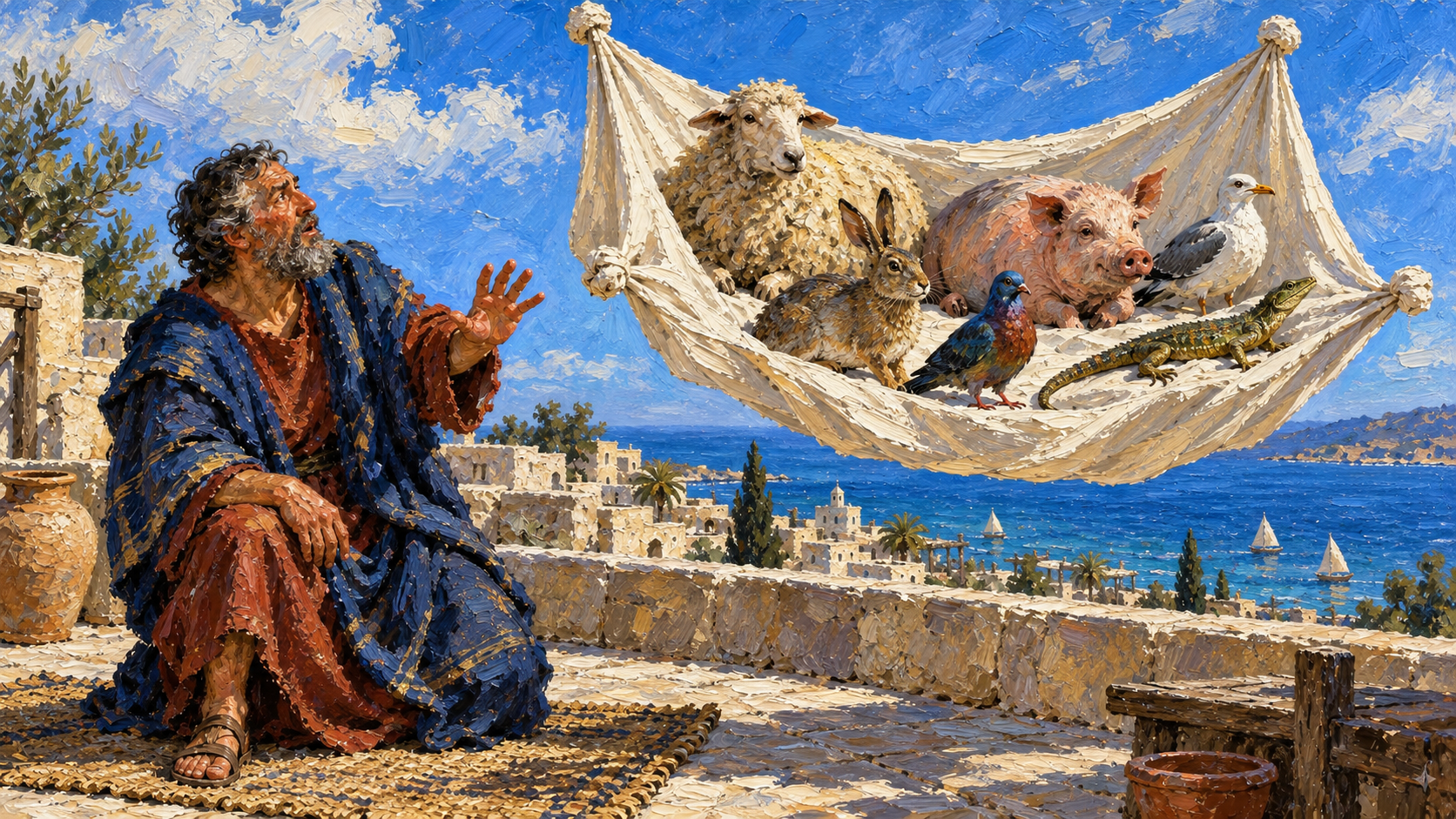
The next day, as they went on their journey and drew near the city, Peter went up on the housetop to pray, about the sixth hour. Then he became very hungry and wanted to eat; but while they made ready, he fell into a trance and saw heaven opened and an object like a great sheet bound at the four corners, descending to him and let down to the earth. In it were all kinds of four-footed animals of the earth, wild beasts, creeping things, and birds of the air. And a voice came to him, "Rise, Peter; kill and eat." But Peter said, "Not so, Lord! For I have never eaten anything common or unclean." And a voice spoke to him again the second time, "What God has cleansed you must not call common." This was done three times. And the object was taken up into heaven again.
Peter saw a sheet containing many kinds of animals, including creatures he had always regarded as unclean. The command to kill and eat shocked him because he had never eaten anything common or unclean. Three times he heard that he must not call common what God had cleansed.
God used food categories Peter knew well, but we do not have to guess at the vision’s main point. Peter explained what God had taught him when he later arrived at Cornelius’s home.
Then he said to them, "You know how unlawful it is for a Jewish man to keep company with or go to one of another nation. But God has shown me that I should not call any man common or unclean. Therefore I came without objection as soon as I was sent for. I ask, then, for what reason have you sent for me?" So Cornelius said, "Four days ago I was fasting until this hour; and at the ninth hour I prayed in my house, and behold, a man stood before me in bright clothing, and said, 'Cornelius, your prayer has been heard, and your alms are remembered in the sight of God. Send therefore to Joppa and call Simon here, whose surname is Peter. He is lodging in the house of Simon, a tanner, by the sea. When he comes, he will speak to you.' So I sent to you immediately, and you have done well to come. Now therefore, we are all present before God, to hear all the things commanded you by God." Then Peter opened his mouth and said: "In truth I perceive that God shows no partiality. But in every nation whoever fears Him and works righteousness is accepted by Him.
Cornelius was a Gentile Roman centurion, and Peter was a Jewish apostle who would not ordinarily enter a Gentile home. God brought Cornelius’s invitation and the arrival of his messengers together with Peter’s vision. Once inside the home, Peter plainly explained that God had shown him not to call any person common or unclean.
While Peter preached Christ, the Holy Spirit fell upon the Gentile hearers who believed. The Jewish witnesses saw God give them the same gift without first requiring them to become Jews. That helps me understand why Acts 10 cannot be reduced to a statement about eating bacon. God used animals in the vision, but Peter explained the lesson in terms of people God receives through Christ.
Therefore I judge that we should not trouble those from among the Gentiles who are turning to God, but that we write to them to abstain from things polluted by idols, from sexual immorality, from things strangled, and from blood. For Moses has had throughout many generations those who preach him in every city, being read in the synagogues every Sabbath." Then it pleased the apostles and elders, with the whole church, to send chosen men of their own company to Antioch with Paul and Barnabas, namely, Judas who was also named Barsabas, and Silas, leading men among the brethren. They wrote this letter by them: The apostles, the elders, and the brethren, To the brethren who are of the Gentiles in Antioch, Syria, and Cilicia: Greetings. Since we have heard that some who went out from us have troubled you with words, unsettling your souls, saying, "You must be circumcised and keep the law"–to whom we gave no such commandment– it seemed good to us, being assembled with one accord, to send chosen men to you with our beloved Barnabas and Paul, men who have risked their lives for the name of our Lord Jesus Christ. We have therefore sent Judas and Silas, who will also report the same things by word of mouth. For it seemed good to the Holy Spirit, and to us, to lay upon you no greater burden than these necessary things: that you abstain from things offered to idols, from blood, from things strangled, and from sexual immorality. If you keep yourselves from these, you will do well. Farewell.
The Jerusalem council met because some teachers insisted that Gentiles had to be circumcised and keep Moses’ law to be saved. The issue went beyond a personal decision about food. These teachers were making entry into Israel’s covenant order a condition of belonging to Christ.
The apostles and elders rejected that demand without treating every food question as settled. Their letter did not impose the clean and unclean animal list, but it did tell Gentile believers to avoid the pollution of idolatry and remain sexually pure. They were also to abstain from things strangled and from blood. Obeying these instructions honored God’s commands and protected fellowship between Jewish and Gentile believers.
I need to hear both parts of the council’s decision. It rejected circumcision and keeping Moses’ law as requirements for salvation, while giving commands believers must still obey. Grace does not make idolatry or sexual immorality harmless. Our freedom from Israel’s menu must respect the limits the apostles actually gave.
Christian Liberty Has Boundaries
Therefore let us not judge one another anymore, but rather resolve this, not to put a stumbling block or a cause to fall in our brother's way. I know and am convinced by the Lord Jesus that there is nothing unclean of itself; but to him who considers anything to be unclean, to him it is unclean. Yet if your brother is grieved because of your food, you are no longer walking in love. Do not destroy with your food the one for whom Christ died. Therefore do not let your good be spoken of as evil; for the kingdom of God is not eating and drinking, but righteousness and peace and joy in the Holy Spirit. For he who serves Christ in these things is acceptable to God and approved by men. Therefore let us pursue the things which make for peace and the things by which one may edify another. Do not destroy the work of God for the sake of food. All things indeed are pure, but it is evil for the man who eats with offense. It is good neither to eat meat nor drink wine nor do anything by which your brother stumbles or is offended or is made weak. Do you have faith? Have it to yourself before God. Happy is he who does not condemn himself in what he approves. But he who doubts is condemned if he eats, because he does not eat from faith; for whatever is not from faith is sin.
Paul was convinced by the Lord Jesus that nothing was unclean in itself, yet he also said it was sinful to eat something while believing it was unclean. That makes me consider more than whether a food is permitted. Conscience needs to be taught by Scripture because it can be mistaken, but a believer must not simply override it while learning.
A believer who is free to eat must not harm another believer over food. The one who abstains must also refuse to condemn someone God has received. God’s kingdom is concerned with righteousness and peace, together with joy in the Holy Spirit, rather than food and drink. If exercising my freedom would cause spiritual harm, love gives me a reason to willingly set it aside.
In 1 Corinthians 8 and 10, Paul explains why buying meat and joining idol worship are different. An idol is nothing, and food does not commend us to God, so ordinary market meat can be eaten without anxious investigation. But participation at an idolatrous sacrificial table is fellowship with demons. An idol has not changed the food itself; the setting involves worship that a Christian must not share. I also have to consider what my example encourages someone else to do against his conscience.
In 1 Timothy 4, Paul warns about teachers who forbid marriage and require abstention from foods God created to be received with thanksgiving. Every creature He made is good and need not be refused when received gratefully within His revealed permission. His Word and prayer set the meal apart for that thankful use.
Paul is explaining how to receive what God permits with gratitude. Thanking God for a meal is not a promise that eating it will cause no harm, nor is prayer a charm that makes food safe.
Colossians 2 tells believers not to accept condemnation over food and drink or over religious festivals, new moons, and sabbaths. These are shadows whose substance belongs to Christ. Someone may freely choose to abstain, but that choice cannot justify a sinner or overcome the flesh. It gives him no right to condemn another servant of Christ.
Blood needs separate consideration because the command about it runs from Genesis 9, before Moses, through the law and into Acts 15. It represents life and belongs to God. In Israel’s sacrifices, God gave blood upon the altar for atonement. Christians are saved through Jesus’ actual shed blood and death, never through consuming blood.
I distinguish the small amount of blood remaining in properly prepared meat from a dish that deliberately includes blood as an ingredient. A medical blood transfusion is different again: it is neither eating blood nor participating in idolatrous worship. I want to obey the prohibition Scripture gives without extending it to something else through a careless comparison.
Cleansing and a Faithful Response
Only Christ can cleanse a guilty heart. He is fully God and fully man, born of a virgin and completely without sin. Wicked men physically tortured and punished Him before killing Him. Jesus willingly bore that real punishment for our sins in His innocent body. He shed His blood and died, then was buried and rose bodily from the grave. The Father did not punish or curse Jesus. He did not abandon His Son or strike or bruise Him, nor did He pour wrath on Him.
Christ died for the whole world, so God’s offer of salvation is genuine for every person, even though people can resist His grace and reject Him. Whoever repents and believes is forgiven and justified before God. That believer is born again and made new. The Holy Spirit comes to dwell within him and seals him, so he is eternally secure in Christ. This security never excuses lawlessness, and a superficial profession does not prove that someone has been born again.
We receive salvation by faith in Christ’s blood. A permitted meal cannot give us that cleansing, and the root problem separating a person from God cannot be reduced to eating a forbidden meal.
Understanding why God gave Israel these laws should deepen our respect for His holiness and His Word. They were not irrational, even though the church follows the apostolic instructions given to it. We may receive food with thanksgiving while refusing blood and participation in idolatry, and we must not act against conscience. If I limit my diet for health or cultural reasons, I should say so honestly. If conscience leads me to abstain, I must not make that choice a condition of salvation.
Peter’s explanation in Acts 10 should also shape the way I receive people. Someone God welcomes through Christ is not spiritually contaminating because of ethnicity or a former distance from Israel. I don’t want an argument about food to obscure that lesson. A brother or sister is worth more than satisfying my appetite or winning a dispute about a menu.
For fuller background, see The Law, The Mosaic Covenant, and Life Is in the Blood.
My Final Thoughts
I don’t find one answer to every food question in the words clean and unclean. Noah’s clean animals were available for sacrifice, while Israel’s menu taught the nation to live as God’s holy people. The church can receive food with thanksgiving while still obeying the instructions about idolatry and blood and respecting conscience. Food cannot cleanse my heart; I depend on Jesus, who shed His blood and died, was buried, and rose bodily. I want that gratitude to show in my choices at the table and in my love for the people He has received.