
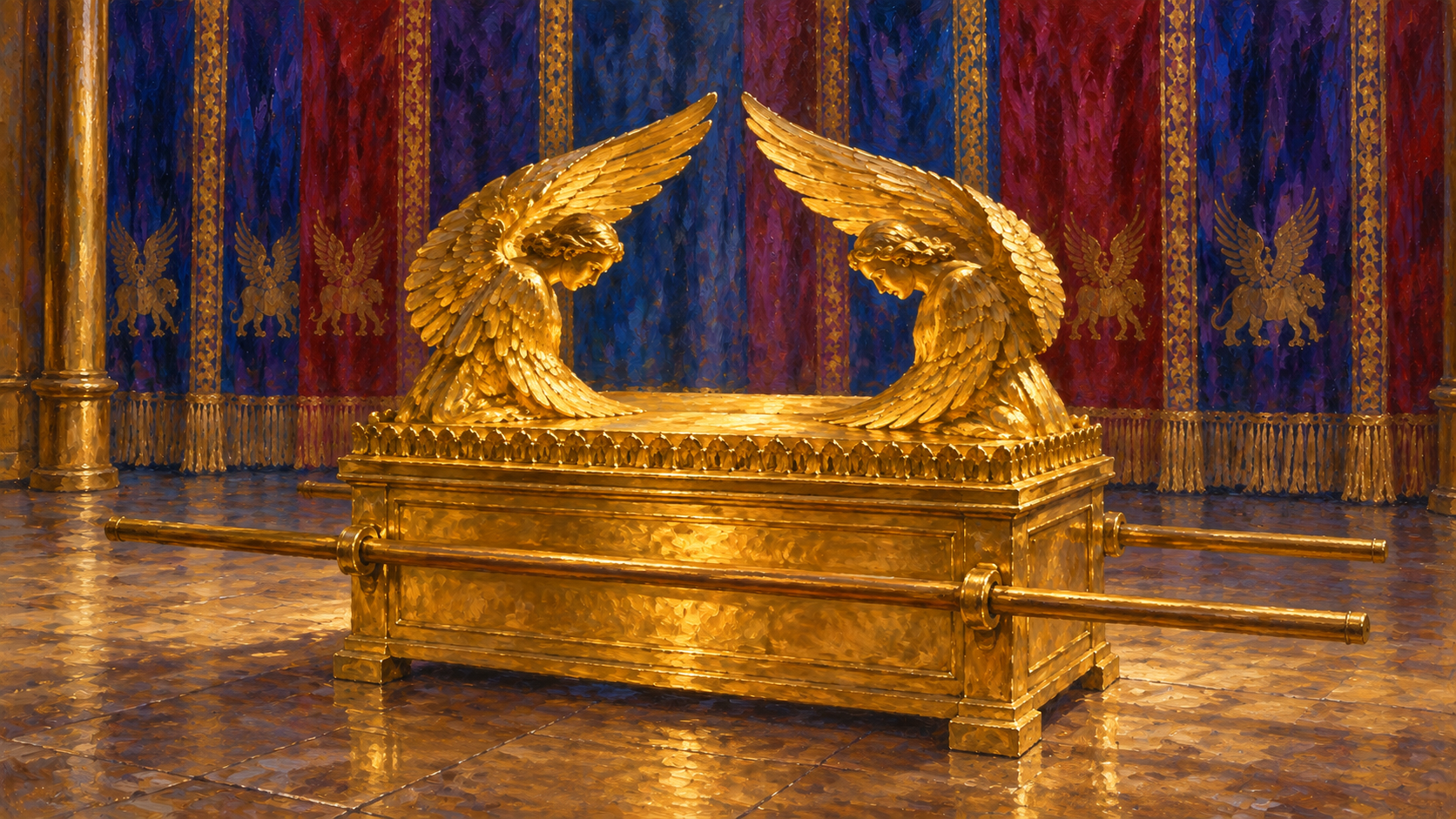
The little winged infants familiar from later art do not prepare us for the cherubim in Scripture. At Eden they guard the way to the tree of life. Their likenesses spread wings over the mercy seat, and Ezekiel sees living cherubim beneath God’s throne. I want to follow those descriptions carefully, because they teach us about His holiness without making these created servants objects of worship. Their place beside guarded access also helps explain why we can approach God only through Jesus Christ.
Cherub and Cherubim: Created Servants of Holy Space
The Hebrew singular is commonly written keruv and the plural keruvim; English Bibles normally use cherub and cherubim. One is a cherub, and more than one are cherubim. The older English form Cherubims adds another plural ending, while cheribum is a misspelling. The deeper origin of the Hebrew word is uncertain, so a proposed connection with another ancient term should not determine what we believe about these beings.
Scripture gives us particular settings in which to understand them. They guard at Eden, appear in the sanctuary’s design, and accompany the throne in Ezekiel’s visions. Their name does not simply mean anything angelic, and their biblical descriptions bear little resemblance to the winged infants of later European art.
Ezekiel repeatedly describes a likeness or appearance because he is reporting a prophetic vision. That does not make the beings imaginary. It means he tells us what God showed him through visible forms and comparisons, rather than supplying a complete account of a heavenly creature’s anatomy. I want to receive the features he records without pretending a drawing could capture everything he saw.
God created the cherubim. Their strength, service, and nearness to His throne never make them divine or independent of Him. When they move beneath His glory or guard a place He has closed, they act as servants under His command.
Their first appearance comes after Adam and Eve have sinned. God sends them out of Eden and prevents their return to the tree of life:
Then the LORD God said, "Behold, the man has become like one of Us, to know good and evil. And now, lest he put out his hand and take also of the tree of life, and eat, and live forever"– therefore the LORD God sent him out of the garden of Eden to till the ground from which he was taken. So He drove out the man; and He placed cherubim at the east of the garden of Eden, and a flaming sword which turned every way, to guard the way to the tree of life.
Adam and Eve had eaten from the forbidden tree and heard God’s judgments upon their rebellion. They could not restore the relationship by walking back into the garden and taking what they wanted. God drove out the man, then placed cherubim at the east of Eden and a flaming sword that turned every way to guard the way to the tree of life.
Genesis names cherubim and one flaming sword. It does not say that each cherub held a sword, though artists sometimes portray them that way. The recorded task is clear even where the arrangement is not described further: the way was guarded because God had closed it.
Exile was a severe consequence of sin, yet the exclusion also showed mercy. God would not allow fallen humanity to eat from the tree of life and perpetuate its corrupted condition. The cherubim did not devise that restriction or decide who deserved entry. They enforced the boundary He established, while life and any future access remained in His hands.
We therefore meet cherubim beside a guarded entrance long before their likenesses appear in Israel’s sanctuary. Sinful people cannot force their way into God’s presence. If access is to be restored, He must provide it.
Cherubim in the Tabernacle and Temple
"You shall make a mercy seat of pure gold; two and a half cubits shall be its length and a cubit and a half its width. And you shall make two cherubim of gold; of hammered work you shall make them at the two ends of the mercy seat. Make one cherub at one end, and the other cherub at the other end; you shall make the cherubim at the two ends of it of one piece with the mercy seat. And the cherubim shall stretch out their wings above, covering the mercy seat with their wings, and they shall face one another; the faces of the cherubim shall be toward the mercy seat. You shall put the mercy seat on top of the ark, and in the ark you shall put the Testimony that I will give you. And there I will meet with you, and I will speak with you from above the mercy seat, from between the two cherubim which are on the ark of the Testimony, about everything which I will give you in commandment to the children of Israel.
God told Moses to place two hammered-gold cherubim at the ends of the mercy seat, the cover above the ark. Their wings spread over it, and their faces turned toward it and toward one another. These were representations of heavenly beings, made according to the pattern God supplied. They were not living beings contained inside metal figures.
The LORD promised to meet with Moses and speak above the mercy seat, between the two cherubim. The ark held the Testimony, God’s covenant word for Israel. That arrangement put His authority and His appointed meeting place together without suggesting that the golden figures themselves could speak for Him.
Cherubim were also woven into the inner curtains and the veil separating the Most Holy Place. Those repeated figures recall the guarded access at Eden. Entry was restricted, and a worshiper could not decide to cross that boundary merely out of curiosity or confidence in personal sincerity.
Yet God had chosen to dwell among Israel. He gave His word and appointed priests and sacrifices through which the people could approach Him. The sanctuary taught both the seriousness of the separation sin had caused and God’s provision for approach. He was not confined to the tent or the space above the ark; even heaven and the highest heaven cannot contain Him. The mercy seat was the covenant meeting place He had chosen, an earthly sign of His royal presence.
Because God commanded the figures, their presence did not violate His prohibition of idols. The second commandment forbids making an image in order to bow down to it or serve it. The LORD specified these particular representations without ever telling Israel to pray to a cherub, seek its favor, or offer sacrifice to it.
That command does not give people unlimited freedom to invent religious images and assign them spiritual power. God also commanded the bronze serpent for a particular purpose, but Hezekiah later destroyed it when people burned incense to it. An object that once served a legitimate purpose can become an idol when people worship it or seek from it the help and access that belong to God.
The cherubim depicted His throne and guarded presence; worship belonged to the LORD. Their being symbolic does not mean the heavenly beings were imaginary. The gold figures pointed beyond themselves to a real heavenly setting, while remaining crafted objects rather than the beings they represented.
On the Day of Atonement, entry into the Most Holy Place depended on God’s appointed sacrifice and priesthood. Aaron could not approach simply because his office gave him permission to do as he pleased:
"And Aaron shall bring the bull of the sin offering, which is for himself, and make atonement for himself and for his house, and shall kill the bull as the sin offering which is for himself. Then he shall take a censer full of burning coals of fire from the altar before the LORD, with his hands full of sweet incense beaten fine, and bring it inside the veil. And he shall put the incense on the fire before the LORD, that the cloud of incense may cover the mercy seat that is on the Testimony, lest he die. He shall take some of the blood of the bull and sprinkle it with his finger on the mercy seat on the east side; and before the mercy seat he shall sprinkle some of the blood with his finger seven times. "Then he shall kill the goat of the sin offering, which is for the people, bring its blood inside the veil, do with that blood as he did with the blood of the bull, and sprinkle it on the mercy seat and before the mercy seat. So he shall make atonement for the Holy Place, because of the uncleanness of the children of Israel, and because of their transgressions, for all their sins; and so he shall do for the tabernacle of meeting which remains among them in the midst of their uncleanness. There shall be no man in the tabernacle of meeting when he goes in to make atonement in the Holy Place, until he comes out, that he may make atonement for himself, for his household, and for all the assembly of Israel.
The high priest entered with sacrificial blood and incense. The incense cloud covered the mercy seat so that he would not die, and he sprinkled blood on it and before it for himself, his household, and the people. God specified the offering, the time of entry, and the way the priest must come. Even Aaron needed atonement for his own sin.
The cherubim did not mediate that approach or provide the sacrifice. They belonged to the sanctuary’s design, while the priest performed the service God had prescribed. Calling them mediators would give them a responsibility the passage does not assign. Neither their golden likenesses nor Aaron’s rank could remove the need for blood.
Animal sacrifices provided ceremonial cleansing and taught through what they foreshadowed. They could not perfect the conscience or permanently remove sin. Paul therefore directs us in Hebrews beyond the earthly sanctuary to Christ’s priesthood and His once-for-all sacrifice. The full opening of the way depended on Him, not on a more impressive sanctuary or more powerful heavenly attendants.
The Psalms address the LORD as the One dwelling or enthroned between the cherubim. The people pray to their Shepherd and King, not to the creatures beside His throne:
Give ear, O Shepherd of Israel, You who lead Joseph like a flock; You who dwell between the cherubim, shine forth! Before Ephraim, Benjamin, and Manasseh, Stir up Your strength, And come and save us! Restore us, O God; Cause Your face to shine, And we shall be saved!
Psalm 80 asks God to shine forth, exercise His strength, and restore His people. Describing Him as dwelling between the cherubim expresses confidence in His covenant presence. It neither divides His deity among the figures nor confines Him to the small space above the ark.
Israel had already suffered for treating the ark as though its presence guaranteed victory. In 1 Samuel 4, they carried it into battle without dealing with their sin, and the Philistines captured it. Sacred furniture could not force the LORD to bless disobedience. The sign of His presence gave Israel no control over Him.
Psalm 99 also describes Him as dwelling between the cherubim while calling the nations to tremble before His holiness and justice. His forgiveness and His judgment belong together in that psalm. I cannot use the privilege of knowing Him as permission to disregard His commands or treat Him as common.
Solomon’s temple later enlarged the setting around the ark with two additional cherubim in the inner sanctuary:
Inside the inner sanctuary he made two cherubim of olive wood, each ten cubits high. One wing of the cherub was five cubits, and the other wing of the cherub five cubits: ten cubits from the tip of one wing to the tip of the other. And the other cherub was ten cubits; both cherubim were of the same size and shape. The height of one cherub was ten cubits, and so was the other cherub. Then he set the cherubim inside the inner room; and they stretched out the wings of the cherubim so that the wing of the one touched one wall, and the wing of the other cherub touched the other wall. And their wings touched each other in the middle of the room. Also he overlaid the cherubim with gold. Then he carved all the walls of the temple all around, both the inner and outer sanctuaries, with carved figures of cherubim, palm trees, and open flowers.
These cherubim were carved from olive wood and overlaid with gold. Their outstretched wings reached from wall to wall and met in the middle. The ark still had its own smaller cherubim above the mercy seat, while carvings of cherubim, palm trees, and open flowers appeared on the temple’s walls and doors.
The craftsmanship presented the LORD as King and recalled creation, but Solomon did not think the building could contain Him. At its dedication, he acknowledged that even the heaven of heavens could not do so. When the priests placed the ark and withdrew, the LORD’s glory filled the house in a cloud, and they could not continue ministering. The glory came from God, not from the carved figures or the quality of the construction.
The temple’s holiness depended on the God whose name and presence were there. Every part of its design, including the cherubim, remained subordinate to Him. A Complete Bible Study on the Ark of the Covenant examines the ark and its place in Israel’s worship more fully.
David’s Song and Ezekiel’s Moving Throne
Before Solomon built the temple, David had celebrated the LORD’s deliverance in a song. He pictures the LORD answering his distress with the force of a terrifying storm:
In my distress I called upon the LORD, And cried out to my God; He heard my voice from His temple, And my cry entered His ears. "Then the earth shook and trembled; The foundations of heaven quaked and were shaken, Because He was angry. Smoke went up from His nostrils, And devouring fire from His mouth; Coals were kindled by it. He bowed the heavens also, and came down With darkness under His feet. He rode upon a cherub, and flew; And He was seen upon the wings of the wind. He made darkness canopies around Him, Dark waters and thick clouds of the skies. From the brightness before Him Coals of fire were kindled. "The LORD thundered from heaven, And the Most High uttered His voice. He sent out arrows and scattered them; Lightning bolts, and He vanquished them. Then the channels of the sea were seen, The foundations of the world were uncovered, At the rebuke of the LORD, At the blast of the breath of His nostrils.
The earth shakes, smoke and fire accompany God’s descent, and darkness and wind surround Him. David describes the LORD riding a cherub, flying on the wings of the wind, and scattering the enemy through thunder and lightning. The royal chariot imagery agrees with the throne setting we later see in Ezekiel, but the song praises God as the One who hears and rescues His servant.
This is the language of a theophany, God making His presence known. David celebrates the speed and overwhelming power of His intervention in poetry. I would misunderstand the passage if I treated it as a diagram of heavenly transportation or concluded that God needed a creature to carry Him. Recognizing the poetic form allows us to receive the truth of His deliverance through the vivid language He inspired.
Ezekiel received his vision among the captives by the River Chebar. Jerusalem’s temple was far away, but the LORD revealed His glory to the prophet there, with four living creatures beneath His throne:
Then I looked, and behold, a whirlwind was coming out of the north, a great cloud with raging fire engulfing itself; and brightness was all around it and radiating out of its midst like the color of amber, out of the midst of the fire. Also from within it came the likeness of four living creatures. And this was their appearance: they had the likeness of a man. Each one had four faces, and each one had four wings. Their legs were straight, and the soles of their feet were like the soles of calves' feet. They sparkled like the color of burnished bronze. The hands of a man were under their wings on their four sides; and each of the four had faces and wings. Their wings touched one another. The creatures did not turn when they went, but each one went straight forward. As for the likeness of their faces, each had the face of a man; each of the four had the face of a lion on the right side, each of the four had the face of an ox on the left side, and each of the four had the face of an eagle. Thus were their faces. Their wings stretched upward; two wings of each one touched one another, and two covered their bodies. And each one went straight forward; they went wherever the spirit wanted to go, and they did not turn when they went. As for the likeness of the living creatures, their appearance was like burning coals of fire, like the appearance of torches going back and forth among the living creatures. The fire was bright, and out of the fire went lightning. And the living creatures ran back and forth, in appearance like a flash of lightning.
The whirlwind, raging fire, brightness, and glowing color introduced creatures with a human likeness, yet each had four faces and four wings. Ezekiel also describes straight legs, calf-like feet, and human hands under their wings. Their faces were those of a man, lion, ox, and eagle in the directions he specifies. Two wings joined with those of the other creatures, while two covered each creature’s body.
Their movement was as extraordinary as their appearance. They went straight ahead without turning, wherever the spirit directed, with fire and lightning among them. Ezekiel’s repeated words likeness and appearance tell us how he reports the vision through comparison. We should not dismiss those details, but neither should we assemble them into a biological explanation the prophet does not give.
Above their heads was a firmament, an expanse, and above it the likeness of a sapphire throne with the likeness of a Man seated upon it. Ezekiel fell on his face before the appearance of the likeness of the LORD’s glory. However impressive the creatures were, they did not occupy that throne or produce its glory. Ezekiel’s worship was directed to the LORD.
Beside the creatures, Ezekiel saw wheels whose movement was joined to theirs:
Now as I looked at the living creatures, behold, a wheel was on the earth beside each living creature with its four faces. The appearance of the wheels and their workings was like the color of beryl, and all four had the same likeness. The appearance of their workings was, as it were, a wheel in the middle of a wheel. When they moved, they went toward any one of four directions; they did not turn aside when they went. As for their rims, they were so high they were awesome; and their rims were full of eyes, all around the four of them. When the living creatures went, the wheels went beside them; and when the living creatures were lifted up from the earth, the wheels were lifted up. Wherever the spirit wanted to go, they went, because there the spirit went; and the wheels were lifted together with them, for the spirit of the living creatures was in the wheels. When those went, these went; when those stood, these stood; and when those were lifted up from the earth, the wheels were lifted up together with them, for the spirit of the living creatures was in the wheels.
Each wheel had the appearance of a wheel within a wheel, with high rims full of eyes. The wheels and creatures moved, stood, and rose together without turning aside. Ezekiel explains that the spirit of the living creatures was in the wheels. Their movements were united under the directing spirit.
Eyes often suggest perception in prophetic imagery, but Ezekiel does not decode every feature. The vision presents purposeful, coordinated movement under divine direction. It gives no basis for treating the creatures as independent powers or imagining that God could be trapped by an obstacle in their path.
Ezekiel saw this in the land of exile. The LORD’s glory had not become stranded in Jerusalem or subject to Babylon’s gods. He could reveal Himself among the captives and act in judgment against the city whose leaders assumed their temple guaranteed safety.
In chapter 10, Ezekiel explicitly identifies the beings he had first seen by the River Chebar:
And the cherubim were lifted up. This was the living creature I saw by the River Chebar. When the cherubim went, the wheels went beside them; and when the cherubim lifted their wings to mount up from the earth, the same wheels also did not turn from beside them. When the cherubim stood still, the wheels stood still, and when one was lifted up, the other lifted itself up, for the spirit of the living creature was in them. Then the glory of the LORD departed from the threshold of the temple and stood over the cherubim. And the cherubim lifted their wings and mounted up from the earth in my sight. When they went out, the wheels were beside them; and they stood at the door of the east gate of the LORD's house, and the glory of the God of Israel was above them. This is the living creature I saw under the God of Israel by the River Chebar, and I knew they were cherubim. Each one had four faces and each one four wings, and the likeness of the hands of a man was under their wings. And the likeness of their faces was the same as the faces which I had seen by the River Chebar, their appearance and their persons. They each went straight forward.
The prophet knew they were cherubim. Their wings and hands, their united movement with the wheels, and their position beneath the God of Israel connect this vision with the earlier one. Here their identity is stated; it does not depend on guessing what kind of being a face or wing might represent.
Ezekiel 10:14 calls one face that of a cherub, where chapter 1 describes the corresponding face as that of an ox. Some infer that a cherub’s face therefore looked like an ox’s. The wording allows that proposal, but the prophet does not explain the change in terms. He does expressly identify the creatures as the same ones he had seen before, so the difference in wording does not require us to invent a second group.
Ezekiel’s detailed descriptions have also led readers to assign particular meanings to the four faces. A human face may suggest wisdom, a lion majesty, an ox strength, and an eagle swiftness. Those associations can form a memorable devotional picture, but the prophet does not supply that explanation.
The composite features appear to express the creatures’ extraordinary fullness and a relationship to the created order. I hold that as an inference. What Ezekiel explicitly gives us is their identity, their place beneath the throne, and their obedience to the directing spirit. Systems assigning the faces to four virtues, four Gospel writers, four tribes, or four regions of creation go beyond his explanation and cannot be made binding doctrine.
I do not need a meaning for every feature before receiving what the vision reveals. The creatures are astonishing, but the prophet falls before the glory above them. Speculation becomes a distraction when it makes an imagined code more interesting than the God who revealed Himself.
The throne’s movement in chapter 10 is part of God’s judgment on Jerusalem. Earlier in the same chapter, before the departure described in verses 15-22, the prophet saw this command concerning the city:
And I looked, and there in the firmament that was above the head of the cherubim, there appeared something like a sapphire stone, having the appearance of the likeness of a throne. Then He spoke to the man clothed with linen, and said, "Go in among the wheels, under the cherub, fill your hands with coals of fire from among the cherubim, and scatter them over the city." And he went in as I watched. Now the cherubim were standing on the south side of the temple when the man went in, and the cloud filled the inner court. Then the glory of the LORD went up from the cherub, and paused over the threshold of the temple; and the house was filled with the cloud, and the court was full of the brightness of the LORD's glory. And the sound of the wings of the cherubim was heard even in the outer court, like the voice of Almighty God when He speaks.
The surrounding temple visions expose idolatry, violence, corrupt leaders, and false confidence. The man clothed in linen is told to take coals from among the cherubim and scatter them over Jerusalem. The cloud and brightness fill the court, and the sound of the cherubim’s wings reaches even the outer court like the voice of Almighty God.
The glory pauses at the threshold, stands above the cherubim, and moves with them to the east gate. Ezekiel 11 then describes it rising from the city and standing over the mountain on its east side. The cherubim participate in this vision of judgment as servants accompanying the throne’s movement. They do not decide Jerusalem’s guilt or replace the God who gives the command.
Ezekiel later sees the glory returning in his restoration vision. Judgment has not defeated God’s covenant purposes, but restoration still comes according to His holiness. His faithfulness gives reason for hope without excusing the conduct for which He judged His people.
The LORD had appointed the temple, yet its beauty and sacred history could not protect people who persisted in rebellion. His glory withdrew from the house they had polluted. I need to receive that warning without imagining that a church’s history, building, or familiar religious language can take the place of repentance.
The Covering Cherub and Other Heavenly Orders
Ezekiel 28 first addresses Tyre’s prince, a human ruler who claims to be a god. The lament over the king then uses language that goes beyond an ordinary royal biography: Eden, created perfection, the holy mountain, fiery stones, and an anointed cherub who covers.
"Son of man, take up a lamentation for the king of Tyre, and say to him, 'Thus says the Lord GOD: "You were the seal of perfection, Full of wisdom and perfect in beauty. You were in Eden, the garden of God; Every precious stone was your covering: The sardius, topaz, and diamond, Beryl, onyx, and jasper, Sapphire, turquoise, and emerald with gold. The workmanship of your timbrels and pipes Was prepared for you on the day you were created. "You were the anointed cherub who covers; I established you; You were on the holy mountain of God; You walked back and forth in the midst of fiery stones. You were perfect in your ways from the day you were created, Till iniquity was found in you. "By the abundance of your trading You became filled with violence within, And you sinned; Therefore I cast you as a profane thing Out of the mountain of God; And I destroyed you, O covering cherub, From the midst of the fiery stones. "Your heart was lifted up because of your beauty; You corrupted your wisdom for the sake of your splendor; I cast you to the ground, I laid you before kings, That they might gaze at you.
I believe the earthly ruler and the spiritual rebellion behind him both need to remain in view. Tyre’s wealth and trade had become bound to violence and self-exaltation. The lament also reaches beyond that ruler to the proud spiritual rebel whose pattern his empire embodied. I understand it to contribute to our knowledge of Satan as a creature made good who corrupted himself through pride.
The passage does not identify him as the highest angel or place him above the ark. Nor does it say he guarded God’s throne or led heavenly music. It calls him a covering cherub without describing a complete heavenly office. Beauty, wisdom, and privileged service did not make rebellion inevitable or give him a right to exalt himself. He sinned, and God brought him down.
Isaiah 14 similarly begins with the king of Babylon before speaking of a shining one seeking to rise above God’s stars. I receive the spiritual dimension of these passages without erasing their judgments on historical rulers. Satan is never God’s eternal opposite. He remains a creature who cannot seize the Creator’s throne. A Complete Bible Study on Satan develops those passages further.
The covering cherub’s position does not provide a complete ranking of heavenly beings. Scripture uses angel to mean messenger and describes angels sent to people on particular missions. Cherubim appear especially with guarded holiness, the sanctuary’s representations, and visions of the throne. Those different descriptions do not give us a chart of every heavenly office.
Isaiah 6 names seraphim with six wings, covering their faces and feet and flying as they proclaim the LORD’s holiness. Ezekiel’s cherubim have four wings. We should retain those differences rather than make all throne servants identical. A Complete Bible Study on the Seraphim considers Isaiah’s description more closely.
Jude calls Michael the archangel, and Daniel and Luke name Gabriel as a messenger. Scripture does not rank a cherub against either of them or direct believers to seek specialized help from particular classes of heavenly beings. When John fell before an angel in Revelation, the angel refused his worship and told him to worship God. Studying these servants should not become an attempt to invoke or contact them.
Jesus belongs on the Creator’s side of that distinction. He is the eternal Son through whom everything in heaven and earth was created. Hebrews places Him above angels because He is God and Son, not because He advanced through their ranks. No amount of glory given to a created servant makes that servant equal to Him.
Revelation’s Living Creatures and Christ’s Open Way
Before the throne there was a sea of glass, like crystal. And in the midst of the throne, and around the throne, were four living creatures full of eyes in front and in back. The first living creature was like a lion, the second living creature like a calf, the third living creature had a face like a man, and the fourth living creature was like a flying eagle. The four living creatures, each having six wings, were full of eyes around and within. And they do not rest day or night, saying: "Holy, holy, holy, Lord God Almighty, Who was and is and is to come!" Whenever the living creatures give glory and honor and thanks to Him who sits on the throne, who lives forever and ever, the twenty-four elders fall down before Him who sits on the throne and worship Him who lives forever and ever, and cast their crowns before the throne, saying: "You are worthy, O Lord, To receive glory and honor and power; For You created all things, And by Your will they exist and were created."
John saw four living creatures in and around the throne, full of eyes and each having six wings. One was like a lion, another like a calf, a third had a human face, and the fourth was like a flying eagle. They continually proclaimed the holiness, power, and eternity of the Lord God Almighty.
The resemblance to Ezekiel’s vision is substantial, but the descriptions are not identical. Ezekiel gives each creature four faces and four wings; Revelation describes each by a primary likeness and gives each six wings. John does not call them cherubim. They may be cherubim presented in another prophetic setting, or they may be a distinct heavenly order. Neither conclusion has the certainty of Ezekiel 10’s explicit identification.
Their worship is clear even where their classification is not. They give glory, honor, and thanks to the One on the throne, and the elders fall before Him. He is worthy because He created all things and sustains their existence by His will. The most glorious creatures in the vision acknowledge their dependence on Him.
In the next chapter, the Lamb, Jesus Christ, takes the scroll, and the living creatures and elders fall before Him:
Now when He had taken the scroll, the four living creatures and the twenty-four elders fell down before the Lamb, each having a harp, and golden bowls full of incense, which are the prayers of the saints. And they sang a new song, saying: "You are worthy to take the scroll, And to open its seals; For You were slain, And have redeemed us to God by Your blood Out of every tribe and tongue and people and nation, And have made us kings and priests to our God; And we shall reign on the earth." Then I looked, and I heard the voice of many angels around the throne, the living creatures, and the elders; and the number of them was ten thousand times ten thousand, and thousands of thousands, saying with a loud voice: "Worthy is the Lamb who was slain To receive power and riches and wisdom, And strength and honor and glory and blessing!" And every creature which is in heaven and on the earth and under the earth and such as are in the sea, and all that are in them, I heard saying: "Blessing and honor and glory and power Be to Him who sits on the throne, And to the Lamb, forever and ever!" Then the four living creatures said, "Amen!" And the twenty-four elders fell down and worshiped Him who lives forever and ever.
The new song celebrates His worthiness to take the scroll and open its seals because He was slain and redeemed people to God by His blood. The redeemed come from every tribe, language, people, and nation. The NKJV’s first-person wording belongs to a song in which the elders also participate; it should not be used to turn every living creature into a redeemed human being. Manuscripts differ over the pronouns, as the NET Bible’s textual notes explain.
Countless angels then proclaim the Lamb worthy, and every creature joins in ascribing blessing, honor, glory, and power to Him and to the One seated on the throne. The living creatures answer Amen. Jesus receives divine worship alongside the Father; He is not another cherub or an exalted angel being congratulated by his peers.
Heaven’s worship names God’s holiness and work of creation, redemption through blood, and the Lamb’s right to rule. The song also anticipates the redeemed reigning on earth. Their praise is not an emotional atmosphere detached from truth. I want Christian worship to attend to who God is and what He has done, with reverence that grows from His Word rather than fascination with a heavenly spectacle.
We are not called to copy the form or motions of a cherub. Our calling is lived in union with Christ, obedience to His Word, and fellowship with His church as the Holy Spirit produces holiness in us. The Lord those creatures worship is also the One who has provided our access to God.
Paul explains that access in Hebrews, moving beyond the earthly veil and its guarded entrance to the sufficiency of Jesus’ blood:
Therefore, brethren, having boldness to enter the Holiest by the blood of Jesus, by a new and living way which He consecrated for us, through the veil, that is, His flesh, and having a High Priest over the house of God, let us draw near with a true heart in full assurance of faith, having our hearts sprinkled from an evil conscience and our bodies washed with pure water. Let us hold fast the confession of our hope without wavering, for He who promised is faithful. And let us consider one another in order to stir up love and good works, not forsaking the assembling of ourselves together, as is the manner of some, but exhorting one another, and so much the more as you see the Day approaching.
At Eden, cherubim guarded the way to the tree of life. Their likenesses later appeared on the veil before the Most Holy Place. Hebrews now calls believers to enter the Holiest boldly through the new and living way Jesus consecrated through His flesh. The earlier restrictions help us appreciate what His sacrifice has opened.
No cherub became our High Priest or died for sinners and rose again. Jesus is the eternal Son, fully God and fully man, born of a virgin and completely sinless. He alone is our Savior and Mediator, the One through whom we come to the Father.
Wicked men physically tortured, punished, and killed Him, yet He willingly bore that real punishment for our sins in His innocent body and shed His blood. His saving work through His blood and death was complete before His burial and bodily resurrection. The Father did not punish, curse, abandon, strike, bruise, or pour wrath on Jesus.
Christ died for the whole world, and God’s offer is genuine for every person, though people can resist His grace and reject Him. Everyone who repents and believes receives forgiveness and justification, being declared righteous before God. That person is born again as a new creation, indwelt and sealed by the Holy Spirit, and eternally secure in Christ.
A Christian label alone does not prove new birth, and eternal security gives no permission for lawlessness. Obedience grows from the life God gives; it neither earns nor keeps salvation. Hebrews connects our confidence with approaching sincerely, holding firmly to our confession, and encouraging one another to love and good works as we gather faithfully. Access to God is a reason to draw near and care for His people.
Our confidence rests in Christ’s sufficient blood and perfect priesthood. God has not become less holy, and we have not made ourselves fit to approach Him. Through Jesus, however, we have the living access that no created servant could provide.
My Final Thoughts
As I follow the cherubim from Eden to Ezekiel’s visions, their service keeps directing attention to God. They guard where He commands and move beneath His glory, while the creatures in Revelation join heaven’s worship of the Lamb. None invites our prayers or supplies the access we need. The guarded tree, veil, and mercy seat teach the seriousness of sin, yet Jesus has opened the way through His blood. We can draw near confidently because of Him, with reverence for the holy God whose servants bow before His throne.