
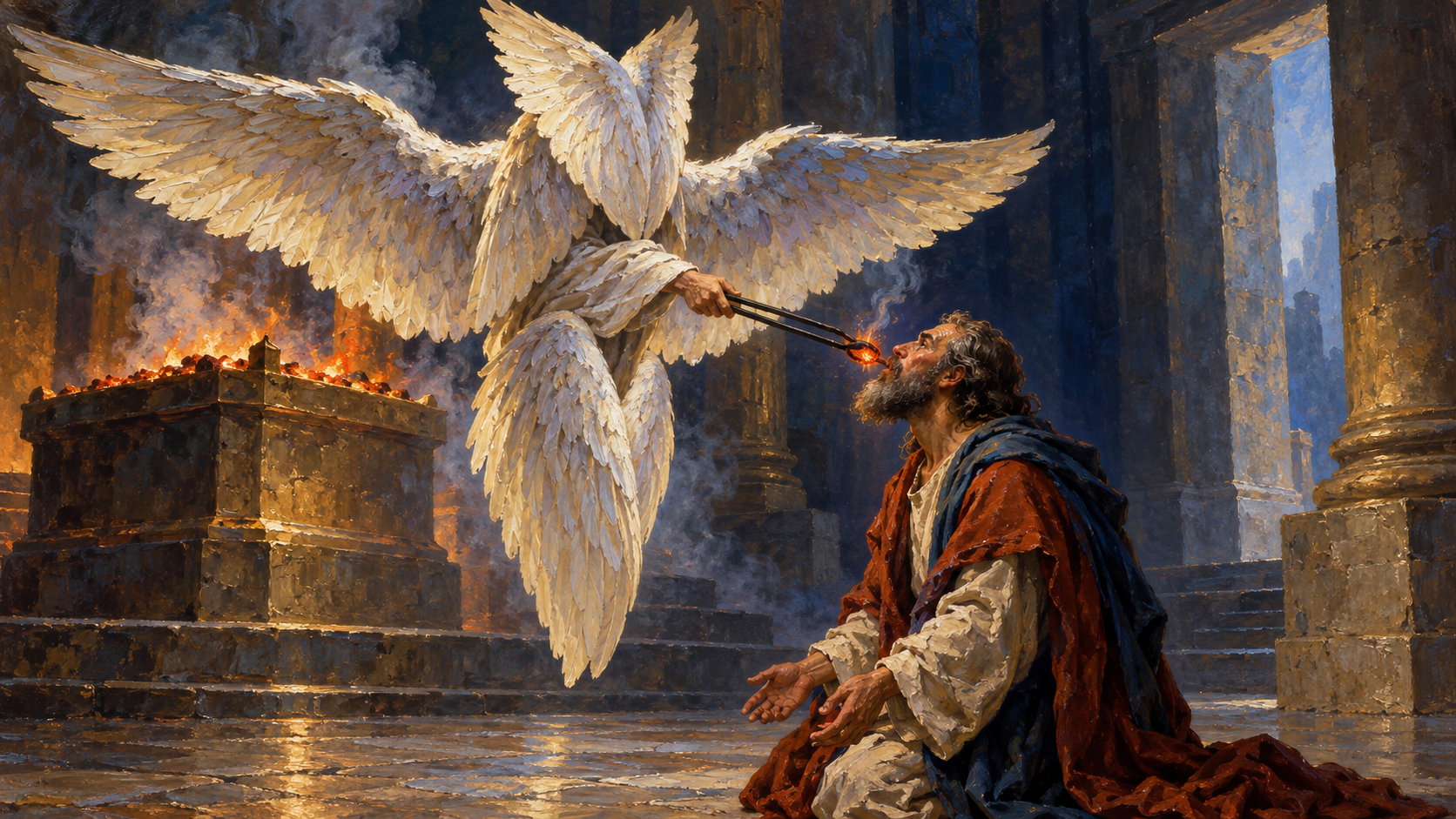
Seraphim have inspired many pictures and theories, although only one biblical passage names them as heavenly beings. Isaiah gives us specific details about their wings, speech, and service without supplying a complete description. I notice that what they say and do keeps directing attention to the holy King. Their place near His throne does not make them the objects of worship.
The King Is Still on His Throne
Isaiah dates the vision to the year King Uzziah died.
In the year that King Uzziah died, I saw the Lord sitting on a throne, high and lifted up, and the train of His robe filled the temple. Above it stood seraphim; each one had six wings: with two he covered his face, with two he covered his feet, and with two he flew. And one cried to another and said: “Holy, holy, holy is the LORD of hosts; The whole earth is full of His glory!” And the posts of the door were shaken by the voice of him who cried out, and the house was filled with smoke.
Uzziah had strengthened Judah while seeking the LORD, improving its defenses and enjoying considerable success. Pride later led him into the temple to burn incense, a priestly service God had not assigned to him. When the priests confronted him, he became angry. He was struck with leprosy and spent the rest of his life in a separate house, excluded from the temple while his son governed the king’s house.
When Uzziah’s long reign ended, Isaiah saw the Lord still seated in royal majesty. Uzziah had presumed to enter the sanctuary on his own terms; the heavenly servants Isaiah saw covered themselves before God. Neither royal office nor nearness to the throne gave a creature permission to disregard His holiness.
The throne and temple belong together in the vision. The train of the Lord’s robe filled the temple, smoke filled the house, and the thresholds shook at the voice calling out. Isaiah was receiving real revelation of God’s royal and holy presence. We need not suppose that he had physically entered the earthly sanctuary to understand the scene he describes.
The seraphim stood above the throne setting and called to one another. They were neither co-rulers nor lesser gods, and they were not portions of deity flowing out from God. They were created servants under His authority. Colossians 1:16 places every visible and invisible power within the order Christ created, which rules out treating these beings as rivals to their Creator.
Isaiah 6 is the only passage that directly names heavenly beings as seraphim. More than one appears, each with six wings, but Isaiah does not count them all or assign them a position in a complete heavenly hierarchy. He tells us what their wings did and records their praise. Later, he describes one flying with a coal from the altar. Those details allow us to study their service without pretending we know everything about their form or rank.
What the Name and the Six Wings Tell Us
Seraphim, שְׂרָפִים, is the plural of the Hebrew saraph. Its word family is connected with burning, making “burning ones” a reasonable explanation of the name. The same consonants also occur in the descriptions of fiery serpents sent among rebellious Israel in Numbers 21, and in Isaiah 14:29 and 30:6, which mention a flying fiery serpent.
Those connections do not settle the body shape of the beings in Isaiah 6. They speak, cover their faces and feet with wings, and fly; one has a hand that holds tongs. The passage describes fire on the altar and smoke in the house without saying that the seraphim themselves visibly burn or glow. Whether the name refers to their appearance, service, or some other feature remains unexplained.
The Hebrew uses of saraph belong in the discussion, but word origins cannot supply a physical description Isaiah never gives. I would neither dismiss the connection with burning nor use it to claim certainty about serpent bodies. We need the actual description in the throne vision to govern what we teach about these servants.
Two wings covered each face and two covered the feet. I understand these gestures as reverence, modesty, and humility before the Creator. The seraphim appear as pure servants in the vision, yet their purity does not make them God’s equals or give them reason to treat His presence casually.
Some interpreters take “feet” as an indirect reference to another part of the body; others assign a detailed spiritual meaning to every pair of wings. Isaiah does not explain the covering that way. He shows the beings covering themselves before the King, and then one uses the remaining pair of wings to fly to the prophet. Their readiness to serve is demonstrated by what happens, without requiring a symbolic chart for each movement.
An artist has to supply details Isaiah leaves undescribed. The prophet mentions covered faces and feet, voices, wings, and a hand, but never gives a portrait of a beautiful human body with three pairs of wings attached. An illustration may help us picture the scene while remaining an artist’s interpretation. The featured image on this page is an illustration, not a photograph of heaven.
God’s Holiness Exposes Isaiah
The seraphim called to one another, proclaiming “Holy, holy, holy.” The repetition gives overwhelming emphasis to the LORD’s holiness, His complete purity and distinction from every creature. His glory fills the whole earth; it is not restricted to the temple Isaiah saw.
Judah’s sin, the death of its king, and the judgment ahead could not diminish God’s authority. Isaiah was seeing the King whose rule reaches every nation and whose promised salvation would reach the Gentiles. The praise was true even while the people of Judah were refusing to live under His Word. Before this holy King, Isaiah confessed his own uncleanness.
So I said: “Woe is me, for I am undone! Because I am a man of unclean lips, And I dwell in the midst of a people of unclean lips; For my eyes have seen the King, The LORD of hosts.”
In the opening chapters of the book, Isaiah has pronounced woes against Judah’s rebellion, pride, and injustice. He has exposed worship offered by people who tolerated wickedness. Before the throne, he now says, “Woe is me.” His neighbors’ corruption gave him no reason to excuse himself. He confessed his own uncleanness while identifying with the people among whom he lived.
His confession about his lips follows the pure praise of the seraphim. His mouth belonged to a sinful man, and he knew it. The word rendered “undone” conveys ruin or being brought to silence. He could not repair that condition through determination or make himself fit to speak for God. The cleansing he needed had to be provided by the King.
The Coal, the Cleansing, and the Glory of Christ
One of the throne’s servants then came to the prophet with a coal from the altar.
Then one of the seraphim flew to me, having in his hand a live coal which he had taken with the tongs from the altar. And he touched my mouth with it, and said: “Behold, this has touched your lips; Your iniquity is taken away, And your sin purged.”
The seraph brought what God provided and announced that Isaiah’s guilt was removed. He did not create forgiveness through power of his own. The source of cleansing remained the Lord whose altar supplied the coal and whose servant pronounced the verdict.
The touch was suited to Isaiah’s confession of unclean lips and to the speaking ministry ahead. It was a sign of cleansing, not a magical object or a ritual Christians should reproduce. Fire can judge or refine elsewhere in Scripture, and the altar speaks of sacrifice and approach to God. Here the announcement explains the action: Isaiah’s iniquity was taken away and his sin purged.
After that cleansing, Isaiah heard the Lord asking whom He would send and who would go for “Us.” He answered, “Here am I! Send me.” His willingness did not purchase grace; God had already addressed his guilt. The commission that followed also kept service from becoming a promise of easy success. He was to speak to people whose continued refusal would harden them further until judgment came.
John’s Gospel identifies whose glory stood behind that call. In describing unbelief toward Jesus, John quotes Isaiah 6:10 and then makes this statement.
These things Isaiah said when he saw His glory and spoke of Him.
The glory belongs to Jesus, the One whose signs and rejection John has been describing. By saying that Isaiah saw His glory and spoke of Him, John identifies the Son with the Lord of the throne vision. Jesus is not a seraph, an archangel, or a creature promoted to a greater rank. He is the eternal Son whom the heavenly servants worshiped.
The King worshiped in the vision entered human history as the incarnate Son, becoming fully man without ceasing to be fully God. Many rejected Him, yet His saving work reaches the nations. He rose bodily and will return as King. Recognizing His glory does not collapse the divine Persons into one Person. The Father is God, the Son is God, and the Holy Spirit is God; there is one God eternally existing in three co-equal Persons.
In Acts 28:25-27, Paul attributes the words spoken through Isaiah to the Holy Spirit. John’s identification of Christ’s glory and Paul’s attribution of the commission to the Spirit belong together in the full revelation of the triune God. The threefold declaration of holiness agrees with the Trinity, but the doctrine rests on this wider testimony, not on counting repetitions. The study on Isaiah follows the prophet’s commission, Judah’s crisis, the suffering Servant, and the coming kingdom through the larger book.
Isaiah’s need for cleansing also directs us to Christ as Savior and Mediator, the One through whom sinners are reconciled to God. Wicked men physically tortured and punished Jesus before killing Him on the cross, and He willingly bore that real punishment for our sins in His innocent body. He shed His blood and died, completing His saving work before His bodily resurrection. The Father did not punish or curse Jesus, and He never abandoned His Son. He did not strike or bruise Him or pour wrath upon Him.
Salvation is in Christ’s blood. A heavenly messenger, a coal, a ceremony, or human suffering cannot supply His atoning sacrifice. He died for the whole world, making God’s offer genuine for every person. People can resist and reject it, but everyone who repents and believes is forgiven and justified, declared righteous before God. Through the new birth, the believer becomes a new creation indwelt and sealed by the Holy Spirit.
Christ keeps those He saves, so every true believer is eternally secure. That assurance does not excuse rebellion, and a superficial profession does not prove new birth. Obedience grows from the life He has given; it does not earn forgiveness. Isaiah’s service likewise followed the grace that dealt with his guilt.
Revelation, Cherubim, and Our Response
Revelation presents another scene around God’s throne, with a striking resemblance to what Isaiah heard and saw.
The four living creatures, each having six wings, were full of eyes around and within. And they do not rest day or night, saying: “Holy, holy, holy, Lord God Almighty, Who was and is and is to come!”
Both visions include six-winged beings proclaiming God’s holiness three times. John describes four living creatures, distinct forms, and eyes around and within; he also says their praise does not cease. Isaiah supplies neither the eyes nor those four forms, and he does not describe the duration of their praise. Revelation’s statement about unceasing worship does not establish that Isaiah’s seraphim repeat those exact words eternally.
The creatures may belong to the same order viewed in different visions, or different throne servants may share these features. Revelation does not call its living creatures seraphim, and Isaiah does not call his beings cherubim. Ezekiel’s living creatures share other traits, and Ezekiel 10 explicitly identifies his creatures as cherubim. We can explain the parallels without claiming that the prophets gave us one settled classification.
Cherubim appear earlier guarding Eden, and their forms stand at the mercy seat in the tabernacle and temple imagery. Seraphim are named as heavenly beings only in Isaiah 6. Both names concern mighty servants associated with God’s holy presence, but these passages do not place them in a ranked list. The study on cherubim follows those related descriptions.
Later traditions developed ninefold angelic hierarchies, commonly placing seraphim highest and cherubim below them. The scheme in The Celestial Hierarchy is an example of that later arrangement. Its theological influence does not make it a hierarchy Isaiah revealed.
Angel means messenger and can describe assigned service rather than a technical species. Scripture also uses names such as living creatures and watchers and identifies an archangel among heavenly servants. I can use the terms given without pretending they form a complete catalogue of the unseen world. The study on angels examines their ministries, rebellion, limits, and submission to Christ.
The seraphim’s words concern the Lord’s holiness and glory, and their action serves His cleansing of Isaiah. Neither their appearance nor a private spiritual experience becomes the subject of their proclamation. I need to consider whether our worship directs attention to the God they praised. Truth and reverence should lead us to glorify the Father, Son, and Holy Spirit, rather than become fascinated with spiritual novelty.
Isaiah’s task was to deliver the Word faithfully, even when many refused it. I need to remember that before measuring ministry by applause or an immediate response. Being willing to serve does not guarantee an easy assignment, and discouragement does not excuse changing the Word God has given us to teach.
Isaiah did not hide behind his office or blame the surrounding culture for his uncleanness. I should also confess known sin and trust Christ’s blood instead of treating personal suffering as a means of atonement. Grace gives me no reason to call sin harmless, but it does give me reason to receive the cleansing God provides and obey Him.
The vision gives us no authority to pray to seraphim, seek their names, or command them. It provides no private method for picturing them and entering the throne room. These servants worship God and carry out His purpose. We should bring our prayers to Him, trust Christ, and test claims about heavenly encounters by His written Word.
My Final Thoughts
Isaiah tells us enough to study the seraphim carefully while leaving their full appearance and place among other heavenly beings unexplained. They covered themselves before the King, proclaimed His holiness, and served when cleansing was provided. Their nearness to Him calls attention to His greatness.
I want to respond to the Lord they worshiped. His holiness exposed Isaiah’s sin, His grace removed the prophet’s guilt, and His commission called for faithful service even when people would not listen. We need the same honesty about our sin and dependence on the cleansing Christ provides, with a willingness to obey the Word He has given us.