
Scripture calls us to take Satan seriously without becoming fascinated or frightened by him. I want to understand how he works and where his power ends, because the Bible teaches us to face spiritual opposition with our confidence in Christ. It also tells us what judgment awaits the enemy.
Satan Is Real but Remains Under God’s Rule
Scripture presents Satan as a real personal enemy who reasons with people as he tempts them to disobey God. Through accusation and deception he seeks worship that belongs to the Lord alone, and he coordinates rebellion that will end in judgment. A symbol of human evil cannot account for these personal actions. But recognizing that he is real does not make him a dark power equal to God.
Satan is a creature who neither made himself nor possesses independent life. He has never established a rival kingdom outside God’s authority. The one eternal God created all things, so no created spirit can threaten His throne.
Satan’s lies and destructive work give us reason to take spiritual opposition seriously. Still, I don’t want our study of him to leave us afraid or preoccupied with darkness. He remains under God’s rule, Christ is already victorious, and Scripture has made his final defeat certain.
The Hebrew word satan means an adversary or opponent, and in some Old Testament passages it describes a role. We need the surrounding passage to tell us whether it refers to the personal enemy. Job and Zechariah clearly present that adversary, whose identity becomes unmistakable throughout the Gospels and Revelation.
The Greek word diabolos, translated Devil, describes a slanderer or false accuser. Revelation calls him the dragon and identifies him with the ancient serpent. Jesus describes the evil one as a murderer and the father of lies, so these descriptions show us more than opposition alone. Paul calls him the tempter as he explains Satan’s influence over the present age.
These titles help me recognize how the same enemy works. He opposes God’s purpose by defaming His people and twisting the truth to entice them into sin. When his deception advances into persecution, violence becomes another means of opposition.
Genesis introduces the serpent as cunning, and Revelation 12:9 identifies that ancient serpent as the Devil and Satan. We don’t have to invent the connection because Scripture supplies it. His first recorded attack distorted God’s words and what His command revealed about His goodness.
Now the serpent was more cunning than any beast of the field which the LORD God had made. And he said to the woman, "Has God indeed said, ‘You shall not eat of every tree of the garden’?" And the woman said to the serpent, "We may eat the fruit of the trees of the garden; but of the fruit of the tree which is in the midst of the garden, God has said, ‘You shall not eat it, nor shall you touch it, lest you die.’" Then the serpent said to the woman, "You will not surely die. For God knows that in the day you eat of it your eyes will be opened, and you will be like God, knowing good and evil."
Notice how the serpent portrayed God’s generosity. God had given Adam and Eve every tree except one, yet he made that abundance sound like deprivation. He questioned God’s warning before directly denying that death would follow disobedience, then offered rebellion as a way to better themselves. I see the same danger in temptation that loosens the plain meaning of God’s Word and encourages suspicion of His character. Once we distrust His goodness, disobedience can begin to sound like freedom even though that promise is false.
Eve was deceived, and Adam knowingly ate. Romans 5 traces the entrance of sin and death into the human race through Adam. Scripture acknowledges the tempter while holding human beings responsible for chosen disobedience.
I cannot use Satan’s involvement to excuse my own sin. Blaming him for every failure can become a way of avoiding repentance, even though he does entice people and exploit desires that already draw them away from God. He presents lies and may arrange circumstances that increase the pressure to compromise. That pressure does not remove our responsibility for choosing to disobey.
Genesis 3 also announces the coming Seed of the woman who will crush the serpent’s head. Even as Scripture introduces the enemy, it gives the first promise of his defeat. Human rebellion brought devastation, but God did not have to devise a desperate rescue after discovering what had happened. His saving purpose belongs to the God who knows the end from the beginning.
Satan’s Origin and Limited Authority
Isaiah introduces chapter 14 as a taunt against the king of Babylon, whose pride and oppression of the surrounding nations would end with God bringing him down. Verses 12-15 use language that reaches beyond that ordinary description of a ruler. Readers have long understood it to reveal the Satanic power and pattern of rebellion behind him.
"How you are fallen from heaven, O Lucifer, son of the morning! How you are cut down to the ground, You who weakened the nations! For you have said in your heart: ‘I will ascend into heaven, I will exalt my throne above the stars of God; I will also sit on the mount of the congregation On the farthest sides of the north; I will ascend above the heights of the clouds, I will be like the Most High.’ Yet you shall be brought down to Sheol, To the lowest depths of the Pit."
The Hebrew expression describes a shining one called son of the dawn. Since the term “Lucifer” came into English through a Latin rendering, I would not insist that the passage reveals Satan’s personal name. What it plainly shows is the humiliation that follows proud self-exaltation when God judges it.
We should keep that historical king in view. Satanic pride works through earthly empires when their rulers claim glory for themselves and crush people as though no one could hold them accountable. God brings those rulers down, so the earthly setting helps us understand how that pride works.
Ezekiel first addresses the prince of Tyre, a man who says, “I am a god.” The later lament for the king of Tyre describes more than an ordinary human ruler: a figure who was created perfect, was in Eden, and appeared on the holy mountain as an anointed cherub.
"Son of man, take up a lamentation for the king of Tyre, and say to him, ‘Thus says the Lord GOD: "You were the seal of perfection, Full of wisdom and perfect in beauty. You were in Eden, the garden of God; Every precious stone was your covering: The sardius, topaz, and diamond, Beryl, onyx, and jasper, Sapphire, turquoise, and emerald with gold. The workmanship of your timbrels and pipes Was prepared for you on the day you were created. "You were the anointed cherub who covers; I established you; You were on the holy mountain of God; You walked back and forth in the midst of fiery stones. You were perfect in your ways from the day you were created, Till iniquity was found in you. "By the abundance of your trading You became filled with violence within, And you sinned; Therefore I cast you as a profane thing Out of the mountain of God; And I destroyed you, O covering cherub, From the midst of the fiery stones. "Your heart was lifted up because of your beauty; You corrupted your wisdom for the sake of your splendor; I cast you to the ground, I laid you before kings, That they might gaze at you.
I believe Ezekiel is pronouncing judgment on the historical power of Tyre while also exposing the proud spiritual rebel behind its king. The descriptions of Eden and the cherub lead me to that conclusion, but they do not give me permission to forget Tyre or turn every image of trade into a detailed account of angelic life.
Ezekiel describes a cherub who was created blameless in his ways and only later became sinful. That sequence is important to the question of where evil came from. God did not create a morally evil rival, and evil has not existed eternally beside Him. A good creature corrupted his wisdom through pride and rebellion.
Scripture tells us that Satan was created good before pride led him into sin, and that other angels joined his rebellion. It traces their activity through human history and assures us that they will be judged. It does not, however, give us a complete chronology of their fall.
I want to be content with what God has told us about that fall. Filling the gaps with elaborate speculation about heaven before Eden would give us imagination to rely on where we need Scripture.
Now there was a day when the sons of God came to present themselves before the LORD, and Satan also came among them. And the LORD said to Satan, "From where do you come?" So Satan answered the LORD and said, "From going to and fro on the earth, and from walking back and forth on it." Then the LORD said to Satan, "Have you considered My servant Job, that there is none like him on the earth, a blameless and upright man, one who fears God and shuns evil?" So Satan answered the LORD and said, "Does Job fear God for nothing? Have You not made a hedge around him, around his household, and around all that he has on every side? You have blessed the work of his hands, and his possessions have increased in the land. But now, stretch out Your hand and touch all that he has, and he will surely curse You to Your face!" And the LORD said to Satan, "Behold, all that he has is in your power; only do not lay a hand on his person." So Satan went out from the presence of the LORD.
Satan challenged the sincerity of Job’s worship and wanted suffering to make him abandon his faith. Yet he could harm Job only within the boundary God expressly permitted. The second chapter of Job records another limit when the testing continued.
Job and the others in the account did not know what had happened in heaven. That should make me cautious about claiming to know the cause of someone else’s suffering. The book does not trace every instance of pain to direct demonic action, but it does assure us that Satan never acts outside God’s knowledge or permission.
In Zechariah 3, Satan stood ready to accuse Joshua the high priest. The Angel of the LORD, a Christophany or appearance of Christ, rebuked the accuser and ordered Joshua’s filthy garments removed. The guilty servant was cleansed by grace, which was God’s answer to the charge against him.
An accusation can remind me of a real sin and still lead to a false conclusion about God’s grace. Satan would have the believer think that grace cannot hold someone who has sinned. The gospel answers with the forgiveness Christ’s blood provides, not by pretending the sin never happened. Our Advocate is righteous even when the charge concerns a real failure.
Knowing Satan as a slanderer should also make me examine my own speech. Passing on rumors or treating reckless suspicion as truth resembles his work, and deliberately destroying someone’s character does too. Biblical correction needs truth and proper witnesses. We should seek a person’s restoration under Scripture’s authority, not adopt the accuser’s methods.
Christ Defeated the Tempter
You are of your father the devil, and the desires of your father you want to do. He was a murderer from the beginning, and does not stand in the truth, because there is no truth in him. When he speaks a lie, he speaks from his own resources, for he is a liar and the father of it.
Jesus connects lying with murder. The serpent’s lie led Adam and Eve toward death, and deception still prepares people to destroy themselves and others. That is why we should never treat falsehood as spiritually harmless.
Satan can present himself as an angel of light, and false apostles can appear righteous. That means I cannot judge a teaching by how moral or compassionate it sounds. Some of the most dangerous deception can even sound scholarly and deeply spiritual while denying the truth of Christ.
Discernment therefore depends upon the whole counsel of Scripture. A powerful experience cannot overrule God’s written Word, no matter how impressive the person describing it may be. The same standard applies to every supernatural claim and every apparently appealing result.
Matthew places the temptation immediately after Jesus’ baptism. The Father had publicly identified Him as the beloved Son, and the Holy Spirit had descended upon Him. The Spirit then led Jesus into the wilderness, though it was Satan who tempted Him. After forty days of fasting, Jesus faced an attack aimed first at His bodily hunger. The devil then misused Scripture to urge Him to test God before offering the world’s kingdoms in return for worship. Jesus would neither negotiate with him nor perform at his command.
Again, the devil took Him up on an exceedingly high mountain, and showed Him all the kingdoms of the world and their glory. And he said to Him, "All these things I will give You if You will fall down and worship me." Then Jesus said to him, "Away with you, Satan! For it is written, ‘You shall worship the LORD your God, and Him only you shall serve.’" Then the devil left Him, and behold, angels came and ministered to Him.
Jesus answered from Deuteronomy 6 and 8, passages that explain Israel’s failure in the wilderness. He trusted God’s Word instead of demanding bread on Satan’s terms. He also refused to test the Father and would worship God alone. Jesus is fully God and fully man, and He remains completely sinless. I notice the contrast between His hunger and Adam’s abundance: Adam fell in a garden full of provision, while Christ obeyed in the wilderness where Israel had repeatedly failed. He will receive the kingdoms from the Father in the appointed way, never by worshiping the enemy.
Jesus described His approaching death as the judgment of this world and the casting out of its ruler. Colossians explains that He disarmed principalities and powers. Paul also tells us in Hebrews that Christ used death itself to break the devil’s power of death and release people who had lived in lifelong fear of it.
That victory came through the willing obedience of the Son who had become man. Wicked men physically tortured and punished Jesus before putting Him to death. In His innocent body He bore that real punishment for our sins and shed His blood, then rose bodily from the grave after His death. The Father did not inflict that punishment upon Jesus. He neither cursed nor abandoned Him, and He did not strike Him, bruise Him, or pour wrath upon Him.
Satan remains active, but that does not mean Christ’s victory is in doubt. The cross secured forgiveness for everyone who believes, and the resurrection broke death’s claim. Christ will publicly apply His victory through every remaining stage of judgment.
But even if our gospel is veiled, it is veiled to those who are perishing, whose minds the god of this age has blinded, who do not believe, lest the light of the gospel of the glory of Christ, who is the image of God, should shine on them.
Paul uses the phrase “god of this age” to describe Satan’s blinding influence among unbelievers without granting him deity. Ephesians likewise calls him the prince of the power of the air and connects his work with the spirit operating in the sons of disobedience.
The present world system encourages sinful desire and human pride while putting power to work in rebellion against God. Satan exploits and directs that pattern, but he does not displace the Lord as Creator and Judge. The Lord is also Redeemer, and the gospel He sends can break through spiritual blindness. Those who refuse its light remain responsible for their refusal.
Because Christ died for the whole world, we can bring His invitation to the lost without treating them as unreachable captives of another god. The invitation is genuine even though people can resist it and refuse to believe.
Revelation describes angels aligned with Satan, and the Gospels show demons recognizing Jesus and fearing their coming judgment. They afflict people, yet they must obey His authority. We can recognize organized opposition within Satan’s kingdom without pretending Scripture gives us a complete hierarchy to chart.
Demonic counterfeits can use false doctrine and lying signs to deceive people, drawing them toward idol worship or occult practices. Christians must reject divination, which seeks hidden knowledge through forbidden means, and every attempt to consult spirits. Magic and other efforts to gain hidden power apart from God have no place in a believer’s life.
Christ’s authority gives the church a clear way to oppose darkness without imitating occult curiosity. We proclaim the gospel and test every spirit by apostolic truth. As we care for suffering people, we pray with conscious dependence on God and resist the enemy by obeying what He has said.
Satan cannot be everywhere at once or know everything. He does not possess God’s unlimited power either. Job describes him moving from place to place, and the Gospels distinguish him from the many demons. His agents and influence reach widely, but that does not give a finite creature the abilities that belong to God alone.
The Bible never says Satan can read every human thought. Observing behavior and recognizing patterns in people’s conduct is different from knowing their minds perfectly. He can suggest lies and may arrange tempting circumstances before making accusations, but I would not give him the perfect knowledge Scripture reserves for God.
Knowing Satan’s limits gives me courage without making me careless. He cannot force a believer to sin or overturn a promise God has made. Christ’s sheep are beyond his power to tear from the Savior’s hand, and the judgment already pronounced against him cannot be rewritten.
Spiritual Warfare Must Be Biblical
Finally, my brethren, be strong in the Lord and in the power of His might. Put on the whole armor of God, that you may be able to stand against the wiles of the devil. For we do not wrestle against flesh and blood, but against principalities, against powers, against the rulers of the darkness of this age, against spiritual hosts of wickedness in the heavenly places.
Therefore take up the whole armor of God, that you may be able to withstand in the evil day, and having done all, to stand. Stand therefore, having girded your waist with truth, having put on the breastplate of righteousness, and having shod your feet with the preparation of the gospel of peace;
above all, taking the shield of faith with which you will be able to quench all the fiery darts of the wicked one. And take the helmet of salvation, and the sword of the Spirit, which is the word of God; praying always with all prayer and supplication in the Spirit, being watchful to this end with all perseverance and supplication for all the saints–
Paul tells believers to draw their strength from the Lord and put on the armor God provides so they can withstand the enemy and remain standing. I want to follow those instructions when thinking about spiritual warfare. This passage gives us no direction to discover demons’ names, map supposed territorial spirits, or stage confrontations with them.
The armor describes ordinary Christian faithfulness that endures and enables us to keep standing. Truth takes the place of deception, and righteousness guards the believer’s heart. Being ready with the gospel of peace prepares us to stand and serve, while faith extinguishes the enemy’s fiery darts. Our confidence in salvation protects the mind. With the Spirit’s help we use God’s Word and continue praying with perseverance.
Paul’s distinction between people and spiritual powers should affect how I treat those who oppose the faith. Unbelievers and political opponents are not our ultimate enemy. Even false teachers and persecutors are human beings, not the powers working behind deception. We must speak truth and expose error while protecting vulnerable people, but we cannot use spiritual conflict to justify hatred toward people Christ calls us to reach.
Therefore submit to God. Resist the devil and he will flee from you. Draw near to God and He will draw near to you. Cleanse your hands, you sinners; and purify your hearts, you double-minded.
Before this command, James traces quarrels to sinful desires and warns against friendship with the world. He confronts the pride that resists God, which helps explain why submission comes before resistance to the devil. I cannot replace humble allegiance to God with self-confident shouting at darkness. Victory grows from that allegiance and takes shape in genuine repentance. Drawing near to God means turning from sinful conduct as we seek an undivided heart.
We begin resisting by refusing the enemy’s lie and obeying what is true. In temptation, prayer and remembering Scripture help us respond faithfully, and sometimes we need to leave the situation that is pressuring us to compromise. If we have already sinned, hiding it only makes the problem worse. We need to confess and ask for help so we can take the next step back into the light.
Be sober, be vigilant; because your adversary the devil walks about like a roaring lion, seeking whom he may devour. Resist him, steadfast in the faith, knowing that the same sufferings are experienced by your brotherhood in the world.
Peter was writing to suffering believers who needed to take the danger seriously without being overcome by fear. The enemy seeks out the isolated and discouraged. Peter reminds these Christians that they belong to a worldwide brotherhood, so they can recognize that they are not suffering alone.
The prayer described in Ephesians 6 is part of continuing to use God’s armor. We stay watchful and pray for all the saints, especially when weariness makes the enemy’s lies harder to resist. Persecution or division can leave believers vulnerable in the same way, and intense temptation also calls for persevering prayer.
Jude 9 records Michael refusing to bring a reviling accusation against the devil and saying instead, “The Lord rebuke you.” If an archangel would not speak arrogantly, I have no reason to taunt Satan or boast about my own power. Speaking louder does not give us spiritual authority.
The New Testament does not tell churches to bind Satan by making declarations. Nor does it put a demon behind every difficulty or require territorial mapping before evangelism. Revelation 20 places Satan’s binding at God’s appointed time and gives the task to an angel. We cannot bring about that future event through words spoken today.
Jesus did give the apostles real authority, and spiritual gifts remain subject to God’s Word. That means we must test every claim, even when a dramatic testimony or an alleged result seems to support it. Such reports cannot give biblical authority to a practice Scripture does not warrant.
Everyone who truly believes in Christ becomes a new creation, indwelt by the Holy Spirit and sealed for the day of redemption. That person can still face Satan’s temptation and accusation. The enemy can deceive or intimidate God’s children as he opposes their obedience, but Scripture does not present him as possessing someone the divine Spirit permanently indwells.
Being eternally secure does not make lawlessness acceptable. Paul still warns believers against giving the devil an opportunity, and Peter tells them to stay vigilant. I need to obey God and confess sin as His secure child, not assume that belonging to Him removes those responsibilities. Church fellowship helps protect us and gives us wisdom, while Christian discipline remains necessary.
When a believer falls into sin, neither denial nor despair will help. We can confess what we have done and receive the cleansing God promised. Repentance should also lead us to repair the harm wherever that is possible. Christ’s keeping power is stronger than the accuser’s voice, so the believer can walk in the light again.
Job’s ordeal shows Satan using suffering to accuse God’s people, a pattern also confirmed by Peter’s warning and the experience of Revelation’s martyrs. The enemy would have us believe that pain proves God is absent or that obedience has been wasted. When the pressure becomes severe, he makes compromise sound necessary for survival.
Resisting Satan does not come with a promise that every trial will end immediately. Scripture promises sufficient grace and Christ’s presence while suffering continues. We have a faithful High Priest, and bodily resurrection and final restoration are certain. That gives me reason to endure even when endurance is as quiet as praying through confusion or refusing a lie. Remaining with the church and continuing to do good can also be expressions of that faithfulness.
Job’s suffering should keep us from accusing someone of secret sin simply because hardship continues. Some distress has a spiritual dimension, but ordinary illness and profound grief are also part of life in this fallen world. Persecution and another person’s cruelty can cause suffering too. Bodily weakness and these other trials do not by themselves reveal a hidden demonic cause, so persistent suffering gives us no grounds to shame the person enduring it.
Satan’s Future Judgment
And war broke out in heaven: Michael and his angels fought with the dragon; and the dragon and his angels fought, but they did not prevail, nor was a place found for them in heaven any longer. So the great dragon was cast out, that serpent of old, called the Devil and Satan, who deceives the whole world; he was cast to the earth, and his angels were cast out with him.
Then I heard a loud voice saying in heaven, “Now salvation, and strength, and the kingdom of our God, and the power of His Christ have come, for the accuser of our brethren, who accused them before our God day and night, has been cast down. And they overcame him by the blood of the Lamb and by the word of their testimony, and they did not love their lives to the death.
Therefore rejoice, O heavens, and you who dwell in them! Woe to the inhabitants of the earth and the sea! For the devil has come down to you, having great wrath, because he knows that he has a short time.”
Revelation 12 looks forward to Satan’s expulsion from heaven, when his access as accuser will finally end. His wrath will then intensify on earth because, as the passage explicitly says, he knows his time is short.
The overcomers rely on the Lamb’s blood and remain faithful in their testimony even when that loyalty costs their lives. I cannot understand their victory as a promise of physical ease or as the result of secret techniques. Their loyalty to Christ rests on the redemption He has already accomplished.
We need to keep this conflict in its place within Revelation’s future Tribulation. It is not Satan’s original fall, and it should not be turned into a symbol for every difficult period in church history.
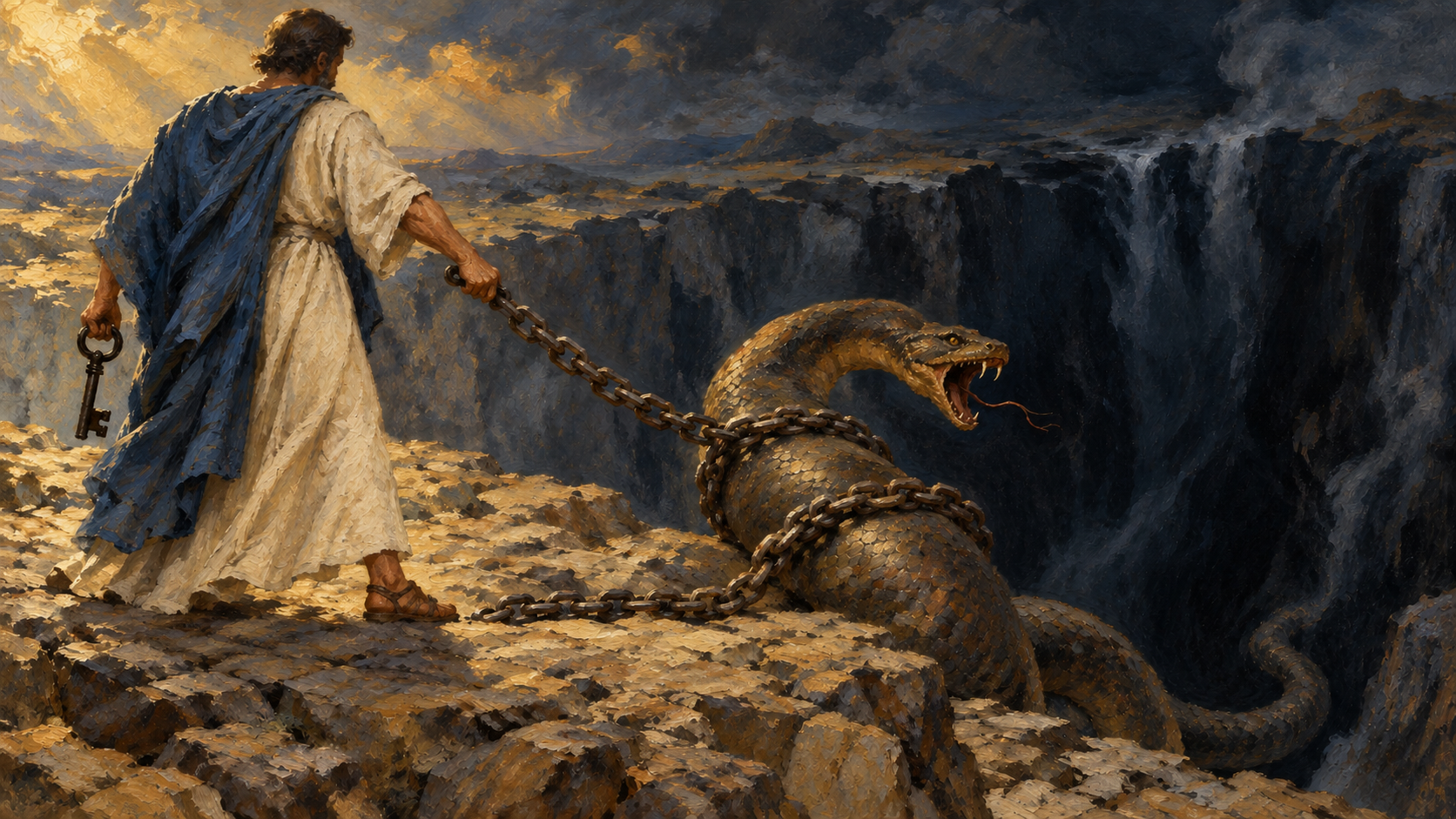
Then I saw an angel coming down from heaven, having the key to the bottomless pit and a great chain in his hand. He laid hold of the dragon, that serpent of old, who is the Devil and Satan, and bound him for a thousand years; and he cast him into the bottomless pit, and shut him up, and set a seal on him, so that he should deceive the nations no more till the thousand years were finished. But after these things he must be released for a little while.
Satan will be confined during Christ’s literal thousand-year reign, after Christ has returned bodily. John gives the purpose of that confinement: Satan will not be able to deceive the nations until the thousand years have ended.
When I compare that confinement with the evil and worldwide deception we see now, I cannot equate it with the church age. John describes a future act of God at a particular point in the prophetic sequence.
Notice that one angel carries out God’s sentence with ease. Satan may be formidable to human beings, but the angel’s task shows how limited he is before God. He cannot match divine authority.
Now when the thousand years have expired, Satan will be released from his prison and will go out to deceive the nations which are in the four corners of the earth, Gog and Magog, to gather them together to battle, whose number is as the sand of the sea. They went up on the breadth of the earth and surrounded the camp of the saints and the beloved city.
And fire came down from God out of heaven and devoured them. The devil, who deceived them, was cast into the lake of fire and brimstone where the beast and the false prophet are. And they will be tormented day and night forever and ever.
Even after a thousand years of Christ’s righteous government and abundant blessing, people who have not been born again will still be able to follow Satan when he is released. A heart that refuses God is not converted simply by living under perfect government.
The rebellion will gather rapidly, yet the prolonged contest Satan appears to expect will never develop. Fire from heaven will devour the attacking nations, and he will be taken directly to the judgment appointed for him.
Revelation 20:10 gives the devil a distinct sentence: torment day and night forever and ever. The beast and false prophet receive that sentence with him. After deceiving the nations and accusing the saints, this promoter of death will face a judgment from which he can never escape or return.
The account then moves to the Great White Throne, where unbelievers will be raised before God and judged before being cast into the Lake of Fire. Scripture calls this the second death and describes their fate as final death and destruction of both body and soul. Human beings do not possess an inherent immortality that preserves them in endless conscious torment.
I do not want to blur those judgments. Scripture explicitly gives Satan endless torment, while the final destruction of unbelieving humans is irreversible. God will end human evil rather than preserve it forever, and the devil will receive the distinct sentence assigned to him.
Living Vigilantly Without Fear
The Bible tells us about Satan so that we can recognize deception and resist temptation while continuing to trust Christ under accusation. It gives us no invitation to turn darkness into entertainment or pursue forbidden power out of curiosity.
A healthy church gives far more attention to the Lord than to the enemy. It teaches the full counsel of God, and its discipline should be governed by truth and love. Serious prayer need not become a spectacle of spiritual warfare. Leaders should protect people from abuse, including the use of demon language to manipulate them through fear.
Daily resistance may not look impressive to anyone watching. Reading Scripture carefully should lead us to tell the truth and turn away from what draws us into sin, whether that is pornography or media that encourages interest in the occult. In our relationships, we can forgive without pretending evil is acceptable, and we need to keep our covenant promises. We also resist together as we pray and share in the work of the gospel. If temptation is growing stronger, I should ask for help before secrecy hardens my heart.
These practices do not earn salvation or pay the price of remaining saved. Christ died for the whole world, and His genuine offer can be resisted, but every person is responsible to repent and believe. Everyone who truly believes is born again and receives the Holy Spirit, who indwells and seals that believer. The new life is eternally secure. Obedience is the faithful walk of people whom grace has already rescued.
My Final Thoughts
Satan is a real enemy, but I never want to speak about him as though he were God’s equal or the master of a believer’s future. Christ defeated him through His death and bodily resurrection. Everyone who is truly born again is sealed by the Holy Spirit, so we can stay watchful without living in fear. We resist by submitting to God and walking in the truth, not by turning spiritual warfare into a show. The devil’s judgment is certain, and our confidence rests in the Lord who has already won.