
Bethel was where God promised to keep Jacob as he left home and where Jacob later led his household back to worship. Generations afterward, Jeroboam set a golden calf there to keep the northern tribes loyal to his kingdom. I find that change sobering. People could stand in a place associated with God’s faithfulness while practicing worship He had forbidden. Following Bethel through Scripture helps us understand both the mercy God showed Jacob and the danger of using a respected religious past to excuse present disobedience.
God Met Jacob at Bethel
Jacob was traveling from Beersheba toward Haran because his family had been torn apart by deception. He had deceived Isaac to obtain the blessing Isaac intended to give Esau, and Esau planned to kill him. Rebekah urged Jacob to go to her brother Laban. Isaac sent him away with instructions about marriage and expressly gave him Abraham’s covenant blessing. Jacob left carrying that promise, but also living with the repercussions of what he had done.
When the sun went down, Jacob stopped for the night, placed a stone at his head, and lay down to sleep. Genesis does not describe him choosing the spot because he expected a revelation. God met him there and spoke before Jacob had built an altar or made a vow. His conduct had not earned him a reassuring word from the LORD.
Then he dreamed, and behold, a ladder was set up on the earth, and its top reached to heaven; and there the angels of God were ascending and descending on it.
And behold, the LORD stood above it and said: “I am the LORD God of Abraham your father and the God of Isaac; the land on which you lie I will give to you and your descendants.”
The Hebrew word translated ladder is sullam, also understood as a stairway. Whether we picture rungs or steps, Jacob saw a connection between heaven and earth, with God’s angels ascending and descending. The LORD stood above it and identified Himself as the God of Abraham and Isaac. The vision was not an invitation for Jacob to become preoccupied with angels or learn a technique for reaching heaven. God was revealing His presence and renewing His promise to the man lying on the ground.
God promised Jacob the land beneath him, descendants who would spread in every direction, and blessing reaching all the families of the earth. He also addressed the journey Jacob had just begun.
“Also your descendants shall be as the dust of the earth; you shall spread abroad to the west and the east, to the north and the south; and in you and in your seed all the families of the earth shall be blessed.
Behold, I am with you and will keep you wherever you go, and will bring you back to this land; for I will not leave you until I have done what I have spoken to you.”
Jacob was leaving Canaan, but he would not leave God’s care. The LORD promised to keep him wherever he went and bring him back. During the years ahead, Jacob would work for Laban, suffer deception himself, and live with bitter rivalry within his household. God’s promise did not mean those troubles would never happen. It meant the difficulties could not prevent Him from keeping His word and bringing Jacob home.
The promise also extended far beyond one man’s safe return. God was continuing the covenant He had made with Abraham and Isaac, including the land and the descendants through whom the Messiah would come. The blessing for all families would be fulfilled through Jesus Christ. I need to keep both parts of the promise in view rather than treating Jacob’s immediate need as the whole purpose of the vision.
When Jacob awoke, he recognized that the LORD had been present without his knowing it. His own words explain the fear he felt in response to what God had revealed.
Then Jacob awoke from his sleep and said, “Surely the LORD is in this place, and I did not know it.”
And he was afraid and said, “How awesome is this place! This is none other than the house of God, and this is the gate of heaven!”
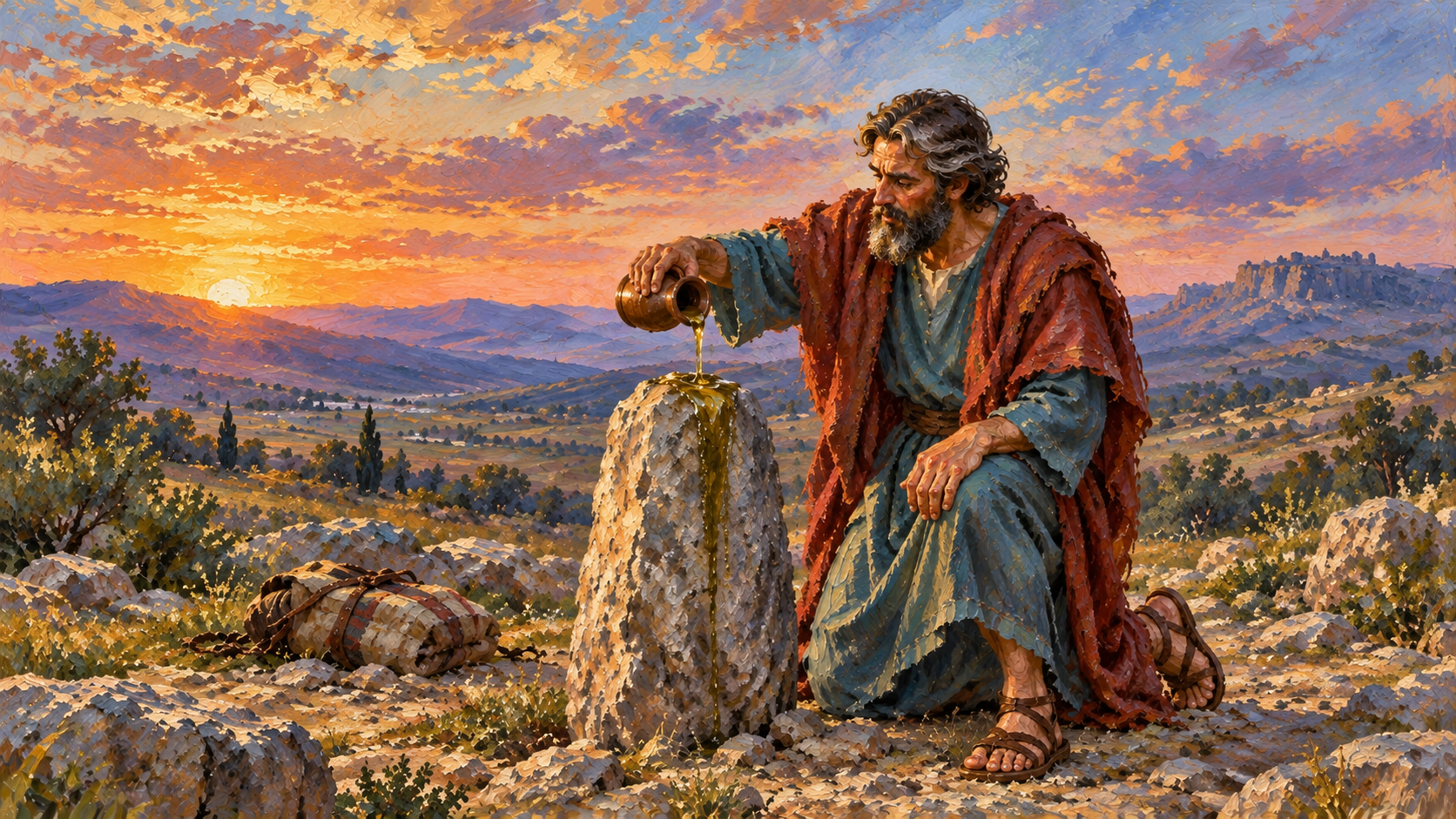
Early the next morning, Jacob raised the stone as a pillar and poured oil on it. He called the place Bethel, meaning House of God; the city had previously been called Luz. The new name recalled God’s appearance there. Jacob had not discovered a stone with power of its own, and the pillar could not control whether God stayed with him. The assurance came from the LORD’s promise. Genesis records the pillar as Jacob’s memorial of this revelation, not a command for Christians to create sacred objects.
Jacob then vowed that if God accompanied him, provided food and clothing, and brought him back to his father’s house in peace, the LORD would be his God. He also promised a tenth of what God gave him. Some readers understand the conditional wording as bargaining: Jacob would serve God only after receiving what he wanted. I can see why the wording raises that concern. Yet God had just promised His presence, protection, and Jacob’s return. In that context, I understand the vow primarily as Jacob’s response to what God had already pledged, though his faith still needed to grow.
Either way, the order is plain. God made His promise before Jacob made his vow. Jacob’s obedience was a response to grace, not a payment that persuaded God to begin caring for him. The study on Jacob’s ladder examines the vision more fully.
Returning to Bethel Meant Returning to Obedience
By Genesis 35, Jacob had returned to Canaan after years with Laban and had been reconciled with Esau. He had settled near Shechem, where a terrible family crisis followed. Shechem, the son of Hamor, violated Jacob’s daughter Dinah, and Simeon and Levi used a deceitful agreement to slaughter the city’s men. Jacob feared that the surrounding peoples would unite against his household. God called him back to Bethel in the aftermath of those events.
Then God said to Jacob, “Arise, go up to Bethel and dwell there; and make an altar there to God, who appeared to you when you fled from the face of Esau your brother.”
Jacob was to go there, dwell there, and build an altar to the God who had appeared when he fled from Esau. Before setting out, he told his household and everyone with him to put away their foreign gods, purify themselves, and change their clothes. They surrendered their idols and earrings, and Jacob hid them beneath the terebinth tree near Shechem. He could not sensibly lead them to worship the LORD while allowing them to carry their idols along.
As they traveled, God caused terror to fall on the surrounding cities, and no one pursued Jacob’s sons. Once at Bethel, Jacob built the altar and called the place El Bethel, meaning God of Bethel. The name directed attention to the One who had appeared there and had kept him throughout his journey. God blessed Jacob again, reaffirmed his name Israel, and renewed the promises of descendants, nations, kings, and land.
Jacob’s return joined gratitude with obedience. God had done what He promised, and Jacob now had to lead his household according to His word. Remembering the dream would not have excused keeping the idols. I should be grateful when I remember God’s help, but gratitude becomes a poor excuse if I use it to avoid dealing with disobedience He is exposing now. The fuller study of Jacob’s life follows the years between these two visits.
A Sacred Place Became a Center of False Worship
Bethel remained a place where Israelites sought the LORD. During the conflict with Benjamin in Judges 20, they went there to weep, fast, offer sacrifices, and inquire of Him. The ark of the covenant was there in those days, with Phinehas ministering before it. Yet the city’s association with Jacob and later worship did not guarantee that everyone who worshiped there afterward would be faithful.
After the kingdom divided, Jeroboam feared that journeys to Jerusalem for worship would draw the northern tribes back to the house of David. He devised a religious system to protect his political position. He made two golden calves and offered the people a convenient alternative to going where God had appointed.
Therefore the king asked advice, made two calves of gold, and said to the people, “It is too much for you to go up to Jerusalem. Here are your gods, O Israel, which brought you up from the land of Egypt!”
And he set up one in Bethel, and the other he put in Dan.
Jeroboam’s announcement echoed the language used during Israel’s golden-calf rebellion in the wilderness. He also appointed priests who were not sons of Levi, established a feast of his own choosing, and offered sacrifices on the altar at Bethel. These changes contradicted God’s commands. His concern about losing power did not give him authority to invent worship for the people.
I don’t want to reduce that rebellion to a disagreement about religious style. The king was directing Israel toward an image and replacing arrangements God had given with ones he had devised. Bethel’s name still meant House of God, but retaining the name did not make the calf acceptable. The study on Jeroboam considers how his political fear became a lasting influence on Israel’s worship.
God sent a man from Judah to confront the altar in 1 Kings 13. He announced that a future king named Josiah would judge it, a prophecy fulfilled much later in 2 Kings 23. People continued offering sacrifices there during the intervening generations, but the passage of time did not overturn God’s verdict. He had condemned that altar before Josiah was born.
Before Josiah’s reform, Amos had also confronted the worship practiced at Bethel and called the people away from it. Going to a place associated with God could not give them life while they refused the God they claimed to seek.
But do not seek Bethel, Nor enter Gilgal, Nor pass over to Beersheba; For Gilgal shall surely go into captivity, And Bethel shall come to nothing.
Seek the LORD and live, Lest He break out like fire in the house of Joseph, And devour it, With no one to quench it in Bethel.
That warning included a merciful invitation. The people could turn to the LORD and live, but they needed to abandon the corrupt worship they had made familiar. Visiting Bethel while persisting in rebellion would expose them to judgment. Hosea sharpened the rebuke by using Beth Aven, a name understood as House of Wickedness or House of Vanity, for Bethel. The worship practiced there contradicted the city’s honored name.
A church or ministry can face the same temptation to rely on its reputation. Perhaps faithful people taught Scripture there for years. That history deserves appreciation, but it cannot authorize a later leader to contradict Scripture or manipulate worship to protect his position. I need to judge the teaching and conduct being encouraged now. A respected name, an old building, or a memory of answered prayer cannot make disobedience holy. The study on idolatry examines what it means to give created things the allegiance owed to God.
Jesus Is the True Access Between Heaven and Earth
Bethel’s corruption did not cancel God’s covenant promise, including the blessing that would come through Jacob’s descendants. When Jesus spoke to Nathanael in John 1, He used the language of Jacob’s vision. Nathanael had confessed Him as the Son of God and King of Israel. Jesus answered by promising a greater revelation of who He was.
And He said to him, “Most assuredly, I say to you, hereafter you shall see heaven open, and the angels of God ascending and descending upon the Son of Man.”
In Jacob’s dream the angels ascended and descended on the ladder; Jesus spoke of their ascending and descending upon the Son of Man. I understand Him to be identifying Himself as the One through whom heaven and earth are truly joined. He was directing Nathanael to His own person, not instructing him to travel to Bethel. Jesus is fully God and fully man, the only Mediator between God and humanity. A mediator brings parties together, and only Christ can reconcile sinful people to God.
His saving work explains how that access is possible. The eternal Son became truly human through His virgin birth and lived without sin. Wicked men physically tortured Him and killed Him, but He willingly gave Himself for our sins. He bore the punishment in His innocent body and shed His blood, completing His saving sacrifice when He died. He was then buried and rose bodily from the dead. The Father did not punish, curse, abandon, strike, bruise, or pour wrath on Jesus; Father and Son were united in the work of saving us.
In Hebrews, Paul grounds our confidence to approach God in the blood Jesus shed. He calls believers to draw near because Christ has opened the way and serves as our High Priest.
Therefore, brethren, having boldness to enter the Holiest by the blood of Jesus,
by a new and living way which He consecrated for us, through the veil, that is, His flesh,
and having a High Priest over the house of God,
let us draw near with a true heart in full assurance of faith.
The Holiest recalls the inner sanctuary where access under the old covenant was restricted. Through Christ, believers can come to God with a true heart and full assurance of faith. We do not need to reach a particular city, possess an object from a sacred place, or reproduce Jacob’s dream. Nor can religious effort earn the welcome Christ provides. God offers salvation by grace, and everyone who turns to Jesus in repentance and faith receives forgiveness and access to the Father.
God’s House Is Built Through Christ
Because Christ has reconciled us to God, the New Testament also describes His people as God’s house. Peter calls believers living stones being built together, and he explains how their worship becomes acceptable.
You also, as living stones, are being built up a spiritual house, a holy priesthood, to offer up spiritual sacrifices acceptable to God through Jesus Christ.
The spiritual sacrifices Peter describes are acceptable through Jesus Christ. Belonging to God’s house does not make believers additional mediators or saviors. We remain dependent on the Lord who redeemed us, and God dwells among His people by the Spirit. Architecture and a carefully produced religious atmosphere cannot give a congregation that life.
In Ephesians 2, Paul describes God’s household as built on the foundation of the apostles and prophets, with Jesus Christ Himself as the chief cornerstone. Christ holds His people together, and the teaching given through His appointed witnesses governs the church. Calling ourselves God’s household does not give us permission to alter that teaching whenever obedience becomes inconvenient.
Jeroboam wanted worship to serve his own interests. Jacob, when called back to Bethel, required his household to leave its idols behind. I need to take that difference seriously in my own life. If I am protecting a practice Scripture condemns, a cherished memory of God’s kindness should lead me to acknowledge the sin and put it away. It cannot serve as evidence that He approves of everything I am doing now.
At the same time, Jacob’s years away from home remind me that God’s care is not confined to familiar surroundings or easy circumstances. He kept Jacob through hardship and corrected him without abandoning His promise. I can depend on the Lord while listening to His correction. Remembering His faithfulness should make me more willing to follow His word, including when it requires a costly change.
My Final Thoughts
God’s promise gave Bethel its significance, and no later corruption could make Him unfaithful. Yet the people who worshiped there were responsible for what they did with His word. I want to remember His mercy with gratitude and respond with present obedience. Above all, my confidence in approaching the Father rests in Jesus Christ, who has opened the way through His blood and is building His people into God’s household.