
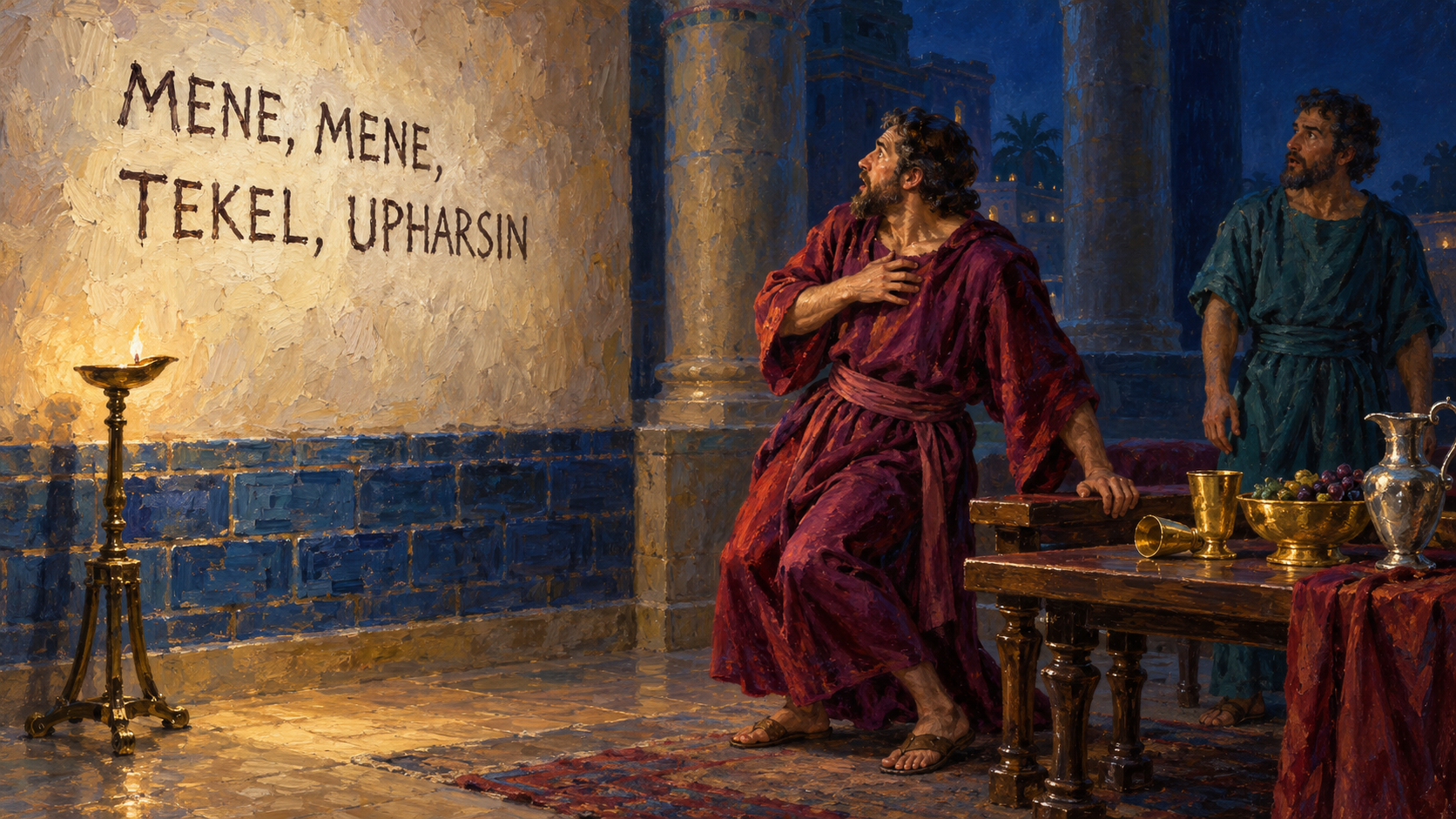
Belshazzar held his feast on the last night of his life. He drank before a thousand nobles, called for vessels taken from God’s temple, and used them to honor idols. A hand appeared on his palace wall, and the celebration gave way to terror. I find Daniel’s explanation of that judgment sobering because the king was not ignorant of God’s power. He knew how God had humbled Nebuchadnezzar and still refused to humble himself.
Belshazzar at the End of Babylon’s Glory
Years before this feast, Daniel had explained Nebuchadnezzar’s dream of a great image. Babylon was the head of gold, but another kingdom would follow it. Nebuchadnezzar’s reign had since ended, and the change Daniel foretold would come on the night of Belshazzar’s banquet.
Nebuchadnezzar’s humiliation had given Belshazzar a warning. After God restored Nebuchadnezzar’s reason, the king confessed that “those who walk in pride He is able to put down.” Belshazzar knew what had happened, yet did not take the warning to heart. The study on Nebuchadnezzar examines that judgment and restoration.
Belshazzar the king made a great feast for a thousand of his lords, and drank wine in the presence of the thousand.
A Feast That Defied the Living God
As Belshazzar drank, he ordered the vessels taken from Jerusalem’s temple to be brought into the feast. He wanted his guests to drink from objects that had been set apart for the Lord’s service.
While he tasted the wine, Belshazzar gave the command to bring the gold and silver vessels which his father Nebuchadnezzar had taken from the temple which had been in Jerusalem, that the king and his lords, his wives, and his concubines might drink from them.
Then they brought the gold vessels that had been taken from the temple of the house of God which had been in Jerusalem; and the king and his lords, his wives, and his concubines drank from them.
Babylon had those vessels because God had allowed Judah to be conquered as judgment for covenant unfaithfulness. Their capture did not prove Babylon’s gods were greater, and it did not make the vessels ordinary palace property for Belshazzar to use as he pleased. He was taking something consecrated, or set apart for God, and making it part of a pagan celebration. That deliberate disrespect for something sacred is called sacrilege.
The idolatry at this feast was especially brazen because they were using vessels from God’s house while honoring idols made from materials their own craftsmen could shape.
They drank wine, and praised the gods of gold and silver, bronze and iron, wood and stone.
Belshazzar knew how God had humbled Nebuchadnezzar, so his use of the temple vessels could not be excused as an innocent misunderstanding. He was publicly dishonoring the Lord while praising gods that could not see or hear. God interrupted that defiance with a sign the king could not explain.
In the same hour the fingers of a man’s hand appeared and wrote opposite the lampstand on the plaster of the wall of the king’s palace; and the king saw the part of the hand that wrote.
Then the king’s countenance changed, and his thoughts troubled him, so that the joints of his hips were loosened and his knees knocked against each other.
Belshazzar was now terrified before the same lords who had watched him drink. He cried out for Babylon’s religious advisers and promised a substantial reward to anyone who could explain the writing.
The king cried aloud to bring in the astrologers, the Chaldeans, and the soothsayers. The king spoke, saying to the wise men of Babylon, “Whoever reads this writing, and tells me its interpretation, shall be clothed with purple and have a chain of gold around his neck; and he shall be the third ruler in the kingdom.”
The wise men could neither read the writing nor explain it, and their failure left Belshazzar even more distressed. As in Daniel 2, when Babylon’s experts could not discover Nebuchadnezzar’s dream, the court needed knowledge those advisers could not supply.
Daniel Speaks Without Flattery
The queen came into the banquet hall and urged Belshazzar to summon Daniel, who was now an older man. She remembered the wisdom he had shown during Nebuchadnezzar’s reign, when he had explained what the other advisers could not.
There is a man in your kingdom in whom is the Spirit of the Holy God. And in the days of your father, light and understanding and wisdom, like the wisdom of the gods, were found in him; and King Nebuchadnezzar your father, your father the king, made him chief of the magicians, astrologers, Chaldeans, and soothsayers.
When Daniel arrived, Belshazzar repeated the offer of gifts and promotion. Daniel would explain the writing without bargaining for a reward. The king was offering him a place in the very kingdom whose end he was about to announce.
Then Daniel answered, and said before the king, “Let your gifts be for yourself, and give your rewards to another; yet I will read the writing to the king, and make known to him the interpretation.”
Before reading the inscription, Daniel reminded Belshazzar that the Most High had given Nebuchadnezzar his kingdom and honor. When pride hardened Nebuchadnezzar’s heart, God humbled him until he acknowledged who truly ruled. Belshazzar already knew all of this, and Daniel held him responsible for refusing to humble himself.
But you his son, Belshazzar, have not humbled your heart, although you knew all this.
And you have lifted yourself up against the Lord of heaven. They have brought the vessels of His house before you, and you and your lords, your wives and your concubines, have drunk wine from them. And you have praised the gods of silver and gold, bronze and iron, wood and stone, which do not see or hear or know; and the God who holds your breath in His hand and owns all your ways, you have not glorified.
When Daniel said “although you knew all this,” he was holding Belshazzar answerable for a warning he had chosen to disregard. The king was using the breath God sustained to praise idols that could neither see nor hear. His rank did not put him above the One on whom his life depended.
Numbered, Weighed, and Divided
Having told Belshazzar why his conduct was an offense against God, Daniel read the inscription and explained what it meant for both the king and the kingdom.
And this is the inscription that was written: MENE, MENE, TEKEL, UPHARSIN.
This is the interpretation of each word. MENE: God has numbered your kingdom, and finished it; TEKEL: You have been weighed in the balances, and found wanting; PERES: Your kingdom has been divided, and given to the Medes and Persians.
The inscription is in Aramaic, the language used from Daniel 2:4 through 7:28. Mene carries the idea of numbering or reckoning, and tekel of weighing. Peres refers to division; upharsin is the related plural form. Daniel explained how these words applied to Belshazzar’s kingdom: God had numbered it and brought it to an end, weighed its ruler and found him wanting, and announced its transfer to the Medes and Persians. We don’t need to search for hidden numerology when the passage supplies the interpretation.
A thousand nobles had gathered to feast with Belshazzar, but their presence could not change God’s verdict. I need to remember how readily a person’s rank or reputation can influence my judgment of him. God was weighing Belshazzar’s conduct, including his refusal to heed a warning he knew to be true.
Belshazzar ordered that Daniel receive the promised honors. That same night Belshazzar was slain, and Darius the Mede received the kingdom. God had fulfilled the message before the king had another day to reconsider.
History and Prophecy Meet in Babylon
Belshazzar offered Daniel third place in a kingdom whose senior king was Nabonidus. Belshazzar was Nabonidus’s son and exercised royal authority while his father was away. If the first two places were already occupied by those rulers, third place would have put Daniel immediately beneath them. This arrangement provides a reasonable explanation for the reward Daniel records.
According to the Nabonidus Chronicle, Nabonidus spent periods in Tayma while the prince, his officers, and the army were in Babylonia. The chronicle uses the name Akkad for Babylonia and also records Babylon’s capture in 539 BC. A separate cylinder inscription identifies Belshazzar as Nabonidus’s son. These records support Daniel’s description of Belshazzar exercising royal authority while Nabonidus remained king.
Daniel calls Nebuchadnezzar Belshazzar’s father and addresses Belshazzar as his son. I understand those terms in a broader royal or ancestral sense, since Nabonidus was Belshazzar’s immediate father. The exact family connection between Nebuchadnezzar and Belshazzar is not given. Daniel’s accusation rests on what Belshazzar knew about God’s humbling of that earlier king.
Babylon’s fall also fulfilled earlier prophecy. Jeremiah 25:11–12 had foretold a limited period of Babylonian rule, after which God would punish the nation. Isaiah 44–45 named Cyrus and described God opening the way before him. The dream Daniel interpreted in chapter 2 had already shown that another kingdom would follow Babylon. The study on the seventy weeks of Daniel considers a later prophetic revelation in the same book.
None of these prophecies forced Belshazzar to profane the vessels or praise idols. He was responsible for the rebellion Daniel condemned. God carried out His purpose without turning the king into a puppet or making his wicked choices blameless.
The Warning Reaches Beyond Belshazzar
I can know a biblical warning well enough to explain it to someone else and still resist what it requires of me. Belshazzar had not lacked information about God; he had refused to humble himself before Him. Before I look for something new to learn, I need to consider whether I am obeying what I already understand.
Proverbs 16:18 says, “Pride goes before destruction, And a haughty spirit before a fall.” Galatians 6:7 also warns that God is not mocked and that a man reaps what he sows. Belshazzar did not have another day to reconsider his conduct. We should not assume that we will, or take a delay in judgment as evidence that God approves.
Belshazzar’s misuse of the vessels also warns me about using the things of God for my own advantage. A person can handle Scripture to build a reputation, or make public prayer a performance for those listening. The ordinances and the church’s gathering must not be manipulated for entertainment or personal gain. Reverence requires us to use what He calls holy for His purposes, without turning worship into a means of promoting ourselves.
Daniel spoke God’s message without softening it to secure the king’s favor. That is the kind of counsel I need when Scripture exposes something I would rather excuse. If I choose teachers only because they affirm me, I can surround myself with approval while avoiding the correction I need.
Belshazzar could not use his wealth or authority to escape God’s judgment, and neither can I make myself acceptable to God through status or influence. The God who judges rightly has provided a Savior for sinners.
Jesus Christ, the sinless Son of God, willingly gave Himself to be slain as the perfect sacrifice for our sins. Wicked men mocked and beat Him before crucifying Him, but the Father did not punish or abandon Him. Father, Son, and Holy Spirit were united in providing salvation. Through His shed blood and death, Christ completed His saving sacrifice before His burial and bodily resurrection.
God invites us to turn to Christ in repentance and faith. We should receive His mercy now, without presuming that we will always have another opportunity.
My Final Thoughts
What unsettles me about Belshazzar is how much truth a person can know without yielding to it. I need to ask where Scripture has already corrected me and whether pride is keeping me from admitting that I am wrong. The king’s position and the company around him could not soften God’s verdict. I want to receive His correction now and seek mercy through Christ, instead of waiting for a crisis that may leave me no time to reconsider.