
In Daniel 4, Nebuchadnezzar told his subjects how God had taken away his reason and his kingdom, then restored both. A king who had admired his own majesty now publicly praised the King of heaven. I want to follow what brought him to that confession, including the warning he received before judgment came.
Nebuchadnezzar Had Already Seen God’s Power
Nebuchadnezzar addressed his proclamation to peoples of every nation and language, announcing the signs and wonders the Most High had worked toward him. He could speak about his humiliation because he was looking back on it after his restoration. The ruler who had demanded worship for his golden image was now declaring that God’s kingdom lasts from generation to generation.
He had already learned a great deal about the God of heaven. In Daniel 2, God revealed the king’s dream to Daniel and made known what would happen to successive earthly kingdoms. Daniel explained that God “removes kings and raises up kings” in Daniel 2:21. In Daniel 3, Nebuchadnezzar saw Shadrach, Meshach, and Abed-Nego survive the furnace into which he had ordered them thrown. They had refused to worship his image even under threat of death, and their deliverance compelled him to acknowledge their God’s power.
Those earlier encounters help explain the seriousness of the warning in chapter 4. Nebuchadnezzar knew that God could reveal what his advisers could not discover and rescue men from his own execution order. Nevertheless, he continued to exalt himself. Being impressed by God’s power had not brought him to submit humbly to God.
Daniel and his friends lived as Jewish exiles in Babylon, but the Lord’s authority had not been confined to the land they had lost. He ruled over their captors too. Nebuchadnezzar could command armies and decide the fate of whole peoples, yet he depended on God for the breath and understanding he needed to give an order. The broader study on King Nebuchadnezzar follows his encounters with the Lord through these opening chapters.
I read the judgment and restoration in Daniel 4 as events that actually happened. God warned this particular king, gave him time to turn, and then fulfilled His word. Treating the account as a moral fable would remove the very dealings with God that Nebuchadnezzar was announcing to his subjects.
The Great Tree and Daniel’s Warning
While enjoying peace and prosperity in his palace, Nebuchadnezzar had a frightening dream. His Babylonian wise men could not give him its interpretation. When Daniel came before him, the king described a tree in the middle of the earth whose size and abundance supported life all around it.
“The tree grew and became strong; Its height reached to the heavens, And it could be seen to the ends of all the earth. Its leaves were lovely, Its fruit abundant, And in it was food for all. The beasts of the field found shade under it, The birds of the heavens dwelt in its branches, And all flesh was fed from it.”
Daniel would identify that tree as Nebuchadnezzar himself. The picture acknowledged the extent of his rule and the benefits people received within his empire. Its grandeur was real. The question was whether the king would recognize who had allowed him to become so great.
As the king watched, a watcher, a holy one from heaven, ordered the tree cut down. This heavenly messenger called for its branches to be stripped, its fruit scattered, and the animals and birds driven away. The stump and roots, however, were to remain in the ground, bound with iron and bronze. The announcement then turned from the tree to a man who would live among the beasts and lose his human understanding for an appointed period.
“This decision is by the decree of the watchers, And the sentence by the word of the holy ones, In order that the living may know That the Most High rules in the kingdom of men, Gives it to whomever He will, And sets over it the lowest of men.”
The watchers were not issuing a sentence independently of God. Daniel later explained that it was the decree of the Most High (Daniel 4:24). Its stated purpose reached beyond Nebuchadnezzar: the living were to learn that God rules over human kingdoms and gives authority to whomever He chooses. Even the lowliest man can be raised to a throne by His decision. A royal title therefore gives no one grounds to regard himself as independent of God.
When the king finished describing the dream, Daniel was troubled by its meaning. He told Nebuchadnezzar that he wished it concerned the king’s enemies, then plainly identified him as the tree that would be cut down. His respect for the king did not allow him to conceal what God had said.
“They shall drive you from men, your dwelling shall be with the beasts of the field, and they shall make you eat grass like oxen. They shall wet you with the dew of heaven, and seven times shall pass over you, till you know that the Most High rules in the kingdom of men, and gives it to whomever He chooses.”
The “seven times” are commonly understood as seven years, a reasonable reading also noted in the NET Bible’s note on Daniel 4:16. The passage emphasizes that God had appointed the period and its purpose: the king would learn that the Most High rules. This judgment would have an end.
Daniel also explained why the stump and roots remained. The kingdom would be preserved for Nebuchadnezzar until he recognized that heaven rules (Daniel 4:26). The destruction of the tree did not mean that God intended to destroy the king altogether. Along with the sentence, he received a promise of restoration.
Daniel then appealed to him to turn from his sins. He did not tell Nebuchadnezzar to sit helplessly and wait for disaster.
“Therefore, O king, let my advice be acceptable to you; break off your sins by being righteous, and your iniquities by showing mercy to the poor. Perhaps there may be a lengthening of your prosperity.”
Notice how specific the counsel was. Nebuchadnezzar needed to do what was righteous and show mercy to the poor. Repentance would reach into the way he governed and treated people who had little power to defend themselves. Daniel was not offering a charitable payment that would purchase God’s favor. He was calling the king to abandon sinful conduct, with the possibility that his prosperity might be prolonged. The word “Perhaps” in the appeal should keep us from turning it into an unconditional guarantee.
I appreciate the way Daniel delivered that warning. He was troubled over what would happen to a pagan ruler, yet he spoke directly about the ruler’s sins. We can tell someone the truth without taking pleasure in the judgment he faces. Daniel could not make the king repent, but he could explain the danger honestly and urge him to turn while there was time.
The Proud King Was Humbled Like a Beast
Twelve months passed. God had not struck Nebuchadnezzar the moment Daniel finished speaking, and I see mercy in that opportunity to repent. Yet a year later, as the king walked about his royal palace, he was still admiring his own greatness.
The king spoke, saying, “Is not this great Babylon, that I have built for a royal dwelling by my mighty power and for the honor of my majesty?”
Listen to where he placed the credit: “I have built,” “my mighty power,” and “my majesty.” Babylon’s splendor became an occasion for him to glorify himself. His achievements were real, but neither his ability nor his authority made him the ultimate source of what he possessed. He had already been told that the God who raises kings could remove him.
The delay had given him no permission to disregard that warning. Before he had even finished his boast, a voice from heaven interrupted him.
While the word was still in the king’s mouth, a voice fell from heaven: “King Nebuchadnezzar, to you it is spoken: the kingdom has departed from you!”
The sentence took effect that very hour. The man who had spoken so confidently of his royal majesty could no longer retain his place among other people.
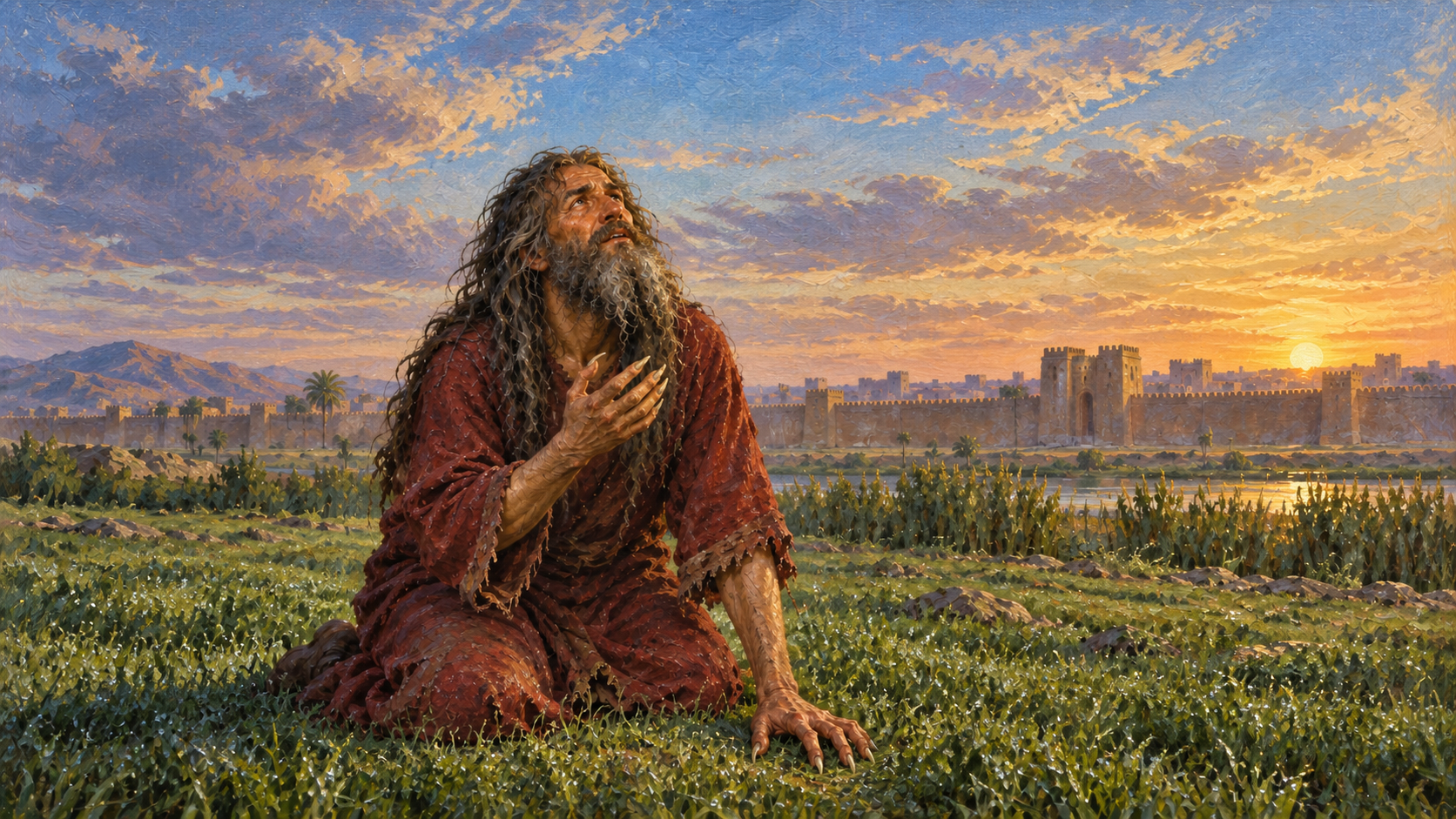
That very hour the word was fulfilled concerning Nebuchadnezzar; he was driven from men and ate grass like oxen; his body was wet with the dew of heaven till his hair had grown like eagles’ feathers and his nails like birds’ claws.
Daniel described Nebuchadnezzar living like an animal, not being transformed into one. The king had lost the understanding needed for ordinary human life, let alone the government of an empire. Neither his title nor the splendor of his palace could preserve his dignity when God carried out the sentence.
I would not attach a modern psychiatric diagnosis to this description. The passage identifies God’s judgment as the cause of this particular humiliation and explains what the king was to learn from it. Nebuchadnezzar had received a specific warning from God, and what followed fulfilled that warning.
Reason Restored and Pride Replaced With Praise
When the appointed period ended, Nebuchadnezzar could describe his recovery for himself:
And at the end of the time I, Nebuchadnezzar, lifted my eyes to heaven, and my understanding returned to me; and I blessed the Most High and praised and honored Him who lives forever: For His dominion is an everlasting dominion, And His kingdom is from generation to generation.
I understand his look toward heaven as a sign of repentance. His own words show the change: the king who had boasted about his majesty now honored the One whose kingdom outlasts every generation. His restored understanding did not lead him back to congratulating himself.
All the inhabitants of the earth are reputed as nothing; He does according to His will in the army of heaven And among the inhabitants of the earth. No one can restrain His hand Or say to Him, “What have You done?”
Nebuchadnezzar acknowledged that God acts according to His will in heaven and on earth. No ruler can restrain Him or summon Him to answer as though He were a subordinate. The king had experienced the limits of human power when he could not preserve his own reason. He now confessed that God’s dominion has no such limit.
His counselors and nobles sought him again, and his royal honor was restored. God had fulfilled the promise represented by the stump. The throne Nebuchadnezzar had treated as his personal achievement was given back to him, and his proclamation ended by crediting the King of heaven.
“Now I, Nebuchadnezzar, praise and extol and honor the King of heaven, all of whose works are truth, and His ways justice. And those who walk in pride He is able to put down.”
These are strong words, and I see no reason to brush them aside. Nebuchadnezzar publicly acknowledged God’s truth, justice, and power to humble the proud. At the same time, the chapter does not give his full later history or explicitly settle the question of his final spiritual state. I can rejoice in the confession Daniel records without claiming that it supplies every detail of the king’s salvation.
What Daniel 4 Teaches About Pride and Mercy
Daniel’s prophecies describe earthly kingdoms giving way to the kingdom God will establish. Here, that teaching reaches into the life of the man ruling Babylon. Nebuchadnezzar’s kingdom was temporary, his authority was received, and his conduct remained subject to God’s judgment. Psalm 103:19 likewise teaches that the Lord has established His throne in heaven and that His kingdom rules over all.
That gives me confidence when rulers speak as though they control everyone’s future. Their power to harm is real; Nebuchadnezzar had ordered men executed and subjected whole peoples to his rule. Yet he could not place himself beyond God’s reach. The Lord can remove a ruler, protect His servants, or bring a powerful man to confess the truth. His servants can trust Him without assuming that faithfulness will spare them every hardship.
Daniel’s conduct also helps us respond to earthly authority. He served faithfully and addressed the king respectfully, while telling him that he needed to repent. Respect did not require flattery or silence about sin. When God’s word exposed the king’s wrongdoing, Daniel gave him the warning he needed to hear.
It would be easy to agree with Daniel about an arrogant emperor and overlook the same presumption in an ordinary home or workplace. A person can work hard, acquire skill, and accomplish something worthwhile, then speak as though he owes nothing to God. He may even resent correction because success has convinced him that he knows better. The study on the pride of men considers that refusal to acknowledge our dependence on the Lord.
Proverbs 16:18 warns that pride goes before destruction. James 4:6 and 1 Peter 5:5 teach that God resists the proud and gives grace to the humble. Nebuchadnezzar could not dismiss God’s warning forever, and we have no reason to assume that we will always have more time to respond to correction. When we know that we are wrong, we need to turn.
Daniel’s counsel about the poor also keeps humility practical. Someone who acknowledges God’s authority should use his own authority with care for the people under it. A boss who boasts about his success while mistreating his workers has reason to examine more than his vocabulary. A parent who will never admit wrongdoing needs to repent of the conduct, not merely learn to sound less confident. True humility involves accepting correction and treating others rightly before God.
We find the fullest example of humility in Christ. Jesus is the true King, fully God and fully man, yet He willingly took the form of a servant. Though worthy of every honor, He gave Himself for sinners. Wicked men inflicted His bodily suffering and death, but He voluntarily shed His blood and completed His saving work in that death before rising bodily from the grave. We need more than an improvement in manners; we need to turn from sin and trust the King who saves us.
My Final Thoughts
Nebuchadnezzar received a clear warning and a year in which to respond. His continued boasting ended in the humiliation Daniel had foretold, but God also fulfilled His promise to restore him. I want to take both the warning and that mercy seriously. Our accomplishments give us no excuse to disregard the Lord or mistreat people under our care. When He corrects us, the right response is to turn to Him and obey. The restored king finally honored the One whose works are truth and whose ways are just, and his own proclamation calls every reader to recognize who rules over us.