
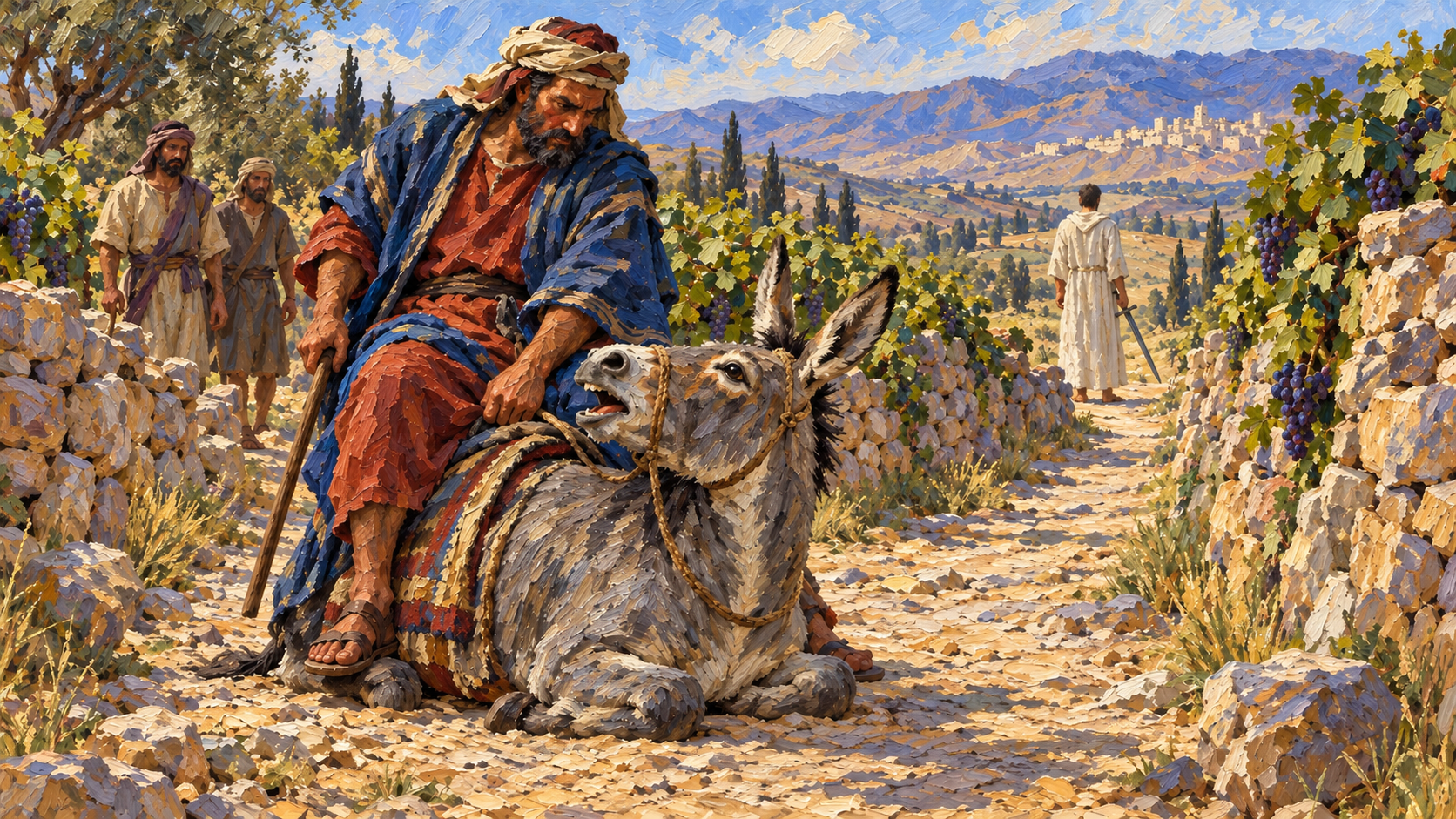
Balaam heard his own donkey speak, but that miracle did not end his pursuit of corrupt gain. Why did the LORD stop him on the road and then let him continue? God later put blessings in Balaam’s mouth, yet Balaam went on to counsel Israel’s corruption at Peor. We need to follow those events to understand the encounter on the road.
Balak Hires Balaam Against Israel
Israel had completed the wilderness years and defeated the Amorite kings Sihon and Og east of the Jordan. The people were now camped in the plains of Moab, across the river from Jericho. Balak, Moab’s king, saw their numbers and knew what had happened to the Amorites. He feared that Israel would consume his country and sought a curse to help him defeat them.
Then the children of Israel moved, and camped in the plains of Moab on the side of the Jordan across from Jericho. Now Balak the son of Zippor saw all that Israel had done to the Amorites. And Moab was exceedingly afraid of the people because they were many, and Moab was sick with dread because of the children of Israel. So Moab said to the elders of Midian, “Now this company will lick up everything around us, as an ox licks up the grass of the field.” And Balak the son of Zippor was king of the Moabites at that time. Then he sent messengers to Balaam the son of Beor at Pethor, which is near the River in the land of the sons of his people, to call him, saying: “Look, a people has come from Egypt. See, they cover the face of the earth, and are settling next to me! Therefore please come at once, curse this people for me, for they are too mighty for me. Perhaps I shall be able to defeat them and drive them out of the land, for I know that he whom you bless is blessed, and he whom you curse is cursed.” So the elders of Moab and the elders of Midian departed with the diviner’s fee in their hand, and they came to Balaam and spoke to him the words of Balak. And he said to them, “Lodge here tonight, and I will bring back word to you, as the LORD speaks to me.” So the princes of Moab stayed with Balaam. Then God came to Balaam and said, “Who are these men with you?” So Balaam said to God, “Balak the son of Zippor, king of Moab, has sent to me, saying, ‘Look, a people has come out of Egypt, and they cover the face of the earth. Come now, curse them for me; perhaps I shall be able to overpower them and drive them out.'” And God said to Balaam, “You shall not go with them; you shall not curse the people, for they are blessed.” So Balaam rose in the morning and said to the princes of Balak, “Go back to your land, for the LORD has refused to give me permission to go with you.” And the princes of Moab rose and went to Balak, and said, “Balaam refuses to come with us.”
Balak sent Moabite and Midianite elders to Balaam at Pethor, near the River, generally understood as the Euphrates. They carried a diviner’s fee, hoping to obtain spiritual power against Israel. Balak trusted Balaam’s ability to bless or curse, but the LORD’s answer left no room for the result the king wanted. Israel was already blessed. Balaam must neither curse the people nor go with the men.
Scripture does not present Balaam as a faithful Israelite prophet. Joshua 13:22 calls him a soothsayer, a practitioner of divination, which seeks hidden knowledge or spiritual direction through forbidden means. Yet the LORD really did speak to him, and the Spirit later gave him a true oracle, a prophetic message. We need to recognize those genuine experiences without overlooking Scripture’s judgment of the man who received them.
The New Testament tells us that Balaam loved unrighteous wages. I cannot therefore take his religious vocabulary, or even the true words God made him speak, as proof of a faithful heart. God restrained him without approving his religion or the corrupt purpose he wanted it to serve.
After the first delegation returned, Balak sent more numerous and more distinguished princes, promising great honor. Balaam replied that even a house full of silver and gold could not take him beyond the LORD’s word. Then he invited them to stay while he asked God what more He would say. God had already declared Israel blessed, but Balaam reopened the request when the offer became more attractive.
The Angel of the LORD and the Talking Donkey
God’s second answer allowed Balaam to travel if the men came to call him, with the restriction that he do only what God said. The permission did not remove that obligation or approve his corrupt purpose. On the road, the LORD confronted him.
Then Balak again sent princes, more numerous and more honorable than they. And they came to Balaam and said to him, “Thus says Balak the son of Zippor: ‘Please let nothing hinder you from coming to me; for I will certainly honor you greatly, and I will do whatever you say to me. Therefore please come, curse this people for me.'” Then Balaam answered and said to the servants of Balak, “Though Balak were to give me his house full of silver and gold, I could not go beyond the word of the LORD my God, to do less or more. Now therefore, please, you also stay here tonight, that I may know what more the LORD will say to me.” And God came to Balaam at night and said to him, “If the men come to call you, rise and go with them; but only the word which I speak to you–that you shall do.” So Balaam rose in the morning, saddled his donkey, and went with the princes of Moab. Then God’s anger was aroused because he went, and the Angel of the LORD took His stand in the way as an adversary against him. And he was riding on his donkey, and his two servants were with him. Now the donkey saw the Angel of the LORD standing in the way with His drawn sword in His hand, and the donkey turned aside out of the way and went into the field. So Balaam struck the donkey to turn her back onto the road. Then the Angel of the LORD stood in a narrow path between the vineyards, with a wall on this side and a wall on that side. And when the donkey saw the Angel of the LORD, she pushed herself against the wall and crushed Balaam’s foot against the wall; so he struck her again. Then the Angel of the LORD went further, and stood in a narrow place where there was no way to turn either to the right hand or to the left. And when the donkey saw the Angel of the LORD, she lay down under Balaam; so Balaam’s anger was aroused, and he struck the donkey with his staff. Then the LORD opened the mouth of the donkey, and she said to Balaam, “What have I done to you, that you have struck me these three times?” And Balaam said to the donkey, “Because you have abused me. I wish there were a sword in my hand, for now I would kill you!” So the donkey said to Balaam, “Am I not your donkey on which you have ridden, ever since I became yours, to this day? Was I ever disposed to do this to you?” And he said, “No.” Then the LORD opened Balaam’s eyes, and he saw the Angel of the LORD standing in the way with His drawn sword in His hand; and he bowed his head and fell flat on his face. And the Angel of the LORD said to him, “Why have you struck your donkey these three times? Behold, I have come out to stand against you, because your way is perverse before Me. The donkey saw Me and turned aside from Me these three times. If she had not turned aside from Me, surely I would also have killed you by now, and let her live.” And Balaam said to the Angel of the LORD, “I have sinned, for I did not know You stood in the way against me. Now therefore, if it displeases You, I will turn back.” Then the Angel of the LORD said to Balaam, “Go with the men, but only the word that I speak to you, that you shall speak.” So Balaam went with the princes of Balak.
Why was God angry after permitting Balaam to go? The Angel states the problem: Balaam’s way was perverse before Him. Permission to travel had not become approval of the greed driving the journey. Some explain the anger by suggesting Balaam left before the princes called him. Numbers records his rising and saddling the donkey without repeating their summons, but it does not say that he violated that condition. The Angel’s own explanation directs us to the wrongness of his way.
The donkey first saw the Angel’s drawn sword and turned into a field. Balaam struck her to force her back onto the road. When the Angel stood in the narrow path between vineyard walls, she pressed against a wall and crushed Balaam’s foot, and he struck her again. At the third obstruction, she had nowhere to turn and lay down beneath him. Furious, Balaam beat her with his staff.
The very actions Balaam punished were keeping him alive. Unable to see the danger, he treated the donkey’s resistance as an affront. When the LORD opened her mouth, she appealed to the faithful service Balaam knew she had given him. Had she ever behaved like this before? He admitted she had not.
Balaam wished for a sword so he could kill her, while a sword was already drawn against him. Numbers records his angry reply without describing his surprise at hearing her speak. We are given the exchange itself: the donkey’s reasonable appeal and the diviner’s threat against the animal that had protected him. Peter later confirms that the mute donkey spoke with a man’s voice and restrained the prophet’s madness. This was an actual miracle, not a fable about being kind to animals.
The LORD then opened Balaam’s eyes, and he saw the Angel with His sword drawn. He bowed and fell flat before the Messenger, who explained that the donkey’s turning aside had spared his life. Without it, the Angel would have killed Balaam and left her alive. The man Balak trusted for spiritual insight had needed an animal’s intervention and sight from God to recognize the danger before him.
Balaam had been spared, but the drawn sword and the Angel’s words left no doubt about the danger he faced. He confessed that he had sinned and offered to turn back if the journey displeased the Angel. The answer allowed him to continue, but only to speak the word given to him. His later conduct shows that admitting sin in this crisis did not end his desire for corrupt gain.
The Angel of the LORD is the preincarnate Christ, the eternal Son appearing before His birth in Bethlehem. Such an appearance before He became man is called a Christophany. The Hebrew mal’ak means messenger; it names a role without deciding whether the messenger is created or divine. Here He judges Balaam’s way, holds his life in His hands, and determines the exact word he must speak. I understand this encounter within the wider pattern in Genesis, Exodus, Judges, and Zechariah, where this Messenger acts and speaks with divine authority. The studies on the Angel of the LORD and Christophanies in the Old Testament examine those passages in greater detail.
This particular encounter gives me no basis for saying that animals normally see hidden spiritual realities. God used the donkey to expose Balaam’s blindness and stop him before he died. He warned and restrained Balaam without taking away his responsibility for pursuing the reward he wanted.
God Turns the Curse into Blessing
Balak still wanted Israel cursed when Balaam arrived. At the first location, Balaam called for seven altars and sacrifices, then went aside to find out what the LORD would reveal. The king could arrange the offerings, but the words Balaam brought back would come from God.
Then Balaam said to Balak, “Build seven altars for me here, and prepare for me here seven bulls and seven rams.” And Balak did just as Balaam had spoken, and Balak and Balaam offered a bull and a ram on each altar. Then Balaam said to Balak, “Stand by your burnt offering, and I will go; perhaps the LORD will come to meet me, and whatever He shows me I will tell you.” So he went to a desolate height. And God met Balaam, and he said to Him, “I have prepared the seven altars, and I have offered on each altar a bull and a ram.” Then the LORD put a word in Balaam’s mouth, and said, “Return to Balak, and thus you shall speak.” So he returned to him, and there he was, standing by his burnt offering, he and all the princes of Moab. And he took up his oracle and said: “Balak the king of Moab has brought me from Aram, From the mountains of the east. ‘Come, curse Jacob for me, And come, denounce Israel!’ “How shall I curse whom God has not cursed? And how shall I denounce whom the LORD has not denounced? For from the top of the rocks I see him, And from the hills I behold him; There! A people dwelling alone, Not reckoning itself among the nations. “Who can count the dust of Jacob, Or number one-fourth of Israel? Let me die the death of the righteous, And let my end be like his!” Then Balak said to Balaam, “What have you done to me? I took you to curse my enemies, and look, you have blessed them bountifully!” So he answered and said, “Must I not take heed to speak what the LORD has put in my mouth?”
The LORD put His word in Balaam’s mouth. As Balaam looked upon Israel dwelling apart, he asked how he could curse a people God had not cursed. Balak had sought a hired weapon against Israel; instead, he heard a public blessing over them. Neither his complaint nor his demand could change the word Balaam had been commanded to speak.
Balaam also wished to die the death of the righteous. Later events make those words painful to read: he desired their end without choosing a faithful walk before their God. He could speak truly about Israel’s blessed condition while continuing to pursue a reward for harming the nation.
Balak responded by taking Balaam to another location, where he would see only the outer part of Israel’s camp. He asked for the curse again, hoping a different view would produce a different answer.
Then Balak said to him, “Please come with me to another place from which you may see them; you shall see only the outer part of them, and shall not see them all; curse them for me from there.” So he brought him to the field of Zophim, to the top of Pisgah, and built seven altars, and offered a bull and a ram on each altar. And he said to Balak, “Stand here by your burnt offering while I meet the LORD over there.” Then the LORD met Balaam, and put a word in his mouth, and said, “Go back to Balak, and thus you shall speak.” So he came to him, and there he was, standing by his burnt offering, and the princes of Moab were with him. And Balak said to him, “What has the LORD spoken?” Then he took up his oracle and said: “Rise up, Balak, and hear! Listen to me, son of Zippor! “God is not a man, that He should lie, Nor a son of man, that He should repent. Has He said, and will He not do? Or has He spoken, and will He not make it good? Behold, I have received a command to bless; He has blessed, and I cannot reverse it. “He has not observed iniquity in Jacob, Nor has He seen wickedness in Israel. The LORD his God is with him, And the shout of a King is among them. God brings them out of Egypt; He has strength like a wild ox. “For there is no sorcery against Jacob, Nor any divination against Israel. It now must be said of Jacob And of Israel, ‘Oh, what God has done!’ Look, a people rises like a lioness, And lifts itself up like a lion; It shall not lie down until it devours the prey, And drinks the blood of the slain.” Then Balak said to Balaam, “Neither curse them at all, nor bless them at all!” So Balaam answered and said to Balak, “Did I not tell you, saying, ‘All that the LORD speaks, that I must do’?”
God does not lie, and He will not break His promise because a man keeps pressing Him to do so. Balak could change the view, repeat the sacrifices, and renew his demand, but he could not bargain the LORD out of His word. Balaam had been commanded to bless Israel and could not reverse that blessing.
We should not take that faithfulness to mean God is impersonal or indifferent to prayer and repentance. He responds in ways consistent with His truth. Here He had declared His blessing over Israel, and no enchantment could make Him betray it.
The language about God not observing iniquity in Jacob does not mean no Israelite had ever sinned. Numbers records judgments on Israel’s wrongdoing before and after these oracles. Here the LORD declares His presence and blessing over the nation against Balak’s attempt to curse it. That covenant protection did not excuse the people’s later conduct at Peor.
At the third location, Balaam no longer went out to seek sorcery as he had before. He looked toward the wilderness, saw Israel camped by tribes, and received another oracle when the Spirit of God came upon him.
Now when Balaam saw that it pleased the LORD to bless Israel, he did not go as at other times, to seek to use sorcery, but he set his face toward the wilderness. And Balaam raised his eyes, and saw Israel encamped according to their tribes; and the Spirit of God came upon him. Then he took up his oracle and said: “The utterance of Balaam the son of Beor, The utterance of the man whose eyes are opened, The utterance of him who hears the words of God, Who sees the vision of the Almighty, Who falls down, with eyes wide open: “How lovely are your tents, O Jacob! Your dwellings, O Israel! Like valleys that stretch out, Like gardens by the riverside, Like aloes planted by the LORD, Like cedars beside the waters. He shall pour water from his buckets, And his seed shall be in many waters. “His king shall be higher than Agag, And his kingdom shall be exalted. “God brings him out of Egypt; He has strength like a wild ox; He shall consume the nations, his enemies; He shall break their bones And pierce them with his arrows. ‘He bows down, he lies down as a lion; And as a lion, who shall rouse him?’ “Blessed is he who blesses you, And cursed is he who curses you.” Then Balak’s anger was aroused against Balaam, and he struck his hands together; and Balak said to Balaam, “I called you to curse my enemies, and look, you have bountifully blessed them these three times! Now therefore, flee to your place. I said I would greatly honor you, but in fact, the LORD has kept you back from honor.” So Balaam said to Balak, “Did I not also speak to your messengers whom you sent to me, saying, ‘If Balak were to give me his house full of silver and gold, I could not go beyond the word of the LORD, to do good or bad of my own will. What the LORD says, that I must speak’? And now, indeed, I am going to my people. Come, I will advise you what this people will do to your people in the latter days.” So he took up his oracle and said: “The utterance of Balaam the son of Beor, And the utterance of the man whose eyes are opened; The utterance of him who hears the words of God, And has the knowledge of the Most High, Who sees the vision of the Almighty, Who falls down, with eyes wide open: “I see Him, but not now; I behold Him, but not near; A Star shall come out of Jacob; A Scepter shall rise out of Israel, And batter the brow of Moab, And destroy all the sons of tumult. “And Edom shall be a possession; Seir also, his enemies, shall be a possession, While Israel does valiantly. Out of Jacob One shall have dominion, And destroy the remains of the city.”
The third oracle described Israel flourishing and its kingdom growing strong, with a blessing for those who blessed the nation and a curse for those who cursed it. Balak struck his hands together in anger. Three attempts had produced three blessings. He blamed the LORD for depriving Balaam of the honor he had offered, acknowledging how completely his effort to obtain a curse had failed.
Balaam then announced a coming King through the images of a Star from Jacob and a Scepter from Israel. The prophecy promises royal dominion over hostile powers and recalls Jacob’s earlier words about Judah’s scepter and Shiloh. Israel’s later victories over Moab and Edom anticipate that dominion, but I do not see an ordinary king exhausting the promise. Its final fulfillment belongs to Jesus, the Son of David, whose rule will prevail over every enemy.
Numbers 24 does not explain the star the wise men later saw in Matthew. I would not insist that the two signs must be identical. Here the Star and Scepter proclaim the coming Ruler and His dominion. That promise was true because the Spirit gave it, despite the corruption of the man through whom He spoke.
I can trust an oracle God has preserved in inspired Scripture without trusting Balaam as a spiritual guide. God governed the words he spoke on these occasions; He did not approve the man’s life. A teacher today remains accountable to the written Word for both his teaching and his conduct. Being useful gives him no exemption from either responsibility.
Deuteronomy gives the reason God turned the intended curse into blessing.
“An Ammonite or Moabite shall not enter the assembly of the LORD; even to the tenth generation none of his descendants shall enter the assembly of the LORD forever, because they did not meet you with bread and water on the road when you came out of Egypt, and because they hired against you Balaam the son of Beor from Pethor of Mesopotamia, to curse you. Nevertheless the LORD your God would not listen to Balaam, but the LORD your God turned the curse into a blessing for you, because the LORD your God loves you. You shall not seek their peace nor their prosperity all your days forever.
The LORD loved Israel. Divination and a king’s money could not overturn His covenant purpose. I can therefore reject occult practices without fearing them as a power equal to God. Their evil is real, but they cannot force Him to abandon His promises. That confidence is not a guarantee that His people will escape every hardship.
When Micah later confronted Israel’s unfaithfulness, he called the people to remember that protection. The LORD had not failed them; He asked them to consider what He had done on their behalf.
Hear now what the LORD says: “Arise, plead your case before the mountains, And let the hills hear your voice. Hear, O you mountains, the LORD’s complaint, And you strong foundations of the earth; For the LORD has a complaint against His people, And He will contend with Israel. “O My people, what have I done to you? And how have I wearied you? Testify against Me. For I brought you up from the land of Egypt, I redeemed you from the house of bondage; And I sent before you Moses, Aaron, and Miriam. O My people, remember now What Balak king of Moab counseled, And what Balaam the son of Beor answered him, From Acacia Grove to Gilgal, That you may know the righteousness of the LORD.” With what shall I come before the LORD, And bow myself before the High God? Shall I come before Him with burnt offerings, With calves a year old? Will the LORD be pleased with thousands of rams, Ten thousand rivers of oil? Shall I give my firstborn for my transgression, The fruit of my body for the sin of my soul? He has shown you, O man, what is good; And what does the LORD require of you But to do justly, To love mercy, And to walk humbly with your God?
The LORD reminded His people that He had brought them out of bondage and protected them against Balak’s counsel. Recognizing His righteousness should have led them to act justly, love mercy, and walk humbly with Him. No elaborate offering could compensate for refusing that faithful life. They were to remember His protection and respond in obedience.
Balaam’s Counsel and the Sin at Peor
Balaam could not defeat God’s blessing by pronouncing a curse, so he advised another way to harm Israel. We learn what he did by reading beyond the oracles: Numbers 25 records Israel’s sin at Peor, and Numbers 31 later identifies the counsel behind it.
Now Israel remained in Acacia Grove, and the people began to commit harlotry with the women of Moab. They invited the people to the sacrifices of their gods, and the people ate and bowed down to their gods. So Israel was joined to Baal of Peor, and the anger of the LORD was aroused against Israel. Then the LORD said to Moses, “Take all the leaders of the people and hang the offenders before the LORD, out in the sun, that the fierce anger of the LORD may turn away from Israel.” So Moses said to the judges of Israel, “Every one of you kill his men who were joined to Baal of Peor.” And indeed, one of the children of Israel came and presented to his brethren a Midianite woman in the sight of Moses and in the sight of all the congregation of the children of Israel, who were weeping at the door of the tabernacle of meeting. Now when Phinehas the son of Eleazar, the son of Aaron the priest, saw it, he rose from among the congregation and took a javelin in his hand; and he went after the man of Israel into the tent and thrust both of them through, the man of Israel, and the woman through her body. So the plague was stopped among the children of Israel. And those who died in the plague were twenty-four thousand. Then the LORD spoke to Moses, saying: “Phinehas the son of Eleazar, the son of Aaron the priest, has turned back My wrath from the children of Israel, because he was zealous with My zeal among them, so that I did not consume the children of Israel in My zeal. Therefore say, ‘Behold, I give to him My covenant of peace; and it shall be to him and his descendants after him a covenant of an everlasting priesthood, because he was zealous for his God, and made atonement for the children of Israel.'” Now the name of the Israelite who was killed, who was killed with the Midianite woman, was Zimri the son of Salu, a leader of a father’s house among the Simeonites. And the name of the Midianite woman who was killed was Cozbi the daughter of Zur; he was head of the people of a father’s house in Midian.
Israelite men committed sexual immorality with Moabite women, accepted invitations to their sacrificial meals, and bowed to their gods. Joining in the worship of Baal of Peor brought the LORD’s anger and a plague. God had protected the nation from an outside curse, but the people were still responsible for refusing idolatry and sexual sin.
Then Zimri, a leader among the Simeonites, publicly brought Cozbi, a Midianite leader’s daughter, into the camp. Phinehas followed them into the tent and killed both with a javelin. The plague stopped, having claimed twenty-four thousand lives.
Balaam himself was killed in Israel’s later campaign against Midian, which the LORD had commanded. As the army returned, Moses confronted its officers about the women they had brought back alive. His explanation identifies Balaam’s part in the earlier corruption.
And the LORD spoke to Moses, saying: “Take vengeance on the Midianites for the children of Israel. Afterward you shall be gathered to your people.” So Moses spoke to the people, saying, “Arm some of yourselves for war, and let them go against the Midianites to take vengeance for the LORD on Midian. A thousand from each tribe of all the tribes of Israel you shall send to the war.” So there were recruited from the divisions of Israel one thousand from each tribe, twelve thousand armed for war. Then Moses sent them to the war, one thousand from each tribe; he sent them to the war with Phinehas the son of Eleazar the priest, with the holy articles and the signal trumpets in his hand. And they warred against the Midianites, just as the LORD commanded Moses, and they killed all the males. They killed the kings of Midian with the rest of those who were killed–Evi, Rekem, Zur, Hur, and Reba, the five kings of Midian. Balaam the son of Beor they also killed with the sword. And the children of Israel took the women of Midian captive, with their little ones, and took as spoil all their cattle, all their flocks, and all their goods. They also burned with fire all the cities where they dwelt, and all their forts. And they took all the spoil and all the booty–of man and beast. Then they brought the captives, the booty, and the spoil to Moses, to Eleazar the priest, and to the congregation of the children of Israel, to the camp in the plains of Moab by the Jordan, across from Jericho. And Moses, Eleazar the priest, and all the leaders of the congregation, went to meet them outside the camp. But Moses was angry with the officers of the army, with the captains over thousands and captains over hundreds, who had come from the battle. And Moses said to them: “Have you kept all the women alive? Look, these women caused the children of Israel, through the counsel of Balaam, to trespass against the LORD in the incident of Peor, and there was a plague among the congregation of the LORD.
The women had led Israel into trespass through Balaam’s counsel. Revelation 2 adds that he taught Balak to put this stumbling block before Israel through food sacrificed to idols and sexual immorality. The temptation depended on Israelites willingly joining the sin. Balaam had not overpowered God; he had exploited desires among the people God had protected.
We cannot end Balaam’s account with the speaking donkey or his beautiful oracles. The same man used his influence to lead people into wrongdoing and died under judgment with Midian. His wish for the death of the righteous did not make his chosen course righteous.
Why the New Testament Remembers Balaam
Peter recalls both Balaam’s greed and the donkey’s rebuke when warning the church about corrupt teachers.
But these, like natural brute beasts made to be caught and destroyed, speak evil of the things they do not understand, and will utterly perish in their own corruption, and will receive the wages of unrighteousness, as those who count it pleasure to carouse in the daytime. They are spots and blemishes, carousing in their own deceptions while they feast with you, having eyes full of adultery and that cannot cease from sin, enticing unstable souls. They have a heart trained in covetous practices, and are accursed children. They have forsaken the right way and gone astray, following the way of Balaam the son of Beor, who loved the wages of unrighteousness; but he was rebuked for his iniquity: a dumb donkey speaking with a man’s voice restrained the madness of the prophet. These are wells without water, clouds carried by a tempest, for whom is reserved the blackness of darkness forever. For when they speak great swelling words of emptiness, they allure through the lusts of the flesh, through lewdness, the ones who have actually escaped from those who live in error. While they promise them liberty, they themselves are slaves of corruption; for by whom a person is overcome, by him also he is brought into bondage. For if, after they have escaped the pollutions of the world through the knowledge of the Lord and Savior Jesus Christ, they are again entangled in them and overcome, the latter end is worse for them than the beginning. For it would have been better for them not to have known the way of righteousness, than having known it, to turn from the holy commandment delivered to them. But it has happened to them according to the true proverb: “A dog returns to his own vomit,” and, “a sow, having washed, to her wallowing in the mire.”
The teacher who lures people into lust while promising freedom is himself enslaved to corruption. Peter connects such teachers with Balaam, who loved unrighteous wages. The donkey restrained his madness on the road, but his later counsel at Peor shows that he had not given up the greed behind it.
Peter also warns that knowing the way of righteousness and turning from it makes a person’s position worse. His images of a dog returning to vomit and a washed sow returning to mire describe a return to corruption after outward change. Knowledge and temporary escape from disgraceful conduct cannot, by themselves, establish that someone has been regenerated, genuinely born again. I cannot dismiss a teacher’s conduct and influence when Scripture warns us so plainly about both.
Jude also connects Balaam’s error with profit. He describes teachers whose impressive words serve desires they refuse to surrender.
But I want to remind you, though you once knew this, that the Lord, having saved the people out of the land of Egypt, afterward destroyed those who did not believe. And the angels who did not keep their proper domain, but left their own abode, He has reserved in everlasting chains under darkness for the judgment of the great day; as Sodom and Gomorrah, and the cities around them in a similar manner to these, having given themselves over to sexual immorality and gone after strange flesh, are set forth as an example, suffering the vengeance of eternal fire. Likewise also these dreamers defile the flesh, reject authority, and speak evil of dignitaries. Yet Michael the archangel, in contending with the devil, when he disputed about the body of Moses, dared not bring against him a reviling accusation, but said, “The Lord rebuke you!” But these speak evil of whatever they do not know; and whatever they know naturally, like brute beasts, in these things they corrupt themselves. Woe to them! For they have gone in the way of Cain, have run greedily in the error of Balaam for profit, and perished in the rebellion of Korah. These are spots in your love feasts, while they feast with you without fear, serving only themselves. They are clouds without water, carried about by the winds; late autumn trees without fruit, twice dead, pulled up by the roots; raging waves of the sea, foaming up their own shame; wandering stars for whom is reserved the blackness of darkness forever. Now Enoch, the seventh from Adam, prophesied about these men also, saying, “Behold, the Lord comes with ten thousands of His saints, to execute judgment on all, to convict all who are ungodly among them of all their ungodly deeds which they have committed in an ungodly way, and of all the harsh things which ungodly sinners have spoken against Him.” These are grumblers, complainers, walking according to their own lusts; and they mouth great swelling words, flattering people to gain advantage.
Jude exposes teachers who flatter people to gain an advantage, serve themselves, and defile the church’s fellowship. Their religion accommodates the desires that govern them. In comparing them with Balaam, he directs our attention to the financial motive behind spiritual corruption, beyond the unusual miracle for which Balaam is remembered.
Christ addresses the danger to a church directly in His message to Pergamos. Its courage in the face of persecution had not prevented corrupt teaching from finding a place within it.
“And to the angel of the church in Pergamos write, ‘These things says He who has the sharp two-edged sword: “I know your works, and where you dwell, where Satan’s throne is. And you hold fast to My name, and did not deny My faith even in the days in which Antipas was My faithful martyr, who was killed among you, where Satan dwells. But I have a few things against you, because you have there those who hold the doctrine of Balaam, who taught Balak to put a stumbling block before the children of Israel, to eat things sacrificed to idols, and to commit sexual immorality. Thus you also have those who hold the doctrine of the Nicolaitans, which thing I hate. Repent, or else I will come to you quickly and will fight against them with the sword of My mouth. “He who has an ear, let him hear what the Spirit says to the churches. To him who overcomes I will give some of the hidden manna to eat. And I will give him a white stone, and on the stone a new name written which no one knows except him who receives it.”‘
The believers at Pergamos had held to Christ’s name even when Antipas was killed. Yet they also tolerated people who held Balaam’s doctrine. Their faithfulness under persecution gave them no excuse to allow corrupt teaching, and Christ commanded them to repent. He warned that He would fight against the offenders with the sword of His mouth. The judgment at Peor belonged to Israel’s covenant life under Moses; His command to this church required it to reject the teaching that corrupted its people. It did not grant church leaders Israel’s civil authority to carry out such judgments.
A church must examine what a teacher teaches and what his teaching encourages. Does he help people rationalize sexual sin or participation in false worship? Does he flatter supporters and conceal wrongdoing to protect his income? We should patiently instruct confused believers while refusing to give hardened deceivers room to keep subverting others. The study on false teachers considers that responsibility more fully.
Receiving financial support for faithful ministry is biblical. Balaam’s example calls us to ask whether gain governs the teacher’s heart and message. Will he tell the truth when doing so threatens his support? If he sells access to spiritual power or makes compromise profitable, he is following Balaam’s way, whatever religious language he uses.
I also need to examine what I want from a teacher. Balak repeatedly sought someone who would give him the answer he wanted. People who want their rebellion blessed still create a demand for accommodating teachers. Testing a teacher honestly includes refusing to reward him for telling me what I prefer over what God says.
Providence, Scripture, and the Warning Balaam Leaves
The LORD literally opened the donkey’s mouth, and He has given us inspired Scripture to explain what happened. That recorded miracle does not make animal behavior, coincidences, or inner impressions into messages bearing God’s authority. We know what He said to Balaam because He preserved it in His Word.
Providence is God’s care and rule over events. He can block a plan, expose a motive, or redirect circumstances, but my interpretation of an obstacle is not automatically His revelation. An obstacle may call for prayer, honest examination, and wise counsel. Scripture can establish whether my purpose contradicts His commands, while circumstances alone do not establish that He has spoken a particular sentence to me.
The written Scriptures are inspired, given by God, and inerrant, without error. They provide what we need for faith and obedience and remain our final authority. Hebrews 1 directs us to God’s climactic revelation in His Son, following His many ways of speaking through the prophets. We are directed to Christ and the faith His apostles delivered, preserved in Scripture. Balaam’s experience gives us no reason to wait for a comparable sign before obeying what God has already made known.
I should not say, “God told me,” when I mean that events seemed to point me toward a decision. I can acknowledge uncertainty about why something happened while obeying the commands that are clear. God kept Balaam alive and constrained his speech, yet Balaam continued seeking the gain that finally brought him into judgment. A remarkable experience had not reconciled him to God.
The Star and Scepter point to the promised King, Jesus Christ, who is fully God and fully man. His atonement rests on His sinless perfection and His willing death as the perfect sacrifice for our sins. Wicked men inflicted His bodily suffering and killed Him on the cross, while He willingly gave Himself to be slain and shed His blood. His saving sacrifice was complete before His burial and bodily resurrection. The Father did not punish, curse, abandon, strike, bruise, or pour wrath on Jesus. Father, Son, and Holy Spirit acted in perfect agreement.
Everyone who repents and believes in Him is born again, indwelt and sealed by the Holy Spirit, and eternally secure in salvation. No Christian label or useful religious role can produce that life. Obedience gives evidence of the new birth; it neither earns salvation nor keeps us saved. A believer still needs correction and growth, and security gives no permission to live in lawlessness.
The related teaching on false teachers develops this responsibility to distinguish religious influence from a life faithful to Christ.
My Final Thoughts
Balaam’s donkey saw the danger he missed and spared him from a sword, but he continued to love corrupt gain. God protected Israel and announced the coming King through him without approving his life. I need to look beyond impressive words and experiences when considering someone’s spiritual condition, including my own. The truth I can repeat does not excuse the sin I choose, and profitable religious influence cannot replace reconciliation with God through Christ.