
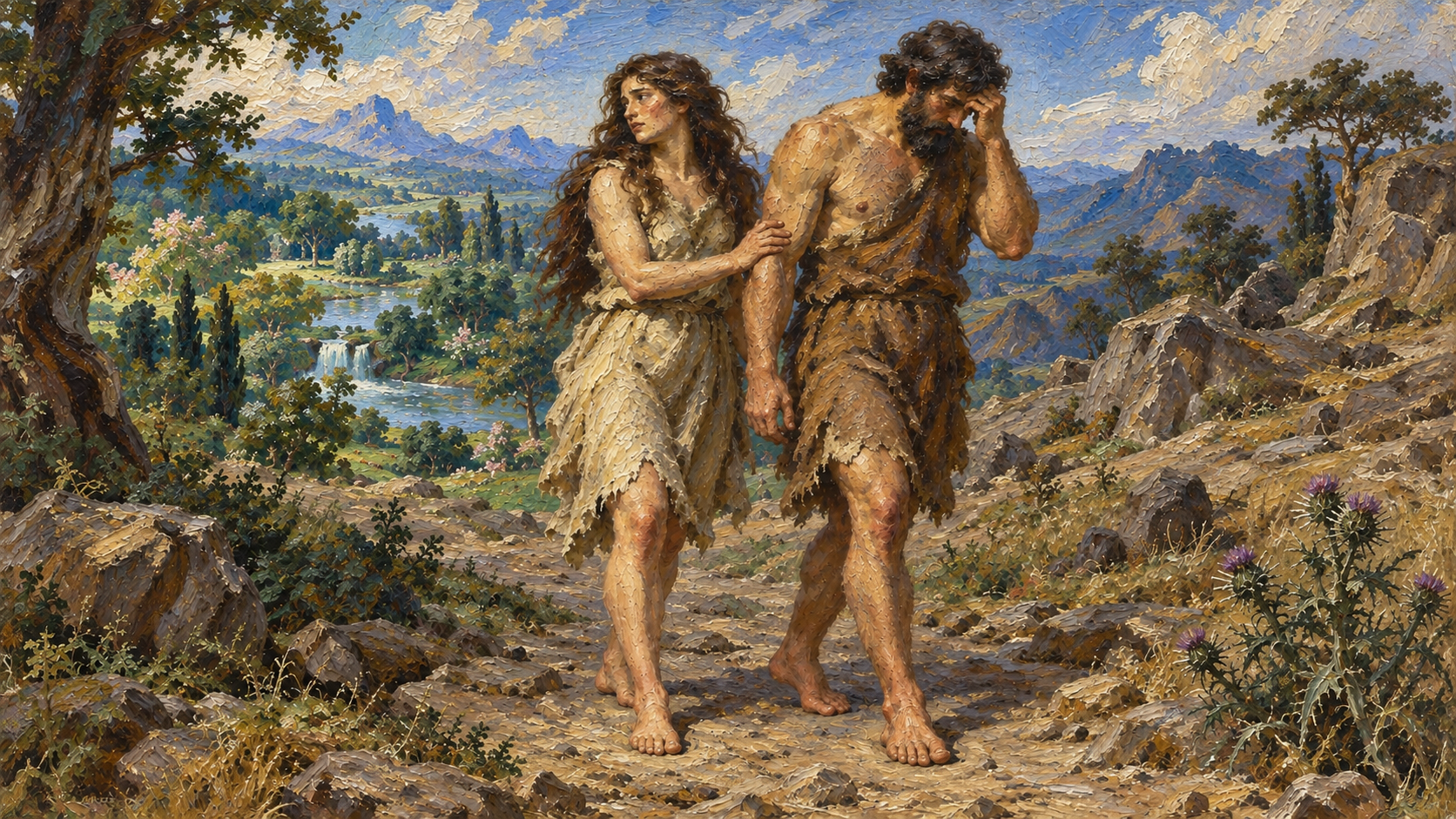
Who were Adam and Eve, and why does so much of what Scripture teaches about us begin with them? Genesis presents them as the first man and woman, and the rest of the Bible treats them as real people. I cannot separate the question of who we are from what happened to them, because their history also explains why we need Christ.
God Created One Human Family in His Image
God directly created Adam and Eve at the beginning of human history. He placed them in a real garden and joined them in the first marriage, giving His command before the serpent tempted them. When they disobeyed, He judged their sin but also promised a coming Seed who would defeat the serpent. Genesis gives us the history on which these doctrines rest, rather than a myth that later writers turned into doctrine.
Jesus grounded marriage in the Creator making humanity male and female. Luke traced the genealogy of Jesus back to Adam, while Jude placed Adam within a line of generations. Paul likewise treated Adam as a real man when he explained how sin brought death and how Christ brings justification and resurrection. If I make Adam only a symbol, I lose the historical foundation for what Scripture says about human identity and marriage. I also obscure the connection between sin and death and the answer Christ provides.
What happened in Eden helps us understand much of our own lives. Our worth comes from God’s image rather than our achievements, and both work and marriage belonged to creation before the curse. We also see temptation casting doubt on God’s Word and goodness, followed by the shame and blame with which people try to hide sin. Genesis explains why human life now includes pain and exhausting toil and ends in death. Our hope begins with God’s promise of the Seed, fulfilled in Jesus Christ, rather than with our ability to improve ourselves.
Then God said, "Let the earth bring forth the living creature according to its kind: cattle and creeping thing and beast of the earth, each according to its kind"; and it was so. And God made the beast of the earth according to its kind, cattle according to its kind, and everything that creeps on the earth according to its kind. And God saw that it was good. Then God said, "Let Us make man in Our image, according to Our likeness; let them have dominion over the fish of the sea, over the birds of the air, and over the cattle, over all the earth and over every creeping thing that creeps on the earth." So God created man in His own image; in the image of God He created him; male and female He created them. Then God blessed them, and God said to them, "Be fruitful and multiply; fill the earth and subdue it; have dominion over the fish of the sea, over the birds of the air, and over every living thing that moves on the earth." And God said, "See, I have given you every herb that yields seed which is on the face of all the earth, and every tree whose fruit yields seed; to you it shall be for food. Also, to every beast of the earth, to every bird of the air, and to everything that creeps on the earth, in which there is life, I have given every green herb for food"; and it was so. Then God saw everything that He had made, and indeed it was very good. So the evening and the morning were the sixth day.
After creating the land animals according to their kinds, God introduced the creation of mankind with the deliberate words, “Let Us make man in Our image.” I understand that plural wording alongside the fuller biblical revelation of one God in three co-equal and co-eternal Persons. It does not mean several gods worked together. God alone created mankind, and we bear His image as His creatures.
God blessed both male and female, commanding them to be fruitful and entrusting them together with stewardship over the other creatures. He directly created mankind during the ordinary sixth day and declared His finished creation very good. Humanity did not emerge accidentally from an animal line and receive religious meaning later. Genesis 2 brings us closer to the garden to explain how God formed Adam and made Eve within the ordered week of Genesis 1. It does not give a rival account of creation.
The Hebrew words tselem and demuth, translated “image” and “likeness,” speak of representation and resemblance. Those words fit the way Genesis describes our relationship with God. Bearing His image includes governing, but it involves more than doing a job. God made us personal and moral creatures who could know Him and receive His Word. We can reason and speak with one another, form covenant relationships, and use our varied abilities under His authority. That includes creating things as well as governing responsibly and worshiping Him. None of this makes us divine or means God has a human body. He is Spirit, and we represent Him as embodied creatures.
Both sexes fully bear God’s image, so a woman’s dignity does not derive from her husband and a man’s authority does not make him more valuable. I need to carry that understanding beyond people whose abilities or circumstances resemble my own. An unborn child and a disabled adult remain image-bearers, as do people living in poverty or old age. Even imprisonment or opposition to God cannot erase someone’s humanity. Bearing God’s image is not the same as being saved, but it governs how I must treat every person. Our worth comes from God’s act of creation, regardless of our intelligence or independence, what we produce, or whether society approves of us.
These truths are developed further in The Literal Six Days of Creation and The Image of God. Here I want us to notice that Genesis begins with one human family. Whatever distinctions appear later, they cannot undo the dignity and accountability we share because God created us.
Adam in the Garden Before Sin
This is the history of the heavens and the earth when they were created, in the day that the LORD God made the earth and the heavens, before any plant of the field was in the earth and before any herb of the field had grown. For the LORD God had not caused it to rain on the earth, and there was no man to till the ground; but a mist went up from the earth and watered the whole face of the ground. And the LORD God formed man of the dust of the ground, and breathed into his nostrils the breath of life; and man became a living being. The LORD God planted a garden eastward in Eden, and there He put the man whom He had formed. And out of the ground the LORD God made every tree grow that is pleasant to the sight and good for food. The tree of life was also in the midst of the garden, and the tree of the knowledge of good and evil. Now a river went out of Eden to water the garden, and from there it parted and became four riverheads. The name of the first is Pishon; it is the one which skirts the whole land of Havilah, where there is gold. And the gold of that land is good. Bdellium and the onyx stone are there. The name of the second river is Gihon; it is the one which goes around the whole land of Cush. The name of the third river is Hiddekel; it is the one which goes toward the east of Assyria. The fourth river is the Euphrates. Then the LORD God took the man and put him in the garden of Eden to tend and keep it. And the LORD God commanded the man, saying, "Of every tree of the garden you may freely eat; but of the tree of the knowledge of good and evil you shall not eat, for in the day that you eat of it you shall surely die." And the LORD God said, "It is not good that man should be alone; I will make him a helper comparable to him." Out of the ground the LORD God formed every beast of the field and every bird of the air, and brought them to Adam to see what he would call them. And whatever Adam called each living creature, that was its name. So Adam gave names to all cattle, to the birds of the air, and to every beast of the field. But for Adam there was not found a helper comparable to him. And the LORD God caused a deep sleep to fall on Adam, and he slept; and He took one of his ribs, and closed up the flesh in its place. Then the rib which the LORD God had taken from man He made into a woman, and He brought her to the man. And Adam said: "This is now bone of my bones And flesh of my flesh; She shall be called Woman, Because she was taken out of Man." Therefore a man shall leave his father and mother and be joined to his wife, and they shall become one flesh. And they were both naked, the man and his wife, and were not ashamed.
Genesis says the LORD God formed Adam from the dust of the ground. The Hebrew verb yatsar means to form or fashion and can describe a potter’s purposeful work. It emphasizes what God directly did without implying that He has physical hands. There is also a wordplay between adam, man, and adamah, ground. I see both dignity and a reason for humility here. Adam bore God’s image, but he was made from the ground and depended entirely on his Creator for life.
God formed Adam’s body before sin and called His creation very good, so I would not describe the body as an embarrassing prison for the real person. Redemption will end in resurrection, not permanent escape from having a body. Adam became a living being when God breathed into his nostrils. The Hebrew phrase neshamah chayyim describes that breath of life from God, while Nephesh chayyah describes Adam as a living being. Scripture uses that second expression for living animals too.
Genesis 2:7 describes Adam becoming alive as a whole person, not an inherently immortal person being inserted into a disposable body. Animals also have life and breath, though they do not bear God’s image or receive Adam’s covenant calling. Human beings are unique because of that image and the relationship God established with us. John 20:22 records how Jesus breathed on His disciples and said, “Receive the Holy Spirit,” which may bring creation to mind. I would keep the comparison within what John tells us. He never identifies that event as the fulfillment of Genesis 2:7.
God planted a beautiful and fruitful garden before placing Adam there to tend and keep it. Cultivation and skillful, responsible service were already part of good human life before sin. The curse later brought thorns and painful labor, making work a source of sweat and frustration. I don’t want to confuse those hardships with work itself. Adam received both abundance and a vocation from the LORD, and his dominion meant caring for creation under God’s rule rather than exploiting it for himself.
The verbs translated “tend” and “keep” can carry the ideas of service and guarding. I would be careful about building an elaborate priestly office for Adam from those two words alone, but his basic responsibility is plain. God gave him a place to live and food to eat, along with meaningful work to do. Faithful human life was active before it became difficult, and Adam remained answerable to the One who had given him all of this.
Adam could freely eat from every tree except the tree of the knowledge of good and evil. Before dwelling on the prohibition, notice how much God had given him. The restriction concerned only one tree, and neither that tree nor knowledge itself was evil. God was calling Adam to receive wisdom under His authority instead of claiming the right to define good and evil for himself. His warning left no doubt about the consequence of disobedience: eating would bring death.
God did not program Adam and Eve to rebel or withhold their ability to obey. They could genuinely love and obey Him because their choice was real. I cannot read Calvinistic determinism back into the garden when the first couple could trust God’s Word and became responsible for rejecting it. The serpent’s temptation did not take away their accountability.
God said it was not good for the man to be alone. When the animals came to Adam for naming, none shared his human nature or could meet that need for fellowship. The Hebrew phrase ezer kenegdo describes a helper who corresponds to him. Ezer can describe God’s powerful help elsewhere, so we should not understand it to mean an inferior assistant. Kenegdo identifies a suitable counterpart. Adam’s authority over the other creatures could not replace fellowship with another image-bearer.
Eve and the Creation Pattern for Marriage
God caused Adam to sleep deeply, took something from his side, and closed the flesh. He then built the woman and brought her to the man. The Hebrew word tsela can mean “side” and is traditionally rendered “rib” here. Those details draw my attention to God’s initiative and to the humanity Adam and Eve shared. She was neither an afterthought nor a lesser kind of human, and Adam recognized her as bone of his bones and flesh of his flesh.
The familiar saying about woman coming from man’s side rather than his head or feet can make a useful point about equality and companionship. I would distinguish that pastoral illustration from what the Hebrew word means, though, because Genesis does not give that explanation. The details Moses does give already establish Eve’s dignity and her distinction from Adam. She shared his image-bearing nature as the strong corresponding helper no animal could be, joining him in humanity’s calling as a woman.
For a man indeed ought not to cover his head, since he is the image and glory of God; but woman is the glory of man. For man is not from woman, but woman from man. Nor was man created for the woman, but woman for the man. For this reason the woman ought to have a symbol of authority on her head, because of the angels. Nevertheless, neither is man independent of woman, nor woman independent of man, in the Lord. For as woman came from man, even so man also comes through woman; but all things are from God.
Paul explained that woman came from man and was created for man, but he did not leave room for either to claim independence in the Lord. Every man after Adam has come through a woman, and all things come from God. I need to keep that mutual dependence together with creation order. A man’s responsibility does not make him self-sufficient, any more than shared dignity removes the order Scripture draws from creation.
The Pharisees also came to Him, testing Him, and saying to Him, "Is it lawful for a man to divorce his wife for just any reason?" And He answered and said to them, "Have you not read that He who made them at the beginning 'made them male and female,' and said, 'For this reason a man shall leave his father and mother and be joined to his wife, and the two shall become one flesh'? So then, they are no longer two but one flesh. Therefore what God has joined together, let not man separate." They said to Him, "Why then did Moses command to give a certificate of divorce, and to put her away?" He said to them, "Moses, because of the hardness of your hearts, permitted you to divorce your wives, but from the beginning it was not so. And I say to you, whoever divorces his wife, except for sexual immorality, and marries another, commits adultery; and whoever marries her who is divorced commits adultery."
Genesis moves from the first couple to a rule for later generations: a man leaves his father and mother to be joined to his wife, and they become one flesh. Adam had no human parents to leave, which helps us see that the statement reaches beyond his own wedding. Jesus treated this account as historical and authoritative when He described how “at the beginning” the Creator made male and female. What God joins, people must not tear apart.
Marriage is the covenant union of one man and one woman. Our desires cannot redefine the Creator’s pattern, and neither civil law nor changing culture can overturn it. Adam and Eve’s nakedness without shame describes innocent intimacy before sin and places sexual union within marriage. Later polygamy and adultery depart from that pattern, as do fornication and same-sex relations. Pornography also distorts it. Abusive control corrupts marriage as well; it does not express biblical headship.
Scripture gives husband and wife equal dignity while also giving them responsibilities within their marriage covenant. A husband is called to sacrificial headship modeled after Christ, and a wife to willing submission to her own husband. I cannot reconcile either command with cruelty or contempt for the other person. Coercion is no part of it, and a husband cannot appeal to headship to defend either his passivity or his domination. A wife is not required to conceal abuse or pretend that evil conduct is godly leadership.
The Fall and God’s First Promise
Genesis 3 records the choice that changed human history. It also shows us how God answered rebellion with judgment while placing a promise of victory in the middle of it.
Now the serpent was more cunning than any beast of the field which the LORD God had made. And he said to the woman, "Has God indeed said, 'You shall not eat of every tree of the garden'?" And the woman said to the serpent, "We may eat the fruit of the trees of the garden; but of the fruit of the tree which is in the midst of the garden, God has said, 'You shall not eat it, nor shall you touch it, lest you die.'" Then the serpent said to the woman, "You will not surely die. For God knows that in the day you eat of it your eyes will be opened, and you will be like God, knowing good and evil." So when the woman saw that the tree was good for food, that it was pleasant to the eyes, and a tree desirable to make one wise, she took of its fruit and ate. She also gave to her husband with her, and he ate. Then the eyes of both of them were opened, and they knew that they were naked; and they sewed fig leaves together and made themselves coverings. And they heard the sound of the LORD God walking in the garden in the cool of the day, and Adam and his wife hid themselves from the presence of the LORD God among the trees of the garden. Then the LORD God called to Adam and said to him, "Where are you?" So he said, "I heard Your voice in the garden, and I was afraid because I was naked; and I hid myself." And He said, "Who told you that you were naked? Have you eaten from the tree of which I commanded you that you should not eat?" Then the man said, "The woman whom You gave to be with me, she gave me of the tree, and I ate." And the LORD God said to the woman, "What is this you have done?" The woman said, "The serpent deceived me, and I ate." So the LORD God said to the serpent: "Because you have done this, You are cursed more than all cattle, And more than every beast of the field; On your belly you shall go, And you shall eat dust All the days of your life. And I will put enmity Between you and the woman, And between your seed and her Seed; He shall bruise your head, And you shall bruise His heel." To the woman He said: "I will greatly multiply your sorrow and your conception; In pain you shall bring forth children; Your desire shall be for your husband, And he shall rule over you." Then to Adam He said, "Because you have heeded the voice of your wife, and have eaten from the tree of which I commanded you, saying, 'You shall not eat of it': "Cursed is the ground for your sake; In toil you shall eat of it All the days of your life. Both thorns and thistles it shall bring forth for you, And you shall eat the herb of the field. In the sweat of your face you shall eat bread Till you return to the ground, For out of it you were taken; For dust you are, And to dust you shall return." And Adam called his wife's name Eve, because she was the mother of all living. Also for Adam and his wife the LORD God made tunics of skin, and clothed them. Then the LORD God said, "Behold, the man has become like one of Us, to know good and evil. And now, lest he put out his hand and take also of the tree of life, and eat, and live forever"– therefore the LORD God sent him out of the garden of Eden to till the ground from which he was taken. So He drove out the man; and He placed cherubim at the east of the garden of Eden, and a flaming sword which turned every way, to guard the way to the tree of life.
The serpent was a real creature involved in the temptation, and Revelation identifies the ancient serpent with the devil and Satan. Scripture does not explain every detail of how Satan used the animal, so I would not let theories about its original anatomy distract us from the temptation itself. The serpent questioned God’s Word and exaggerated the prohibition before directly denying the warning about death. He made God’s goodness seem suspect and offered Eve a way to become “like God,” even though she already bore His image as a creature.
Eve saw that the tree appeared good for food and was pleasant to her eyes. She desired the wisdom it seemed to offer and was deceived. Adam was with her and ate what she gave him, but Romans 5 assigns him decisive responsibility. He was not merely a bystander who failed to communicate. Both had received enough truth to obey God, and both became personally guilty.
When their eyes opened, Adam and Eve experienced shame rather than the elevation they had been promised. They tried to cover their nakedness and then hid from the LORD. God questioned them to invite confession, not because He lacked information. Adam pointed to Eve and indirectly blamed God for giving her to him. Eve, in turn, pointed to the serpent’s deception without fully acknowledging her own responsibility. I notice that their answers included facts. Yet each used those facts to move responsibility away from themselves.
I can see in this account how sin still works. Desire welcomes a lie because disobedience promises freedom, only for shame to follow and the sinner’s own covering to fail. Blaming someone else then becomes a way to avoid responsibility. Repentance takes us in the opposite direction: we come into God’s light and agree with His judgment. Instead of hiding behind excuses, we seek the mercy He provides.
God cursed the serpent and pronounced painful consequences for both the woman and the man. Childbearing would bring multiplied sorrow, and sin would bring conflict into marriage. Because of Adam, the ground was cursed and his work would meet thorns and exhausting resistance until he returned to dust. These judgments describe what rebellion damaged. They give us no reason to celebrate domination or rivalry as part of good creation, or to call sinful control biblical headship.
The woman’s “desire” and her husband’s rule over her are often debated. The Hebrew word for desire is rare, also appearing in Genesis 4:7 and Song of Solomon 7:10. Knowing the word does not by itself settle whether the emphasis here is longing, conflict, or attempted control. I return to the setting to keep that discussion in perspective. God is describing the damage sin would cause, so I cannot use this sentence to present a husband’s domination as God’s good design.
“Dust you are, and to dust you shall return” announces bodily death. Adam did not physically collapse the instant he ate, but mortality entered human experience. God later removed his access to the Tree of Life, and Adam eventually died. I see no reason to insert an immortal spirit that died instantly while his body kept living. Scripture presents the whole man as mortal and dependent on God for life.
Within the judgment, Genesis 3:15 promises enmity between the serpent and the woman and between their seed. The serpent would bruise the woman’s Seed, but He would crush the serpent’s head. Later revelation identifies that victor as Jesus Christ. I can follow the promise toward His virgin birth and the cross, then His resurrection and second coming, without claiming that this verse already explains each event. What it gives us here is a human descendant who would be wounded yet decisively defeat the serpent.
Adam and Eve had made coverings of fig leaves, but God later clothed them with tunics of skin. It is reasonable to infer that an animal died, though Genesis never calls this a sacrifice or names the animal. Nor does it describe blood presented at an altar or guilt transferred to a punished substitute. I would not put those claims into Moses’ account as though he had stated them. We can still recognize God’s mercy in what is recorded: the Judge promised the Seed and clothed the guilty pair before sending them into exile.
God barred access to the Tree of Life so fallen humanity could not eat and live forever in rebellion. If endless life already belonged to us by nature, that restriction would make little sense. Immortality belongs to God and is given through Christ, which directly challenges the claim that human souls are inherently immortal. For Adam and Eve, exile meant losing the garden’s abundance and the fellowship they had known there. Adam still worked the ground, but outside the garden and under the sentence of death.
And he showed me a pure river of water of life, clear as crystal, proceeding from the throne of God and of the Lamb. In the middle of its street, and on either side of the river, was the tree of life, which bore twelve fruits, each tree yielding its fruit every month. The leaves of the tree were for the healing of the nations. And there shall be no more curse, but the throne of God and of the Lamb shall be in it, and His servants shall serve Him. They shall see His face, and His name shall be on their foreheads. There shall be no night there: They need no lamp nor light of the sun, for the Lord God gives them light. And they shall reign forever and ever.
Revelation closes Scripture with the river of life and the Tree of Life in the holy city. With the curse gone, God’s servants will see His face and reign without end. The Lamb and God’s completed redemption restore what humanity lost through rebellion. My hope for that restoration rests in the victory God provides through Christ, not in finding some way of my own around the cherubim.
One Family Under Sin and Grace
Life outside Eden soon showed that Adam and Eve’s sin would not remain an isolated act. Genesis follows their children so we can see both the spread of rebellion and God’s continued mercy.
Now Adam knew Eve his wife, and she conceived and bore Cain, and said, "I have acquired a man from the LORD." Then she bore again, this time his brother Abel. Now Abel was a keeper of sheep, but Cain was a tiller of the ground. And in the process of time it came to pass that Cain brought an offering of the fruit of the ground to the LORD. Abel also brought of the firstborn of his flock and of their fat. And the LORD respected Abel and his offering, but He did not respect Cain and his offering. And Cain was very angry, and his countenance fell. So the LORD said to Cain, "Why are you angry? And why has your countenance fallen? If you do well, will you not be accepted? And if you do not do well, sin lies at the door. And its desire is for you, but you should rule over it." Now Cain talked with Abel his brother; and it came to pass, when they were in the field, that Cain rose up against Abel his brother and killed him. Then the LORD said to Cain, "Where is Abel your brother?" He said, "I do not know. Am I my brother's keeper?" And He said, "What have you done? The voice of your brother's blood cries out to Me from the ground. So now you are cursed from the earth, which has opened its mouth to receive your brother's blood from your hand. When you till the ground, it shall no longer yield its strength to you. A fugitive and a vagabond you shall be on the earth." And Cain said to the LORD, "My punishment is greater than I can bear! Surely You have driven me out this day from the face of the ground; I shall be hidden from Your face; I shall be a fugitive and a vagabond on the earth, and it will happen that anyone who finds me will kill me." And the LORD said to him, "Therefore, whoever kills Cain, vengeance shall be taken on him sevenfold." And the LORD set a mark on Cain, lest anyone finding him should kill him. Then Cain went out from the presence of the LORD and dwelt in the land of Nod on the east of Eden.
Adam and Eve’s first recorded sons show how quickly sin spread. Abel brought an offering God respected, but Cain became angry when his own was not respected. Even God’s warning about sin’s desire to rule him and His call to do well did not turn Cain from that anger. He murdered Abel in the field and then answered God with denial and contempt. The first recorded human death after Eden came through violence within the first family, and the ground that received Abel’s blood testified against his killer.
God judged Cain as a fugitive while also restraining private vengeance against him. I would not take the mark as a declaration of innocence. It placed Cain’s life under God’s authority. Genesis then follows the family beyond Eden: Seth was born as another seed, and people began to call on the name of the LORD. God’s mercy continued alongside His judgment.
This is the book of the genealogy of Adam. In the day that God created man, He made him in the likeness of God. He created them male and female, and blessed them and called them Mankind in the day they were created. And Adam lived one hundred and thirty years, and begot a son in his own likeness, after his image, and named him Seth. After he begot Seth, the days of Adam were eight hundred years; and he had sons and daughters. So all the days that Adam lived were nine hundred and thirty years; and he died.
Genesis 5 returns to mankind’s creation in God’s likeness and again names humanity as male and female. Adam fathered Seth in his own likeness and image, and he also had other sons and daughters. Those unnamed children help me understand how the first pair became one human family that continued to multiply. At nine hundred and thirty years, Adam died, confirming the sentence God had pronounced in Eden.
Adam named his wife Eve because she was the mother of all living. Acts 17 likewise teaches that God made every nation from one blood, so differences of race belong within one human family. They cannot establish different grades of human value. Cain’s wife also descended from Adam and Eve. She was most likely a sister, or perhaps a niece if enough time had passed, but Scripture does not name her. Scripture gives us no room to invent another human population outside Adam’s line to explain her existence.
In the earliest generations, marriage between close relatives was unavoidable and was not condemned in that setting. After humanity multiplied, God expressly prohibited incest in Leviticus 18, and the New Testament maintains those moral boundaries. We may draw reasonable inferences from modern genetics, but I would distinguish them from what Genesis actually explains. The related study Who Cain’s Wife Was examines that question in more detail.
Surely for your lifeblood I will demand a reckoning; from the hand of every beast I will require it, and from the hand of man. From the hand of every man's brother I will require the life of man. "Whoever sheds man's blood, By man his blood shall be shed; For in the image of God He made man. And as for you, be fruitful and multiply; Bring forth abundantly in the earth And multiply in it."
Even after the fall and the flood, God grounded the seriousness of murder in His image. James likewise condemns cursing people made in God’s likeness. Sin damages the way we represent God without erasing our humanity, and that gives us reason to protect life from conception to natural death. Justice still requires an offender to answer for wrongdoing. Yet even in judgment, I must remember that the person being judged remains an image-bearer.
When redemption renews believers toward Christ’s image, it does not mean unbelievers have stopped bearing God’s image. The Holy Spirit changes the understanding and character of a person who is born again. As that believer grows in righteousness and holiness, obedience gives visible expression to love.
The First Adam and the Last Adam
When Paul explains why death rules the human family and how Christ answers it, he looks back to Adam as a real man whose disobedience changed the history of his descendants.
Therefore, just as through one man sin entered the world, and death through sin, and thus death spread to all men, because all sinned– (For until the law sin was in the world, but sin is not imputed when there is no law. Nevertheless death reigned from Adam to Moses, even over those who had not sinned according to the likeness of the transgression of Adam, who is a type of Him who was to come. But the free gift is not like the offense. For if by the one man's offense many died, much more the grace of God and the gift by the grace of the one Man, Jesus Christ, abounded to many. And the gift is not like that which came through the one who sinned. For the judgment which came from one offense resulted in condemnation, but the free gift which came from many offenses resulted in justification. For if by the one man's offense death reigned through the one, much more those who receive abundance of grace and of the gift of righteousness will reign in life through the One, Jesus Christ.) Therefore, as through one man's offense judgment came to all men, resulting in condemnation, even so through one Man's righteous act the free gift came to all men, resulting in justification of life. For as by one man's disobedience many were made sinners, so also by one Man's obedience many will be made righteous. Moreover the law entered that the offense might abound. But where sin abounded, grace abounded much more, so that as sin reigned in death, even so grace might reign through righteousness to eternal life through Jesus Christ our Lord.
Paul’s argument in Romans 5 depends on one historical man through whom sin entered the world. Death came through sin and spread to everyone because all sinned. Adam was the first representative head of a fallen human family, and Christ brings the gracious gift that answers that ruin. We inherit a mortal and corrupted human condition from Adam, and we also each commit sin.
I do not find support here for the Calvinistic claim that God irresistibly determines every sinner’s rejection or withholds a genuine offer from most people. Christ died for the whole world, and His grace reaches toward everyone with an offer people can resist or receive. His obedience and righteous act open the way to justification and life for everyone who repents and believes. That abundance of grace does not excuse continued rebellion, as Romans 6 immediately explains.
But now Christ is risen from the dead, and has become the firstfruits of those who have fallen asleep. For since by man came death, by Man also came the resurrection of the dead. For as in Adam all die, even so in Christ all shall be made alive. But each one in his own order: Christ the firstfruits, afterward those who are Christ's at His coming. Then comes the end, when He delivers the kingdom to God the Father, when He puts an end to all rule and all authority and power. For He must reign till He has put all enemies under His feet. The last enemy that will be destroyed is death. For "He has put all things under His feet." But when He says "all things are put under Him," it is evident that He who put all things under Him is excepted. Now when all things are made subject to Him, then the Son Himself will also be subject to Him who put all things under Him, that God may be all in all.
Death came through a man, and resurrection comes through a Man. Calling Christ the firstfruits assures us that those who belong to Him will be raised bodily too. I don’t find the answer to Adam’s return to dust in a claim that human souls were immortal all along. God answers it through the risen Christ. Jesus rose in the body that had been crucified, now transformed and incorruptible, and His people will likewise receive resurrection bodies that cannot die.
Later in 1 Corinthians 15, Paul contrasts the first man of dust with the second Man, the Lord from heaven. When mortality puts on immortality, believers will bear the heavenly Man’s image. Unbelievers will also be raised, but for judgment at the Great White Throne. Those who finally reject Christ will be cast into the Lake of Fire, the second death in which God irreversibly destroys the human body and soul. They do not possess indestructible souls that keep them in endless conscious torment.
The same creation history also shapes Paul’s teaching about order in the church.
Let a woman learn in silence with all submission. And I do not permit a woman to teach or to have authority over a man, but to be in silence. For Adam was formed first, then Eve. And Adam was not deceived, but the woman being deceived, fell into transgression. Nevertheless she will be saved in childbearing if they continue in faith, love, and holiness, with self-control.
Paul based this order on Adam’s formation and Eve’s deception, reserving the authoritative teaching office for biblically qualified men. I would not turn that distinction into a judgment that women are less intelligent or less capable of holiness. Creation order does not diminish their gifts or value. The New Testament calls them to vital ministry within that order while retaining the distinction between male and female.
Paul’s statement that a woman “will be saved in childbearing” cannot mean that motherhood earns eternal life. That would contradict salvation through faith and leave unmarried or childless women without hope. Nor does he promise that every faithful woman will survive childbirth. Some understand him to describe preservation as women continue in faithful and holy life within God’s created order, with childbearing representing a maternal calling rather than justification. Others understand “the childbearing” as the promised Seed’s birth through a woman. I think Genesis 3:15 gives us reason to consider that reading, but Paul does not explain it far enough for me to insist it is the only possible meaning.
Whichever reading is correct, I do not believe Paul offers another way of salvation. He calls for continuing faith and love, with holiness and self-control. Only Jesus answers the ruin that began in Eden. He is the promised Seed and the last Adam, the eternal Son who is fully God and fully man. He was born of a virgin and remained completely sinless.
Wicked men physically tortured and killed Jesus, and He willingly bore that real punishment for our sins in His innocent body. He shed His blood and died, was buried, and then rose bodily. The Father did not punish or abandon Him, nor did He curse, strike, or bruise Him or pour wrath upon Him. Father and Son remained united in the work of redemption.
Christ died for the whole world, so God’s offer of salvation is genuine even though people can resist and reject it. Everyone who repents and believes is forgiven and justified, or declared righteous before God. That person is born again and made new, and the Holy Spirit indwells and seals every genuine believer. That believer is eternally secure, but that security gives no permission for lawlessness. Nor can I treat a superficial profession as proof that someone has truly been born again.
Being made new in Christ does not erase our sex or the fact that we have bodies. Marriage ethics and moral accountability still belong to human life. Christ restores us toward faithfulness under our Creator and promises bodily resurrection at His coming. The gospel redeems the humanity God intended rather than offering an escape from being human, and it will finally remove the curse.
My Final Thoughts
I cannot push Adam and Eve’s history aside without weakening the gospel that answers it. God made one human family in His image, but the first couple’s actual disobedience brought shame into that family along with mortality and death. Jesus Christ, the promised Seed and last Adam, obeyed where Adam failed and rose bodily from the dead. To receive Him is to trust God’s Word instead of claiming the right to define good and evil for myself. Because He rose, I can look forward with certainty to the end of the curse.