
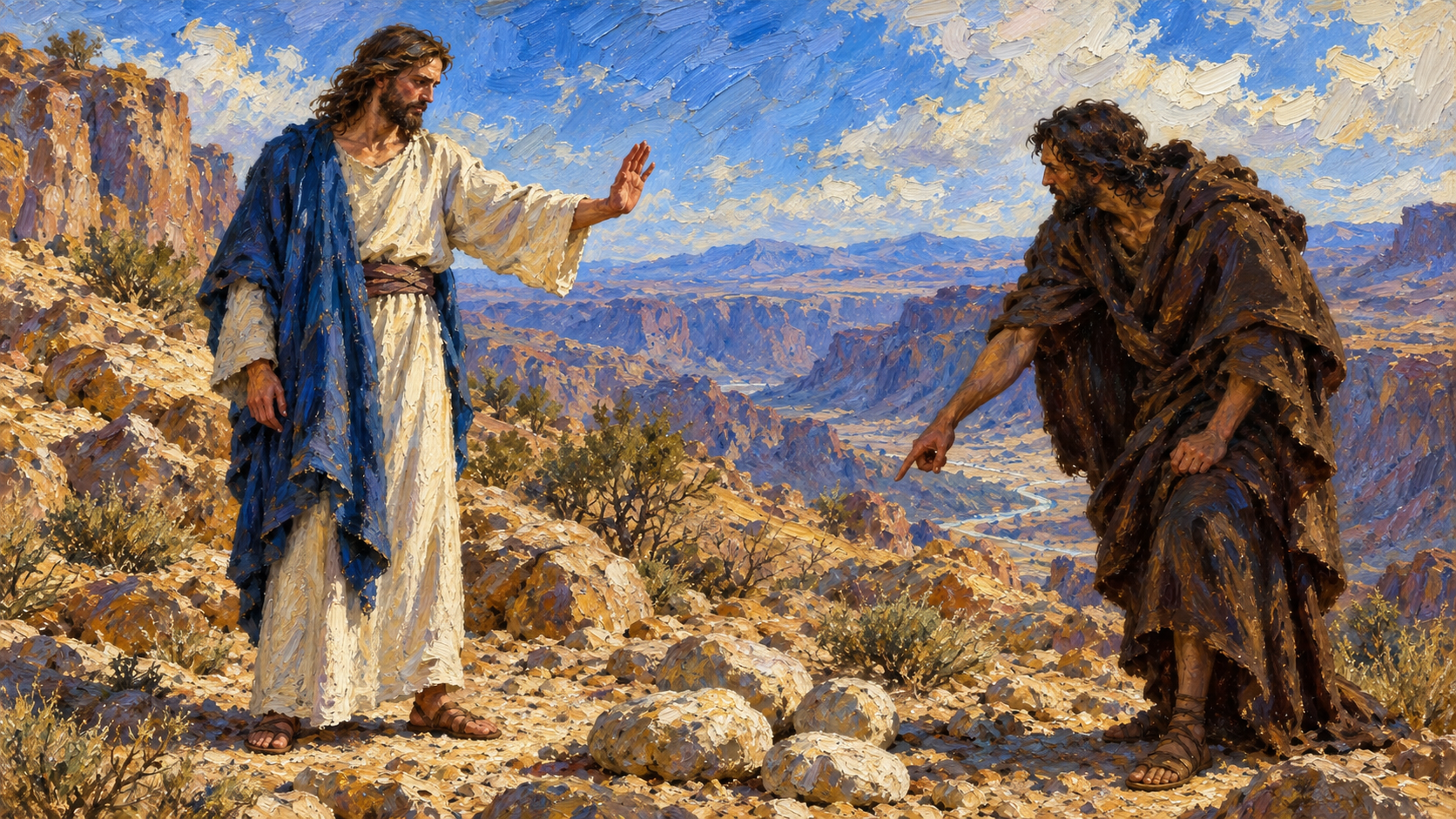
Why did Jesus go into the wilderness immediately after His baptism? Matthew wants us to see the connection. The Father had just named Jesus as His beloved Son, and now Satan would try to turn that Sonship into a reason to step outside the Father’s will.
The Beloved Son Enters the Wilderness
Matthew places this event right after the baptism of Jesus. The heavens had opened, the Spirit of God had descended like a dove, and the Father had declared, “This is My beloved Son, in whom I am well pleased.” Then the Spirit led Jesus into the wilderness, where the devil tempted Him.
Then Jesus was led up by the Spirit into the wilderness to be tempted by the devil.
That order helps us understand Satan’s opening words: “If You are the Son of God.” The devil is attacking the Son’s obedient mission immediately after the Father has publicly identified Him. Jesus has not forgotten who He is. The question is whether He will use His authority apart from the Father’s will. Will He demand proof of the Father’s care on Satan’s terms? Will He take a path to glory that requires worshiping the devil instead of following the path appointed by the Father?
Matthew says the Spirit led Jesus into the wilderness. Luke tells us He was full of the Holy Spirit and was led by Him. Mark uses the more forceful description that the Spirit drove Him there. Read together, these accounts leave me no reason to treat the wilderness as an accident. It was part of God’s purpose.
That does not make God the tempter. James 1 says God does not tempt anyone with evil, so I need to distinguish the Spirit’s purpose in bringing Jesus to the test from the devil’s purpose in tempting Him. God may use a test to reveal faithfulness and strengthen obedience, showing what is true. Satan uses temptation to draw a person into distrust of God and finally into rebellion.
Immediately the Spirit drove Him into the wilderness. And He was there in the wilderness forty days, tempted by Satan, and was with the wild beasts; and the angels ministered to Him.
Jesus faced this test as the holy Son of God who had truly become man. He had no inward corruption for Satan to draw upon, yet the pressure was real. In hunger and isolation, He heard the devil’s lies and faced a genuine invitation to step outside the Father’s will.
Matthew tells us that Jesus fasted for forty days and forty nights and was hungry afterward. That ordinary bodily need helps me understand what it meant for the eternal Son to become man. He was not pretending to be human. He had taken a real human body, and fasting left Him with real bodily weakness.
And when He had fasted forty days and forty nights, afterward He was hungry.
The forty days recall Israel’s forty years in the wilderness, as well as Moses on Sinai and Elijah’s journey to Horeb. I would not make every appearance of forty into a code, but the wilderness connection here is plainly deliberate. God humbled and tested Israel there, feeding the nation with manna. Yet the people repeatedly complained and tested the LORD. Jesus entered the wilderness and obeyed where Israel had failed.
Fasting is not a way to control God or prove that the body does not matter. Jesus’ fasting showed His dependence on the Father. His hunger was real, but He would not use divine power to escape the path the Father had given Him. In that hunger, we see His obedience put to the test.
The Three Temptations and Jesus’ Answers
Satan began with Jesus’ hunger, a real need that was not sinful. There was nothing wrong with bread either, and Jesus had authority over creation. The temptation was to use that authority at the devil’s suggestion, satisfying Himself as the Son apart from the Father’s will.
Now when the tempter came to Him, he said, "If You are the Son of God, command that these stones become bread." But He answered and said, "It is written, ‘Man shall not live by bread alone, but by every word that proceeds from the mouth of God.’"
Jesus answered from Deuteronomy 8, where Moses told Israel to remember how the LORD had led them through the wilderness. God allowed them to hunger and then fed them with manna so they would learn that man does not live by bread alone. Jesus was living out the very dependence on God that the original passage taught during wilderness testing.
Jesus placed His need for food under God’s Word without denying that His body needed it. A person can have plenty to eat and still live in rebellion. Jesus would not let hunger govern His obedience or accept Satan’s way of meeting a legitimate need.
I can recognize the same appeal in ordinary temptation. A real need, such as rest or safety, can become the starting point for an invitation to act outside God’s will. Pretending the desire is not real will not overcome that temptation. We need to bring it under God’s Word and refuse to meet it through unbelief. The study on fasting explains further how biblical fasting expresses dependence rather than spiritual display.
The devil next took Jesus to the holy city and placed Him on the pinnacle of the temple. This time he quoted Scripture to urge a dramatic display. I need to notice who is speaking those Bible words: Satan was using them while fighting against their meaning.
Then the devil took Him up into the holy city, set Him on the pinnacle of the temple, and said to Him, "If You are the Son of God, throw Yourself down. For it is written: ‘He shall give His angels charge over you,’ and, ‘In their hands they shall bear you up, Lest you dash your foot against a stone.’"
Psalm 91 speaks of trust, but Satan used it to demand a dramatic rescue. He wanted Jesus to make the Father prove His care on the devil’s terms. Jesus answered with Deuteronomy 6:16.
Jesus said to him, "It is written again, ‘You shall not tempt the LORD your God.’"
Deuteronomy points back to Massah, where Israel asked whether the LORD was among them. They demanded proof while distrusting the care He had already shown. Jesus refused to repeat that sin. He trusted His Father without creating a crisis to force a rescue.
I need to distinguish that kind of presumption from faith. Someone can make a foolish choice and then demand that God protect it, calling the rescue he expects “faith.” But he has created the danger himself. Real faith obeys God and trusts His care instead of asking Him to perform for human pride.
The devil then showed Jesus the kingdoms of the world and their glory, offering them in exchange for worship. This was a genuine temptation, but the offer did not make Satan sovereign over God’s world. The earth belongs to the LORD. Satan is a created being who claims authority that is not rightfully his, and his defeat is certain.
Again, the devil took Him up on an exceedingly high mountain, and showed Him all the kingdoms of the world and their glory. And he said to Him, "All these things I will give You if You will fall down and worship me." Then Jesus said to him, "Away with you, Satan! For it is written, ‘You shall worship the LORD your God, and Him only you shall serve.’"
Jesus will receive the kingdoms, but He would not bow to Satan to obtain them. Psalm 2 promises the nations to the Son as His inheritance. Daniel 7 shows the Son of Man receiving dominion and a kingdom, and Revelation declares that the kingdoms of this world become those of our Lord and His Christ. With those promises before us, the question is not whether Jesus will reign, but what path He will take to that reign.
Satan was offering rule without the cross and a crown without obedience, on the condition that Jesus worship him. Jesus answered with the heart of the first commandment: the LORD alone must be worshiped and served. The authority being offered could not make idolatry any less evil.
After Jesus refused those offers, Matthew tells us that the devil left and angels came to minister to Him. He had neither turned stones into bread nor demanded a rescue from the temple. He had also refused the kingdoms on Satan’s terms. Now He received ministry according to the Father’s will. Trusting His Father had not left Him abandoned.
Then the devil left Him, and behold, angels came and ministered to Him.
Scripture in Context, and Obedience Where Others Failed
What catches my attention is that both Jesus and Satan quote Scripture. The lesson must go deeper than simply repeating a verse. Jesus understands and obeys the Word in context, while Satan pulls words from their purpose and uses them to press Jesus toward presumption.
Jesus drew all three answers from Deuteronomy, where Moses taught Israel about its wilderness experience. The passages concern hunger and dependence on God, along with the command not to test the LORD and to worship Him alone. Those are the very issues Satan raised. Jesus was answering from their context and living out the obedience Israel had owed to God where the nation had failed.
That makes me examine how I use Scripture when I am tempted. Memorizing a verse is good, but I can use its words to support a lie if I detach them from their context. I need to read humbly and compare Scripture with Scripture so I understand the meaning God gave it. That meaning must govern my response. The passage teaches me how to trust and obey, rather than becoming a religious slogan I bend toward my own desires.
Adam had food available in the garden, yet he listened to the serpent and sinned. Jesus faced Satan in the wilderness after a long fast and still answered him with God’s Word. Even in His hunger, Jesus obeyed where Adam had failed.
Romans 5 explains why that comparison reaches beyond better choices. Sin entered the world through Adam’s disobedience, while many are made righteous through Christ’s obedience. As the second Adam, Jesus is our representative Savior. His obedient life led to His death and bodily resurrection, answering the ruin Adam brought. His victory in the wilderness was part of that wholly sinless life, which qualified Him to be the spotless sacrifice.
God called Israel His son in Exodus 4. The nation passed through the waters into the wilderness, where God fed the people, yet they failed again and again. Jesus, the beloved Son, also passed through waters at His baptism before entering the wilderness. He hungered there and remained faithful. I see Him fulfilling what Israel could not fulfill in itself: He is true Israel, the faithful Servant and Messiah.
When we see these connections, they should lead us to worship rather than reduce Jesus to a moral example. Adam’s failure and Israel’s failure uncover our need for a Savior, while Jesus’ obedience tells us that the Savior has come.
Real Temptation and the Sinless High Priest
Some readers wonder how Jesus could be truly tempted if He is God. Scripture does not ask us to choose between real temptation and His sinless deity. Jesus is one Person with two complete natures. He is fully God and fully man. The theological term for this is the hypostatic union. In plain language, His divine and human natures are united in one Person without being confused or changed.
Jesus knew hunger and weariness in His true humanity, along with sorrow and pain. Satan’s attacks were real, and the offered shortcuts challenged His mission. Yet no inward corruption or unbelieving thought lived in Him, and He never acted in disobedience. The reality of the test does not mean He sinned.
For we do not have a High Priest who cannot sympathize with our weaknesses, but was in all points tempted as we are, yet without sin.
Hebrews does not mean that Jesus faced every exact life situation any human being could encounter. It means that He truly met temptation while sharing our human weakness, yet without sin. He knows temptation without sharing our guilt. He can sympathize with the tempted believer while remaining the holy Lord.
Hebrews 2 explains that the Son shared our flesh and blood and became like His brethren in true humanity so He could be a merciful and faithful High Priest. His wilderness victory helps us see His fitness for that work. The help He gives comes from the sinless Savior who suffered under temptation Himself, not from someone untouched by suffering.
For in that He Himself has suffered, being tempted, He is able to aid those who are tempted.
Christ’s help gives me a reason to resist temptation honestly instead of trying to prove I am strong enough alone. It does not make temptation something to take lightly, but neither must a tempted believer hide from Him in shame. Hebrews moves directly from His sinless temptation to our welcome at the throne of grace.
Let us therefore come boldly to the throne of grace, that we may obtain mercy and find grace to help in time of need.
Jesus’ encounter also helps us understand the difference between God’s testing and Satan’s temptation. God never entices us to sin, while the devil seeks to turn pressure toward rebellion. The related studies on testing and temptation and on Satan examine that distinction and the enemy’s limits more fully.
Resisting Temptation from the Place of Grace
Jesus shows us how to place bodily needs under God’s Word without despising them. A desire becomes dangerous when it demands satisfaction outside His will. I can name the desire honestly and let Scripture govern my response, refusing the lie that disobedience is the only way to find relief.
Jesus also teaches us to trust God’s wisdom and care without creating reckless danger to make Him prove Himself. Faith cannot make peace with idolatry either. Every temptation finally asks the heart to bow somewhere other than the LORD, perhaps for comfort or approval, or for the promise of influence or safety. Whatever the reward, Jesus’ answer sets the boundary: worship the LORD and serve Him alone.
We should use Scripture in context as Jesus did while depending on the Holy Spirit. He entered the wilderness full of the Spirit. We are not the sinless Son, but every true believer is indwelt by the Holy Spirit and is called to walk in His power. Our resistance does not have to rest on bare willpower.
Sometimes obedience means taking the way of escape before desire grows stronger. 1 Corinthians 10:13 promises that God is faithful and provides a way to bear temptation. The way out may require us to leave a setting at once. If sin has been hidden, we may need to confess it and ask another believer for help. At other times, the wise response is to cut off access to something or end a conversation. God’s promised help does not make watchfulness unnecessary; it enables us to obey.
Learning from Jesus’ answers must not become an attempt to save ourselves by copying Him. The good news begins with His obedience where we had failed. His wilderness victory belonged to an entirely sinless life that led to the cross, and we need Him as our Savior.
Jesus physically bore the punishment for our sins in His innocent body. Wicked men mocked and beat Him before scourging and crucifying Him. They killed Him, and He willingly shed His blood and died. The Father did not punish or curse Jesus. He did not abandon, strike, or bruise His Son, and He did not pour wrath upon Him. The Father, Son, and Holy Spirit remained united in the saving purpose.
Christ died for the whole world, and the offer of salvation is genuine. A person may resist and reject Him, but everyone who repents and believes is forgiven and born again. The Holy Spirit indwells and seals the believer, whose salvation is eternally secure. Obedience follows as the fruit of new life. We resist temptation from the place of grace; we do not resist in order to purchase grace.
My Final Thoughts
When I follow this account from Jesus’ baptism into the wilderness, I see far more than an example of strong self-control. Jesus is the beloved Son who trusted the Father, the true Israel who obeyed in the wilderness, and the second Adam who answered the serpent without sin. He refused Satan’s shortcuts and continued toward the cross as our spotless Savior. Because He also knows what it is to suffer under temptation, we can come to Him without hiding and receive mercy when the struggle is real. Our confidence is not in our ability to survive the wilderness alone, but in the sinless High Priest who defeated the tempter and gives grace in time of need.