
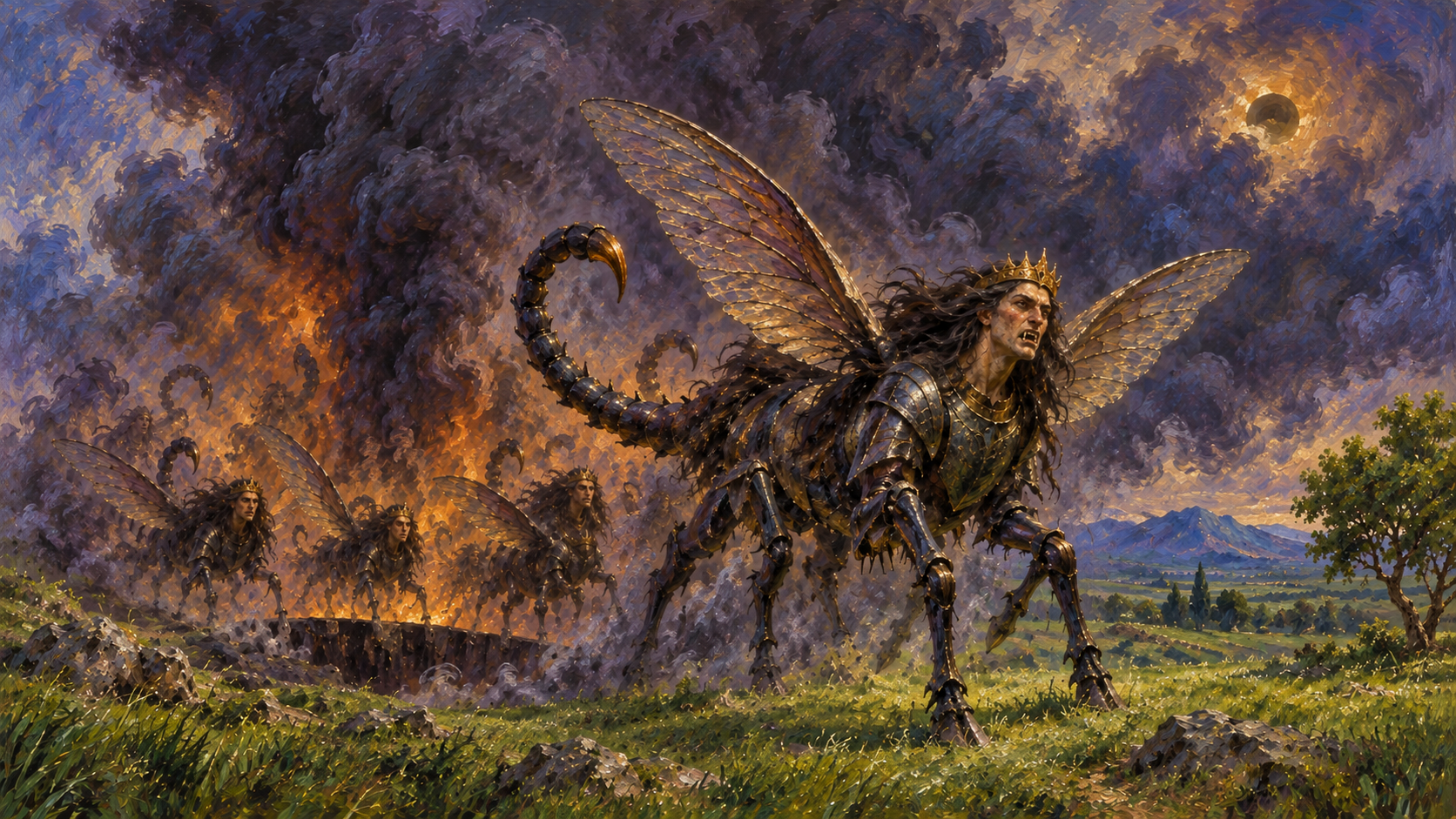
The locusts in Revelation 9 are frightening enough without our inventing details about them. They emerge from the abyss, torment people for five months, and serve an angelic king called Apollyon. I understand John to be describing a real future judgment involving a supernatural host. To explain that conclusion, we need to follow the passage from the sounding trumpet through the end of the first woe, paying attention to the creatures’ origin and instructions as well as their appearance.
Read the Fifth Trumpet in Its Order
The first four trumpets bring devastation to the land, the sea, fresh water, and the heavenly lights. Before the fifth sounds, John hears a warning about the three remaining blasts:
And I looked, and I heard an angel flying through the midst of heaven, saying with a loud voice, "Woe, woe, woe to the inhabitants of the earth, because of the remaining blasts of the trumpet of the three angels who are about to sound!"
A woe announces severe distress and judgment. The earlier trumpets affect the world people inhabit; the fifth brings torment directed at people themselves. Heaven announces that intensification before it occurs. We should therefore read the locust judgment within the sequence John records, rather than lift its most startling details out of their setting.
I understand these as future events within a literal Tribulation. The trumpets follow the opening of the seventh seal, and their sequence leads toward the proclamation of Christ’s kingdom at the seventh trumpet. Treating each blast as an unrelated event somewhere in church history breaks up that progression. My study of The Seven Trumpets of Revelation explains the series more fully; here we are following Revelation 9:1-12.
Then the fifth angel sounded: And I saw a star fallen from heaven to the earth. To him was given the key to the bottomless pit. And he opened the bottomless pit, and smoke arose out of the pit like the smoke of a great furnace. So the sun and the air were darkened because of the smoke of the pit.
John calls this figure a fallen star, then describes him receiving a key and opening the pit. Those personal actions explain why I understand the star as an angelic person. A meteor does not accept an assignment and unlock a prison.
Some readers identify this fallen star as Satan and understand his fall as rebellion. Others understand the description as a descent from heaven to perform an assigned task. John says the star has fallen but does not name him or explain the circumstances of that fall. We can discuss those interpretations without pretending the passage settles his identity.
The key, however, was given to him. He does not break into the abyss or seize it from God. Access is granted when the fifth trumpet sounds. In Revelation 1:18, Jesus holds the keys of Hades and Death; in Revelation 20, an angel carries a key to the abyss when he comes to imprison Satan. These scenes involve different actions and places, but none presents a realm that has slipped beyond God’s authority.
The Greek expression translated bottomless pit refers to the shaft, phrear, of the abyss, abyssos, a deep or unfathomable place. The English word bottomless supplies no map of the earth’s interior. Scripture gives us no coordinates and does not identify the abyss with an ocean trench, a volcano, a black hole, or a tunnel through a flat earth. Its connection with spiritual confinement is much clearer. During Jesus’ ministry, demons possessing a man in the country of the Gadarenes begged Him not to send them there:
Then they sailed to the country of the Gadarenes, which is opposite Galilee. And when He stepped out on the land, there met Him a certain man from the city who had demons for a long time. And he wore no clothes, nor did he live in a house but in the tombs. When he saw Jesus, he cried out, fell down before Him, and with a loud voice said, "What have I to do with You, Jesus, Son of the Most High God? I beg You, do not torment me!" For He had commanded the unclean spirit to come out of the man. For it had often seized him, and he was kept under guard, bound with chains and shackles; and he broke the bonds and was driven by the demon into the wilderness. Jesus asked him, saying, "What is your name?" And he said, "Legion," because many demons had entered him. And they begged Him that He would not command them to go out into the abyss. Now a herd of many swine was feeding there on the mountain. So they begged Him that He would permit them to enter them. And He permitted them. Then the demons went out of the man and entered the swine, and the herd ran violently down the steep place into the lake and drowned.
The demons recognized Jesus as the Son of the Most High God. His command compelled them to leave the man, and they had to ask permission even to enter the swine. Their fear of the abyss tells us something about that place and about Christ’s authority over them. It does not tell us that these particular demons are the beings John later sees released. For more on the passages concerning that realm, see The Abyss or Bottomless Pit.
When the shaft opens in Revelation 9, smoke pours out like the smoke of a great furnace and darkens the sun and air. John describes an enormous outflow, but he gives no chemical analysis or explanation involving a modern weapon. Nor can smoke alone account for what follows, because living beings emerge from it.
The Locust Host and Its God-Given Limits
Then out of the smoke locusts came upon the earth. And to them was given power, as the scorpions of the earth have power. They were commanded not to harm the grass of the earth, or any green thing, or any tree, but only those men who do not have the seal of God on their foreheads. And they were not given authority to kill them, but to torment them for five months. Their torment was like the torment of a scorpion when it strikes a man. In those days men will seek death and will not find it; they will desire to die, and death will flee from them.
John calls them locusts, and I am content to use his word. Their origin, behavior, and later description distinguish them from the insects that devastate crops. They come from the abyss, leave vegetation unharmed, and torment selected human beings with scorpion-like power. This is an extraordinary host, whatever further questions we have about its nature.
I believe the strongest reading is that these are supernatural beings associated with the abyss and its destructive angelic ruler. Calling them demons is a reasonable inference from those connections. Revelation itself does not call them demons or identify them as a particular class of fallen angels, so I would keep that inference separate from John’s explicit description. We have enough information to recognize their dreadful work without supplying a catalogue of beings Scripture never names.
Their instructions are remarkably precise. They receive power, but they cannot use it wherever or however they please. Grass, green plants, and trees are protected. Among human beings, those bearing God’s forehead seal are protected. The host may torment the unsealed for five months, but it has no authority to kill them. Its fierce appearance does not enlarge its assignment.
That repeated language about permission explains how such a hostile force can act during God’s judgment without becoming His rival. The key was given, power was given, and permission to kill was withheld. God restrains evil beings and determines how far they may act; His control does not turn their destructive character into goodness. Neither does their malice mean the judgment has become an uncontrolled disaster.
The forehead seal mentioned here was introduced before the trumpet judgments, when four angels were instructed to hold back harm until God’s servants had been marked:
After these things I saw four angels standing at the four corners of the earth, holding the four winds of the earth, that the wind should not blow on the earth, on the sea, or on any tree. Then I saw another angel ascending from the east, having the seal of the living God. And he cried with a loud voice to the four angels to whom it was granted to harm the earth and the sea, saying, "Do not harm the earth, the sea, or the trees till we have sealed the servants of our God on their foreheads." And I heard the number of those who were sealed. One hundred and forty-four thousand of all the tribes of the children of Israel were sealed: of the tribe of Judah twelve thousand were sealed; of the tribe of Reuben twelve thousand were sealed; of the tribe of Gad twelve thousand were sealed; of the tribe of Asher twelve thousand were sealed; of the tribe of Naphtali twelve thousand were sealed; of the tribe of Manasseh twelve thousand were sealed; of the tribe of Simeon twelve thousand were sealed; of the tribe of Levi twelve thousand were sealed; of the tribe of Issachar twelve thousand were sealed; of the tribe of Zebulun twelve thousand were sealed; of the tribe of Joseph twelve thousand were sealed; of the tribe of Benjamin twelve thousand were sealed.
John heard a definite number, 144,000, and named the tribes of Israel from which they were sealed. I see no reason to make those tribes a disguised name for the church. In Revelation 9, the locusts’ prohibition against harming anyone with God’s forehead seal connects their instructions with that earlier protection. The beings carrying out the judgment can distinguish the sealed from the unsealed, although John does not describe the mark’s physical form.
The Holy Spirit’s sealing of the church is a related truth about God’s ownership, but it should not be confused with this particular forehead mark. The Spirit is a divine Person who indwells and seals every genuine believer, guaranteeing what God has promised. Revelation 7 concerns servants from Israel marked during the Tribulation. In my pre-Tribulation understanding, the church has already been gathered to Christ before this worldwide hour of trial. Our security does not depend on recognizing the locusts or obtaining the mark described in this chapter.
The instructions that identify whom the locusts may attack also limit their activity to five months. Comparisons with the length of an ordinary locust season may be interesting background, but the creatures’ authority lasts five months because that is the period assigned to them. Nothing in the passage authorizes us to stretch those months into centuries of political or religious oppression.
The suffering will be severe. John compares it to a scorpion’s strike, then describes people seeking death and being unable to find it. He does not explain what each person attempts or how death is withheld. We should let the dreadful statement stand without inventing a medical mechanism or claiming to know every circumstance. During this judgment, the sufferers will desire an escape they cannot obtain.
What John’s Comparisons Do and Do Not Mean
The shape of the locusts was like horses prepared for battle. On their heads were crowns of something like gold, and their faces were like the faces of men. They had hair like women's hair, and their teeth were like lions' teeth. And they had breastplates like breastplates of iron, and the sound of their wings was like the sound of chariots with many horses running into battle. They had tails like scorpions, and there were stings in their tails. Their power was to hurt men five months.
John describes what the beings resemble through a series of comparisons. Their shapes are like horses prepared for battle, their faces resemble men’s faces, and their hair resembles women’s hair. They have lion-like teeth, breastplates like iron, and wings whose noise recalls many chariots and horses charging into battle. Their tails have scorpion-like stings. The combined description conveys a fearsome host equipped to inflict the torment already announced.
Taking the passage literally includes reading those comparisons as comparisons. A real creature can have a face resembling a man’s without being human. Something resembling a golden crown need not be made of gold. An iron-like breastplate suggests formidable protection, but John does not say the beings are indestructible. We should neither explain away the coming event nor treat the description as a set of engineering specifications.
The crown-like forms, for example, do not identify a modern political regime or establish an angelic rank. They contribute to the appearance John records, while the passage has already explained that the host’s authority is received. The NET translation note on Revelation 9:7 helpfully points out that John’s wording compares both the forms to crowns and their appearance to gold. We should be careful about declaring the material or explaining a hidden office from that detail.
The comparison with women’s hair is similarly descriptive. John does not call it seductive, shameful, beautiful, or deceptive. He gives us no basis for identifying a particular ethnicity or condemning a modern hairstyle. We are being told what the hair looked like, not being handed a moral lesson about women’s appearance.
The sound of the wings conveys the tumult of a host rushing into battle. It does not identify an engine. The tails explain where the scorpion-like stings are, and John ends the description by returning to the five-month limit. Even these intimidating features belong to beings whose power has a fixed purpose and duration.
The King of the Host and Other Interpretations
And they had as king over them the angel of the bottomless pit, whose name in Hebrew is Abaddon, but in Greek he has the name Apollyon. One woe is past. Behold, still two more woes are coming after these things.
John identifies their king as the angel of the abyss and supplies his name in Hebrew and Greek. Abaddon is associated with destruction or ruin; Apollyon means Destroyer. In the Old Testament wisdom books, Abaddon can refer to destruction or the realm of the dead. Here it names the angelic ruler over this host. The immediate context tells us how the name is being used.
This is a named angelic person, but John gives no account of his creation or rank among other beings. His destructive role does not make him the owner of the abyss or put death at his disposal. He rules a host that may torment but may not kill. Giving the name in two languages helps readers identify him; it does not invite us to search later languages for a similar-sounding politician’s name.
Some readers identify Apollyon with Satan, whom Revelation elsewhere names as the dragon, the serpent of old, and the Devil. John does not use those names for Apollyon. Nor does he say that Apollyon is the fallen star who receives the key in verses 1-2. He introduces the star as the key-holder and Apollyon as the host’s king. Neither proposed identification is explicit, so I would not teach either as certain. At the same time, John’s silence does not prove that these must be different beings.
There is also no explicit identification with the destroyer at Passover, the angel who struck the Assyrians, or the destroying angels mentioned in Psalm 78. Similar work does not establish that every passage concerns the same angel. The distinctive Angel of the LORD in the relevant Old Testament appearances is a Christophany, an appearance of Christ. Apollyon should never be confused with the eternal Son. My study of Apollyon and the Destroyer Angel considers those passages in more detail.
Having a king also sets this host apart from ordinary locusts. Proverbs includes locusts among small creatures whose behavior displays remarkable wisdom:
There are four things which are little on the earth, But they are exceedingly wise: The ants are a people not strong, Yet they prepare their food in the summer; The rock badgers are a feeble folk, Yet they make their homes in the crags; The locusts have no king, Yet they all advance in ranks; The spider skillfully grasps with its hands, And it is in kings' palaces.
Ordinary locusts advance in ranks without a king. Revelation’s host has one. Having a king is another reason to distinguish this host from ordinary insects, alongside its origin in the abyss, its unusual appearance, and its refusal to consume plants. Enlarging an ordinary insect does not explain what John describes.
Exodus 10 and Joel provide other biblical background. A locust invasion could strip a land of its food and leave people facing ruin. Joel uses military language to describe a devastating advance, with darkness and the noise of an approaching host. That background helps us appreciate the dread in Revelation, but similarities do not establish that every passage describes the same event or species. In Revelation 9, the target has changed: the vegetation is spared while people are tormented.
The military comparisons have also led some readers to identify the beings as helicopters. That explanation begins with wings, noise, and a warlike appearance, then tries to make the remaining details fit a machine. Human-like faces, women’s hair, lion-like teeth, and stinging tails require further guesses. The explanation still has to account for the abyss, the angelic king, the distinction between sealed and unsealed people, and the prohibition against killing. Substituting a drone or an engineered bioweapon does not resolve those problems.
If my opening question is What modern object resembles one detail?
I have already given that detail more weight than the rest of the passage. John wrote in the vocabulary of his own day, but that does not mean he was struggling to name a piece of twenty-first-century military equipment. Each generation can find an invention that resembles something in the description. Resemblance alone is poor grounds for identifying the host.
Human-army and political-movement interpretations also draw on the military imagery or on the experience of oppression. Those observations deserve consideration, but neither an ordinary army nor a movement naturally accounts for the host’s origin and exact restrictions. The proposal must explain the whole description, not simply the part that initially suggested it.
Preterist readings place the fulfillment in an ancient invasion or ruler’s actions. Idealist readings understand the scene chiefly as a recurring portrayal of evil and judgment. I understand the passage differently because John locates this host within a progressing series of trumpets, gives it an appointed duration, and moves from the end of its appointed torment to further judgments. A general truth about restrained evil can be drawn from the passage, but that truth does not replace the future event being described.
I therefore understand a real supernatural host to be the best explanation. That conclusion leaves some questions unanswered, including the precise nature of the beings. We do not improve an interpretation by filling every silence. The information John supplies is enough to explain their origin, ruler, targets, torment, and limits.
The Remaining Woes and the Tribulation Timeline
After naming the king, John announces that the first woe is past and two more are coming. The fifth-trumpet host cannot turn its five months into an endless reign. At the sixth trumpet, four angels bound at the Euphrates are released, and another terrifying host brings death to a third of mankind:
Then the sixth angel sounded: And I heard a voice from the four horns of the golden altar which is before God, saying to the sixth angel who had the trumpet, "Release the four angels who are bound at the great river Euphrates." So the four angels, who had been prepared for the hour and day and month and year, were released to kill a third of mankind. Now the number of the army of the horsemen was two hundred million; I heard the number of them. And thus I saw the horses in the vision: those who sat on them had breastplates of fiery red, hyacinth blue, and sulfur yellow; and the heads of the horses were like the heads of lions; and out of their mouths came fire, smoke, and brimstone. By these three plagues a third of mankind was killed–by the fire and the smoke and the brimstone which came out of their mouths. For their power is in their mouth and in their tails; for their tails are like serpents, having heads; and with them they do harm. But the rest of mankind, who were not killed by these plagues, did not repent of the works of their hands, that they should not worship demons, and idols of gold, silver, brass, stone, and wood, which can neither see nor hear nor walk. And they did not repent of their murders or their sorceries or their sexual immorality or their thefts.
The difference between the judgments is substantial. The first host was forbidden to kill; this later judgment brings enormous loss of life. John describes the later horses, riders, and means of destruction in their own terms. We should not merge the two hosts simply because both descriptions are terrifying or contain lion-like features.
What follows the deaths is just as sobering as the plagues themselves. The survivors continue worshiping demons and idols that cannot see, hear, or walk. Their murders, sorceries, sexual immorality, and thefts continue. The judgment has exposed the powerlessness of their objects of worship, yet they refuse to turn to God.
I understand the repeated charge that they did not repent as showing a real opportunity they refuse, rather than an opportunity that never existed. Other Tribulation passages describe God’s witnesses and people who come to faith during that time. His offer is genuine, but overwhelming evidence does not compel someone to receive it. A person can hate the consequences of sin while still refusing to surrender the practices and false worship that brought those consequences.
The word translated sorceries, pharmakeia, concerns magic and occult practices, which could include the use of drugs or potions. The NET note on Revelation 9:21 explains that usage. The context joins sorcery with demon worship and idolatry; it does not condemn legitimate medicine because an English word such as pharmacy has a related origin. Seeking power through spells, divination, and occult rituals is the wrongdoing in view.
After the sixth-trumpet account, Revelation includes an interlude concerning the little book, John’s continuing prophetic commission, the measured temple, and the two witnesses. God continues to give testimony while judgment proceeds. The seventh trumpet then announces the kingdom of our Lord and His Christ. The sequence moves toward Jesus’ rightful reign, rather than toward permanent dominion by the beings released from the abyss.
But I do not want you to be ignorant, brethren, concerning those who have fallen asleep, lest you sorrow as others who have no hope. For if we believe that Jesus died and rose again, even so God will bring with Him those who sleep in Jesus. For this we say to you by the word of the Lord, that we who are alive and remain until the coming of the Lord will by no means precede those who are asleep. For the Lord Himself will descend from heaven with a shout, with the voice of an archangel, and with the trumpet of God. And the dead in Christ will rise first. Then we who are alive and remain shall be caught up together with them in the clouds to meet the Lord in the air. And thus we shall always be with the Lord. Therefore comfort one another with these words.
Paul is comforting believers who grieve over Christians who have died. Those who have died will not miss Christ’s coming: the dead in Christ rise first, and the living are caught up with them to meet the Lord in the air. The promise ends with all of them remaining with Him. Our hope rests on belonging to the Lord who died and rose again.
I understand this gathering to take place before the coming worldwide hour of trial. First Thessalonians 4 describes the gathering itself; its placement before the Tribulation comes from reading it alongside the other prophetic passages, rather than from finding a seven-year timetable in these verses alone. The church’s next great expectation is to meet Christ. We are not instructed to identify the fifth-trumpet creatures in order to survive their mission.
Following that gathering, I understand Daniel’s final week to unfold as a literal seven-year Tribulation. Revelation describes the seals, trumpets, and bowls within God’s dealings at the end of the age, leading to Christ’s visible bodily return. The phrase Great Tribulation refers especially to the intensified final half. It follows the midpoint abomination of desolation, the desecration of the holy place Jesus warned about in Matthew 24:15-21. The fifth trumpet belongs within those seven years, but I would not pin it to a date within them more precisely than Scripture’s sequence allows.
Jesus will return bodily, defeat His enemies, and reign for a literal thousand years. At the beginning of that reign, the abyss appears again, this time as Satan’s prison:
Then I saw an angel coming down from heaven, having the key to the bottomless pit and a great chain in his hand. He laid hold of the dragon, that serpent of old, who is the Devil and Satan, and bound him for a thousand years; and he cast him into the bottomless pit, and shut him up, and set a seal on him, so that he should deceive the nations no more till the thousand years were finished. But after these things he must be released for a little while.
An angel binds Satan, shuts him in the abyss, and seals him there so that he cannot deceive the nations during the thousand years. The abyss remains a place of temporary confinement under God’s control. Satan is released briefly afterward and is later cast into the Lake of Fire. The two destinations should not be treated as interchangeable.
Scripture also speaks of Hades, Gehenna, and angels held in chains of darkness. We need to read each passage in its setting rather than collapse every reference into the same place or event. The locusts’ five-month torment occurs on earth during the Tribulation. It is not the final judgment of every unbelieving human being, and it does not justify saying that hell is simply God turning people over to demons.
Unbelieving humans will be raised bodily for judgment at the Great White Throne. I understand the Lake of Fire to bring the final, irreversible destruction of both body and soul, called the second death. Human souls are not inherently immortal. This differs from both universal salvation and eternal conscious torment for human beings. It also differs from soul sleep, since the dead remain conscious in the intermediate state before resurrection. Revelation 20:10 specifically describes endless torment for the devil, the beast, and the false prophet. Those distinctions should govern our teaching about final judgment; the suffering in Revelation 9 should not be made to answer a different question.
Read Revelation 9 With Sobriety and Hope
We can spend so much time naming the locusts that we scarcely hear the warning. Revelation describes people who continue in false worship and wicked conduct even after devastating judgment. I would not assure someone that he can reject Christ now and easily repent once prophecy becomes unmistakable. The survivors in this chapter do not respond that way. No one should presume on a future willingness to repent while deliberately refusing God’s call today.
People suffering from illness or despair today should not be told that their pain proves the Revelation 9 locusts are attacking them. John is describing a particular future judgment, and a loose resemblance to one feature is no basis for frightening someone with that diagnosis.
For believers, the passage should encourage steady obedience rather than panic. The Holy Spirit indwells and seals those who have truly been born again. Christ’s ownership of His people cannot be overturned by a creature from the abyss. His promise to gather the church gives us comfort, and His coming kingdom gives us reason to remain faithful when evil appears powerful.
Such confidence does not excuse carelessness about sin or make occult investigation harmless. Scripture reveals enough about the host to warn us; it never instructs us to contact its ruler, summon spirits, or seek hidden knowledge through forbidden practices. Christians resist evil by submitting to God, believing His Word, praying, and refusing participation in darkness. Faithful church fellowship helps us receive instruction and correction rather than pursue private spiritual experiments.
The same restraint should govern our claims about current events. A disease, eclipse, volcanic eruption, military project, or political movement does not become the fifth trumpet merely because a few details can be made to resemble John’s language. We should be ready for Christ and honest about what Scripture says. Date-setting and confident identifications that change with the headlines distract people from both.
I also want our attention to prophecy to affect the way we live now. Someone who knows elaborate theories about Apollyon but neglects his family, excuses dishonesty, or refuses to speak of Christ has neglected clearer responsibilities. The coming judgment should make us earnest about repentance and faithful in ordinary obedience. The coming King deserves our worship more than His defeated enemies deserve our curiosity.
That King is the Savior who first came in humility. Jesus is the eternal Son, fully God and fully man, born of a virgin and completely sinless. Wicked men tortured and punished Him physically, then killed Him. He willingly endured their cruelty and shed His blood for our sins. The Father did not punish, curse, abandon, strike, bruise, or pour wrath on Jesus.
Christ completed His saving work through His voluntarily shed blood and death before His bodily resurrection. He was buried and rose again, and He lives as the Savior of everyone who comes to Him. His death was for the whole world. God’s gracious offer is genuine, although people can resist and reject it, as the refusal to repent in Revelation 9 painfully illustrates.
Everyone who truly repents and believes receives forgiveness and justification, meaning a right standing before God. That person is born again, made a new creation, and indwelt and sealed by the Holy Spirit. Salvation is received by grace through faith; our conduct neither earns it nor keeps us saved. Genuine new birth does produce evidence in a changed life, however. Eternal security gives no permission for lawlessness, and a Christian label does not establish that someone has been regenerated.
Every person begins with a place in the Book of Life. Those who finally reject the Messiah have their names blotted out, while believers remain. Through Christ’s blood, it is their sins that are blotted out. The call to repent is therefore a sincere invitation to receive the Savior, not an announcement that some people were never offered salvation at all.
My Final Thoughts
I understand the locusts as a real supernatural host that will emerge from the abyss during the fifth trumpet. Their appearance is extraordinary, their torment severe, and their ruler destructive, yet their targets, actions, and duration are restricted. We can teach those truths firmly while admitting that John leaves some questions about their precise nature unanswered.
Revelation directs us toward the reign of Jesus, who will judge rebellion and fulfill His promises. If you have been putting off repentance, do not assume another frightening event will make surrender easier. Christ genuinely calls you to come to Him now. If you belong to Him, trust His promise, obey what He has already made clear, and tell others why His blood is sufficient to save them.