
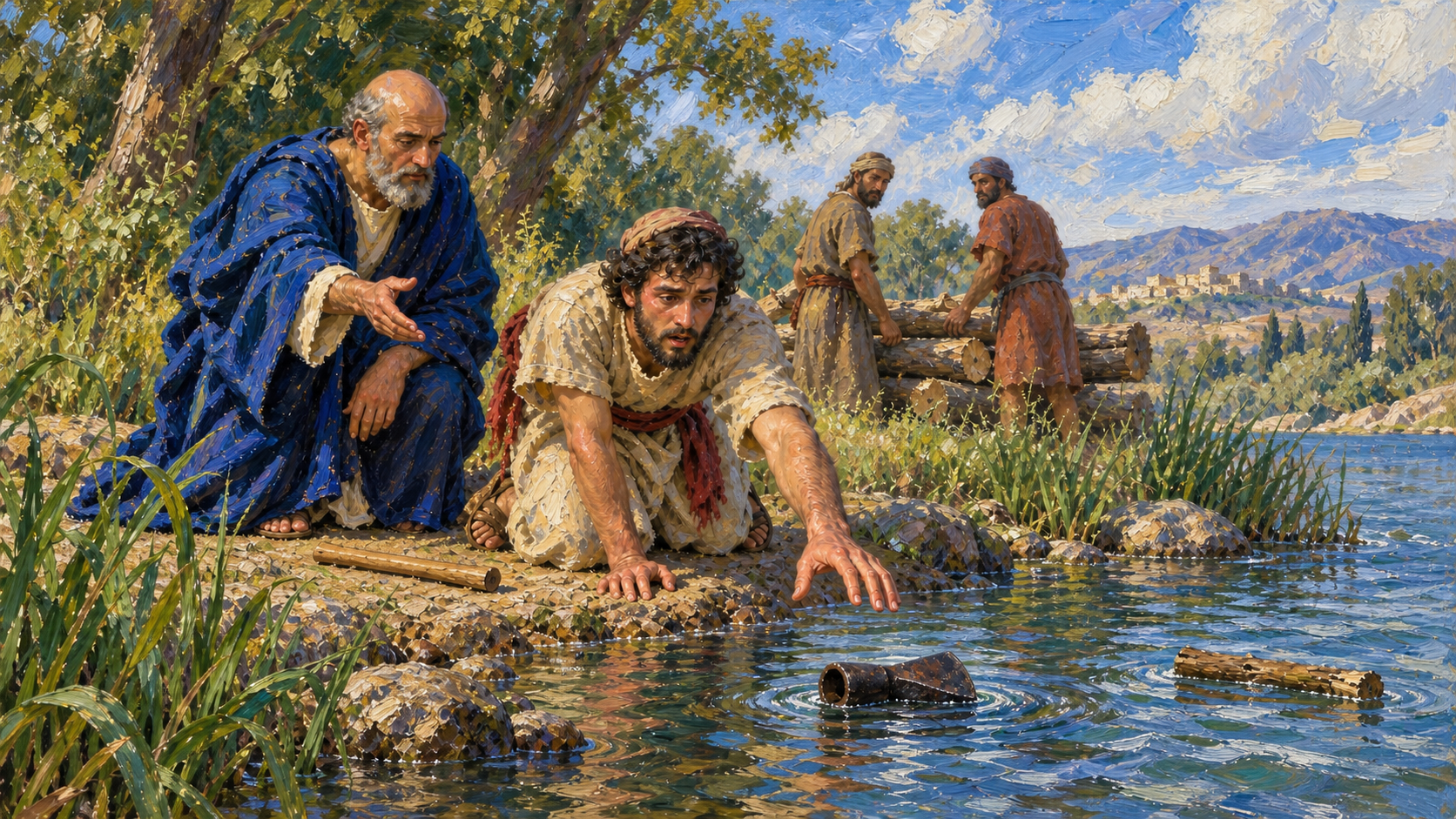
Why did God make a borrowed iron axe head float? Compared with parting the sea or raising the dead, recovering a tool might seem a small thing. But the man who borrowed it had lost something he was responsible to return. I want to understand what this moment in Elisha’s ministry shows us about God’s power and care without treating the axe and stick as a hidden code.
Read the Miracle in Its Place in Elisha’s Ministry
The event took place in the northern kingdom of Israel after Elisha succeeded Elijah as God’s prophet. A community of prophetic servants needed more room, so the men planned to build near the Jordan. Elisha approved their plan and went with them. During the work, an iron axe head slipped into the water. The borrower immediately cried out because the tool belonged to someone else.
Elisha asked where it had fallen. The man showed him, and the prophet cut a stick and threw it at that place. The iron rose to the surface, where the borrower could reach it. Elisha told him to pick it up, and the man did.
Notice what happened before and after the miracle. These men had planned and worked together until an accident left one of them with a real obligation. He told Elisha the truth about the loss, and when God made recovery possible through His prophet, the borrower took the ordinary step of reaching for the tool. I can follow what God and the man actually did without assigning a secret spiritual meaning to each object.
This sign also confirmed Elisha’s ministry, as we can see by reading the events around it. In the preceding chapter, 2 Kings records Naaman’s cleansing and Gehazi’s judgment.
Now Naaman, commander of the army of the king of Syria, was a great and honorable man in the eyes of his master, because by him the LORD had given victory to Syria. He was also a mighty man of valor, but a leper. And the Syrians had gone out on raids, and had brought back captive a young girl from the land of Israel. She waited on Naaman's wife. Then she said to her mistress, "If only my master were with the prophet who is in Samaria! For he would heal him of his leprosy." And Naaman went in and told his master, saying, "Thus and thus said the girl who is from the land of Israel." Then the king of Syria said, "Go now, and I will send a letter to the king of Israel." So he departed and took with him ten talents of silver, six thousand shekels of gold, and ten changes of clothing. Then he brought the letter to the king of Israel, which said, Now be advised, when this letter comes to you, that I have sent Naaman my servant to you, that you may heal him of his leprosy. And it happened, when the king of Israel read the letter, that he tore his clothes and said, "Am I God, to kill and make alive, that this man sends a man to me to heal him of his leprosy? Therefore please consider, and see how he seeks a quarrel with me." So it was, when Elisha the man of God heard that the king of Israel had torn his clothes, that he sent to the king, saying, "Why have you torn your clothes? Please let him come to me, and he shall know that there is a prophet in Israel." Then Naaman went with his horses and chariot, and he stood at the door of Elisha's house. And Elisha sent a messenger to him, saying, "Go and wash in the Jordan seven times, and your flesh shall be restored to you, and you shall be clean." But Naaman became furious, and went away and said, "Indeed, I said to myself, 'He will surely come out to me, and stand and call on the name of the LORD his God, and wave his hand over the place, and heal the leprosy.' Are not the Abanah and the Pharpar, the rivers of Damascus, better than all the waters of Israel? Could I not wash in them and be clean?" So he turned and went away in a rage. And his servants came near and spoke to him, and said, "My father, if the prophet had told you to do something great, would you not have done it? How much more then, when he says to you, 'Wash, and be clean'?" So he went down and dipped seven times in the Jordan, according to the saying of the man of God; and his flesh was restored like the flesh of a little child, and he was clean. And he returned to the man of God, he and all his aides, and came and stood before him; and he said, "Indeed, now I know that there is no God in all the earth, except in Israel; now therefore, please take a gift from your servant." But he said, "As the LORD lives, before whom I stand, I will receive nothing." And he urged him to take it, but he refused. So Naaman said, "Then, if not, please let your servant be given two mule-loads of earth; for your servant will no longer offer either burnt offering or sacrifice to other gods, but to the LORD. Yet in this thing may the LORD pardon your servant: when my master goes into the temple of Rimmon to worship there, and he leans on my hand, and I bow down in the temple of Rimmon–when I bow down in the temple of Rimmon, may the LORD please pardon your servant in this thing." Then he said to him, "Go in peace." So he departed from him a short distance. But Gehazi, the servant of Elisha the man of God, said, "Look, my master has spared Naaman this Syrian, while not receiving from his hands what he brought; but as the LORD lives, I will run after him and take something from him." So Gehazi pursued Naaman. When Naaman saw him running after him, he got down from the chariot to meet him, and said, "Is all well?" And he said, "All is well. My master has sent me, saying, 'Indeed, just now two young men of the sons of the prophets have come to me from the mountains of Ephraim. Please give them a talent of silver and two changes of garments.'" So Naaman said, "Please, take two talents." And he urged him, and bound two talents of silver in two bags, with two changes of garments, and handed them to two of his servants; and they carried them on ahead of him. When he came to the citadel, he took them from their hand, and stored them away in the house; then he let the men go, and they departed. Now he went in and stood before his master. Elisha said to him, "Where did you go, Gehazi?" And he said, "Your servant did not go anywhere." Then he said to him, "Did not my heart go with you when the man turned back from his chariot to meet you? Is it time to receive money and to receive clothing, olive groves and vineyards, sheep and oxen, male and female servants? Therefore the leprosy of Naaman shall cling to you and your descendants forever." And he went out from his presence leprous, as white as snow.
God healed a foreign commander, and Naaman confessed that there was no God in all the earth except in Israel. Elisha refused payment rather than turn that gift of healing into a business. Gehazi then used the prophetic office for his own gain and lied about what he had done, bringing judgment on himself. After the axe head floated, chapter 6 records Elisha receiving Syria’s military plans by divine revelation. The Lord opened a servant’s eyes to see fiery protection and later delivered an enemy army into Israel’s hands without slaughter.
The range of those events helps me appreciate the place of the borrowed tool. The God who dealt with kings and armies also helped one man recover something he had lost. He healed Naaman but judged Gehazi’s deceit, and He revealed hidden things while protecting His servant from an army. When the enemy was in Israel’s hands, He directed the king to show mercy. These were acts of the God of Israel, who spoke through His prophet and acted according to His word. Elisha was not practicing private magic or staging political theater.
The men who built near the Jordan were called the sons of the prophets. They already appear as recognized communities during the transfer from Elijah to Elisha.
And it came to pass, when the LORD was about to take up Elijah into heaven by a whirlwind, that Elijah went with Elisha from Gilgal. Then Elijah said to Elisha, "Stay here, please, for the LORD has sent me on to Bethel." But Elisha said, "As the LORD lives, and as your soul lives, I will not leave you!" So they went down to Bethel. Now the sons of the prophets who were at Bethel came out to Elisha, and said to him, "Do you know that the LORD will take away your master from over you today?" And he said, "Yes, I know; keep silent!" Then Elijah said to him, "Elisha, stay here, please, for the LORD has sent me on to Jericho." But he said, "As the LORD lives, and as your soul lives, I will not leave you!" So they came to Jericho. Now the sons of the prophets who were at Jericho came to Elisha and said to him, "Do you know that the LORD will take away your master from over you today?" So he answered, "Yes, I know; keep silent!" Then Elijah said to him, "Stay here, please, for the LORD has sent me on to the Jordan." But he said, "As the LORD lives, and as your soul lives, I will not leave you!" So the two of them went on. And fifty men of the sons of the prophets went and stood facing them at a distance, while the two of them stood by the Jordan. Now Elijah took his mantle, rolled it up, and struck the water; and it was divided this way and that, so that the two of them crossed over on dry ground. And so it was, when they had crossed over, that Elijah said to Elisha, "Ask! What may I do for you, before I am taken away from you?" Elisha said, "Please let a double portion of your spirit be upon me." So he said, "You have asked a hard thing. Nevertheless, if you see me when I am taken from you, it shall be so for you; but if not, it shall not be so." Then it happened, as they continued on and talked, that suddenly a chariot of fire appeared with horses of fire, and separated the two of them; and Elijah went up by a whirlwind into heaven. And Elisha saw it, and he cried out, "My father, my father, the chariot of Israel and its horsemen!" So he saw him no more. And he took hold of his own clothes and tore them into two pieces. He also took up the mantle of Elijah that had fallen from him, and went back and stood by the bank of the Jordan. Then he took the mantle of Elijah that had fallen from him, and struck the water, and said, "Where is the LORD God of Elijah?" And when he also had struck the water, it was divided this way and that; and Elisha crossed over. Now when the sons of the prophets who were from Jericho saw him, they said, "The spirit of Elijah rests on Elisha." And they came to meet him, and bowed to the ground before him. Then they said to him, "Look now, there are fifty strong men with your servants. Please let them go and search for your master, lest perhaps the Spirit of the LORD has taken him up and cast him upon some mountain or into some valley." And he said, "You shall not send anyone." But when they urged him till he was ashamed, he said, "Send them!" Therefore they sent fifty men, and they searched for three days but did not find him. And when they came back to him, for he had stayed in Jericho, he said to them, "Did I not say to you, 'Do not go'?"
These men lived in groups at Bethel and Jericho, and Scripture also places a community at Gilgal. They knew Elijah was about to depart, watched Elisha receive his mantle, and acknowledged that Elijah’s spirit now rested on him. The word “Sons” can describe membership in a group rather than biological descent. Thinking of them as students may help us understand their relationship with senior prophets, provided we do not picture a school organized like a modern institution.
A Working Community Faced a Real Borrowed-Property Loss
When the men told Elisha their dwelling was too small, they came with a practical proposal and asked for his approval. Each would take a beam from the Jordan area, sharing the work instead of leaving it to one person. I notice that Scripture does not mention a new revelation commanding the expansion. They recognized an ordinary need and made a reasonable plan within what God had already revealed.
One servant asked Elisha to come with them, and he agreed. Housing and manual labor were not beneath a man of God, yet his presence did not relieve the men of their own responsibilities. They still had timber to cut, and Elisha did not take over every task.
Spiritual work often requires ordinary planning, including finding suitable places to meet and caring for material resources. A leader can approve a responsible plan without controlling every measurement. The workers still need to consider safety and the condition of their tools, and to be honest about whether they have the skill the job requires. We should not read the later miracle as a reason to disregard preventable danger or another person’s ownership.
The men cut the timber themselves because prophetic service did not excuse laziness. Scripture honors honest work and condemns exploiting others or refusing proper responsibility through laziness or greed. Other accounts show these communities facing limited food and, in some households, serious debt. They were far from living in luxury. God sometimes met their needs through resources already available or through someone else’s generosity and labor. Manual work by itself does not make a person humble, since we can boast about labor just as easily as status. In this case, though, it was the right way to accomplish their shared purpose.
During that ordinary labor, an axe head came loose. Deuteronomy uses the same kind of accident while explaining refuge for someone who unintentionally killed another person.
"And this is the case of the manslayer who flees there, that he may live: Whoever kills his neighbor unintentionally, not having hated him in time past– as when a man goes to the woods with his neighbor to cut timber, and his hand swings a stroke with the ax to cut down the tree, and the head slips from the handle and strikes his neighbor so that he dies–he shall flee to one of these cities and live; lest the avenger of blood, while his anger is hot, pursue the manslayer and overtake him, because the way is long, and kill him, though he was not deserving of death, since he had not hated the victim in time past.
The law describes an axe head slipping from its handle as a known danger of the work. But 2 Kings does not accuse this borrower of carelessness or hidden sin. The head may have loosened even with reasonable use. I would be going beyond the account if I treated his loss, or every loss, as evidence of secret rebellion against God.
Even without an accusation of wrongdoing, the accident left the man responsible for someone else’s tool. The heavy iron had sunk where he could not retrieve it. Exodus helps explain the distress behind his words “it was borrowed” by setting out a borrower’s responsibilities.
"If a man steals an ox or a sheep, and slaughters it or sells it, he shall restore five oxen for an ox and four sheep for a sheep. If the thief is found breaking in, and he is struck so that he dies, there shall be no guilt for his bloodshed. If the sun has risen on him, there shall be guilt for his bloodshed. He should make full restitution; if he has nothing, then he shall be sold for his theft. If the theft is certainly found alive in his hand, whether it is an ox or donkey or sheep, he shall restore double. "If a man causes a field or vineyard to be grazed, and lets loose his animal, and it feeds in another man's field, he shall make restitution from the best of his own field and the best of his own vineyard. "If fire breaks out and catches in thorns, so that stacked grain, standing grain, or the field is consumed, he who kindled the fire shall surely make restitution. "If a man delivers to his neighbor money or articles to keep, and it is stolen out of the man's house, if the thief is found, he shall pay double. If the thief is not found, then the master of the house shall be brought to the judges to see whether he has put his hand into his neighbor's goods. "For any kind of trespass, whether it concerns an ox, a donkey, a sheep, or clothing, or for any kind of lost thing which another claims to be his, the cause of both parties shall come before the judges; and whomever the judges condemn shall pay double to his neighbor. If a man delivers to his neighbor a donkey, an ox, a sheep, or any animal to keep, and it dies, is hurt, or driven away, no one seeing it, then an oath of the LORD shall be between them both, that he has not put his hand into his neighbor's goods; and the owner of it shall accept that, and he shall not make it good. But if, in fact, it is stolen from him, he shall make restitution to the owner of it. If it is torn to pieces by a beast, then he shall bring it as evidence, and he shall not make good what was torn. "And if a man borrows anything from his neighbor, and it becomes injured or dies, the owner of it not being with it, he shall surely make it good. If its owner was with it, he shall not make it good; if it was hired, it came for its hire.
Israel’s law treated borrowed property carefully, distinguishing deliberate theft from loss or damage and from articles left in safekeeping. Depending on the circumstances, a borrower could have to make good what was lost while the owner was absent. Respecting another person’s ownership meant accepting accountability for the property.
The man had lost someone else’s tool, so he could not simply walk away. His cry was about that responsibility, not some magical quality in the iron. We are not given a price or told that repayment would have ruined him. I don’t need to add those details to understand his distress; his conscience recognized a real duty.
He also admitted the loss immediately instead of hiding it or blaming another worker. If I damage borrowed property, telling the owner promptly protects both that person’s interests and the trust between us. I should accept lawful responsibility and work toward repair or repayment. Asking others for practical help can be part of handling the loss honestly.
The servant turned to Elisha because he recognized God’s prophetic representative. We now come directly to God through Jesus Christ, our only Mediator, but that does not prevent us from sharing a practical burden with trustworthy people in the church. We can pray and accept the community’s help with the same need.
What the Stick and Floating Iron Do—and Do Not—Mean
Elisha asked, “Where did it fall?” and the borrower answered accurately by showing him the place. I can learn from that honesty without making the question into a rule that God restores people only after they identify exactly where they “lost” something. Elisha was asking where the tool had fallen.
Elisha then cut a stick and threw it into the water. This was not the only time a visible action or material object accompanied a miracle in his ministry. He used salt at Jericho and flour in poisoned stew, and he told Naaman to wash in the Jordan. In none of those accounts did the object have power of its own.
We are not told exactly what the stick did. It may have marked the location or served as a visible sign, but Scripture leaves that question open. Ordinary buoyancy would not explain a piece of wood making a separate piece of iron float. Nor does the passage identify the stick with Christ’s cross. The fact that both were made of wood is not enough for me to assign a meaning God never gave the passage.
The main passage gives the miracle and its larger setting together.
And the sons of the prophets said to Elisha, "See now, the place where we dwell with you is too small for us. Please, let us go to the Jordan, and let every man take a beam from there, and let us make there a place where we may dwell." So he answered, "Go." Then one said, "Please consent to go with your servants." And he answered, "I will go." So he went with them. And when they came to the Jordan, they cut down trees. But as one was cutting down a tree, the iron ax head fell into the water; and he cried out and said, "Alas, master! For it was borrowed." So the man of God said, "Where did it fall?" And he showed him the place. So he cut off a stick, and threw it in there; and he made the iron float. Therefore he said, "Pick it up for yourself." So he reached out his hand and took it. Now the king of Syria was making war against Israel; and he consulted with his servants, saying, "My camp will be in such and such a place." And the man of God sent to the king of Israel, saying, "Beware that you do not pass this place, for the Syrians are coming down there." Then the king of Israel sent someone to the place of which the man of God had told him. Thus he warned him, and he was watchful there, not just once or twice. Therefore the heart of the king of Syria was greatly troubled by this thing; and he called his servants and said to them, "Will you not show me which of us is for the king of Israel?" And one of his servants said, "None, my lord, O king; but Elisha, the prophet who is in Israel, tells the king of Israel the words that you speak in your bedroom." So he said, "Go and see where he is, that I may send and get him." And it was told him, saying, "Surely he is in Dothan." Therefore he sent horses and chariots and a great army there, and they came by night and surrounded the city. And when the servant of the man of God arose early and went out, there was an army, surrounding the city with horses and chariots. And his servant said to him, "Alas, my master! What shall we do?" So he answered, "Do not fear, for those who are with us are more than those who are with them." And Elisha prayed, and said, "LORD, I pray, open his eyes that he may see." Then the LORD opened the eyes of the young man, and he saw. And behold, the mountain was full of horses and chariots of fire all around Elisha. So when the Syrians came down to him, Elisha prayed to the LORD, and said, "Strike this people, I pray, with blindness." And He struck them with blindness according to the word of Elisha. Now Elisha said to them, "This is not the way, nor is this the city. Follow me, and I will bring you to the man whom you seek." But he led them to Samaria. So it was, when they had come to Samaria, that Elisha said, "LORD, open the eyes of these men, that they may see." And the LORD opened their eyes, and they saw; and there they were, inside Samaria! Now when the king of Israel saw them, he said to Elisha, "My father, shall I kill them? Shall I kill them?" But he answered, "You shall not kill them. Would you kill those whom you have taken captive with your sword and your bow? Set food and water before them, that they may eat and drink and go to their master." Then he prepared a great feast for them; and after they ate and drank, he sent them away and they went to their master. So the bands of Syrian raiders came no more into the land of Israel.
The NKJV says Elisha “made the iron float.” The Hebrew verb can describe making it rise or swim, so either way the iron moved from the river’s depth to where the man could recover it. Knowing that range helps us understand the result being described without pretending to know how God did it. This was a real miracle over the created order. Scripture does not say whether God suspended the dense iron’s normal behavior or used some means unknown to us.
The floating axe belongs with the events that follow as evidence of God working through His prophet. Elisha knew facts he could not have discovered naturally, and the Lord enabled his servant to see the fiery army already protecting them. God then struck the approaching Syrians with blindness and later restored their sight. Israel fed them and let them go.
When Elisha said, “Pick it up for yourself,” the man reached out and took the tool. God had made recovery possible, and the borrower responded by doing what he could now do. That does not mean every miracle depends on human participation. The dead whom Jesus raised could not cooperate beforehand. Sometimes God commands a response, and sometimes He acts before anyone is able to respond.
Miracles in Scripture reveal who God is and advance His purpose, sometimes confirming a messenger He has chosen. They are neither entertainment nor techniques that religious specialists own. We therefore need to test modern miracle claims by Scripture, including the teaching attached to them. Does it agree with biblical truth and honor the biblical Christ? The fruit should be godly too, because an unusual report never gives a teacher authority to contradict the Bible.
During a time of deep spiritual confusion in Israel, these signs assured the people that the Lord had truly entrusted His word to Elisha. The authority remained God’s; it was not the prophet’s private possession. I want my wonder at the miracle to lead me to the Lord who acted, rather than stop with the man He used.
God’s Care Is Personal but Not Programmable
War, famine, and resurrection can make a borrowed axe seem a minor concern, but its loss was real to the borrower. That helps me see the connection with Jesus’ teaching about the Father noticing details other people easily overlook.
"A disciple is not above his teacher, nor a servant above his master. It is enough for a disciple that he be like his teacher, and a servant like his master. If they have called the master of the house Beelzebub, how much more will they call those of his household! Therefore do not fear them. For there is nothing covered that will not be revealed, and hidden that will not be known. "Whatever I tell you in the dark, speak in the light; and what you hear in the ear, preach on the housetops. And do not fear those who kill the body but cannot kill the soul. But rather fear Him who is able to destroy both soul and body in hell. Are not two sparrows sold for a copper coin? And not one of them falls to the ground apart from your Father's will. But the very hairs of your head are all numbered. Do not fear therefore; you are of more value than many sparrows. "Therefore whoever confesses Me before men, him I will also confess before My Father who is in heaven. But whoever denies Me before men, him I will also deny before My Father who is in heaven. "Do not think that I came to bring peace on earth. I did not come to bring peace but a sword. For I have come to 'set a man against his father, a daughter against her mother, and a daughter-in-law against her mother-in-law'; and 'a man's enemies will be those of his own household.' He who loves father or mother more than Me is not worthy of Me. And he who loves son or daughter more than Me is not worthy of Me. And he who does not take his cross and follow after Me is not worthy of Me. He who finds his life will lose it, and he who loses his life for My sake will find it.
Jesus spoke of sparrows and numbered hairs while preparing His disciples for persecution. Knowing that the Father saw them gave them courage when enemies threatened their lives. He did not promise His witnesses freedom from every earthly loss. He assured them that no threat or need made them invisible to their Father.
God saw this servant’s obligation and chose to intervene, which fits what Jesus teaches about the Father’s care. But I cannot turn the recovery of one axe head into a promise that every lost possession will return supernaturally. Matthew 10 prepares disciples to suffer and even lose their earthly lives. The Father’s knowledge and faithful love remain certain while He decides the earthly outcome.
Elisha’s ministry shows that God’s provision did not always arrive in the same way.
A certain woman of the wives of the sons of the prophets cried out to Elisha, saying, "Your servant my husband is dead, and you know that your servant feared the LORD. And the creditor is coming to take my two sons to be his slaves." So Elisha said to her, "What shall I do for you? Tell me, what do you have in the house?" And she said, "Your maidservant has nothing in the house but a jar of oil." Then he said, "Go, borrow vessels from everywhere, from all your neighbors–empty vessels; do not gather just a few. And when you have come in, you shall shut the door behind you and your sons; then pour it into all those vessels, and set aside the full ones." So she went from him and shut the door behind her and her sons, who brought the vessels to her; and she poured it out. Now it came to pass, when the vessels were full, that she said to her son, "Bring me another vessel." And he said to her, "There is not another vessel." So the oil ceased. Then she came and told the man of God. And he said, "Go, sell the oil and pay your debt; and you and your sons live on the rest." Now it happened one day that Elisha went to Shunem, where there was a notable woman, and she persuaded him to eat some food. So it was, as often as he passed by, he would turn in there to eat some food. And she said to her husband, "Look now, I know that this is a holy man of God, who passes by us regularly. Please, let us make a small upper room on the wall; and let us put a bed for him there, and a table and a chair and a lampstand; so it will be, whenever he comes to us, he can turn in there." And it happened one day that he came there, and he turned in to the upper room and lay down there. Then he said to Gehazi his servant, "Call this Shunammite woman." When he had called her, she stood before him. And he said to him, "Say now to her, 'Look, you have been concerned for us with all this care. What can I do for you? Do you want me to speak on your behalf to the king or to the commander of the army?'" She answered, "I dwell among my own people." So he said, "What then is to be done for her?" And Gehazi answered, "Actually, she has no son, and her husband is old." So he said, "Call her." When he had called her, she stood in the doorway. Then he said, "About this time next year you shall embrace a son." And she said, "No, my lord. Man of God, do not lie to your maidservant!" But the woman conceived, and bore a son when the appointed time had come, of which Elisha had told her. And the child grew. Now it happened one day that he went out to his father, to the reapers. And he said to his father, "My head, my head!" So he said to a servant, "Carry him to his mother." When he had taken him and brought him to his mother, he sat on her knees till noon, and then died. And she went up and laid him on the bed of the man of God, shut the door upon him, and went out. Then she called to her husband, and said, "Please send me one of the young men and one of the donkeys, that I may run to the man of God and come back." So he said, "Why are you going to him today? It is neither the New Moon nor the Sabbath." And she said, "It is well." Then she saddled a donkey, and said to her servant, "Drive, and go forward; do not slacken the pace for me unless I tell you." And so she departed, and went to the man of God at Mount Carmel. So it was, when the man of God saw her afar off, that he said to his servant Gehazi, "Look, the Shunammite woman! Please run now to meet her, and say to her, 'Is it well with you? Is it well with your husband? Is it well with the child?'" And she answered, "It is well." Now when she came to the man of God at the hill, she caught him by the feet, but Gehazi came near to push her away. But the man of God said, "Let her alone; for her soul is in deep distress, and the LORD has hidden it from me, and has not told me." So she said, "Did I ask a son of my lord? Did I not say, 'Do not deceive me'?" Then he said to Gehazi, "Get yourself ready, and take my staff in your hand, and be on your way. If you meet anyone, do not greet him; and if anyone greets you, do not answer him; but lay my staff on the face of the child." And the mother of the child said, "As the LORD lives, and as your soul lives, I will not leave you." So he arose and followed her. Now Gehazi went on ahead of them, and laid the staff on the face of the child; but there was neither voice nor hearing. Therefore he went back to meet him, and told him, saying, "The child has not awakened." When Elisha came into the house, there was the child, lying dead on his bed. He went in therefore, shut the door behind the two of them, and prayed to the LORD. And he went up and lay on the child, and put his mouth on his mouth, his eyes on his eyes, and his hands on his hands; and he stretched himself out on the child, and the flesh of the child became warm. He returned and walked back and forth in the house, and again went up and stretched himself out on him; then the child sneezed seven times, and the child opened his eyes. And he called Gehazi and said, "Call this Shunammite woman." So he called her. And when she came in to him, he said, "Pick up your son." So she went in, fell at his feet, and bowed to the ground; then she picked up her son and went out. And Elisha returned to Gilgal, and there was a famine in the land. Now the sons of the prophets were sitting before him; and he said to his servant, "Put on the large pot, and boil stew for the sons of the prophets." So one went out into the field to gather herbs, and found a wild vine, and gathered from it a lapful of wild gourds, and came and sliced them into the pot of stew, though they did not know what they were. Then they served it to the men to eat. Now it happened, as they were eating the stew, that they cried out and said, "Man of God, there is death in the pot!" And they could not eat it. So he said, "Then bring some flour." And he put it into the pot, and said, "Serve it to the people, that they may eat." And there was nothing harmful in the pot. Then a man came from Baal Shalisha, and brought the man of God bread of the firstfruits, twenty loaves of barley bread, and newly ripened grain in his knapsack. And he said, "Give it to the people, that they may eat." But his servant said, "What? Shall I set this before one hundred men?" He said again, "Give it to the people, that they may eat; for thus says the LORD: 'They shall eat and have some left over.'" So he set it before them; and they ate and had some left over, according to the word of the LORD.
The widow paid her debt with multiplied oil. The Shunammite woman provided hospitality, and we also read how God gave her a son and later raised him from death. Elsewhere, God made poisoned stew safe and multiplied a small supply of bread. These accounts include miracles through Elisha as well as the generosity of a household. God could provide through the land’s produce or through resources people already had and were willing to share.
Psalm 107 surveys an even wider range of God’s providence.
Oh, give thanks to the LORD, for He is good! For His mercy endures forever. Let the redeemed of the LORD say so, Whom He has redeemed from the hand of the enemy, And gathered out of the lands, From the east and from the west, From the north and from the south. They wandered in the wilderness in a desolate way; They found no city to dwell in. Hungry and thirsty, Their soul fainted in them. Then they cried out to the LORD in their trouble, And He delivered them out of their distresses. And He led them forth by the right way, That they might go to a city for a dwelling place. Oh, that men would give thanks to the LORD for His goodness, And for His wonderful works to the children of men! For He satisfies the longing soul, And fills the hungry soul with goodness. Those who sat in darkness and in the shadow of death, Bound in affliction and irons– Because they rebelled against the words of God, And despised the counsel of the Most High, Therefore He brought down their heart with labor; They fell down, and there was none to help. Then they cried out to the LORD in their trouble, And He saved them out of their distresses. He brought them out of darkness and the shadow of death, And broke their chains in pieces. Oh, that men would give thanks to the LORD for His goodness, And for His wonderful works to the children of men! For He has broken the gates of bronze, And cut the bars of iron in two. Fools, because of their transgression, And because of their iniquities, were afflicted. Their soul abhorred all manner of food, And they drew near to the gates of death. Then they cried out to the LORD in their trouble, And He saved them out of their distresses. He sent His word and healed them, And delivered them from their destructions. Oh, that men would give thanks to the LORD for His goodness, And for His wonderful works to the children of men! Let them sacrifice the sacrifices of thanksgiving, And declare His works with rejoicing. Those who go down to the sea in ships, Who do business on great waters, They see the works of the LORD, And His wonders in the deep. For He commands and raises the stormy wind, Which lifts up the waves of the sea. They mount up to the heavens, They go down again to the depths; Their soul melts because of trouble. They reel to and fro, and stagger like a drunken man, And are at their wits' end. Then they cry out to the LORD in their trouble, And He brings them out of their distresses. He calms the storm, So that its waves are still. Then they are glad because they are quiet; So He guides them to their desired haven. Oh, that men would give thanks to the LORD for His goodness, And for His wonderful works to the children of men! Let them exalt Him also in the assembly of the people, And praise Him in the company of the elders. He turns rivers into a wilderness, And the watersprings into dry ground; A fruitful land into barrenness, For the wickedness of those who dwell in it. He turns a wilderness into pools of water, And dry land into watersprings. There He makes the hungry dwell, That they may establish a city for a dwelling place, And sow fields and plant vineyards, That they may yield a fruitful harvest. He also blesses them, and they multiply greatly; And He does not let their cattle decrease. When they are diminished and brought low Through oppression, affliction and sorrow, He pours contempt on princes, And causes them to wander in the wilderness where there is no way; Yet He sets the poor on high, far from affliction, And makes their families like a flock. The righteous see it and rejoice, And all iniquity stops its mouth. Whoever is wise will observe these things, And they will understand the lovingkindness of the LORD.
The psalm follows hungry people in the wilderness and then turns to prisoners in darkness. It also describes sickness and sailors caught in a storm. Later, fruitful land becomes barren while wilderness becomes a place of water and harvest. The circumstances change, but we repeatedly see the Lord’s lovingkindness in His response. The wise response is to observe His ways and give thanks. I need to do that rather than decide that His care must always arrive by one method.
We can pray for miraculous help while using the ordinary means God has made available. Work and careful handling of money may be part of His answer, as may wise counsel and help from the church. He may also give us endurance when the loss remains. Those ordinary forms of care still come from Him, and we cannot claim a miracle as something He owes us on demand.
Jesus also teaches us not to make material security the center of life.
Then He said to His disciples, "Therefore I say to you, do not worry about your life, what you will eat; nor about the body, what you will put on. Life is more than food, and the body is more than clothing. Consider the ravens, for they neither sow nor reap, which have neither storehouse nor barn; and God feeds them. Of how much more value are you than the birds? And which of you by worrying can add one cubit to his stature? If you then are not able to do the least, why are you anxious for the rest? Consider the lilies, how they grow: they neither toil nor spin; and yet I say to you, even Solomon in all his glory was not arrayed like one of these. If then God so clothes the grass, which today is in the field and tomorrow is thrown into the oven, how much more will He clothe you, O you of little faith? "And do not seek what you should eat or what you should drink, nor have an anxious mind. For all these things the nations of the world seek after, and your Father knows that you need these things. But seek the kingdom of God, and all these things shall be added to you. "Do not fear, little flock, for it is your Father's good pleasure to give you the kingdom. Sell what you have and give alms; provide yourselves money bags which do not grow old, a treasure in the heavens that does not fail, where no thief approaches nor moth destroys. For where your treasure is, there your heart will be also.
The Father knows what His children need, so Jesus tells them to seek God’s kingdom instead of anxiously pursuing food and clothing. That freedom from fear should make us generous and turn our hearts toward lasting treasure. Some faithful people will still have a loss to repay, while others may face failed crops, lost homes, or poverty. God’s care remains true through those losses. The resurrection inheritance awaiting the believer will finally exceed anything that could be recovered in this life.
This miracle invites us to trust God in prayer. It gives us no reason to shame someone whose property has not been restored, as though the account guaranteed that result. God’s care is personal, but its outcome is not ours to control.
I should be able to bring an ordinary need to the Father who knows the details of my life without demanding that He repeat one extraordinary answer. The need is worth praying about, even when I do not know how He will meet it. Trust allows us to ask honestly and leave the means with God.
Practice Responsible Trust Without Formulas
Some explanations treat the sinking iron as humanity lost in sin and the stick as divine intervention or the cross. They then make the rising metal represent resurrection and its recovery the restoration of spiritual sharpness. Those meanings are assigned to the objects; none of them comes from 2 Kings itself.
The passages sometimes used to support that allegory are true in their own settings. Psalm 40 and Psalm 51 are psalms, while Revelation 2 addresses the church at Ephesus and James 2 explains living faith. We need to read those passages in their own contexts before connecting them with the axe head. Attaching their teachings to the iron and stick does not establish a secret code. What God actually did is already spiritually rich: He confirmed His prophet and cared for a responsible borrower among men working together.
Faith trusts the God who has spoken rather than trying to reproduce this miracle by copying the stick or repeating, “Pick it up.” Elisha acted with unique prophetic authority. We can pray boldly and use whatever honest means are available without assuming that his action gives us control over the outcome. That belongs to God.
John’s Gospel helps us see how Scripture itself handles signs.
On the third day there was a wedding in Cana of Galilee, and the mother of Jesus was there. Now both Jesus and His disciples were invited to the wedding. And when they ran out of wine, the mother of Jesus said to Him, "They have no wine." Jesus said to her, "Woman, what does your concern have to do with Me? My hour has not yet come." His mother said to the servants, "Whatever He says to you, do it." Now there were set there six waterpots of stone, according to the manner of purification of the Jews, containing twenty or thirty gallons apiece. Jesus said to them, "Fill the waterpots with water." And they filled them up to the brim. And He said to them, "Draw some out now, and take it to the master of the feast." And they took it. When the master of the feast had tasted the water that was made wine, and did not know where it came from (but the servants who had drawn the water knew), the master of the feast called the bridegroom. And he said to him, "Every man at the beginning sets out the good wine, and when the guests have well drunk, then the inferior. You have kept the good wine until now!" This beginning of signs Jesus did in Cana of Galilee, and manifested His glory; and His disciples believed in Him. After this He went down to Capernaum, He, His mother, His brothers, and His disciples; and they did not stay there many days.
When Jesus turned water into wine, He revealed His glory and led His disciples to believe in Him. Scripture tells us directly what the sign accomplished. I don’t need to hide the gospel in Elisha’s iron and wood when God has plainly revealed His Son.
Jesus is the eternal Son, fully God and fully human. He was born of a virgin and remained completely sinless. Wicked men physically tortured and killed Him, yet He willingly bore that bodily punishment for our sins and shed His blood. He died for the whole world, was buried, and rose bodily. The Father did not punish or curse Jesus, and He never abandoned His Son. Scripture does not say the Father struck or bruised Him or poured wrath upon Him.
People can resist Christ’s genuine offer of salvation, but whoever repents and believes is forgiven and justified. God gives that person new birth, and the Holy Spirit comes to dwell within and seal the believer. A person truly born again is eternally secure. That security does not make lawlessness harmless, nor does a shallow profession prove that someone has received new life.
Now Thomas, called the Twin, one of the twelve, was not with them when Jesus came. The other disciples therefore said to him, "We have seen the Lord." So he said to them, "Unless I see in His hands the print of the nails, and put my finger into the print of the nails, and put my hand into His side, I will not believe." And after eight days His disciples were again inside, and Thomas with them. Jesus came, the doors being shut, and stood in the midst, and said, "Peace to you!" Then He said to Thomas, "Reach your finger here, and look at My hands; and reach your hand here, and put it into My side. Do not be unbelieving, but believing." And Thomas answered and said to Him, "My Lord and my God!" Jesus said to him, "Thomas, because you have seen Me, you have believed. Blessed are those who have not seen and yet have believed." And truly Jesus did many other signs in the presence of His disciples, which are not written in this book; but these are written that you may believe that Jesus is the Christ, the Son of God, and that believing you may have life in His name.
John explains that the written signs lead readers to believe Jesus is the Christ, the Son of God, and to have life in His name. The gospel is plainly revealed through Him. Letting each passage say what God inspired it to say honors both the miracle through Elisha and Christ’s saving work.
Responsible trust begins with loving God above the material things He provides.
"Hear, O Israel: The LORD our God, the LORD is one! You shall love the LORD your God with all your heart, with all your soul, and with all your strength. "And these words which I command you today shall be in your heart. You shall teach them diligently to your children, and shall talk of them when you sit in your house, when you walk by the way, when you lie down, and when you rise up. You shall bind them as a sign on your hand, and they shall be as frontlets between your eyes. You shall write them on the doorposts of your house and on your gates. "So it shall be, when the LORD your God brings you into the land of which He swore to your fathers, to Abraham, Isaac, and Jacob, to give you large and beautiful cities which you did not build, houses full of all good things, which you did not fill, hewn-out wells which you did not dig, vineyards and olive trees which you did not plant–when you have eaten and are full– then beware, lest you forget the LORD who brought you out of the land of Egypt, from the house of bondage. You shall fear the LORD your God and serve Him, and shall take oaths in His name.
Moses warned Israel that prosperity could tempt them to forget the Lord who provided it. He told them to love Him with their whole being and remember Him in daily life. What God gives should deepen my gratitude, not persuade me that I no longer depend on Him.
The borrower’s example should affect how I care for anything entrusted to me. If I lose or damage it, I need to tell the owner promptly and accept lawful responsibility so we can work toward a fair remedy. I can ask God for help without demanding a miracle or using spiritual language to pressure the lender.
Wise believers may help us carry practical burdens, and we should use the ordinary means available. Turning an object into a charm or copying a prophetic action will not give us control over God. He may restore what was lost or provide a replacement. He may enable us to repay it through work and help from others. And when an earthly loss remains permanent, He can supply the endurance and lasting hope we need to live with it.
For more context, see The Life of Elisha, Providence and Provision, and Faith.
My Final Thoughts
I find more help in what actually happened here than in the old allegories built around the axe and stick. God confirmed Elisha as His prophet and cared for a servant who had lost something he was responsible to return. That does not give us a formula for recovering every loss, but it does encourage us to bring our needs to God while telling the truth and accepting responsibility. I can trust the Father’s wisdom and use the means He provides. Whether His answer comes through ordinary means or a miracle, every good outcome still comes from His hand.