
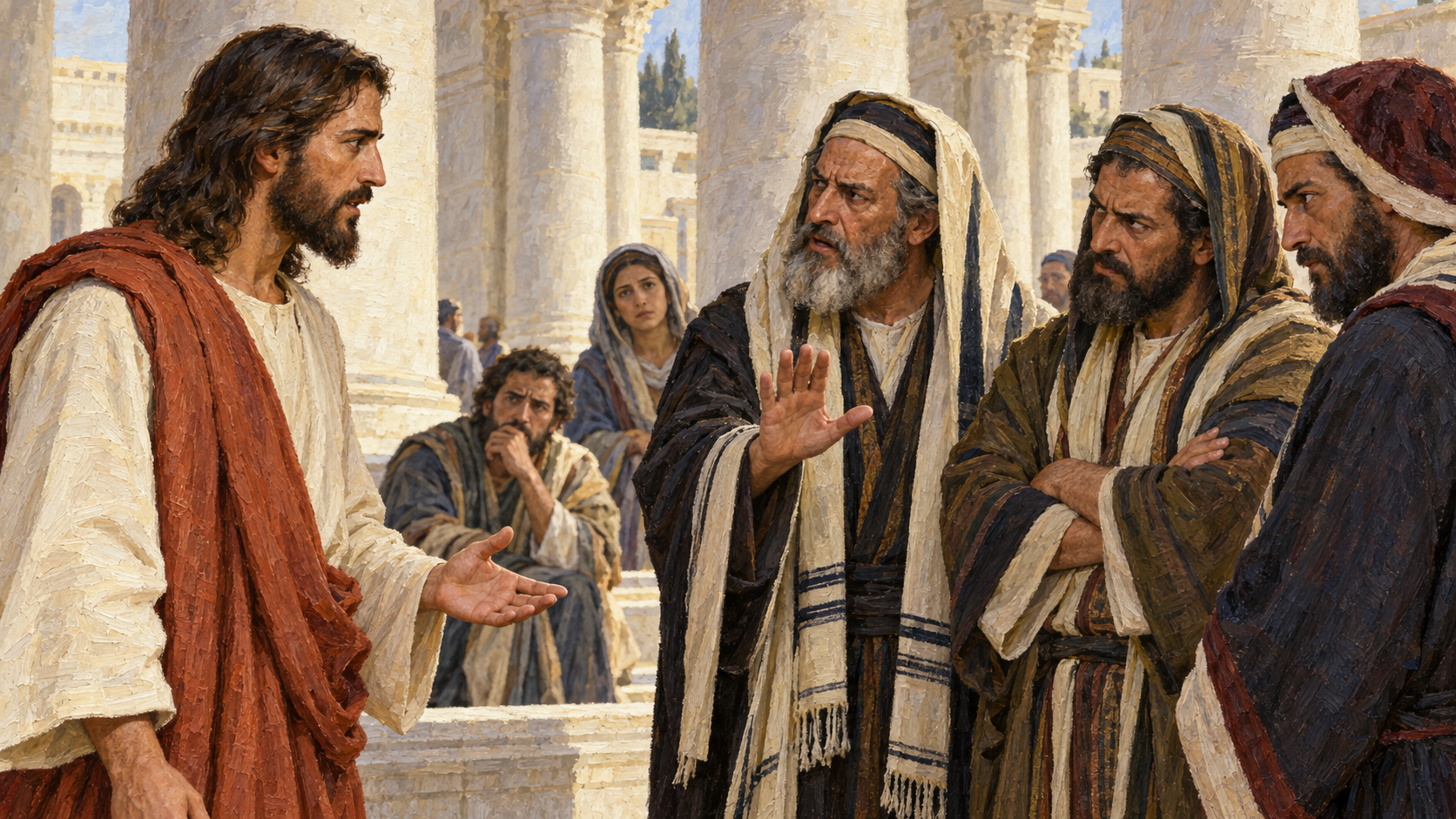
When Jesus said, “You are of your father the devil,” He was confronting men who claimed a relationship with Abraham and with God while rejecting the truth and seeking to kill the Son whom God had sent. Their conduct revealed an allegiance that their religious claims concealed.
I want to read that rebuke within the whole conversation in John 8. Jesus speaks about slavery to sin, the freedom He gives, and what it means to hear God’s Word. He is not condemning people for their ethnicity. The passage warns every religious reader against relying on inherited identity while refusing the Savior.
The Confrontation in John 8
Jesus was teaching in the temple area when He made a public declaration about Himself:
Then Jesus spoke to them again, saying, “I am the light of the world. He who follows Me shall not walk in darkness, but have the light of life.”
The Pharisees objected that He was testifying about Himself. Jesus answered by speaking of the Father who had sent Him and who bore witness to Him. He knew where He had come from and where He was going. Their failure to recognize the Son also exposed their failure to know the Father. The dispute involved the question of who Jesus truly is and whether His hearers would receive Him.
Therefore I said to you that you will die in your sins; for if you do not believe that I am He, you will die in your sins.
Religious standing could not remove their sins. Jesus warned that rejecting Him would leave them to die in those sins, however confidently they spoke about their relationship with God. A respected position, knowledge of Scripture, and a long religious history could not accomplish the deliverance only the Son could give.
John then records Jesus addressing “those Jews who believed Him”:
Then Jesus said to those Jews who believed Him, “If you abide in My word, you are My disciples indeed.
And you shall know the truth, and the truth shall make you free.”
To abide is to remain or continue. Jesus identifies genuine disciples by their continuing reception of His word. The conversation soon exposes resistance to that word, so I do not understand every favorable response described as belief to establish that a person has been born again. Someone can initially welcome what he hears and then reject the Lord’s correction. Continuing in His word reveals genuine discipleship; it does not purchase salvation through a record of flawless obedience.
His hearers answered that they were Abraham’s descendants and had never been in bondage to anyone. Israel had experienced captivity and foreign domination, and Judea was then under Roman rule. Their claim may concern the freedom they associated with their standing as Abraham’s descendants rather than a denial of every foreign occupation. Whatever they intended, they were not acknowledging the bondage Jesus was exposing:
Jesus answered them, “Most assuredly, I say to you, whoever commits sin is a slave of sin.
And a slave does not abide in the house forever, but a son abides forever.
Therefore if the Son makes you free, you shall be free indeed.”
Jesus was speaking about slavery to sin. Claiming Abraham as an ancestor could not free a person from that slavery. The Son has the authority to give the freedom and lasting place in God’s household that a slave cannot secure for himself. Their appeal to ancestry could not answer His warning about sin. They needed to receive the freedom He offered.
Abraham’s Children and the Devil’s Children
Jesus explicitly acknowledged their ancestry: “I know that you are Abraham’s descendants.” He challenged their claim to act as Abraham’s spiritual children. They were seeking the death of the One who spoke God’s truth:
They answered and said to Him, “Abraham is our father.”
Jesus said to them, “If you were Abraham’s children, you would do the works of Abraham.
But now you seek to kill Me, a Man who has told you the truth which I heard from God. Abraham did not do this.”
Descent from Abraham carried real privileges. God gave Israel the covenants and entrusted the nation with His Word, and the Messiah came through Abraham’s family. Jesus did not need to deny those facts to expose unbelief. The men confronting Him were appealing to an ancestor whose response to God differed from their own.
And he believed in the LORD, and He accounted it to him for righteousness.
Abraham believed God’s promise, and God counted him righteous through faith. His obedience grew out of that trust, whereas these men sought to kill the One who spoke God’s truth.
Jesus identified the allegiance expressed through their desire to kill Him and their rejection of the truth:
You are of your father the devil, and the desires of your father you want to do. He was a murderer from the beginning, and does not stand in the truth, because there is no truth in him.
When he speaks a lie, he speaks from his own resources, for he is a liar and the father of it.
He explains the relationship by their desires. They wanted to do what the devil desired, and their intent to murder and refusal of truth resembled his character. Jesus was not saying that Satan had physically fathered them. He was exposing a spiritual allegiance through actions they chose to pursue.
The devil’s work in Eden began with deception about God’s Word and drew humanity into sin and death. In John 8, the same hostility to God’s truth appears in the determination to reject His Son. The study on Satan examines what Scripture reveals about his rebellion and deception.
Jesus then presses the reason for their unbelief:
But because I tell the truth, you do not believe Me.
Which of you convicts Me of sin? And if I tell the truth, why do you not believe Me?
He who is of God hears God’s words; therefore you do not hear, because you are not of God.
They could not establish that Jesus was sinful or that His message was false. He told them the truth, yet they refused Him. His words exposed their lack of a genuine relationship with the God they claimed as Father. Hearing in this passage means receiving God’s words, not merely having the sound reach one’s ears.
Later in the conversation, Jesus returned to Abraham’s response to His own coming:
Your father Abraham rejoiced to see My day, and he saw it and was glad.
I understand Abraham’s gladness in connection with the fulfillment of God’s promise in Christ. Jesus does not explain here every detail of how Abraham saw His day, but He does identify Abraham’s response as joy. The men who claimed Abraham as their father were trying to kill the One in whom Abraham rejoiced.
I need to consider Jesus’ verdict on their unbelief as someone who reads and teaches Scripture. Familiarity with the Bible cannot excuse my refusal to receive what it says. The men in this conversation knew the names and promises of their faith, but used them to resist the Son those promises concerned. A religious vocabulary cannot replace trust in Him.
A Warning About Unbelief, Not Ethnicity
Using John 8 to justify hatred of Jewish people contradicts the argument Jesus makes. He acknowledges physical ancestry while confronting unbelief and murderous intent. His rebuke concerns the people before Him and the conduct He identifies. It is not a declaration that everyone sharing their ancestry is a child of the devil.
Jesus is Israel’s Messiah, born to a Jewish mother and raised in a Jewish home. John the Baptist and the apostles were Jewish, and the first thousands of believers in Jerusalem came from Israel. John’s Gospel itself records Jewish people believing in Jesus. The same Gospel preserves these words from His conversation with the Samaritan woman:
You worship what you do not know; we know what we worship, for salvation is of the Jews.
God’s promises and His dealings with Israel brought salvation into the world through the Messiah. Jesus was speaking from within that history, not expressing hostility toward a people foreign to Him. To turn His rebuke into a condemnation of a bloodline would ignore both His acknowledgment of their ancestry and His explanation of their wrongdoing.
A Gentile has no ground for superiority here. Rejecting Christ and choosing darkness do not become acceptable because a person has a different ancestry. Nor can a Christian family, baptism, years of ministry, or extensive Bible knowledge give a person saving faith. Every sinner needs the Son, and everyone who receives Him is welcomed into God’s family.
How a Person Becomes a Child of God
People sometimes say that we are all God’s children. There is a sense in which every person owes his existence to God, bears His image, and lives under His authority. Paul appealed to that shared origin when he addressed idolaters in Athens:
For in Him we live and move and have our being, as also some of your own poets have said, “For we are also His offspring.”
Therefore, since we are the offspring of God, we ought not to think that the Divine Nature is like gold or silver or stone, something shaped by art and man’s devising.
Paul was explaining that the God who made us cannot be reduced to an image we manufacture out of metal or stone. His reference to human beings as God’s offspring concerns our creation and dependence on Him. It does not mean that all people are already reconciled to Him. John describes becoming God’s children through a saving relationship with Christ:
But as many as received Him, to them He gave the right to become children of God, to those who believe in His name:
who were born, not of blood, nor of the will of the flesh, nor of the will of man, but of God.
Those who receive Christ and believe in His name are born of God. The new birth is “not of blood”; family descent cannot produce it. Neither human effort nor another person’s wishes can bring it about. God gives the new life to those who receive His Son. The study on being born again explains this relationship more fully.
Romans 8:9–10 also connects belonging to Christ with the presence of His Spirit. A Christian label cannot supply the Spirit or make an unbeliever Christ’s own. When I use the word regeneration, I mean genuine new birth, which becomes evident in a changed response to God and to other people. John describes that evidence:
In this the children of God and the children of the devil are manifest: Whoever does not practice righteousness is not of God, nor is he who does not love his brother.
The new life comes first, and righteous conduct follows as its fruit. Works do not earn sonship or keep a believer saved. At the same time, a person cannot make hatred and rebellion harmless by claiming a religious identity. John distinguishes the children of God from the children of the devil through their conduct and love, continuing the spiritual distinction Jesus made.
The issue also reaches beyond present conduct to final judgment. I understand Scripture to teach that every person begins written in the Book of Life. Those who finally reject Christ and remain in unbelief are blotted out; believers remain in the book, while their sins are blotted out through Christ’s blood. Removing sins and removing a person’s name are different things. Christ gives this assurance:
He who overcomes shall be clothed in white garments, and I will not blot out his name from the Book of Life; but I will confess his name before My Father and before His angels.
Revelation also describes people deceived by the beast whose names are absent from the book:
The beast that you saw was, and is not, and will ascend out of the bottomless pit and go to perdition. And those who dwell on the earth will marvel, whose names are not written in the Book of Life from the foundation of the world, when they see the beast that was, and is not, and yet is.
Readers differ over how these passages fit together. Some understand Revelation 17:8 as describing people whose names were never entered. I read its description of absent names alongside the references to blotting out and understand final absence as the result of persistent unbelief. My conclusion that people begin written in the book is an interpretation of the passages together, rather than something Revelation 17:8 explicitly narrates.
The final judgment distinguishes the record of deeds from the Book of Life:
And I saw the dead, small and great, standing before God, and books were opened. And another book was opened, which is the Book of Life.
And the dead were judged according to their works, by the things which were written in the books.
The books record works for judgment, while the Book of Life identifies those who have life. Revelation 20:15 says that anyone not found in it is cast into the Lake of Fire. Rejecting the Son is therefore more serious than choosing one private religious preference over another.
This warning concerns final unbelief, not a truly born-again person losing salvation. The Holy Spirit seals those who have received Christ, and they are secure in Him. Christ died for the world, and the offer of life is genuine for every person. People can resist that grace and refuse the Savior, but their refusal does not show that His provision was insufficient or His invitation insincere.
Hardening, Judgment, and the Gospel’s Answer
As the conversation in John 8 continues, Jesus’ opponents answer Him with accusations, and the chapter ends with their taking up stones to throw at Him. Their appeal to Abraham did not bring them to trust the One Abraham anticipated. The truth Jesus spoke exposed their resistance instead of confirming their religious confidence.
Paul’s warning in Hebrews addresses the danger of refusing God’s voice:
While it is said: “Today, if you will hear His voice, Do not harden your hearts as in the rebellion.”
Hardening is more than being confused or asking an honest question. It happens when God’s Word exposes sin and a person protects it instead of responding. I can defend a tradition because admitting its error would embarrass me, or keep explaining away a command because obedience would cost something I want to keep. Jesus’ words call for an honest response to Him, rather than a defense of the identity I have built around myself.
We should not confuse that settled resistance with a tender believer’s grief over sin. Someone who recognizes wrongdoing, seeks forgiveness, and wants Christ’s correction is responding differently from those who reject His truth and seek His death. The warning should expose false confidence and bring sinners to the Savior, while His promises give assurance to those who trust Him.
Religious performance and self-improvement cannot release us from the bondage Jesus describes. God Himself has provided the Son who makes sinners free:
For God so loved the world that He gave His only begotten Son, that whoever believes in Him should not perish but have everlasting life.
And He Himself is the propitiation for our sins, and not for ours only but also for the whole world.
Propitiation refers to the sacrifice that fully satisfies what is required to deal with our sins. John identifies Jesus Himself as that sacrifice and expressly includes the whole world. No sinner needs to conclude that Christ’s provision is too small to include him. The God who loves the world calls people to believe in His Son and receive life.
Jesus is the eternal Son, fully God and fully man, without sin. Wicked people inflicted the bodily suffering and crucifixion that He willingly endured for our redemption. He physically bore the punishment for our sins in His innocent body, shed His blood, and died. His saving work through His blood and death was complete before He rose bodily from the grave. Through Him, even a person who has spent years resisting the truth can receive forgiveness. The study on the gospel develops that good news.
We cannot preserve a neutral position in which we admire Jesus while finally refusing Him. He describes the issue plainly:
He who is not with Me is against Me, and he who does not gather with Me scatters abroad.
When the Corinthians sought proof that Christ spoke through Paul, he turned the examination toward their own faith (2 Corinthians 13:3–5). He called them to consider whether Christ was in them:
Examine yourselves as to whether you are in the faith. Test yourselves. Do you not know yourselves, that Jesus Christ is in you? unless indeed you are disqualified.
I need to ask whether I receive Christ’s Word and trust the salvation He accomplished, rather than rely on my background or reputation. Such examination should lead me to His gospel and His promises. It should not become an endless attempt to discover enough virtue in myself to deserve salvation. A changed desire for truth, repentance, and love is evidence of new life, while the ground of our confidence remains the Savior who gives it.
The study on self-examination in 1 John 2 considers how warnings and assurance belong together. The Lord who exposes false claims is also the One who receives sinners. We come to the Father through Him, trusting His blood and His promise of life.
My Final Thoughts
Jesus identified the devil’s children by their rejection of truth and their desire to do the devil’s works. He was confronting spiritual allegiance, not condemning Jewish ancestry. Abraham’s descendants needed Abraham’s faith, and a Christian background cannot give any of us the new birth.
I want to hear the warning personally without losing sight of the invitation that runs through the passage. The Son makes sinners free, and everyone who receives Him becomes a child of God. We can acknowledge our sin, turn from the false confidence we have defended, and trust the crucified and risen Lord who gives His people life.