
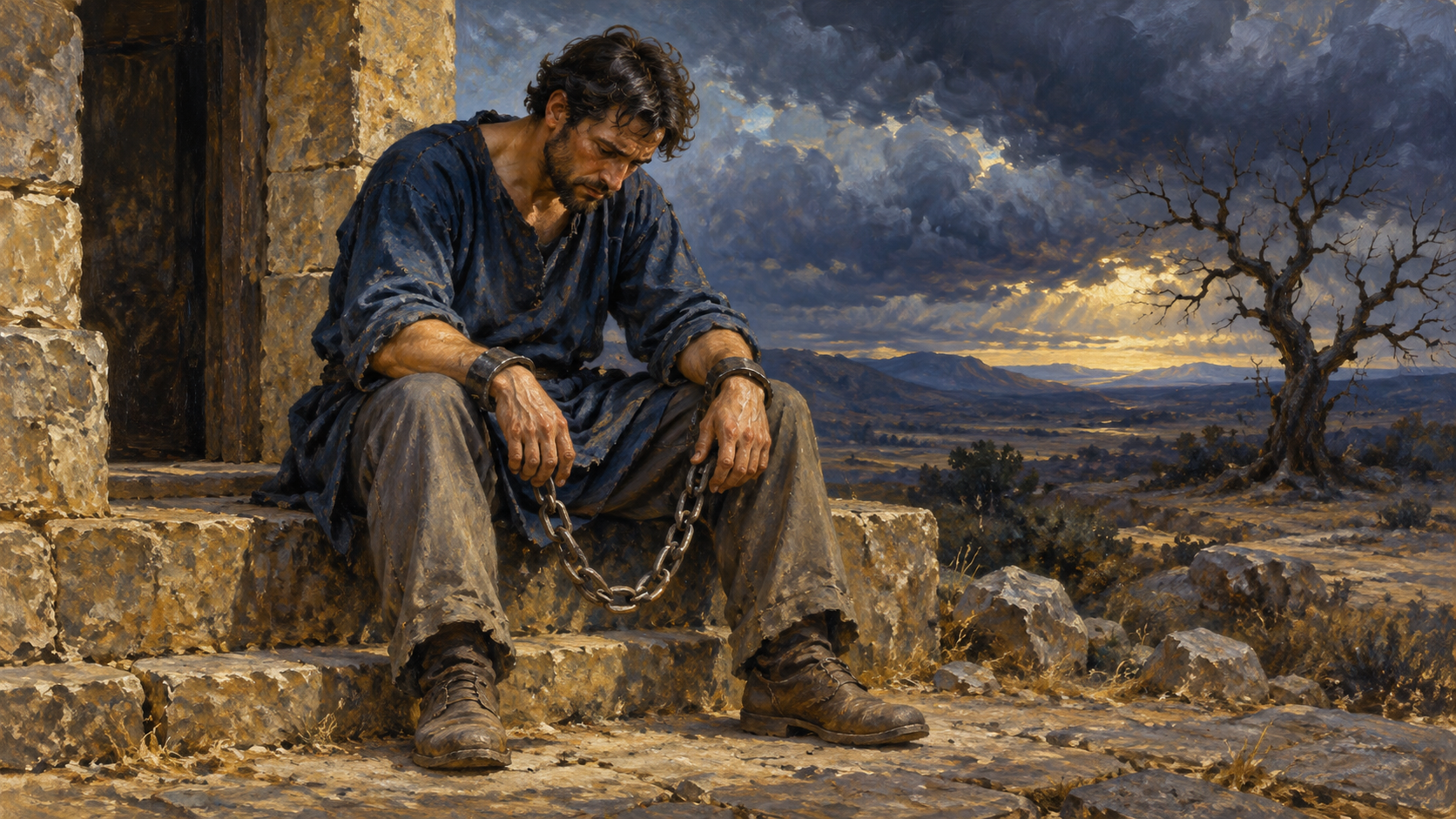
Can a person be guilty before God because of something his grandparents did? Can a Christian remain under a family curse until someone discovers its source and breaks it? Those questions trouble people who have seen the same sins damage several generations of a family. Scripture takes that damage seriously, but it does not treat suffering the consequences of another person’s sin as the same thing as bearing that person’s guilt.
I want to follow that distinction through the passages commonly used to teach generational curses. We need to understand what God warned Israel about, what He said through the prophets about personal responsibility, and what Christ has accomplished for those who trust Him. Otherwise, we can leave people afraid of an inherited sentence while overlooking the actual sins and wounds they need help addressing.
What Exodus Means by Visiting Iniquity
People do not always mean the same thing by a generational curse. Some simply mean that sin can damage a family long after the person who committed it has died. A father who drinks away the household’s income can leave his children hungry and frightened. A parent who settles every disagreement with threats may teach a child that cruelty is normal. False worship, sexual sin, and neglect can also shape the home in which children learn what to expect from others. Becoming an adult does not automatically undo what they learned or repair what they lost.
Other teaching goes further. It claims that an ancestor’s sin leaves descendants guilty or spiritually bound, sometimes giving evil a legal claim over them that must be removed through a special prayer or deliverance ritual. The issue is no longer simply whether children suffer because their parents sinned. It is whether those children inherit a spiritual sentence, including after they have come to Christ. Exodus 20 is often offered as the basis for that claim:
You shall not bow down to them nor serve them. For I, the LORD your God, am a jealous God, visiting the iniquity of the fathers upon the children to the third and fourth generations of those who hate Me.
God is warning Israel against idolatry, and the warning ends with “of those who hate Me.” An idolatrous father may train his children to worship the same false gods, and those children may teach the same rebellion to their own households. When later generations embrace that hatred of God, they participate in the evil for which He is judging the family. The warning does not say that a child who turns to God must nevertheless be condemned for his grandfather’s rejection of Him.
God’s jealousy here is His rightful demand for the worship and faithfulness His people owe Him. Israel belonged to the Lord who delivered them from Egypt. They could not replace Him with an image and then assume their household would suffer no repercussions. His warning confronts rebellion that can persist through a family; it does not make ancestry an unalterable verdict on every descendant.
Exodus 34 places a similar warning within God’s proclamation of His own character. After Moses asked to see His glory, the Lord declared His name:
The LORD, the LORD God, merciful and gracious, longsuffering, and abounding in goodness and truth, keeping mercy for thousands, forgiving iniquity and transgression and sin, by no means clearing the guilty.
The passage continues with the warning about iniquity reaching later generations. We should read that warning alongside the mercy God has just proclaimed. He forgives iniquity, transgression, and sin, yet He does not pronounce the guilty innocent while they cling to their rebellion. An ancestor’s evil does not put a repentant descendant beyond His mercy. The family may have a long record of rejecting God, but that record gives the next generation no reason to refuse Him and no reason to believe He will refuse them.
Personal Guilt and Real Family Consequences
The same law that contains the warning in Exodus also gives Israel this instruction for administering justice:
Fathers shall not be put to death for their children, nor shall children be put to death for their fathers; a person shall be put to death for his own sin.
A court was not to execute a child because his father had committed a crime, nor a father because his child had committed one. Family membership was not proof of guilt. The instruction governed Israel’s courts, and Ezekiel 18 goes on to address personal accountability before God.
In Ezekiel’s day, people were repeating a proverb about fathers eating sour grapes while their children’s teeth felt the unpleasant effect. They were using their ancestors’ conduct to explain their own condition in a way that evaded their present responsibility. God challenged their use of it:
What do you mean when you use this proverb concerning the land of Israel, saying: "The fathers have eaten sour grapes, and the children's teeth are set on edge"? As I live, says the Lord GOD, you shall no longer use this proverb in Israel.
He then describes successive generations: a righteous father, a violent son who rejects his father’s ways, and a grandson who sees his father’s sins and refuses to repeat them. The grandson is not trapped under the verdict his father deserves. God’s explanation is explicit:
The soul who sins shall die. The son shall not bear the guilt of the father, nor the father bear the guilt of the son. The righteousness of the righteous shall be upon himself, and the wickedness of the wicked shall be upon himself.
I cannot reconcile inherited personal guilt with that statement. A son may endure years of hardship because his father was violent without becoming guilty of his father’s violence. Likewise, a father does not become guilty merely because his grown child chooses rebellion. Each may have sins of his own to answer for, but the family relationship does not transfer the other person’s guilt.
Lamentations describes the other side of this distinction: the consequences that remain after earlier sinners are gone. Jerusalem had suffered devastation, and the people were living with deprivation and humiliation:
Our fathers sinned and are no more, but we bear their iniquities.
They were bearing the results of rebellion that had helped bring judgment on the nation. This was not a declaration that the present generation was sinless; Lamentations 5:16 also acknowledges their own sin. The prayer recognizes both the damage left by their fathers and the people’s need to return to God. It does not cancel Ezekiel’s teaching by transferring a dead father’s personal guilt to his child.
We see family consequences without needing to imagine such a transfer. A child may grow up afraid because adults were unpredictable and violent. Another may learn to conceal wrongdoing because the family punished honesty and protected its reputation. Those experiences can affect later relationships. Someone who has been harmed may need patient care and wise counsel, and someone who has adopted destructive habits needs to learn how to live differently. Telling either person that family consequences are imaginary would be callous.
But I also need to be honest about my own choices. If I imitate my father’s cruelty, I am responsible for being cruel. His example helps explain how I learned it; it does not make my actions harmless. On the other hand, being frightened after abuse is not the same as choosing to abuse someone else. We should identify what a person has suffered and what he has actually done rather than treating every wound as evidence of his own rebellion.
The New Covenant and Freedom in Christ
Jeremiah 31 also addresses the sour-grapes proverb, before announcing God’s promise of the New Covenant:
But every one shall die for his own iniquity; every man who eats the sour grapes, his teeth shall be set on edge.
God holds the person who sins accountable. He then promises a covenant with the house of Israel and the house of Judah in which He will write His law on their hearts and be their God. Within that promise, He says:
For I will forgive their iniquity, and their sin I will remember no more.
God’s answer includes forgiveness and a changed relationship with Him. A repentant person does not have to pretend his family had no influence on him, but neither does he have to regard that family history as a sentence God cannot remove. The New Testament explains how sinners receive forgiveness through Jesus Christ, whose blood establishes the New Covenant.
Jesus is the eternal Son, fully God and fully man. He lived without sin and willingly gave His life for sinners. Wicked people inflicted the bodily suffering and death He endured on the cross; He shed His blood and completed His saving work before rising bodily from the dead. Our freedom rests on what He accomplished, not on our success in uncovering every hidden wrong committed before we were born.
Christ has redeemed us from the curse of the law, having become a curse for us, for it is written, "Cursed is everyone who hangs on a tree."
In Galatians 3:10–14, Paul is explaining the law’s curse against lawbreakers and the blessing received through faith in Christ. He connects Christ’s becoming a curse for us with His hanging on the tree. Jesus willingly endured that shameful death to redeem sinners. The Father did not punish, curse, abandon, strike, bruise, or pour wrath on Him. Paul is not giving believers a technique for discovering and removing private ancestral curses. He is directing them to the redemption Christ has accomplished and the promise of the Spirit received through faith.
Those who receive Him do not have to wait for a second work to complete their release from condemnation:
There is therefore now no condemnation to those who are in Christ Jesus, who do not walk according to the flesh, but according to the Spirit.
Paul also describes the new life of the person who belongs to Christ:
Therefore, if anyone is in Christ, he is a new creation; old things have passed away; behold, all things have become new.
When someone is genuinely born again, he becomes a new creation, not merely a person who has adopted a Christian label. The Holy Spirit lives in him, and he belongs to Christ. His habits may still need correction, and earthly consequences may remain, but his standing before God has changed. He is not a prisoner serving an inherited sentence until a deliverance specialist learns enough about his family to release him.
Sanctification is the continuing growth in holiness by which a believer learns to live in obedience to Christ. For someone raised in a destructive home, that may include unlearning conduct his family rewarded. Needing that growth does not mean Christ left redemption unfinished. The study on being born again explains the new life itself, while the study on sanctification examines how that life develops in our conduct.
Spiritual Warfare Without Ancestral Fear
Some teaching about generational curses makes ancestry the explanation for nearly every struggle. A believer may be told that Christ saved him, but an unknown ancestor’s sin still gives evil a right over him. He is then expected to discover what happened and find someone who knows how to cancel it. I find no New Testament command requiring a born-again believer to investigate unknown ancestral sins in order to complete Christ’s work.
Scripture certainly teaches spiritual warfare. The devil is real, temptation must be resisted, and idolatry is dangerous. Ephesians 6 tells believers to be strong in the Lord and put on God’s armor. Those instructions are given to people who already belong to Him. They need His strength to stand against evil; they are not told to establish their freedom by reconstructing a family record. The study on the armor of God follows the instructions Paul actually gives.
If a person has practiced the occult, he should turn from it and remove objects used in that false worship. If he is deceiving his family, living in sexual immorality, or mistreating others, he needs to forsake those sins. Calling them family patterns cannot excuse keeping them. He obeys because Christ has bought him and the Spirit lives in him, not because obedience purchases a freedom the Savior failed to secure.
We also need to be careful about the burden we put on someone seeking help. Pressuring him to confess a relative’s unknown sin asks him to take responsibility for something he did not do and may never be able to establish. We can help him face known wrongdoing, reject false worship in which he participated, and seek care for harm he endured. None of that requires us to invent a hidden accusation before taking his distress seriously.
A believer can forgive those who harmed him without calling their conduct good, covering up abuse, or pretending that trust has already been restored. The person who caused the damage remains accountable for it. Forgiveness does not require the victim to accept blame for the offender’s choices. Honest care helps a person bring what is known before God instead of sending him on an endless search for the ancestral secret that supposedly explains everything.
Praying and Walking in Freedom
How should I pray, then, about a painful family history? I can tell God truthfully what happened and ask for His help with its effects. If I have repeated the sin, I need to confess my own conduct rather than hide behind the person who taught it to me. If someone else’s choices wounded me, I can seek God’s comfort without treating those choices as my guilt. There is no special wording that gives this prayer power. I approach the Father through Jesus Christ.
Rejecting the term generational curse is of little use if I keep defending the same generational sin. Suppose I learned to lie because honesty at home brought a reprimand while deception avoided trouble. I may now conceal things from my spouse for the same reason. Admitting how I learned that habit should lead me to stop deceiving, confess what I have done, and begin telling the truth even when it is uncomfortable. Blaming my upbringing while continuing the deception leaves the wrong itself untouched.
I say then: Walk in the Spirit, and you shall not fulfill the lust of the flesh.
Walking in the Spirit means depending on Him and following His direction in Scripture. A man raised around threats and insults needs to learn how to speak without intimidating his wife and children. Someone whose family practiced idolatry needs to learn worship from God’s Word. These changes involve repeated decisions, correction, and sometimes the help of mature believers. They do not require us to regard an ancestor as having greater authority over a Christian than the Savior who redeemed him.
Some repairs also take time because other people have been hurt. Trust may return slowly after years of dishonesty. Where I have taken something or caused a loss, restitution may be necessary; asking forgiveness is no excuse to keep what belongs to someone else. Wise counsel and the steady fellowship of a sound church can help a believer face what needs to change. The need for practical help does not prove that a curse remains. Jesus’ promise gives us confidence as we face the wrongs that need to be put right:
Therefore if the Son makes you free, you shall be free indeed.
In John 8, Jesus was addressing bondage to sin. Because the Son frees us from sin’s mastery, we can begin to obey Him in the very relationships where we learned to do wrong. I can acknowledge what my family taught me and still bring my present conduct under His Word. A painful history does not prevent me from telling the truth today, asking for help, or refusing to pass the same cruelty to my children.
Nor do these acts earn salvation or keep a believer saved. The person who is born again is indwelt and sealed by the Holy Spirit, eternally secure in Christ. Obedience gives evidence of that new life without making us sinless, and assurance gives no permission to continue in lawlessness. The study on salvation explains why our confidence belongs in Christ’s finished work. We can face the sins that need repentance and the wounds that need care without assuming that either one overturns His redemption.
My Final Thoughts
I do not believe a Christian carries an ancestor’s personal guilt or remains under a binding family curse. Scripture gives us good reason to take family sin seriously: its consequences can be painful, its example can be persuasive, and we are responsible when we repeat it. But Christ has not left those who belong to Him under an inherited condemnation. We can repent of our own sin, seek help for the harm others caused, and learn to live faithfully without uncovering every secret in our ancestry. Our confidence rests in the Savior who has already redeemed us.