
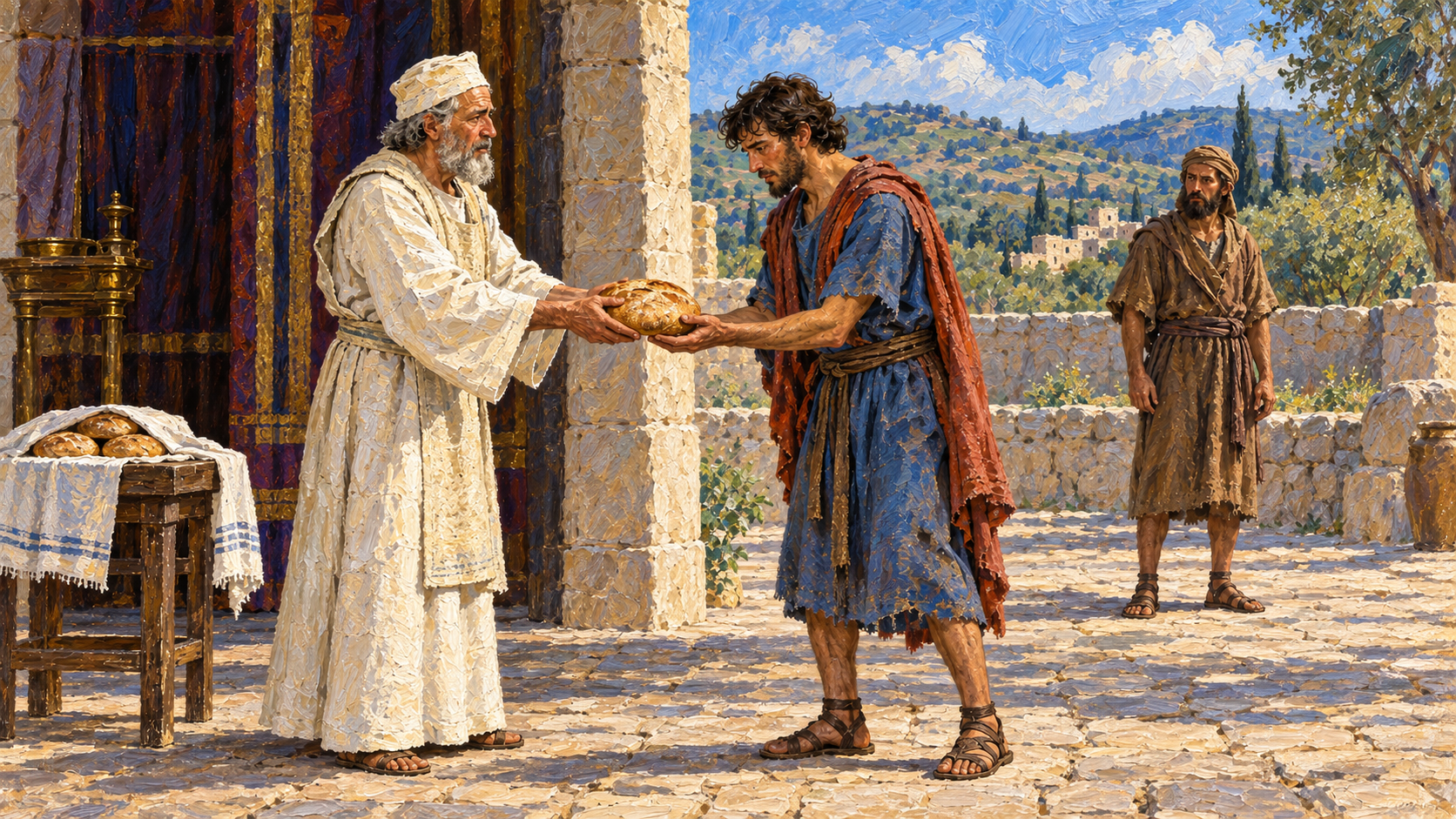
Why did David eat bread God had reserved for the priests? And why did Jesus bring up that troubling event when the Pharisees accused His disciples? David was genuinely hungry, but he also deceived Ahimelech. We need to follow what happened at Nob and hear Jesus’ whole answer. His declaration that the disciples were innocent did not make David’s deception righteous.
The Holy Bread Before the LORD
"You shall also make a table of acacia wood; two cubits shall be its length, a cubit its width, and a cubit and a half its height. And you shall overlay it with pure gold, and make a molding of gold all around. You shall make for it a frame of a handbreadth all around, and you shall make a gold molding for the frame all around. And you shall make for it four rings of gold, and put the rings on the four corners that are at its four legs. The rings shall be close to the frame, as holders for the poles to bear the table. And you shall make the poles of acacia wood, and overlay them with gold, that the table may be carried with them. You shall make its dishes, its pans, its pitchers, and its bowls for pouring. You shall make them of pure gold. And you shall set the showbread on the table before Me always.
The bread David requested belonged to the worship God had appointed for the tabernacle. It stood on a table made of acacia wood and covered with pure gold. Rings and poles allowed the table to travel with the sanctuary, and even its dishes were gold. God required the bread to remain before Him continually. These loaves had been set apart for His service, so Ahimelech could not treat them as spare food from an ordinary meal.
The Hebrew expression translated showbread or bread of the Presence refers to bread set before God’s face or presence. Leviticus explains how the priests were to arrange the loaves, replace them, and eat them.
"And you shall take fine flour and bake twelve cakes with it. Two-tenths of an ephah shall be in each cake. You shall set them in two rows, six in a row, on the pure gold table before the LORD. And you shall put pure frankincense on each row, that it may be on the bread for a memorial, an offering made by fire to the LORD. Every Sabbath he shall set it in order before the LORD continually, being taken from the children of Israel by an everlasting covenant. And it shall be for Aaron and his sons, and they shall eat it in a holy place; for it is most holy to him from the offerings of the LORD made by fire, by a perpetual statute."
Twelve cakes of fine flour stood in two rows, six in each, with frankincense for the memorial offering. Fresh loaves replaced them every Sabbath. The number twelve reasonably makes me think of Israel’s twelve tribes, although Leviticus does not explicitly assign a tribe to each loaf. I would keep that connection distinct from the command God actually gave.
God was explicit about who could eat the bread after its removal: Aaron and his sons were to eat it in a holy place because it was most holy. Replacing the loaves did not make the old ones common food. The loaves Ahimelech later gave David had been removed from the table, but their use was still governed by God’s instruction. David was neither a son of Aaron nor entitled to priestly food simply because he had been anointed king.
God’s Anointed King Became a Hungry Fugitive
Now the LORD said to Samuel, "How long will you mourn for Saul, seeing I have rejected him from reigning over Israel? Fill your horn with oil, and go; I am sending you to Jesse the Bethlehemite. For I have provided Myself a king among his sons." And Samuel said, "How can I go? If Saul hears it, he will kill me." But the LORD said, "Take a heifer with you, and say, 'I have come to sacrifice to the LORD.' Then invite Jesse to the sacrifice, and I will show you what you shall do; you shall anoint for Me the one I name to you." So Samuel did what the LORD said, and went to Bethlehem. And the elders of the town trembled at his coming, and said, "Do you come peaceably?" And he said, "Peaceably; I have come to sacrifice to the LORD. Sanctify yourselves, and come with me to the sacrifice." Then he consecrated Jesse and his sons, and invited them to the sacrifice. So it was, when they came, that he looked at Eliab and said, "Surely the LORD's anointed is before Him!" But the LORD said to Samuel, "Do not look at his appearance or at his physical stature, because I have refused him. For the LORD does not see as man sees; for man looks at the outward appearance, but the LORD looks at the heart." So Jesse called Abinadab, and made him pass before Samuel. And he said, "Neither has the LORD chosen this one." Then Jesse made Shammah pass by. And he said, "Neither has the LORD chosen this one." Thus Jesse made seven of his sons pass before Samuel. And Samuel said to Jesse, "The LORD has not chosen these." And Samuel said to Jesse, "Are all the young men here?" Then he said, "There remains yet the youngest, and there he is, keeping the sheep." And Samuel said to Jesse, "Send and bring him. For we will not sit down till he comes here." So he sent and brought him in. Now he was ruddy, with bright eyes, and good-looking. And the LORD said, "Arise, anoint him; for this is the one!" Then Samuel took the horn of oil and anointed him in the midst of his brothers; and the Spirit of the LORD came upon David from that day forward. So Samuel arose and went to Ramah.
God had rejected Saul as king and sent Samuel to anoint one of Jesse’s sons. Samuel first looked at Eliab’s appearance, but the LORD directed him to David, the youngest, who had been tending sheep. Samuel anointed David before his brothers, and the Spirit of the LORD came upon him. God had chosen him, but Saul still occupied the throne.
David later served in Saul’s household and army and married Saul’s daughter. None of that protected him when the king began treating him as a rival to be killed. Years of danger lay between his anointing and his public reign. I see in his rejection a pattern that reaches its perfect fulfillment in Christ, who suffered rejection before His coming public reign. David himself remained a fallible man, and his calling did not excuse disobedience. By 1 Samuel 20, Saul’s son Jonathan was helping him find out whether it was safe to return to court. They arranged a signal with arrows to convey the answer.
And so it was, in the morning, that Jonathan went out into the field at the time appointed with David, and a little lad was with him. Then he said to his lad, "Now run, find the arrows which I shoot." As the lad ran, he shot an arrow beyond him. When the lad had come to the place where the arrow was which Jonathan had shot, Jonathan cried out after the lad and said, "Is not the arrow beyond you?" And Jonathan cried out after the lad, "Make haste, hurry, do not delay!" So Jonathan's lad gathered up the arrows and came back to his master. But the lad did not know anything. Only Jonathan and David knew of the matter. Then Jonathan gave his weapons to his lad, and said to him, "Go, carry them to the city." As soon as the lad had gone, David arose from a place toward the south, fell on his face to the ground, and bowed down three times. And they kissed one another; and they wept together, but David more so. Then Jonathan said to David, "Go in peace, since we have both sworn in the name of the LORD, saying, 'May the LORD be between you and me, and between your descendants and my descendants, forever.'" So he arose and departed, and Jonathan went into the city.
Saul had made his murderous intention unmistakable, so Jonathan used the agreed signal to tell David to leave. Once the boy was gone, the friends met and wept together, with David weeping even more than Jonathan. They parted under the covenant they had made before the LORD. David was fleeing for his life without the escort and provisions expected of a commander on the king’s business.
That urgency helps explain why he reached Nob hungry and without a weapon. He was escaping the king he had faithfully served, so I would not dismiss his need as an inconvenience he could easily have avoided. Yet he still had to decide whether to tell the priest why he had come.
Now David came to Nob, to Ahimelech the priest. And Ahimelech was afraid when he met David, and said to him, "Why are you alone, and no one is with you?" So David said to Ahimelech the priest, "The king has ordered me on some business, and said to me, 'Do not let anyone know anything about the business on which I send you, or what I have commanded you.' And I have directed my young men to such and such a place. Now therefore, what have you on hand? Give me five loaves of bread in my hand, or whatever can be found." And the priest answered David and said, "There is no common bread on hand; but there is holy bread, if the young men have at least kept themselves from women." Then David answered the priest, and said to him, "Truly, women have been kept from us about three days since I came out. And the vessels of the young men are holy, and the bread is in effect common, even though it was consecrated in the vessel this day." So the priest gave him holy bread; for there was no bread there but the showbread which had been taken from before the LORD, in order to put hot bread in its place on the day when it was taken away. Now a certain man of the servants of Saul was there that day, detained before the LORD. And his name was Doeg, an Edomite, the chief of the herdsmen who belonged to Saul. And David said to Ahimelech, "Is there not here on hand a spear or a sword? For I have brought neither my sword nor my weapons with me, because the king's business required haste." So the priest said, "The sword of Goliath the Philistine, whom you killed in the Valley of Elah, there it is, wrapped in a cloth behind the ephod. If you will take that, take it. For there is no other except that one here." And David said, "There is none like it; give it to me."
Ahimelech was afraid when he saw David and asked, “Why are you alone, and no one is with you?” David’s arrival did not look like an ordinary royal assignment. David concealed his flight by saying that the king had sent him on confidential business. He also said he had arranged for his young men to meet elsewhere. Saul had given him no such orders. The lie made David’s request sound like service to the king while keeping Ahimelech ignorant of the danger.
David asked for five loaves, or whatever could be found. Ahimelech had no common bread, only the holy loaves removed when fresh bread was placed before the LORD that day. He asked whether the young men had abstained from sexual relations, and David assured him that they were ceremonially clean. Under Israel’s law, that cleanness concerned fitness for sacred things. It did not mean moral perfection or make someone a priest.
David’s answer about the men’s “vessels” and the bread is difficult Hebrew. The UBS translation discussion explains that vessels may refer to their bodies or possibly their equipment. In the wording quoted above, David also argues that the bread is effectively common despite its consecration. I understand him to be pressing his case for receiving it in an emergency. Whatever difficulty remains in his wording, Leviticus calls the bread “most holy,” and Jesus later says it was “not lawful” for David and his companions to eat it.
Ahimelech gave David the bread and then Goliath’s sword, which had been stored behind the ephod. David again appealed to the king’s business to explain why he had brought no weapon. The priest believed he was helping Saul’s faithful servant; he did not know that Saul was hunting him. Another of Saul’s servants was there, however, and David knew he would report the meeting to Saul.
Doeg, the Priests of Nob, and David’s Responsibility
Doeg the Edomite, Saul’s chief herdsman, had been detained before the LORD at Nob. He saw David receive help and later reported the provisions, the sword, and Ahimelech’s inquiry of God for David. By then, Saul was accusing his servants of conspiracy. He reminded them of the lands and offices he could give them, appealing to their own interests as he demanded loyalty. Doeg’s report appeared to confirm the betrayal Saul already suspected.
When Saul heard that David and the men who were with him had been discovered–now Saul was staying in Gibeah under a tamarisk tree in Ramah, with his spear in his hand, and all his servants standing about him– then Saul said to his servants who stood about him, "Hear now, you Benjamites! Will the son of Jesse give every one of you fields and vineyards, and make you all captains of thousands and captains of hundreds? All of you have conspired against me, and there is no one who reveals to me that my son has made a covenant with the son of Jesse; and there is not one of you who is sorry for me or reveals to me that my son has stirred up my servant against me, to lie in wait, as it is this day." Then answered Doeg the Edomite, who was set over the servants of Saul, and said, "I saw the son of Jesse going to Nob, to Ahimelech the son of Ahitub. And he inquired of the LORD for him, gave him provisions, and gave him the sword of Goliath the Philistine." So the king sent to call Ahimelech the priest, the son of Ahitub, and all his father's house, the priests who were in Nob. And they all came to the king. And Saul said, "Hear now, son of Ahitub!" He answered, "Here I am, my lord." Then Saul said to him, "Why have you conspired against me, you and the son of Jesse, in that you have given him bread and a sword, and have inquired of God for him, that he should rise against me, to lie in wait, as it is this day?" So Ahimelech answered the king and said, "And who among all your servants is as faithful as David, who is the king's son-in-law, who goes at your bidding, and is honorable in your house? Did I then begin to inquire of God for him? Far be it from me! Let not the king impute anything to his servant, or to any in the house of my father. For your servant knew nothing of all this, little or much." And the king said, "You shall surely die, Ahimelech, you and all your father's house!" Then the king said to the guards who stood about him, "Turn and kill the priests of the LORD, because their hand also is with David, and because they knew when he fled and did not tell it to me." But the servants of the king would not lift their hands to strike the priests of the LORD. And the king said to Doeg, "You turn and kill the priests!" So Doeg the Edomite turned and struck the priests, and killed on that day eighty-five men who wore a linen ephod. Also Nob, the city of the priests, he struck with the edge of the sword, both men and women, children and nursing infants, oxen and donkeys and sheep–with the edge of the sword. Now one of the sons of Ahimelech the son of Ahitub, named Abiathar, escaped and fled after David. And Abiathar told David that Saul had killed the LORD's priests. So David said to Abiathar, "I knew that day, when Doeg the Edomite was there, that he would surely tell Saul. I have caused the death of all the persons of your father's house. Stay with me; do not fear. For he who seeks my life seeks your life, but with me you shall be safe."
Ahimelech defended himself by reminding Saul who David was: an honorable commander and the king’s son-in-law. Helping him and inquiring of God for him did not amount to joining a rebellion. The priest knew nothing of David’s flight and pleaded that neither he nor his father’s household be charged with conspiracy. Saul refused to hear him and ordered the priests killed.
Saul’s own guards refused to strike the LORD’s priests. Doeg carried out the order, killing eighty-five men who wore the linen ephod and then devastating Nob. Women, children, and nursing infants were slaughtered, and the animals were killed as well. Saul’s suspicion had not made these people conspirators, and his royal authority could not make the command righteous. Doeg chose to commit the atrocity the other servants had refused. The study on King Saul follows that ruler’s rebellion further.
Ahimelech’s son Abiathar escaped and brought David the news. David admitted that he had known Doeg would report the meeting, then confessed, “I have caused the death of all the persons of your father’s house.” He did not defend his part in the tragedy by pointing to his hunger. His deception had kept Ahimelech from understanding the danger of helping him.
David had not ordered the massacre, and his lie had not forced Saul or Doeg to murder anyone. Their guilt remained theirs. He nevertheless acknowledged the danger his conduct had helped create and offered Abiathar refuge. If I expose someone to harm through deception, another person’s greater wickedness cannot excuse me from confessing my part. I need to confess the danger my own lie helped create without assuming I controlled every choice that followed.
Abiathar went on to serve alongside David and became a prominent priest during his reign. His later association with David helps us consider a detail in Mark’s account. Before turning to that detail, we need to understand why Jesus brought David’s meal into a dispute about the Sabbath.
Jesus Read David’s Account Within the Whole Law
At that time Jesus went through the grainfields on the Sabbath. And His disciples were hungry, and began to pluck heads of grain and to eat. And when the Pharisees saw it, they said to Him, "Look, Your disciples are doing what is not lawful to do on the Sabbath!" But He said to them, "Have you not read what David did when he was hungry, he and those who were with him: how he entered the house of God and ate the showbread which was not lawful for him to eat, nor for those who were with him, but only for the priests? Or have you not read in the law that on the Sabbath the priests in the temple profane the Sabbath, and are blameless? Yet I say to you that in this place there is One greater than the temple. But if you had known what this means, 'I desire mercy and not sacrifice,' you would not have condemned the guiltless. For the Son of Man is Lord even of the Sabbath." Now when He had departed from there, He went into their synagogue. And behold, there was a man who had a withered hand. And they asked Him, saying, "Is it lawful to heal on the Sabbath?"–that they might accuse Him. Then He said to them, "What man is there among you who has one sheep, and if it falls into a pit on the Sabbath, will not lay hold of it and lift it out? Of how much more value then is a man than a sheep? Therefore it is lawful to do good on the Sabbath." Then He said to the man, "Stretch out your hand." And he stretched it out, and it was restored as whole as the other. Then the Pharisees went out and plotted against Him, how they might destroy Him.
The disciples were hungry as they walked through grainfields with Jesus. Deuteronomy 23:25 permitted someone to pluck a neighbor’s standing grain by hand, so the Pharisees were not accusing them of theft. They considered what the disciples were doing to be work forbidden on the Sabbath.
Jesus answered, “Have you not read what David did?” He directed them to the hungry man they honored as Israel’s king, who had eaten bread reserved for priests. Jesus kept that restriction in His account. I understand His appeal as exposing their inconsistency: they could recognize David’s urgent need, yet condemned hungry disciples accompanying the greater Son of David.
Jesus then directed them to the law’s instructions for priests. Temple service continued on the Sabbath because God required it, and the priests were blameless in carrying it out. If His accusers considered only the command to rest, they could end up condemning work God Himself had commanded. They needed to read His instructions together.
The disciples were with One greater than the temple. Jesus identified Himself as Lord even of the Sabbath, so His accusers had to reckon with who was standing before them. The temple service pointed to Him. His authority belonged at the center of the discussion, because they could not rightly understand God’s day while rejecting its Lord.
Jesus also quoted Hosea: “I desire mercy and not sacrifice.” Those words came from God’s rebuke of people who continued religious observances while dealing treacherously with Him and with one another.
Come, and let us return to the LORD; For He has torn, but He will heal us; He has stricken, but He will bind us up. After two days He will revive us; On the third day He will raise us up, That we may live in His sight. Let us know, Let us pursue the knowledge of the LORD. His going forth is established as the morning; He will come to us like the rain, Like the latter and former rain to the earth. "O Ephraim, what shall I do to you? O Judah, what shall I do to you? For your faithfulness is like a morning cloud, And like the early dew it goes away. Therefore I have hewn them by the prophets, I have slain them by the words of My mouth; And your judgments are like light that goes forth. For I desire mercy and not sacrifice, And the knowledge of God more than burnt offerings. "But like men they transgressed the covenant; There they dealt treacherously with Me. Gilead is a city of evildoers And defiled with blood. As bands of robbers lie in wait for a man, So the company of priests murder on the way to Shechem; Surely they commit lewdness. I have seen a horrible thing in the house of Israel: There is the harlotry of Ephraim; Israel is defiled. Also, O Judah, a harvest is appointed for you, When I return the captives of My people.
Hosea describes people whose faithfulness disappeared like morning dew. Bloodshed and corruption among the priests continued alongside religious observance. The sacrifices God had instituted could not make that conduct acceptable. His call for mercy and the knowledge of God exposed the treachery beneath their outward worship.
The Pharisees likewise claimed to defend God’s commands while condemning people Jesus called guiltless. He was not overlooking a small sin His disciples had committed. Their accusers had judged them wrongly. Those men needed to understand God’s commands and the One who gave them. Claiming to be precise about the law could not excuse their failure to show the mercy He required. The related study on the law considers its purpose and fulfillment more fully.
Matthew then describes Jesus healing a man with a withered hand in the synagogue. He asked whether His accusers would rescue a sheep from a pit on the Sabbath. If they would help an animal, they should recognize the greater worth of a person. Jesus declared it lawful to do good and restored the man’s hand. The Pharisees answered that act of mercy by plotting His destruction.
The Sabbath Was Made for Man
Now it happened that He went through the grainfields on the Sabbath; and as they went His disciples began to pluck the heads of grain. And the Pharisees said to Him, "Look, why do they do what is not lawful on the Sabbath?" But He said to them, "Have you never read what David did when he was in need and hungry, he and those with him: how he went into the house of God in the days of Abiathar the high priest, and ate the showbread, which is not lawful to eat except for the priests, and also gave some to those who were with him?" And He said to them, "The Sabbath was made for man, and not man for the Sabbath. Therefore the Son of Man is also Lord of the Sabbath."
Mark records the same grainfield dispute and Jesus’ explanation that the Sabbath was made for man. God gave the day for people’s good under His authority. The Pharisees needed to consider the hungry people before them as they applied His command. Condemning necessary nourishment while refusing to hear the Lord of the Sabbath defeated the good purpose of the day.
Mark’s phrase “in the days of Abiathar the high priest” presents a genuine interpretive difficulty. In 1 Samuel, Ahimelech gives David the bread; his son Abiathar becomes prominent with David afterward. I understand Mark to be referring to the broader period associated with Abiathar and using the title by which he was known. On that reading, Mark does not date the meal to Abiathar’s actual term as high priest. Ahimelech remains the priest who supplied the bread.
Some readers understand the Greek construction to place the event during Abiathar’s term in office. I find the broader-period reading reasonable, while recognizing that its grammar is disputed. Daniel Wallace’s discussion of Mark 2:26 considers both the reading’s plausibility and its difficulties. Abiathar may have been at Nob when David arrived, but Scripture does not tell us. We can recognize his later connection with David without placing him in the exchange.
After the grainfield dispute, Mark turns to the man with the withered hand and Jesus’ question about what was lawful on the Sabbath.
And He entered the synagogue again, and a man was there who had a withered hand. So they watched Him closely, whether He would heal him on the Sabbath, so that they might accuse Him. And He said to the man who had the withered hand, "Step forward." Then He said to them, "Is it lawful on the Sabbath to do good or to do evil, to save life or to kill?" But they kept silent. And when He had looked around at them with anger, being grieved by the hardness of their hearts, He said to the man, "Stretch out your hand." And he stretched it out, and his hand was restored as whole as the other. Then the Pharisees went out and immediately plotted with the Herodians against Him, how they might destroy Him.
Jesus asked whether it was lawful on the Sabbath to do good or evil, to save life or kill. The men watching Him would not answer. He was angry and grieved at their hardness of heart, then restored the man’s hand. They went out and plotted with the Herodians to destroy Him. Men who had objected to hungry disciples eating were prepared to plan a killing. Their zeal for Sabbath observance concealed hostility toward its Lord.
Luke also records both disputes. He adds the detail that the disciples rubbed the grain in their hands, and he makes clear that the healing took place on another Sabbath.
Now it happened on the second Sabbath after the first that He went through the grainfields. And His disciples plucked the heads of grain and ate them, rubbing them in their hands. And some of the Pharisees said to them, "Why are you doing what is not lawful to do on the Sabbath?" But Jesus answering them said, "Have you not even read this, what David did when he was hungry, he and those who were with him: how he went into the house of God, took and ate the showbread, and also gave some to those with him, which is not lawful for any but the priests to eat?" And He said to them, "The Son of Man is also Lord of the Sabbath." Now it happened on another Sabbath, also, that He entered the synagogue and taught. And a man was there whose right hand was withered. So the scribes and Pharisees watched Him closely, whether He would heal on the Sabbath, that they might find an accusation against Him. But He knew their thoughts, and said to the man who had the withered hand, "Arise and stand here." And he arose and stood. Then Jesus said to them, "I will ask you one thing: Is it lawful on the Sabbath to do good or to do evil, to save life or to destroy?" And when He had looked around at them all, He said to the man, "Stretch out your hand." And he did so, and his hand was restored as whole as the other. But they were filled with rage, and discussed with one another what they might do to Jesus.
On that later Sabbath, Jesus knew what His accusers were thinking. He called the man forward and restored his hand before them. Luke describes their response as rage: they began discussing what they might do to Jesus.
Through all three accounts, we need to keep Jesus’ verdict in view: His disciples were guiltless. His appeal to David made His opponents consider hunger and their own inconsistent judgments. But His answer also included the priests’ lawful service, Hosea’s teaching about mercy, and His own authority over the Sabbath. I cannot reduce that whole answer to permission to set aside commandments whenever we are in need. Nor did Jesus endorse the lie David told to obtain help.
A good result does not make a sinful means of obtaining it righteous. Ahimelech’s compassion gave no general right to priestly bread, and David’s anointing did not make him a priest. At the same time, we must not turn human traditions into divine commands and condemn innocent people for breaking them. Jesus interpreted Scripture as its Lord. We come as His servants and need to hear everything He said.
The Bread of Life and the Better Covenant
David’s meal relieved bodily hunger, but Scripture’s teaching about bread reaches beyond that need. God gave Israel manna in the wilderness and appointed bread for the sanctuary. Jesus later fed a crowd with ordinary loaves, then challenged people who wanted another meal without receiving what the sign revealed about Him.
And when they found Him on the other side of the sea, they said to Him, "Rabbi, when did You come here?" Jesus answered them and said, "Most assuredly, I say to you, you seek Me, not because you saw the signs, but because you ate of the loaves and were filled. Do not labor for the food which perishes, but for the food which endures to everlasting life, which the Son of Man will give you, because God the Father has set His seal on Him." Then they said to Him, "What shall we do, that we may work the works of God?" Jesus answered and said to them, "This is the work of God, that you believe in Him whom He sent." Therefore they said to Him, "What sign will You perform then, that we may see it and believe You? What work will You do? Our fathers ate the manna in the desert; as it is written, 'He gave them bread from heaven to eat.'" Then Jesus said to them, "Most assuredly, I say to you, Moses did not give you the bread from heaven, but My Father gives you the true bread from heaven. For the bread of God is He who comes down from heaven and gives life to the world." Then they said to Him, "Lord, give us this bread always." And Jesus said to them, "I am the bread of life. He who comes to Me shall never hunger, and he who believes in Me shall never thirst. But I said to you that you have seen Me and yet do not believe. All that the Father gives Me will come to Me, and the one who comes to Me I will by no means cast out. For I have come down from heaven, not to do My own will, but the will of Him who sent Me. This is the will of the Father who sent Me, that of all He has given Me I should lose nothing, but should raise it up at the last day. And this is the will of Him who sent Me, that everyone who sees the Son and believes in Him may have everlasting life; and I will raise him up at the last day."
When the crowd appealed to the manna and asked for another sign, Jesus directed them to the Father as the giver of the true bread from heaven. He identified Himself as the bread of life. They needed to believe in the One God had sent, receiving life through faith rather than earning it by religious effort. He promises not to cast out the person who comes to Him and to raise the believer at the last day.
I can follow that theme without making every detail of David’s meal a prediction of Christ. Scripture does not explicitly identify it as a type, an earlier event appointed to foreshadow a later fulfillment. Nor does John 6 say David’s action foretold the Lord’s Supper or that eating a ritual meal automatically saves anyone. Jesus calls people to come to Him and believe. The study on communion explains the meal He later gave His church.
In Hebrews, Paul recalls the sanctuary and its appointed service, then explains how Christ gives the redemption those ordinances could not provide.
Then indeed, even the first covenant had ordinances of divine service and the earthly sanctuary. For a tabernacle was prepared: the first part, in which was the lampstand, the table, and the showbread, which is called the sanctuary; and behind the second veil, the part of the tabernacle which is called the Holiest of All, which had the golden censer and the ark of the covenant overlaid on all sides with gold, in which were the golden pot that had the manna, Aaron's rod that budded, and the tablets of the covenant; and above it were the cherubim of glory overshadowing the mercy seat. Of these things we cannot now speak in detail. Now when these things had been thus prepared, the priests always went into the first part of the tabernacle, performing the services. But into the second part the high priest went alone once a year, not without blood, which he offered for himself and for the people's sins committed in ignorance; the Holy Spirit indicating this, that the way into the Holiest of All was not yet made manifest while the first tabernacle was still standing. It was symbolic for the present time in which both gifts and sacrifices are offered which cannot make him who performed the service perfect in regard to the conscience– concerned only with foods and drinks, various washings, and fleshly ordinances imposed until the time of reformation. But Christ came as High Priest of the good things to come, with the greater and more perfect tabernacle not made with hands, that is, not of this creation. Not with the blood of goats and calves, but with His own blood He entered the Most Holy Place once for all, having obtained eternal redemption. For if the blood of bulls and goats and the ashes of a heifer, sprinkling the unclean, sanctifies for the purifying of the flesh, how much more shall the blood of Christ, who through the eternal Spirit offered Himself without spot to God, cleanse your conscience from dead works to serve the living God?
Paul names the lampstand, table, and showbread in the first part of the tabernacle, where priests repeatedly performed their duties. Only the high priest entered the inner sanctuary, once a year with blood. God had appointed these ordinances, yet their gifts and sacrifices could not perfect the worshiper’s conscience. Christ’s own blood obtained eternal redemption and cleanses the conscience so that we may serve the living God. The passage directs us from the sanctuary’s repeated service to the Savior who willingly offered Himself.
Jesus is the eternal Son, fully God and fully man, born of a virgin and without sin. He willingly gave Himself to be slain as the perfect sacrifice for our sins. Wicked men tortured Him and put Him to death, shedding His innocent blood. His sacrifice was for the whole world, and His saving work through His blood and death was complete before His burial and bodily resurrection. The Father did not punish, curse, abandon, strike, bruise, or pour wrath on Jesus. The Father, Son, and Holy Spirit acted in unity to accomplish our redemption.
God genuinely offers salvation to every person, though people can resist His grace. Whoever repents and believes in Jesus is forgiven and justified, meaning declared righteous before God, and receives new birth. The Holy Spirit indwells and seals the believer, who is eternally secure. Obedience gives evidence of that new life; it neither earns salvation nor keeps us saved. A Christian label alone does not prove that someone has been born again, and assurance never makes lawlessness acceptable.
Neither ancestry nor ceremonial standing can replace personal faith in Christ. The bread at Nob was holy because God had appointed its use, but eating it could not give David eternal redemption. We need Christ Himself for the life no ritual can supply. Receiving His mercy should also shape how we judge others and how honestly we face our own conduct.
Before I accuse someone of disobedience, I need to know whether the command comes from God or from a tradition I have treated as His Word. Related passages and the person’s actual circumstances deserve careful attention. I must be willing to withdraw an accusation instead of defending it simply because I have already made it. When I am the one seeking help, I owe others the truth about my need. David was under real pressure, but his deception kept Ahimelech from understanding the danger. His later admission calls us to confess our part when others suffer, while leaving the guilt of deliberate cruelty with those who chose it.
My Final Thoughts
David’s hunger did not erase the bread’s holiness or make his deception righteous. Yet his failure cannot justify the Pharisees’ condemnation of Jesus’ guiltless disciples. They needed to consider David’s need alongside the priests’ lawful service and God’s desire for mercy, and recognize the Lord of the Sabbath before them. That calls me to examine my judgments and to confess my own wrongdoing as David did after the tragedy at Nob. His admission did not excuse Saul and Doeg’s cruelty, and showing mercy does not require us to defend deception. We come in faith to Jesus, the bread of life, for the eternal life neither our standing nor our religious observances can give.