
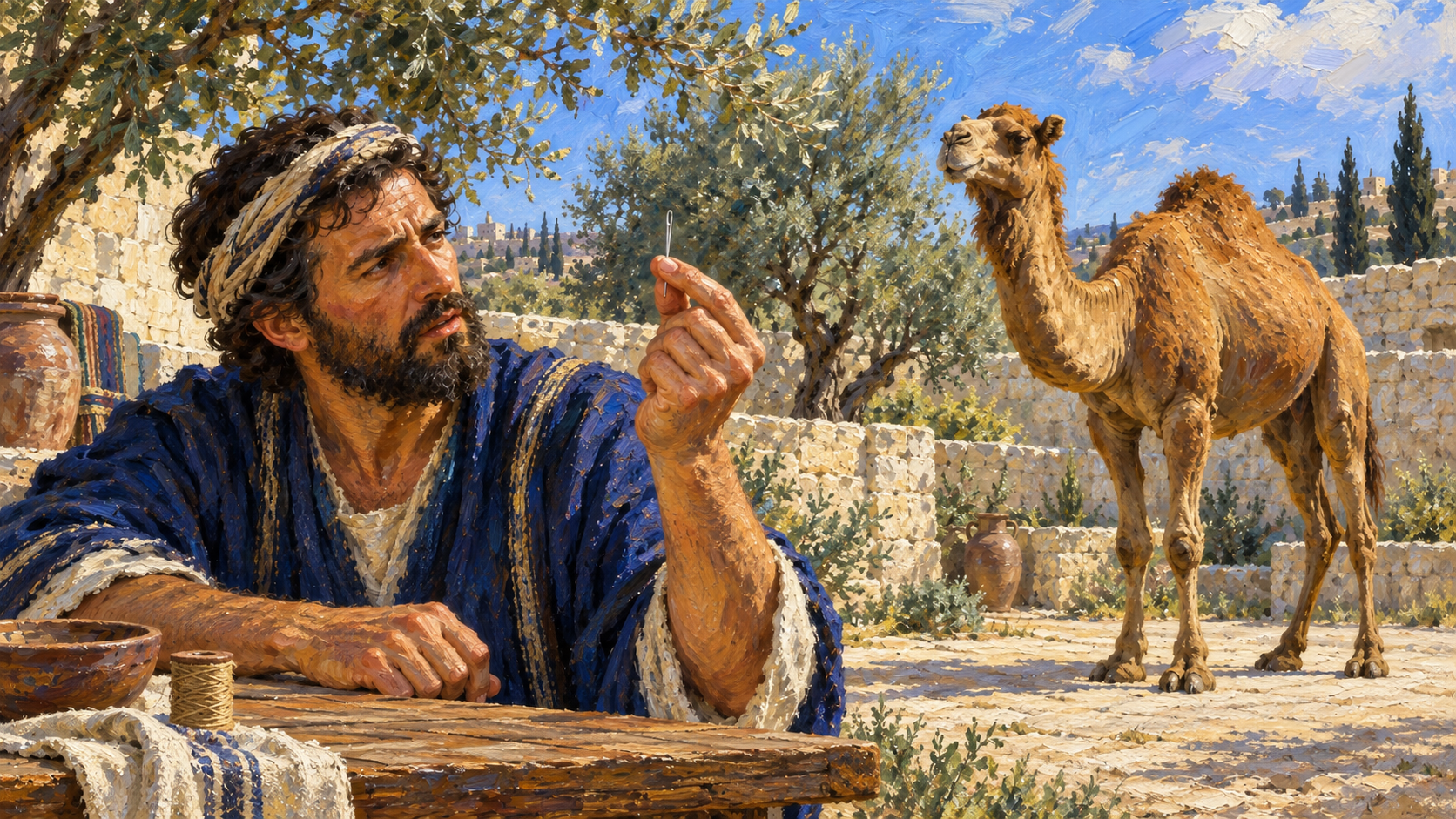
Jesus spoke about a camel passing through the eye of a needle after a wealthy man asked Him how to obtain eternal life. I want to begin with that conversation, because the picture explains more than the dangers of money. Jesus exposed the man’s misplaced confidence, then told His disciples that salvation was impossible for people to accomplish for themselves. His answer leaves us dependent on God, whether we have much or little.
The Rich Ruler’s Confidence Met the Law
Matthew describes a young man, Luke identifies him as a ruler, and Mark tells us that Jesus loved him. Together, the accounts place a wealthy man with public standing before the Lord. His question concerned eternal life, but he framed it around a good deed he could perform:
Now behold, one came and said to Him, “Good Teacher, what good thing shall I do that I may have eternal life?” So He said to him, “Why do you call Me good? No one is good but One, that is, God. But if you want to enter into life, keep the commandments.”
Jesus was not denying His own goodness or deity. He directed the man’s attention to God as the standard of goodness and challenged him to consider whom he was addressing. The ruler was asking what he could do to obtain life. Jesus brought him to the commandments, where his confidence in his own record would be examined.
The law does more than distinguish respectable conduct from public scandal. It exposes sin and reaches into what a person loves and desires. Jesus’ answer should not be read as permission to purchase eternal life by adding one more achievement to a good reputation.
He said to Him, “Which ones?” Jesus said, “‘You shall not murder,’ ‘You shall not commit adultery,’ ‘You shall not steal,’ ‘You shall not bear false witness,’ ‘Honor your father and your mother,’ and, ‘You shall love your neighbor as yourself.’” The young man said to Him, “All these things I have kept from my youth. What do I still lack?”
The ruler claimed to have kept these commandments and still asked what he lacked. His answer did not establish that he had loved God and his neighbor without sin. The next command would expose an attachment his account of his own obedience had not dealt with.
Jesus said to him, “If you want to be perfect, go, sell what you have and give to the poor, and you will have treasure in heaven; and come, follow Me.” But when the young man heard that saying, he went away sorrowful, for he had great possessions.
Jesus gave him both a command and an invitation: give to the poor, and follow Me. Selling his possessions would not pay for eternal life. It would mean relinquishing the wealth he would not surrender when Christ called him. I understand that refusal as exposing a rival master in his heart. He could speak confidently about keeping the law, but he went away rather than follow Jesus on those terms.
The word translated “perfect” can mean complete or whole. In this encounter, Jesus confronted the man’s divided allegiance. He offered treasure in heaven and fellowship with Himself, not merely a program for reducing the man’s assets. Mark 10:21 says Jesus looked at him and loved him before giving the command. The hard truth came from the Savior who invited him to follow.
This particular command is not a requirement that every believer sell every possession. Later instructions to wealthy Christians tell them how to use what they have. We should still let the ruler’s response challenge us: when Jesus exposed what he would not release, sorrow did not become repentance. At that encounter, he chose his possessions over following Christ.
The Camel and the Needle Show What Man Cannot Do
Jesus then turned to His disciples and explained the difficulty riches can present:
Then Jesus said to His disciples, “Assuredly, I say to you that it is hard for a rich man to enter the kingdom of heaven. And again I say to you, it is easier for a camel to go through the eye of a needle than for a rich man to enter the kingdom of God.”
When His disciples heard it, they were greatly astonished, saying, “Who then can be saved?” But Jesus looked at them and said to them, “With men this is impossible, but with God all things are possible.”
The disciples asked who could be saved, not how someone might squeeze through with fewer possessions. Jesus answered that salvation was impossible with men and possible with God. He was not offering an unusually demanding method of self-salvation.
The image places a large animal beside the tiny opening of a sewing needle. A popular explanation substitutes a narrow Jerusalem gate through which a camel could supposedly pass after being unloaded and made to kneel. The passage never identifies such a gate. More seriously, that explanation turns Jesus’ impossible picture into a difficult procedure that can be completed with enough effort.
The Greek kamelos means camel, while trypema describes an opening or hole, here the needle’s eye. Some propose a similar word meaning rope, and a few later manuscripts have that reading. Even a thick rope passing through a sewing needle would present an impossible image, but we do not need to change the received text.
Wealth can make self-reliance seem sensible because it solves so many practical problems. A person with money can obtain comfort, privacy, and influence, yet none of those advantages can erase guilt or produce new birth. Poverty cannot accomplish those things either. The poor person and the rich person both need God to do what they cannot do for themselves.
“With God all things are possible” is therefore a promise of hope in this discussion of salvation. It is not a guarantee that every personal ambition will succeed. God can bring a sinner to repentance, give new life, and break the love of money that has kept him from following Christ. The ruler’s refusal should sober us without making us conclude that wealthy people are beyond God’s reach.
Wealth Is Not Sin, but It Can Become a Master
Scripture warns about the love of money, not the mere existence of money. Abraham and Job possessed wealth, as did Joseph of Arimathea. Their possessions did not automatically place them outside God’s care. The question is how a person regards what he has and whom he trusts.
For the love of money is a root of all kinds of evil, for which some have strayed from the faith in their greediness, and pierced themselves through with many sorrows.
Someone can be poor and consumed by the desire for wealth he does not have. A wealthy believer, on the other hand, can receive his possessions as something entrusted to him under God and use them generously. That does not make riches harmless. Their usefulness can tempt us to ask them for a security they cannot provide.
Paul addressed that temptation among wealthy Christians. Instead of commanding all of them to become penniless, he instructed them to reject pride, place their hope in God, and use their resources for good:
Command those who are rich in this present age not to be haughty, nor to trust in uncertain riches but in the living God, who gives us richly all things to enjoy. Let them do good, that they be rich in good works, ready to give, willing to share, storing up for themselves a good foundation for the time to come, that they may lay hold on eternal life.
Enjoying God’s provision and sharing it with others belong together in these instructions. The rich are not told to look down on people with less or assume that their abundance proves God’s approval. They are to do good and give willingly because their hope rests in the living God rather than uncertain riches.
Mark 10:24 specifically warns about “those who trust in riches.” Money can relieve ordinary pressures, but it cannot reconcile us to God. Jesus also said, “For where your treasure is, there your heart will be also” (Matthew 6:21), and warned that no one can serve both God and mammon, meaning wealth or possessions. The ruler’s response showed what happens when a useful possession becomes a master a person will not leave.
Zacchaeus Shows the Impossible Made Possible
Luke’s Gospel records another encounter with a rich man soon after the ruler’s departure. Zacchaeus was a chief tax collector. He welcomed Jesus joyfully, while others complained that Jesus had gone to be the guest of a sinner. His response gives us a concrete example of the change God can bring:
Then Zacchaeus stood and said to the Lord, “Look, Lord, I give half of my goods to the poor; and if I have taken anything from anyone by false accusation, I restore fourfold.” And Jesus said to him, “Today salvation has come to this house, because he also is a son of Abraham; for the Son of Man has come to seek and to save that which was lost.”
Zacchaeus’ giving did not buy the salvation Jesus announced. His response showed repentance in his handling of money: generosity toward the poor and readiness to make wrongs right. He offered fourfold restoration if he had taken anything through false accusation.
The difference between these two encounters also warns me against judging spiritual condition by respectability. The ruler could point to an outwardly moral life, yet he would not follow Christ when his possessions were confronted. The despised tax collector received Him, and his handling of wealth changed. A good public name cannot save us, and a shameful past does not put a repentant person beyond the Savior’s mercy.
Following Christ Is Worth More Than What We Leave
Returning to the earlier conversation in Matthew 19, Peter asked what the disciples would receive after leaving their former lives to follow Jesus. The Lord answered with a promise that reached beyond their present circumstances:
Then Peter answered and said to Him, “See, we have left all and followed You. Therefore what shall we have?” So Jesus said to them, “Assuredly I say to you, that in the regeneration, when the Son of Man sits on the throne of His glory, you who have followed Me will also sit on twelve thrones, judging the twelve tribes of Israel. And everyone who has left houses or brothers or sisters or father or mother or wife or children or lands, for My name’s sake, shall receive a hundredfold, and inherit eternal life. But many who are first will be last, and the last first.
Here, “regeneration” refers to the renewal associated with the Son of Man sitting on His glorious throne. The NET Bible’s note on Matthew 19:28 likewise identifies the future renewal in view. Jesus promised the disciples a place in His coming rule and expressly named the twelve tribes of Israel. He was not simply promising that their lives would become more comfortable immediately.
He also acknowledged losses involving homes, family ties, and land. His promise concerns what is left for His name’s sake, not selfish neglect of responsibilities. Following Him can cost affection, approval, and earthly security. He was not selling eternal life as payment for those sacrifices; He was assuring His followers that they had not made a foolish choice by valuing Him more highly.
The warning about the first and last also challenges the way we rank people. The ruler’s youth, standing, and possessions could put him ahead in public estimation, yet he walked away from Jesus. Those who seem insignificant in this age are not excluded from God’s grace. Present rank cannot decide who belongs in His kingdom.
All of this returns us to the ruler’s opening question about eternal life. The gospel directs us to Christ’s saving work, which we receive by grace through faith. Moral achievement and religious bargaining cannot produce the new birth. God gives that life to those who repent and trust His Son.
Jesus is the eternal Son, fully God and fully man, born of a virgin and without sin. Wicked men mocked, tortured, and crucified Him, but He willingly bore the punishment for our sins in His innocent body. He shed His blood and completed His saving work in His death before He was buried and rose bodily. The Father did not punish, curse, abandon, strike, bruise, or pour wrath on Jesus. Christ gave Himself for the sins of the whole world.
God’s offer is genuine, and people can resist His grace and reject the Savior. Everyone who truly repents and believes is forgiven and born again. That believer is a new creation, indwelt and sealed by the Holy Spirit and eternally secure in Christ. Obedience is evidence of that life, not the price of obtaining or retaining salvation. Security gives us no permission to continue in lawlessness.
I need to ask what I am protecting when obedience seems too costly. Money may be involved, but the rival can also be a comfortable career, family approval, a reputation, or a cherished sin. Bitterness and the determination to remain in control can become things a person refuses to relinquish. Even pride in religion can keep someone defending himself instead of receiving correction from Christ.
Abundance is no proof of spiritual safety. The rich fool had full barns while remaining unprepared to meet God. Nor does having little remove the need for self-examination. We need to turn from whatever we have placed above the Lord, rather than assume that our income or outward morality settles the question.
We have reason to pray for people who seem firmly attached to wealth or religious respectability. God can free a heart that appears unwilling to surrender anything. When He changes our use of money, it can support a family, serve gospel work, and relieve someone’s need instead of feeding covetousness. Generosity then expresses gratitude and love; it does not purchase forgiveness.
Paul had also given up confidence in the religious standing he once prized. In Philippians 3, he compared those former gains with knowing Christ:
But what things were gain to me, these I have counted loss for Christ. Yet indeed I also count all things loss for the excellence of the knowledge of Christ Jesus my Lord, for whom I have suffered the loss of all things, and count them as rubbish, that I may gain Christ.
He had found someone worth more than the advantages he had once treasured. His willingness to lose them came from valuing Christ, rather than from trying to make God indebted to him through sacrifice.
My Final Thoughts
The camel and the needle do not describe a hidden entrance for people willing to work hard enough. Jesus teaches us that we cannot accomplish our own salvation, while God can save even the person whose wealth has become a rival master. I want to let the ruler’s sorrow examine what I will not release, and let Zacchaeus’ changed conduct encourage me to trust God’s mercy. Whether we own much or little, our hope rests in Christ’s grace rather than what we can earn, possess, or surrender.